Welcome to the website of the
Jewish Community of Robertson
Overview
The Jewish community of Robertson was one of the oldest and most enduring country communities in the Western Cape. Situated in the fertile Breede River Valley approximately 150 kilometres east of Cape Town, Robertson developed into an important agricultural and commercial centre during the late 19th century. Jewish settlers were among the town's early traders, merchants, artisans, farmers, and professionals, and for many decades they formed an integral part of local civic and economic life.
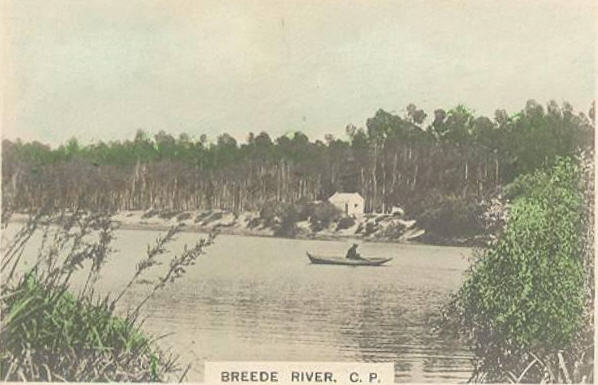
Source: Real-photo postcard, The Colonial Series, issued by Cavanders Ltd., London & Glasgow. Image from a postcard in the HipPostcard collection.
Although never a large community, Robertson Jewry established all the institutions necessary for communal life, including a synagogue, Hebrew school, cemetery, burial society, Zionist organisations, and philanthropic societies. The community flourished during the first half of the twentieth century before gradually declining, as younger generations moved to larger cities.
Today no organized Jewish community remains in Robertson, but its synagogue, cemetery, and historical records testify to more than a century of Jewish life in the town.
Early Settlement
Jewish settlement in Robertson dates to the early 1880s. By 1881 there were sufficient Jewish residents to assemble a minyan on occasion, indicating the existence of a small but established community. Like many South African country communities, Robertson's Jewish population was largely composed of immigrants and descendants of immigrants from Lithuania and other parts of Eastern Europe.
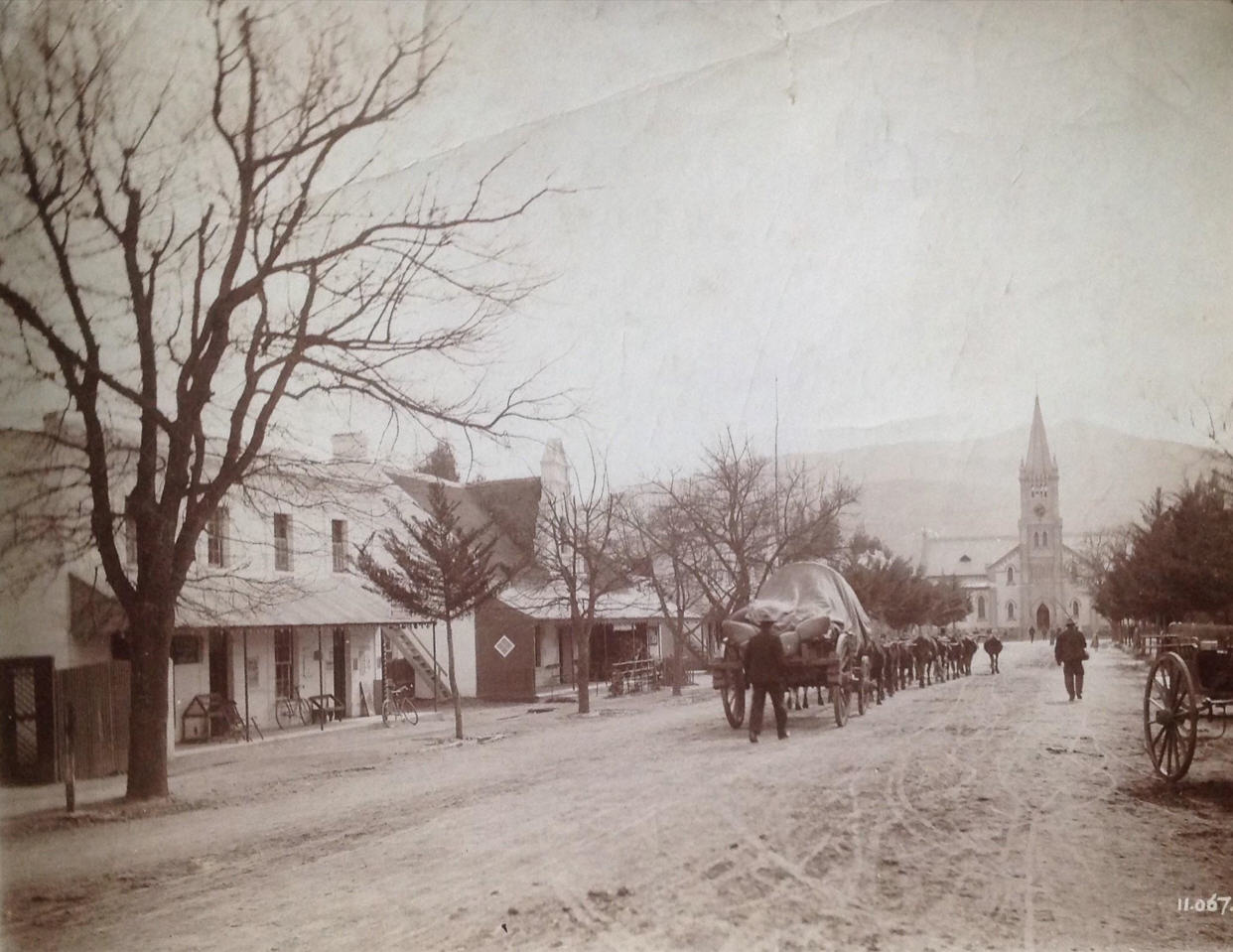
Source: South African Railways Publicity Department. Historical Photographs Research Collection (HPRC), via The Heritage Portal
The Jews who settled in Robertson participated in virtually every aspect of local economic life. They worked, inter alia, as general dealers and merchants, ostrich feather buyers, farmers, tailors, tinsmiths, wagon makers, butchers, teachers, hotel proprietors, doctors, bookkeepers.
Their contribution mirrored that of many other Jewish country communities throughout South Africa, where Jews often served as intermediaries between rural producers and urban markets.
Zionism and National Jewish Affairs
Robertson maintained strong links with broader South African Jewish institutions.
The congregation sent a delegate to the historic 1912 conference in Bloemfontein that established the South African Jewish Board of Deputies (SAJBD).
In 1912, the Robertson Zionist Association was formed, following a visit by Morris Alexander, founder and chairman of the Cape Council of the SAJBD. The association became an important focus of communal activity during the early 20th century.
In 1935, during a period of rising antisemitism and Greyshirt activity in South Africa, the Robertson Hebrew Congregation formally affiliated with the Cape Council of the SAJBD.
Military Service
The Robertson community made notable contributions during the Second World War.
Sydney Lazarus, whose parents, Lewis and Ethel Lazarus, farmed in the Robertson district, became both the first South African and the first Jew from South Africa to be killed in action during the war against Nazi Germany and its allies. He was shot down near El Wak in East Africa, and is buried in Nairobi. His sacrifice occupies an important place in both local and South African Jewish military history.
Families of Robertson
Prominent Jewish families associated with Robertson include:
- Blumberg
- Buirski
- Josefowitz
- Klein
- Lazarus
- Pinto
- Rosenzweig
- Saacks
These families played important roles in commerce, agriculture, civic leadership, education and communal development.
Decline of the Community
Like many South African country communities, Robertson experienced a gradual demographic decline after the Second World War.
Younger generations increasingly left for Cape Town, Johannesburg, and overseas opportunities. As elderly residents followed their children to larger centres, the community's numbers diminished steadily. By 1967 Robertson could no longer consistently assemble a minyan.
Discussions with the Cape Board of Deputies began during the 1970s regarding the future of communal assets. By 1977 only four members remained resident in Robertson. Plans were therefore developed to preserve the cemetery and synagogue while using surplus funds to support Jewish educational causes in the Western Cape.
Legacy
Although organised Jewish life in Robertson has effectively ceased, the community's legacy remains visible in several forms:
- The former Knesset Israel Synagogue
- The Jewish cemetery
- Municipal records documenting Jewish civic leadership
- The Robertson Museum's collections
- The continuing preservation efforts of the Cape Jewish community
- The descendants of Robertson families now living elsewhere in South Africa and abroad.
For more than a century, Robertson's Jewish residents helped shape the commercial, civic, educational, and cultural development of the town. Their story forms an important chapter in the history of South African country Jewry.
About the CHOL Jewish Community of Robertson pages
Much has been researched and many books and articles have been published about the Robertson Jewish community, and here it is not our intention to repeat what has been written in these publications. Where appropriate, links to such material are provided on the pages of this website.
A significant amount of the content on this platform has been compiled with the assistance of OpenAI's ChatGPT, and subsequently reviewed and edited by the CHOL team. It draws on published historical sources, archival material, cemetery records, community histories, and other documentary evidence.
While every effort has been made to present an accurate account of the Robertson Jewish community, much of the personal dimension has inevitably been lost over time, and the facts and dates recorded here tell only part of the story. Memories, family stories, photographs, anecdotes, and historical details known only to former residents and their descendants are missing from this account.
We warmly invite former residents, descendants, and anyone with knowledge of the Robertson Jewish community to provide information that will help create a richer and more complete record.
The content co-ordinator for the Robertson platform is Philip Stodel. Please get in touch with him to help populate and improve this website.
To join the CHOL email list email info@chol.website.
Click here for a map.
Website of the Robertson Jewish Community
Hosted by CHOL – Community History On-Line
Created by Philip Stodel, Israel
Acknowledging information and pictures from
Jewish Life in the South African Country Communities, Volume III,
researched and published by The South
African Friends of Beth Hatefutsoth.
September 2026