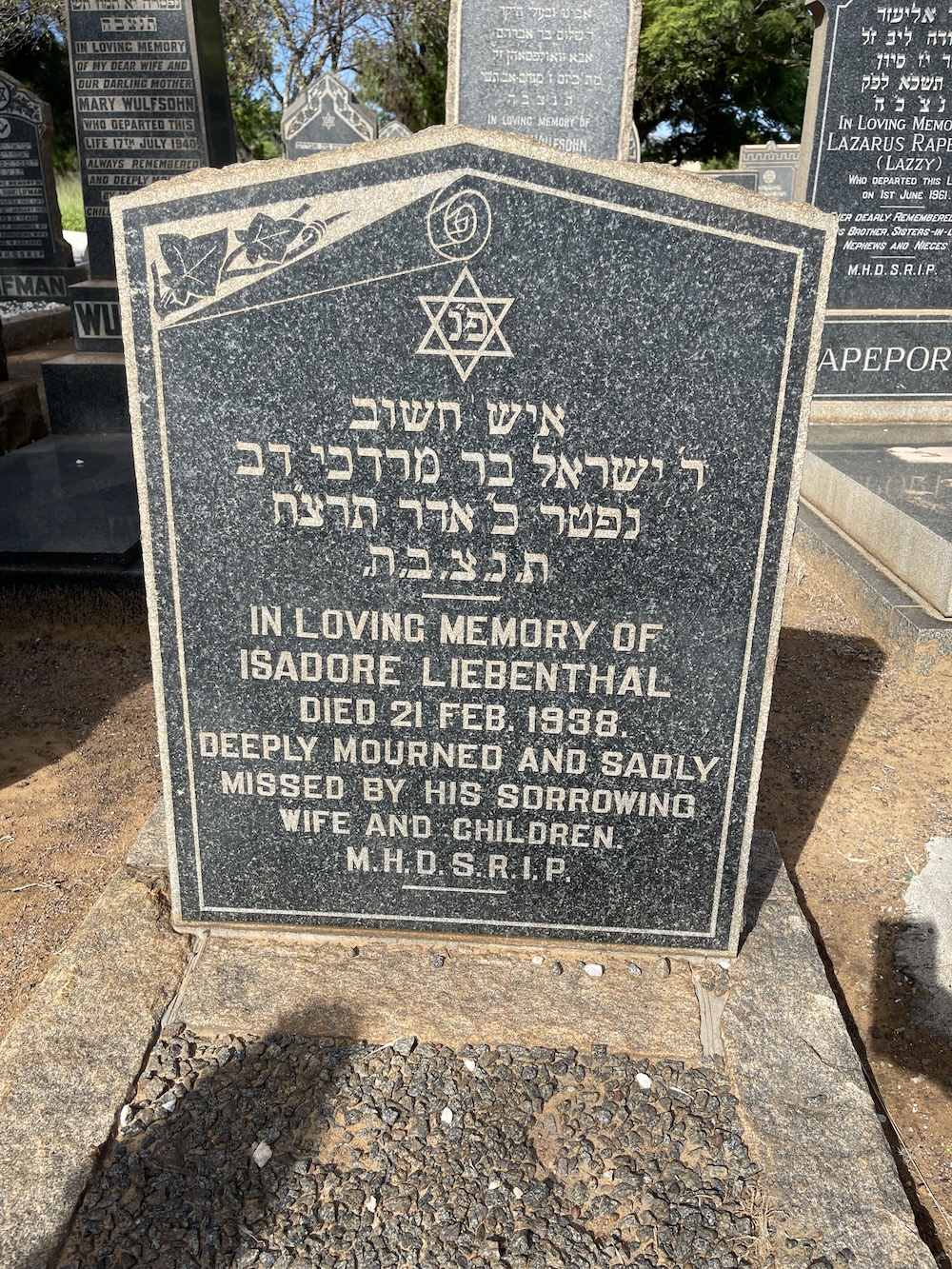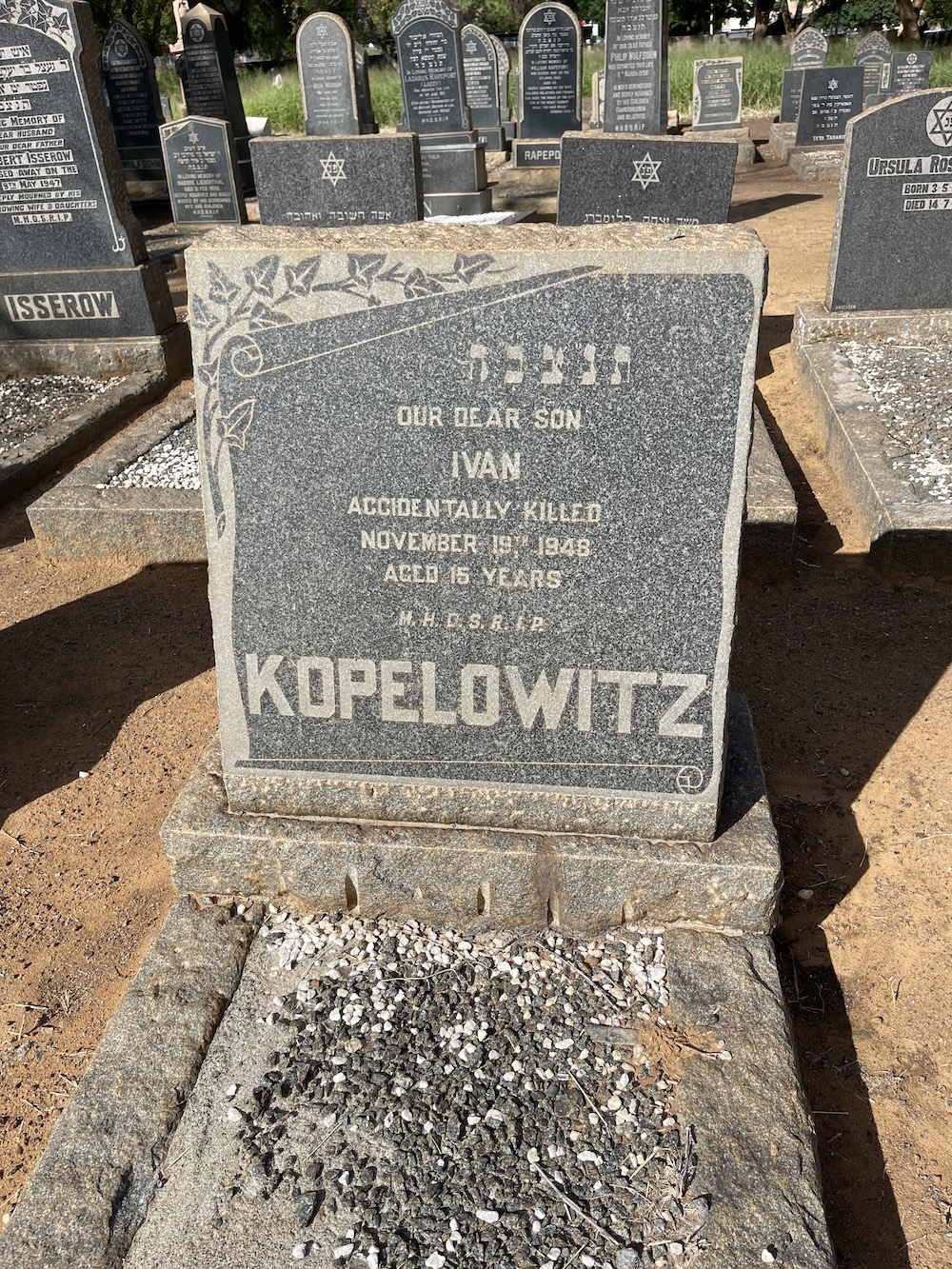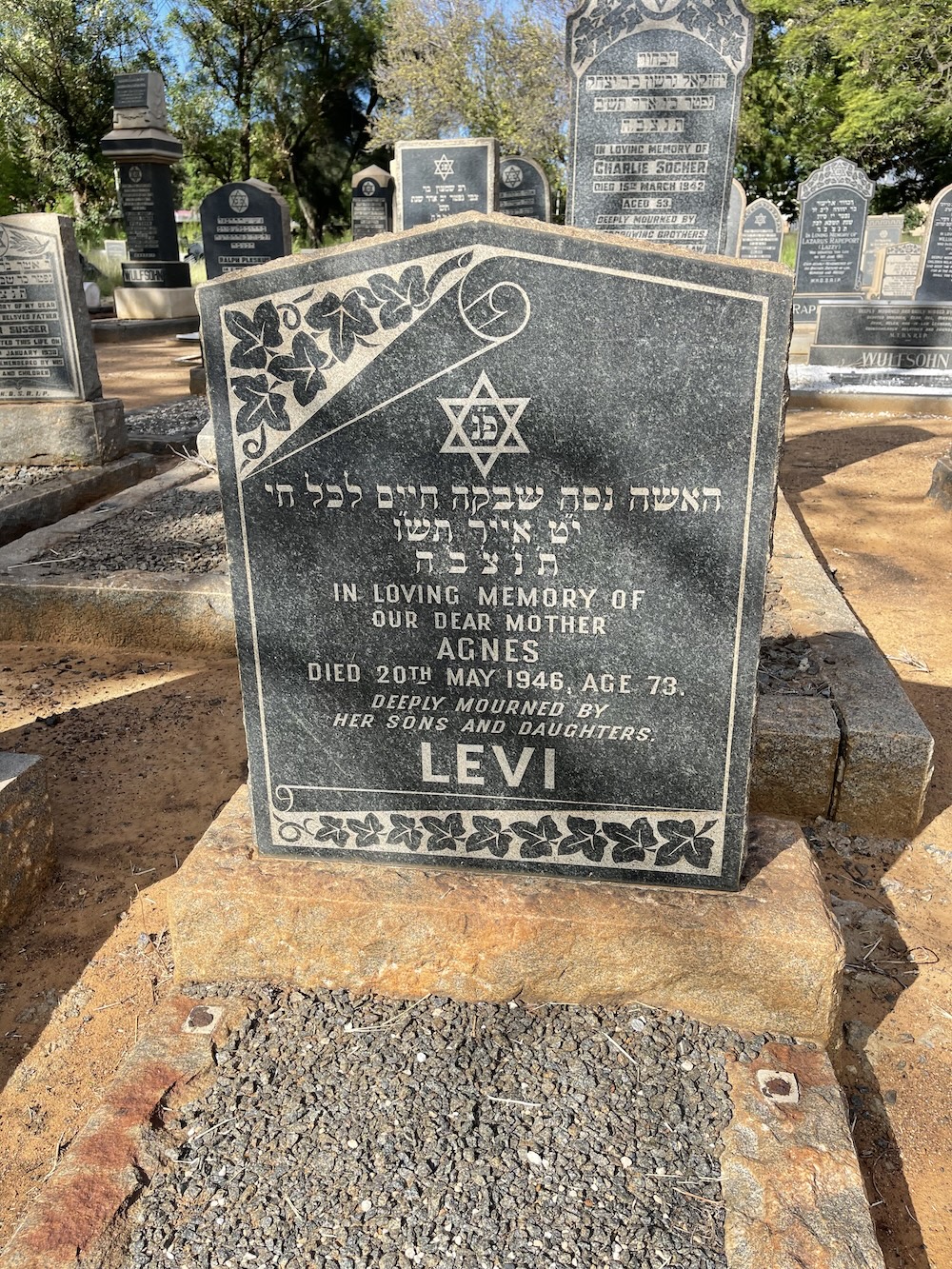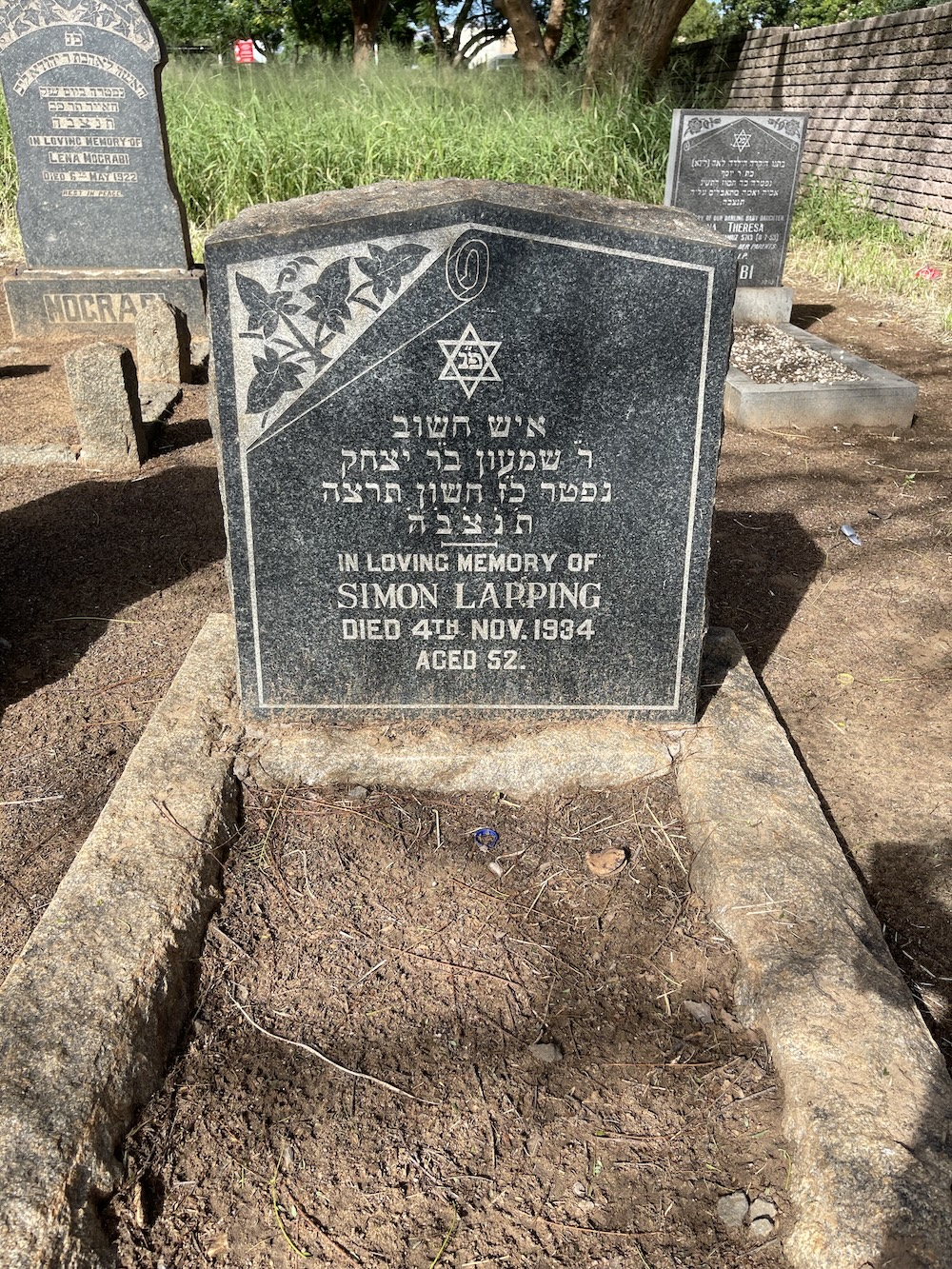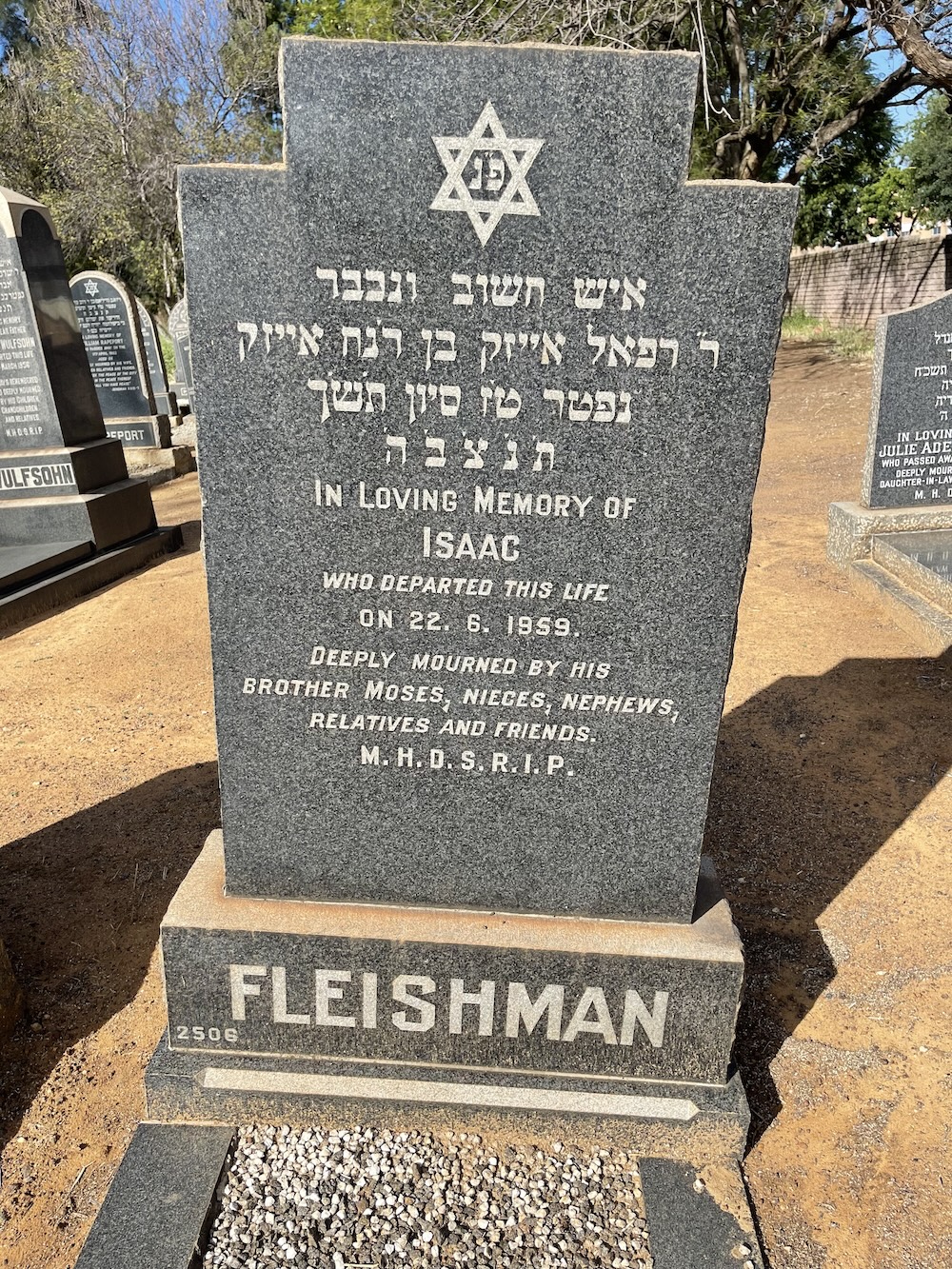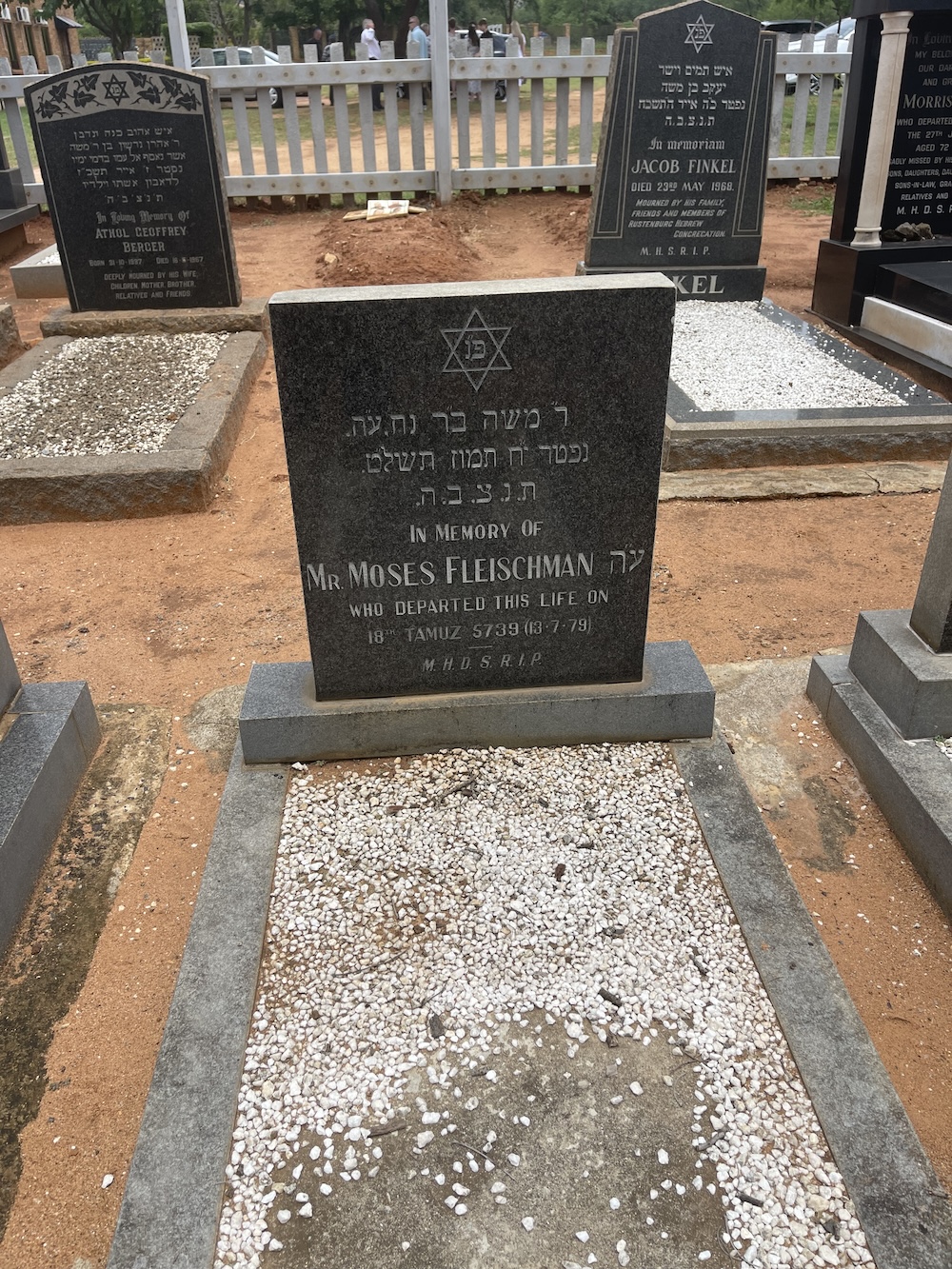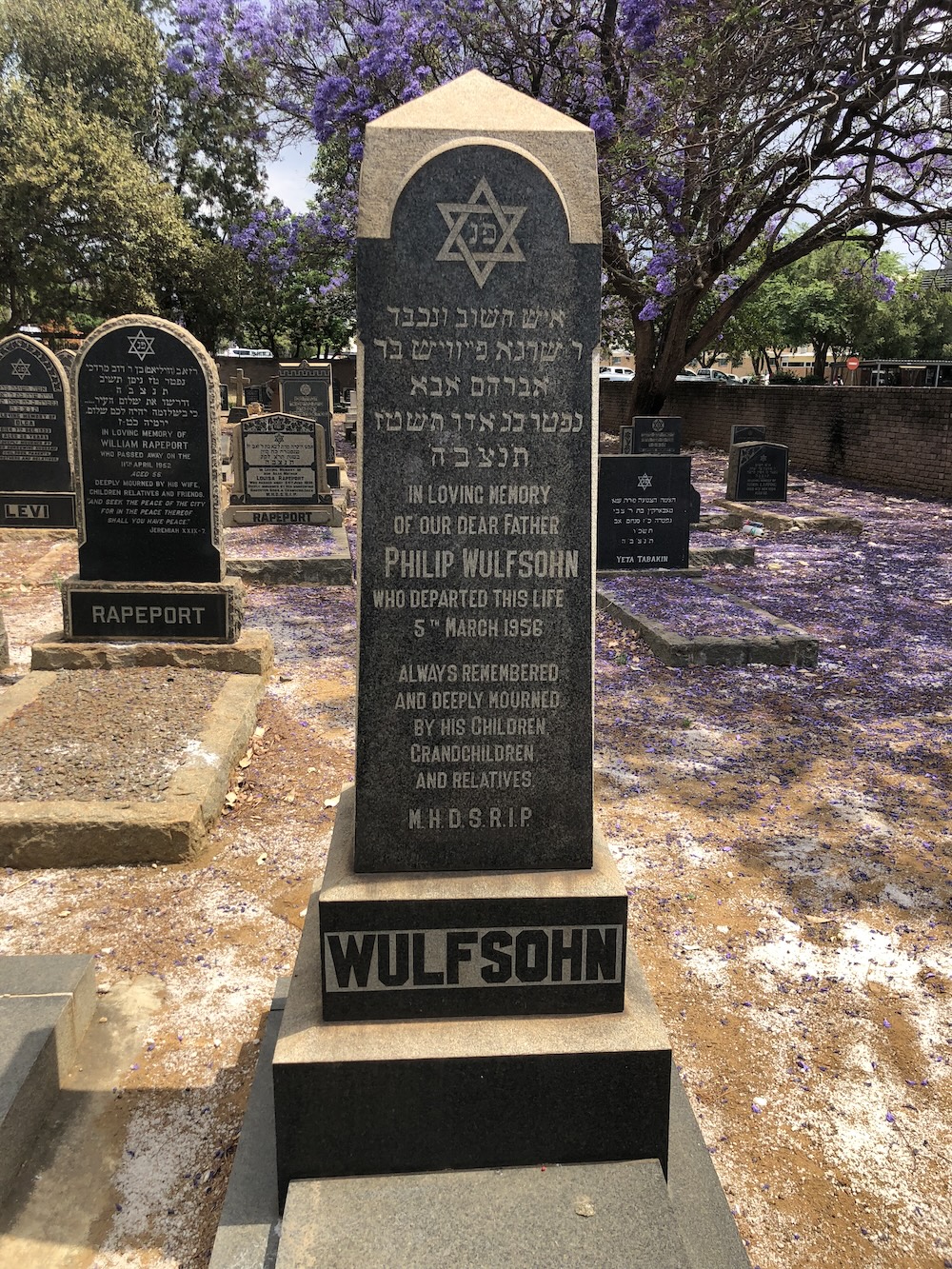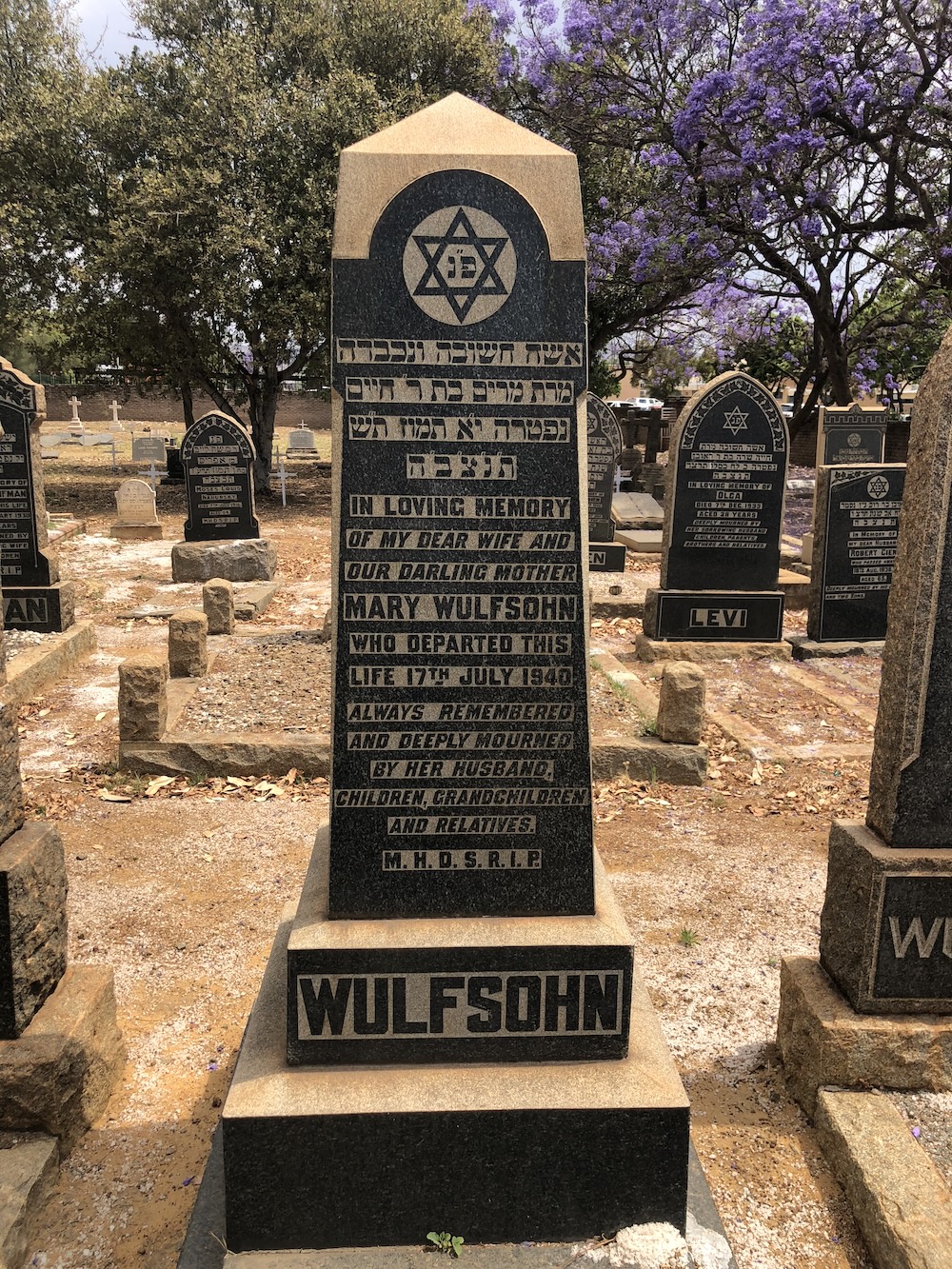
Jewish families of Rustenburg
More than 110 Jewish families lived in Rustenburg and the surrounding area from the 1880s until recently. The early arrivals were from Prussia and Germany and were followed later by the arrival of Litvak emigrants, of whom numerous lost family members in the Holocaust. In later years most families who moved to Rustenburg relocated from within South Africa. Although the Timeline of Jewish Life in Rustenburg highlights the community's involvement in the town, all the families listed below contributed to the community.
Information about the families was obtained personally from a number of descendants as well as from the following sources:
- CHOL Southern African Jewish Communities Cemeteries – Rustenburg.
- Genealogical Society of South Africa Cemetery Recording Project - eGGSA Graves.
- The genealogical sites Ancestry, FamilySearch, Geni, JewishGen and MyHeritage.
- National Archives of South Africa (NASA), including documents scanned by FamilySearch from the NASA.
- National Library of South Africa - Rustenburg Herald newspaper 1929-1950.
Links to the above sources are highlighted in blue in the listings of the families. The list below and the "Back to top" buttons at the end of individual entries can facilitate navigation within this page.
- Alstadt
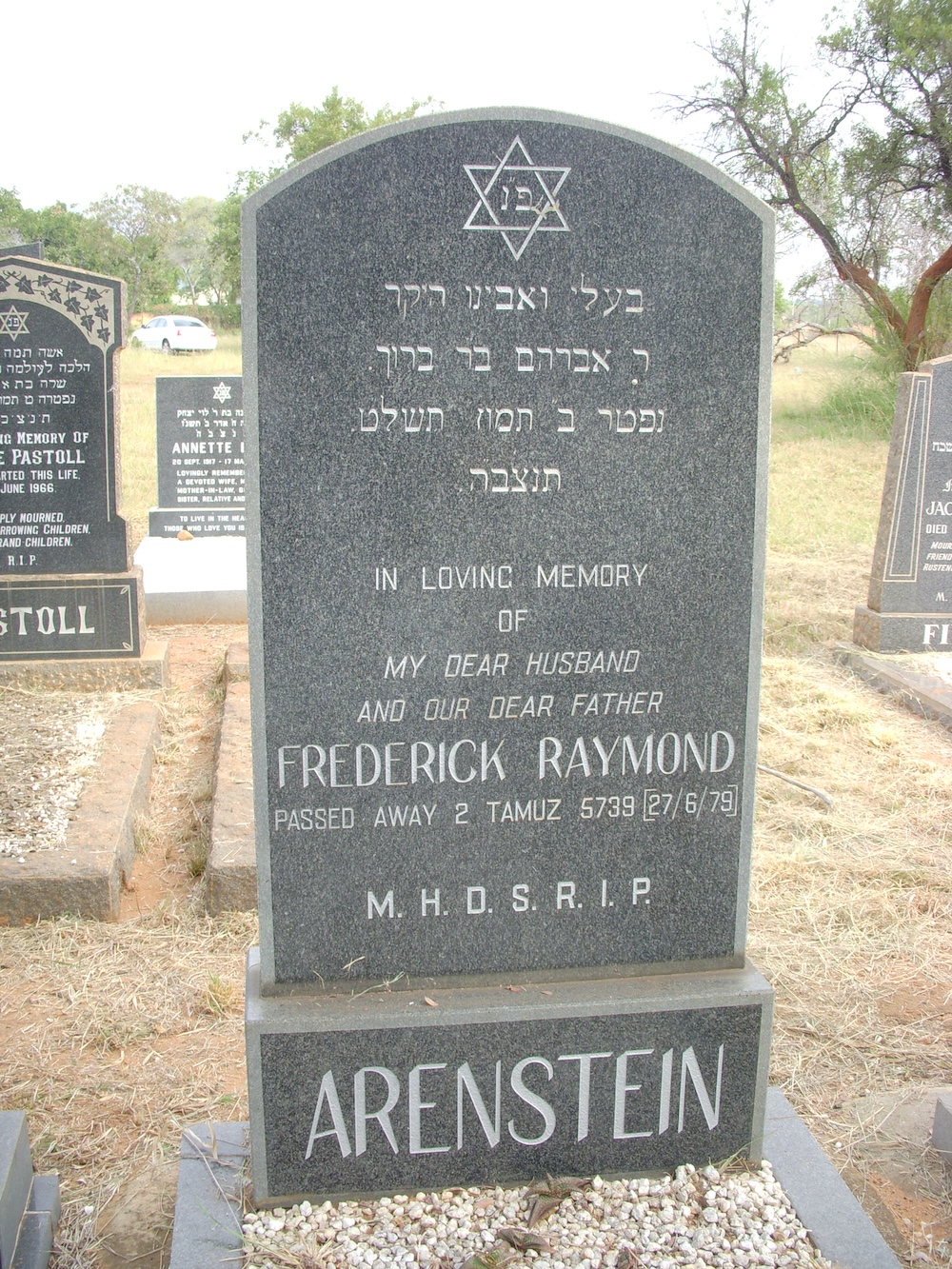
- Arenstein
- Baron
- Been
- Benjamin
- Berger
- Berkowitz
- Blecher
- Blumberg
- Cantor
- Chatzkelowitz
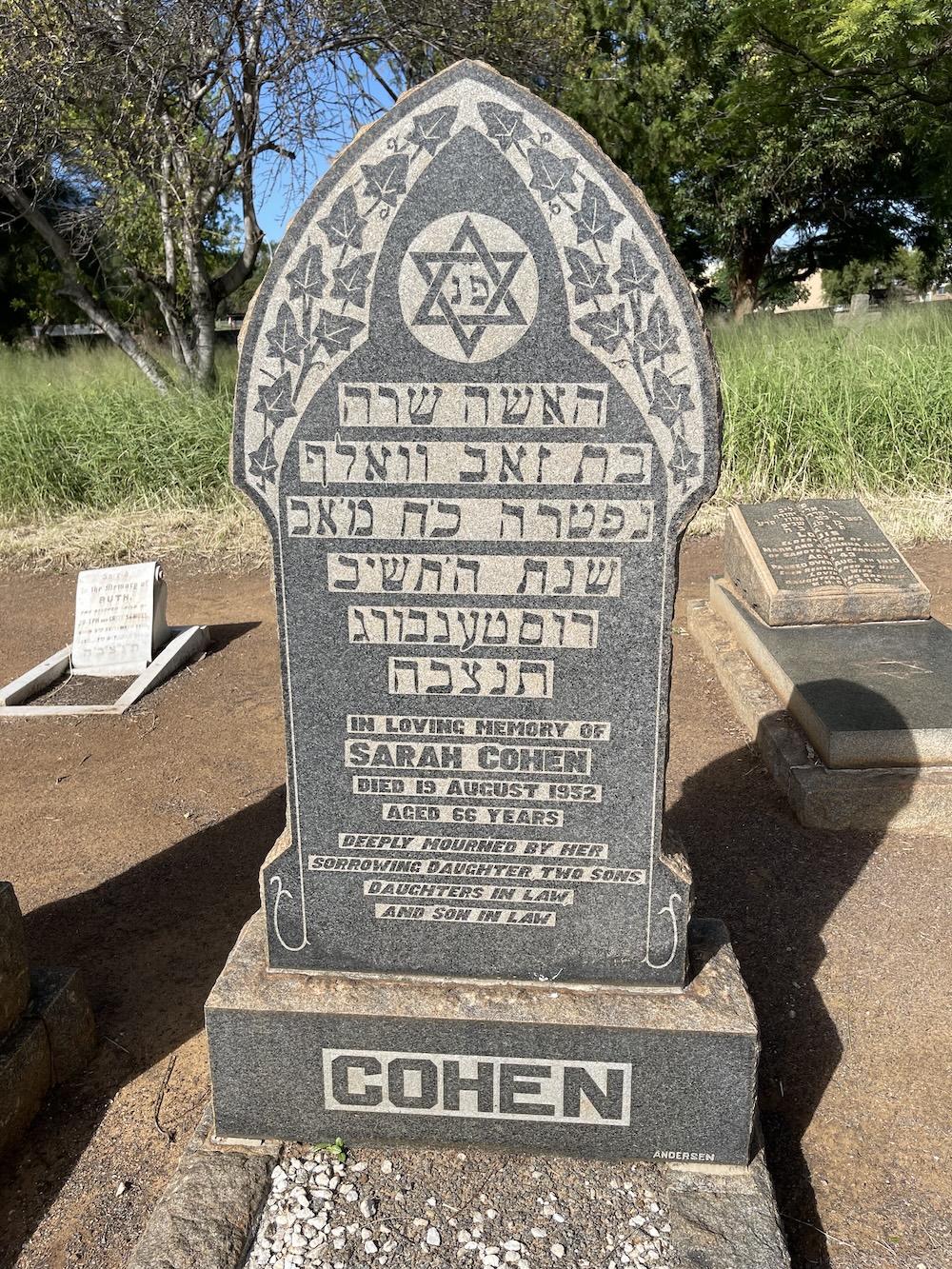
- Cohen, Adolf and Sarah
- Cohen, Paul and Stephne
- Cranko
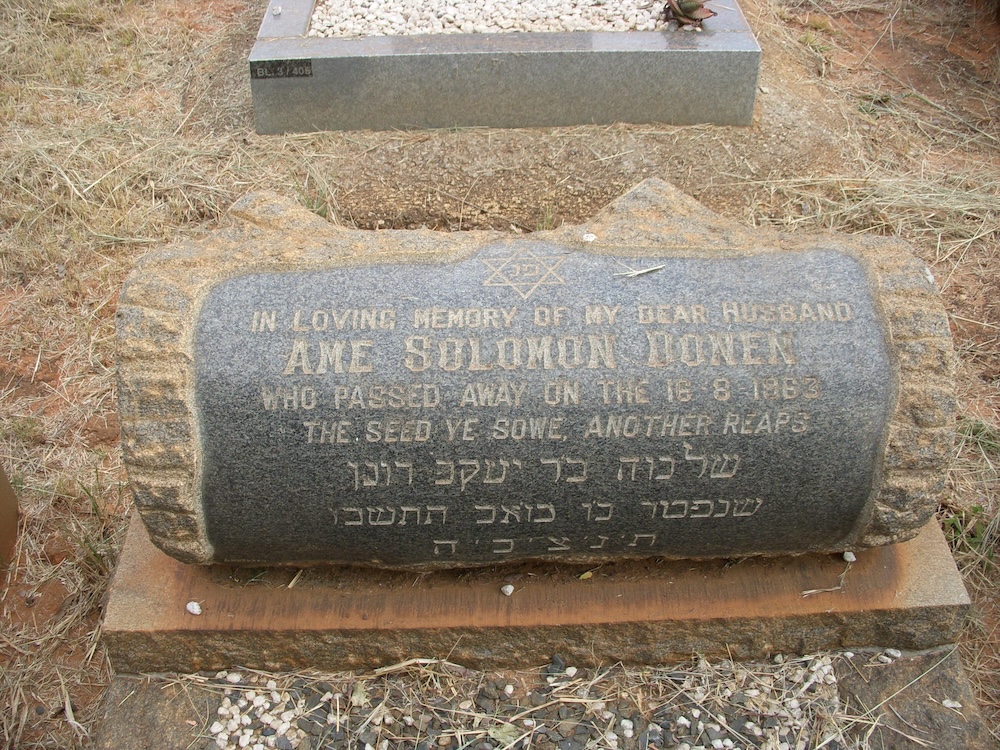
- Donen
- Epstein
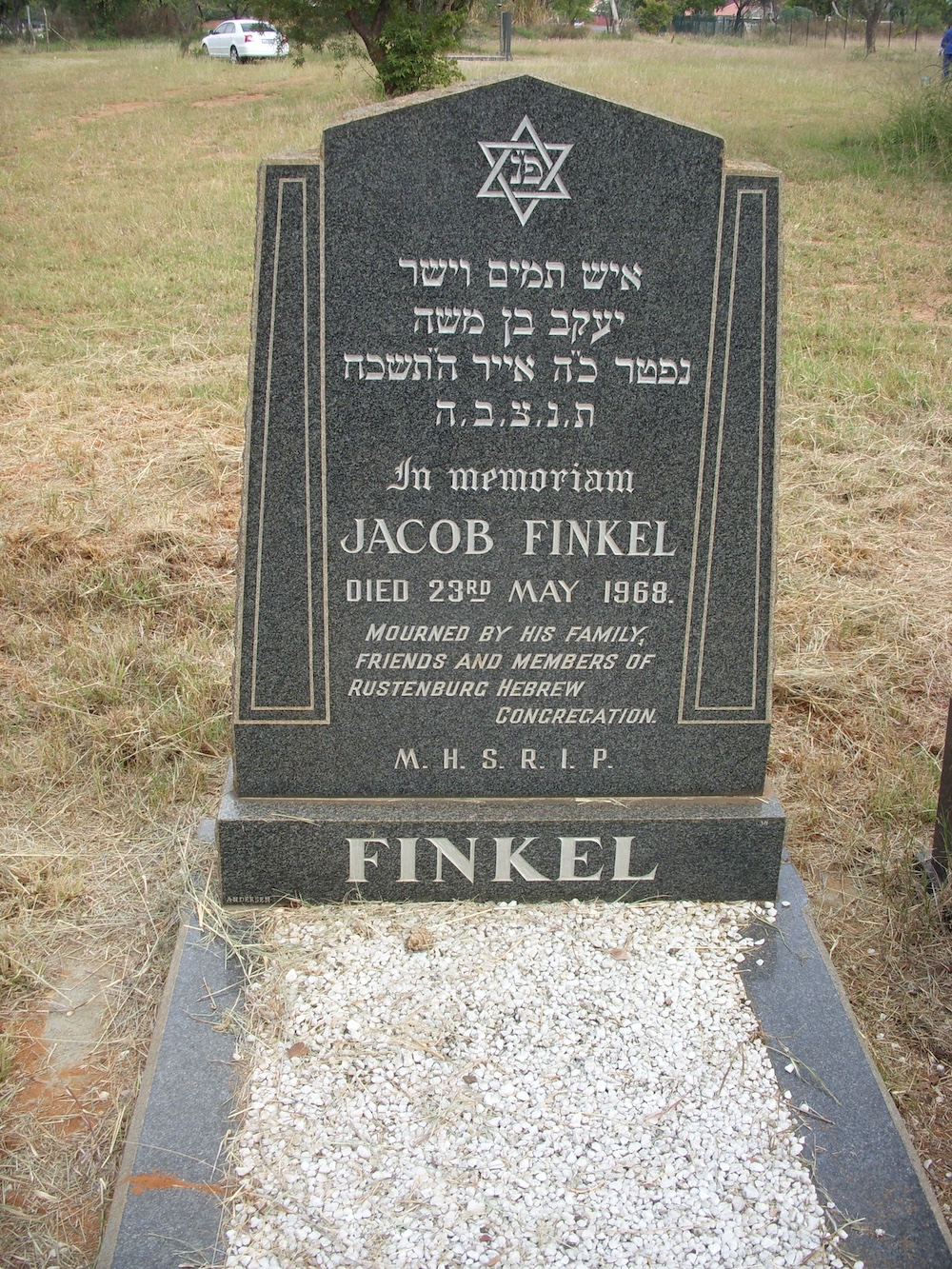
- Finkel
- Fleischman
- Frankfurth
- Friedenthal
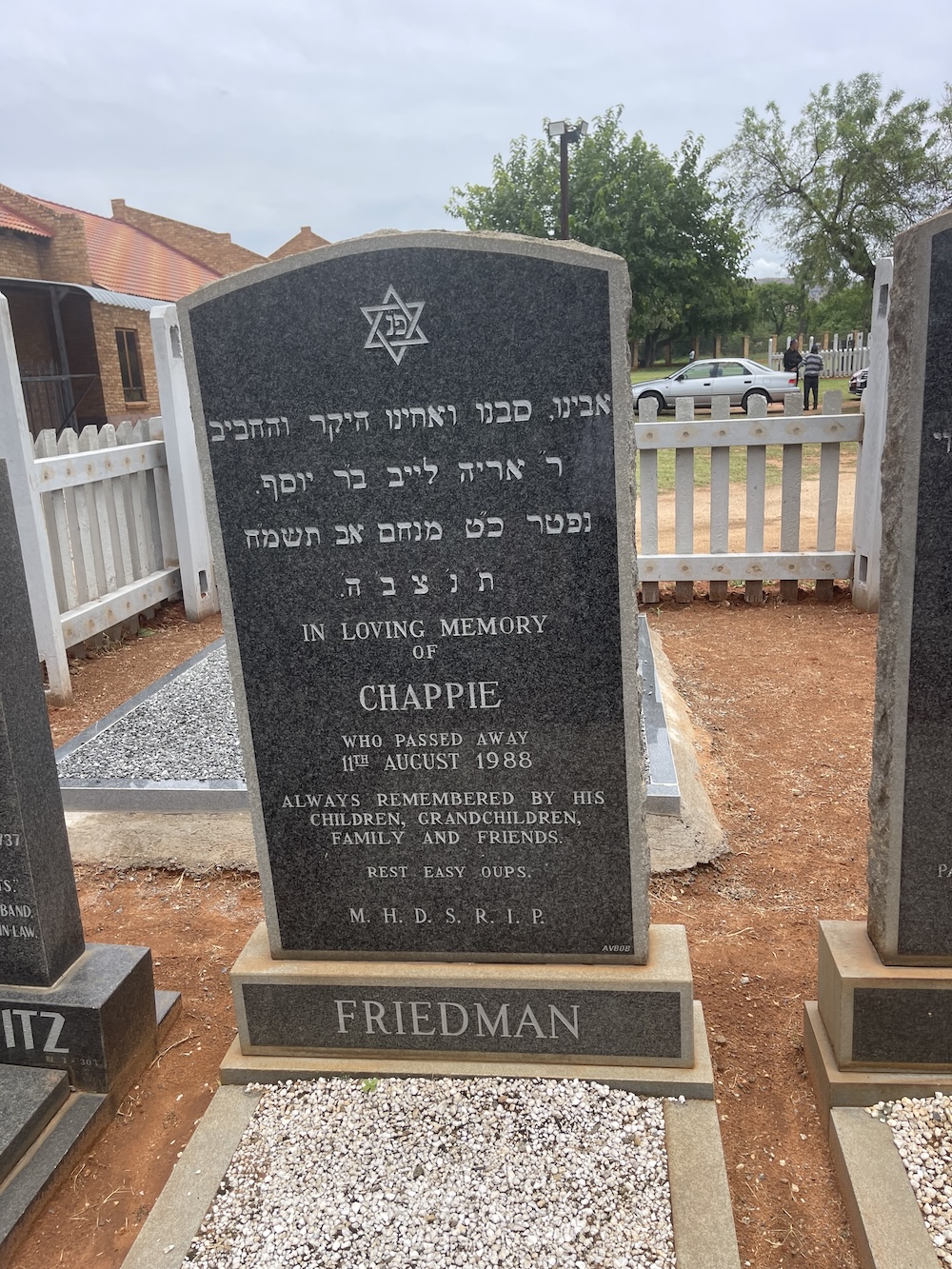
- Friedman
- Gawron
- Gersh
- Gien
- Gillis
- Goldblatt
- Greenberg
- Gutkin
- Harris
- Hartley
- Hermer
- Herzfeld
- Hirschowitz
- Hovsha
- Isaacs
- Isserow
- Jacobsohn
- Joel
- Joffe
- Kabrun
- Kacev
- Kadey
- Kahn, Leah
- Kahn, Frume Leia
- Karstaedt
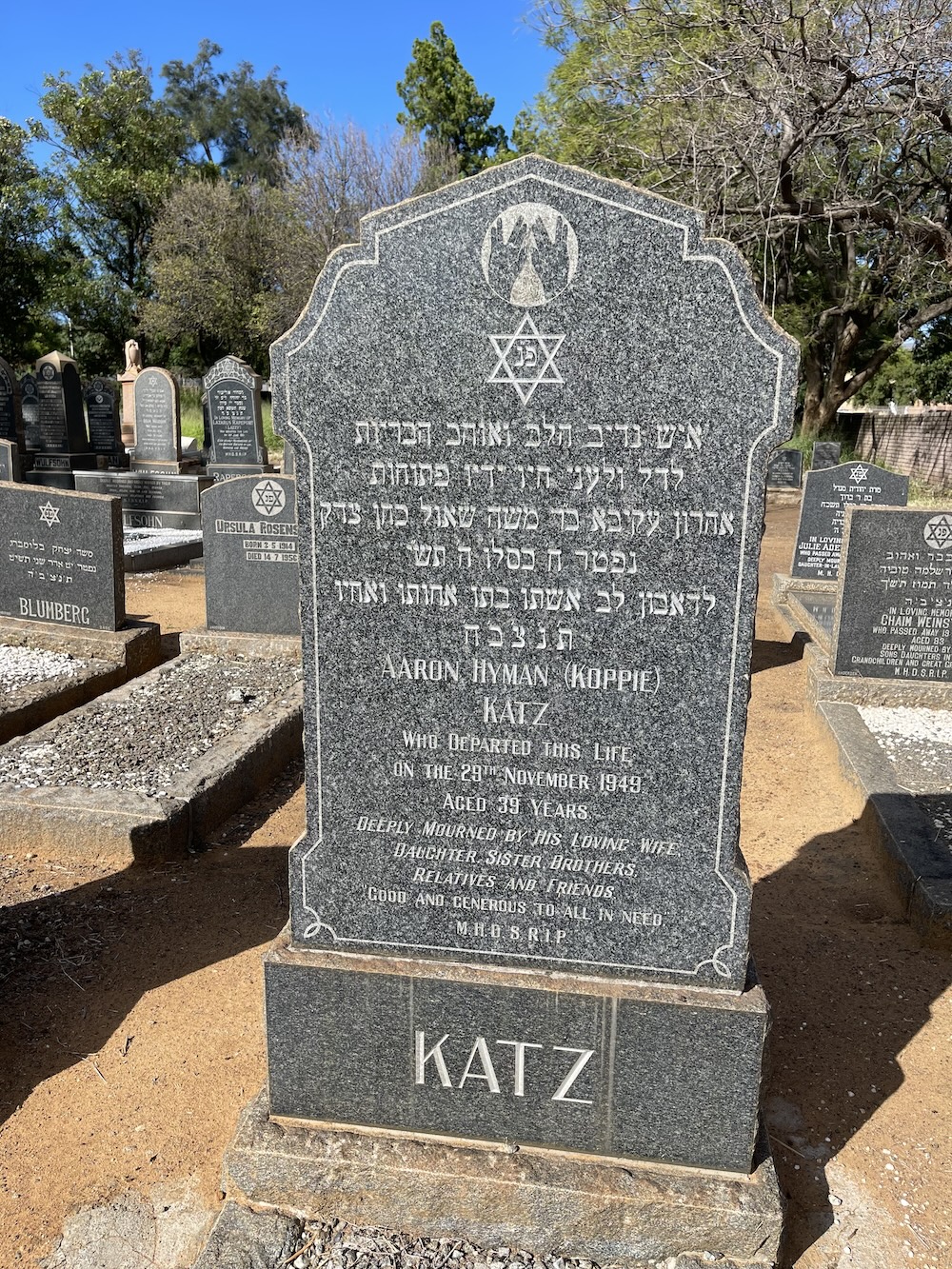
- Katz
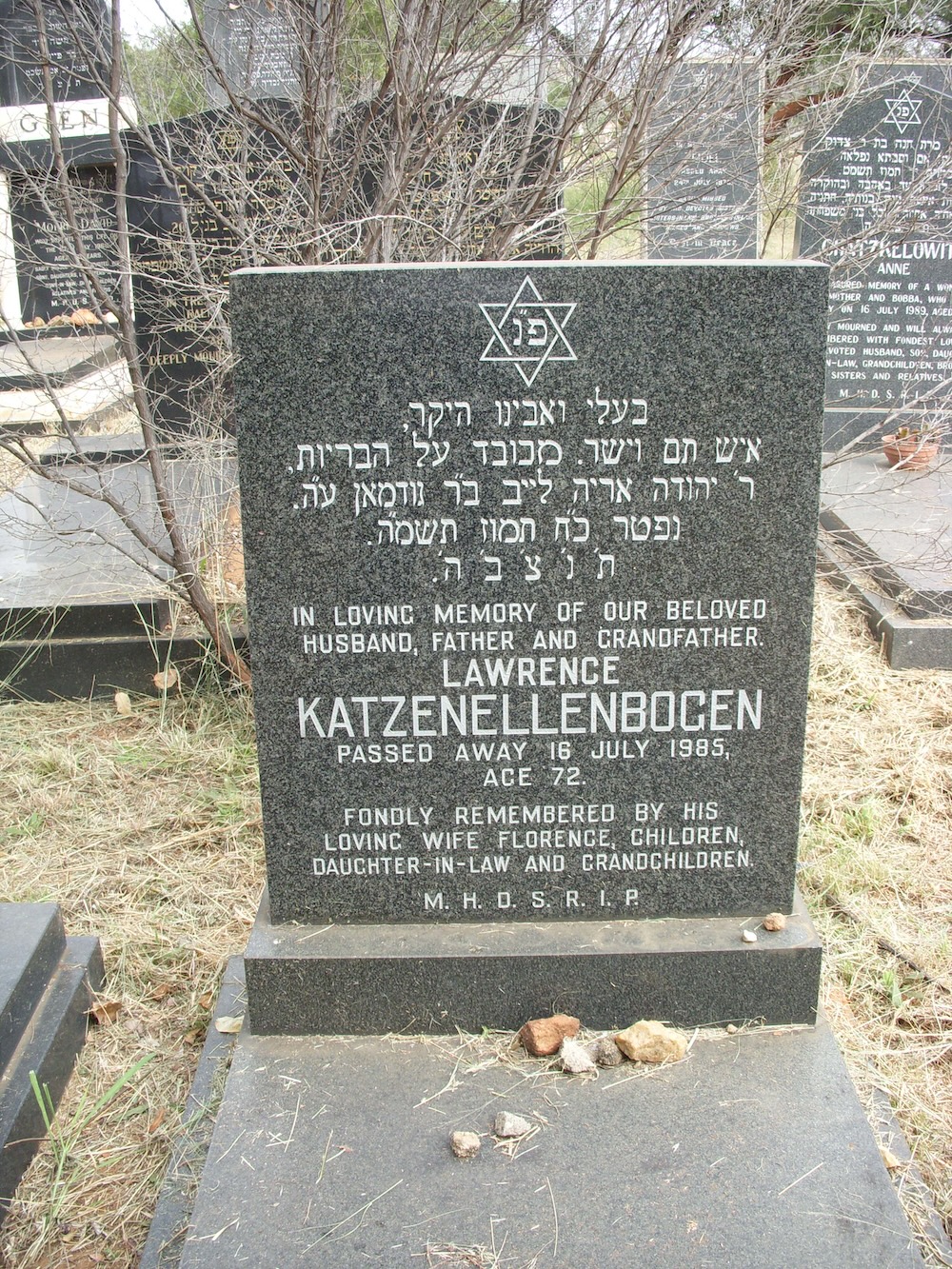
- Katzenellenbogen
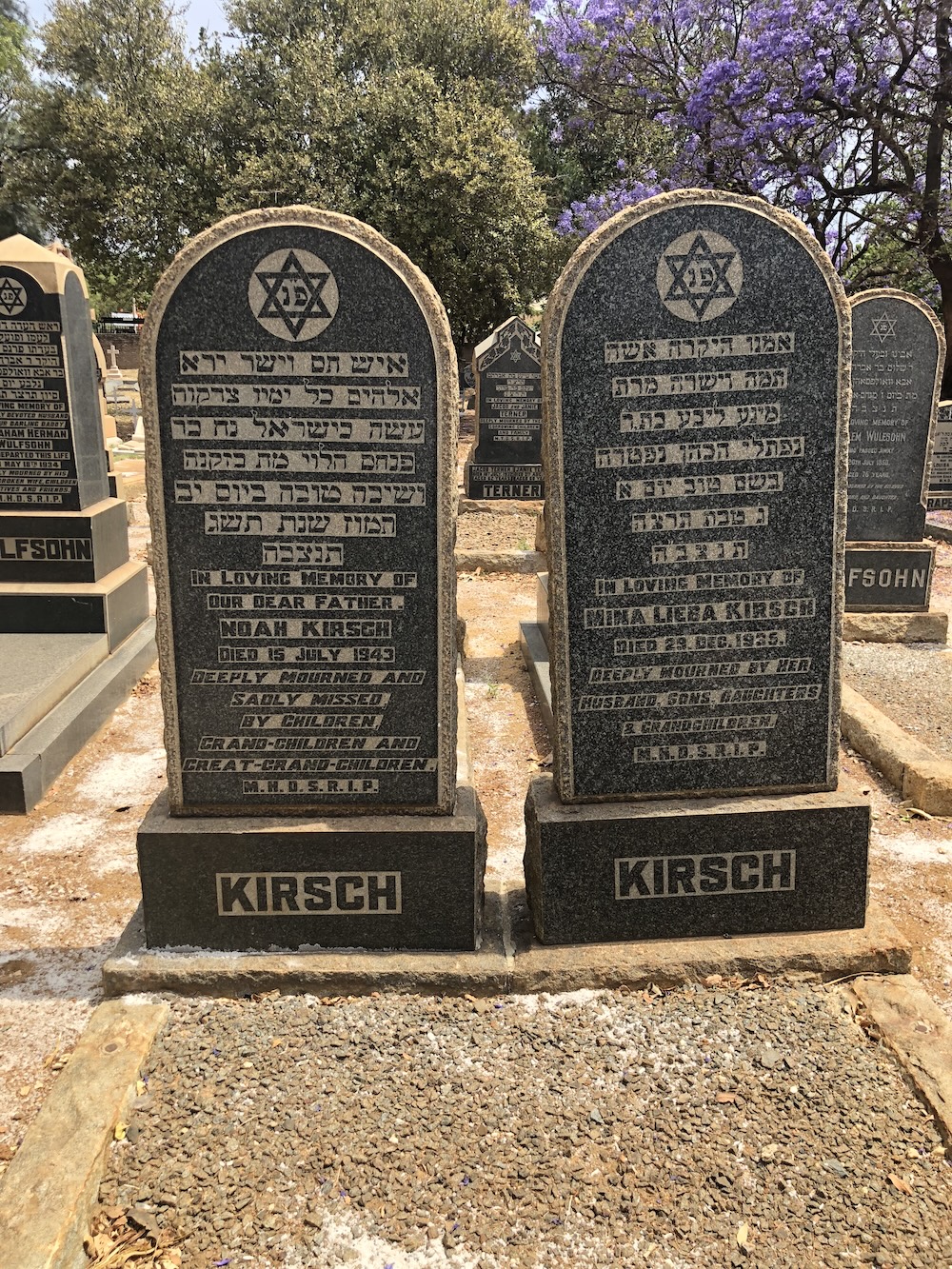
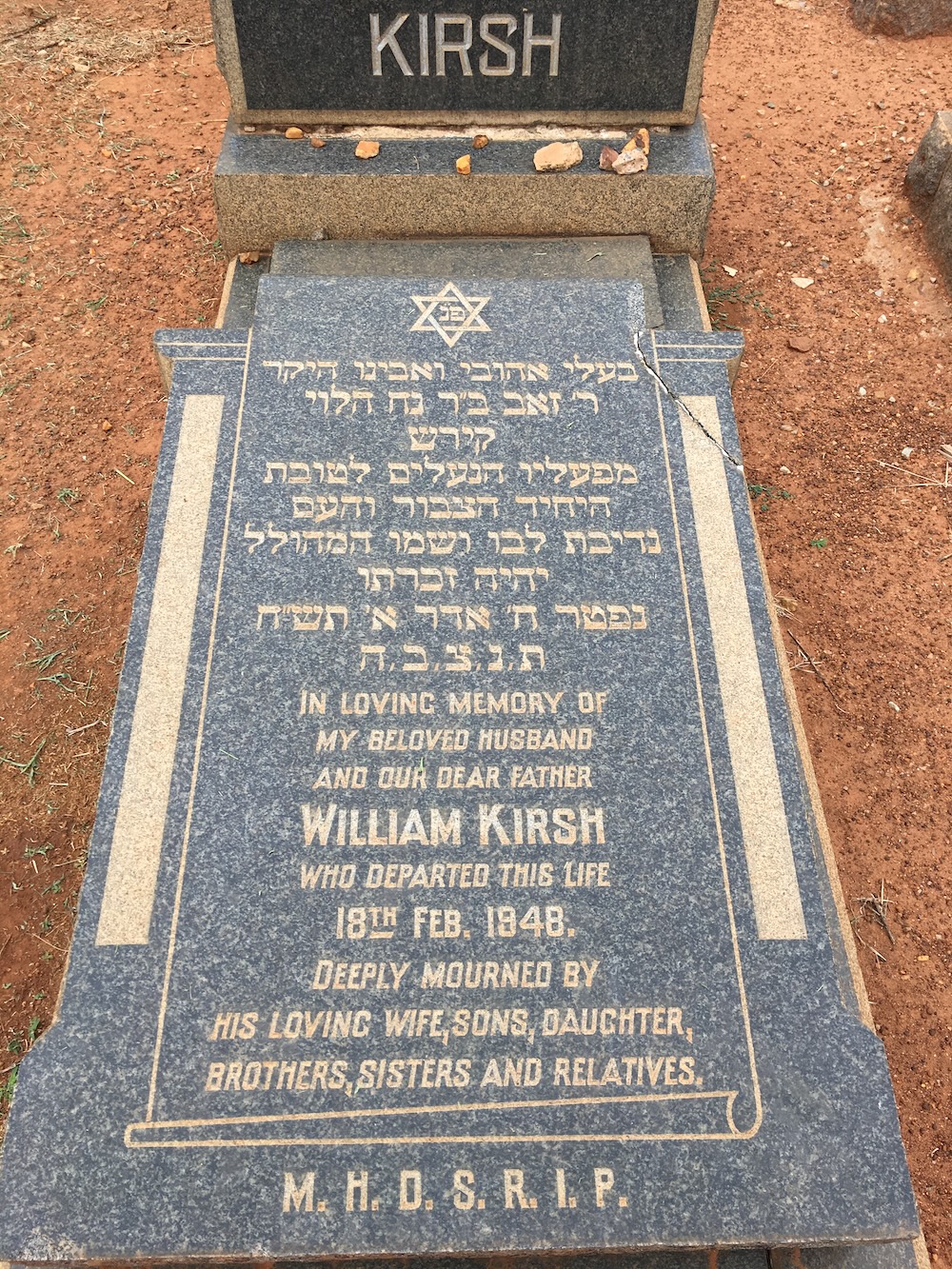
- Kirsch
- Kopelowitz
- Kramer, Sidney and Sam
- Kramer, Nathan and Gabriel
- Kuming
- Landy
- Lapping
- Lazarus
- Lederman
- Leibowitz
- Levi
- Levitt
- Levy
- Lewy
- Lichtenstein
- Liebenthal
- Lifman
- Lipman
- Lurie
- Machol
- Mankowitz
- Michaelis
- Milner
- Mograbi
- Morris
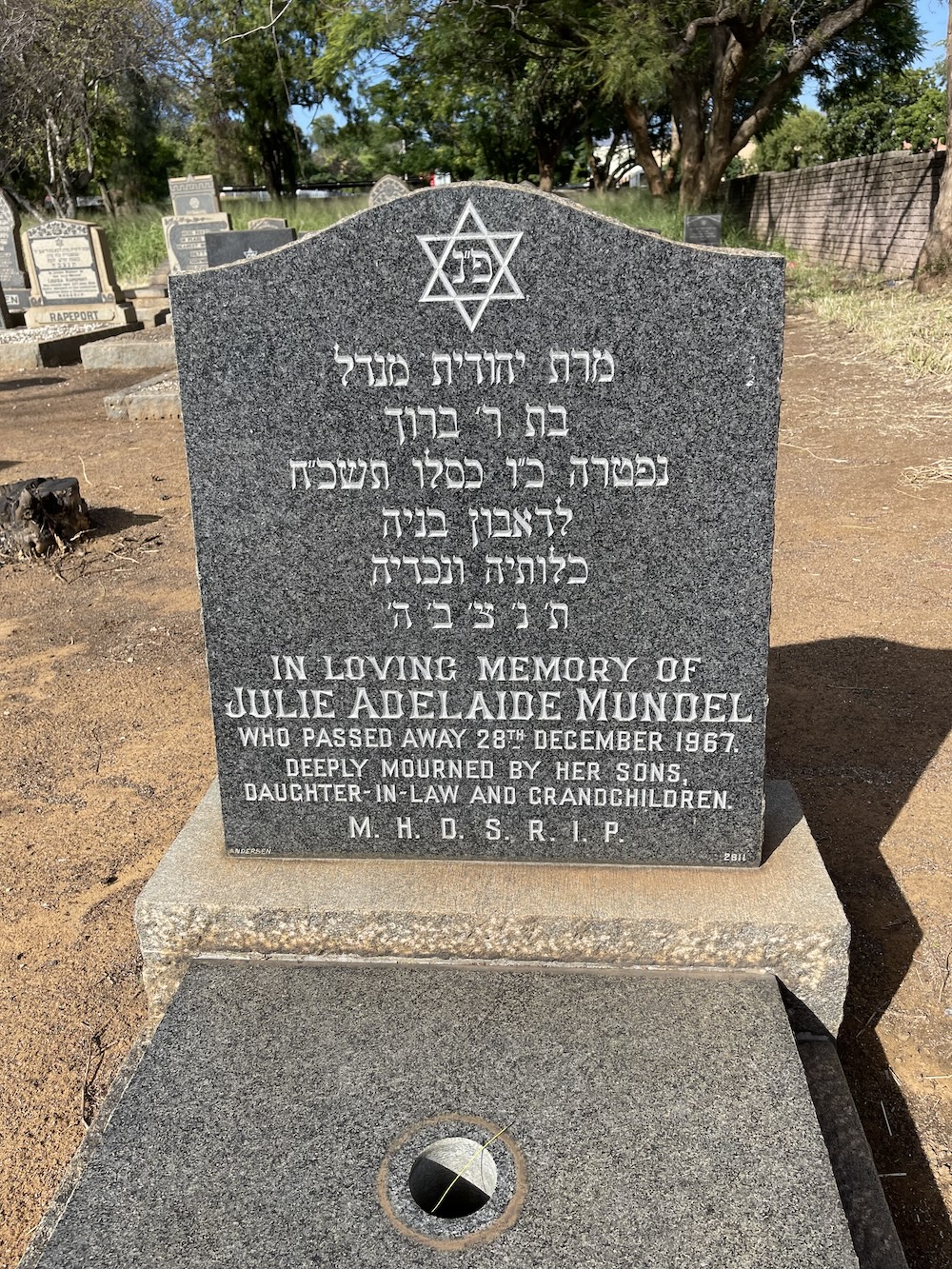
- Mundel
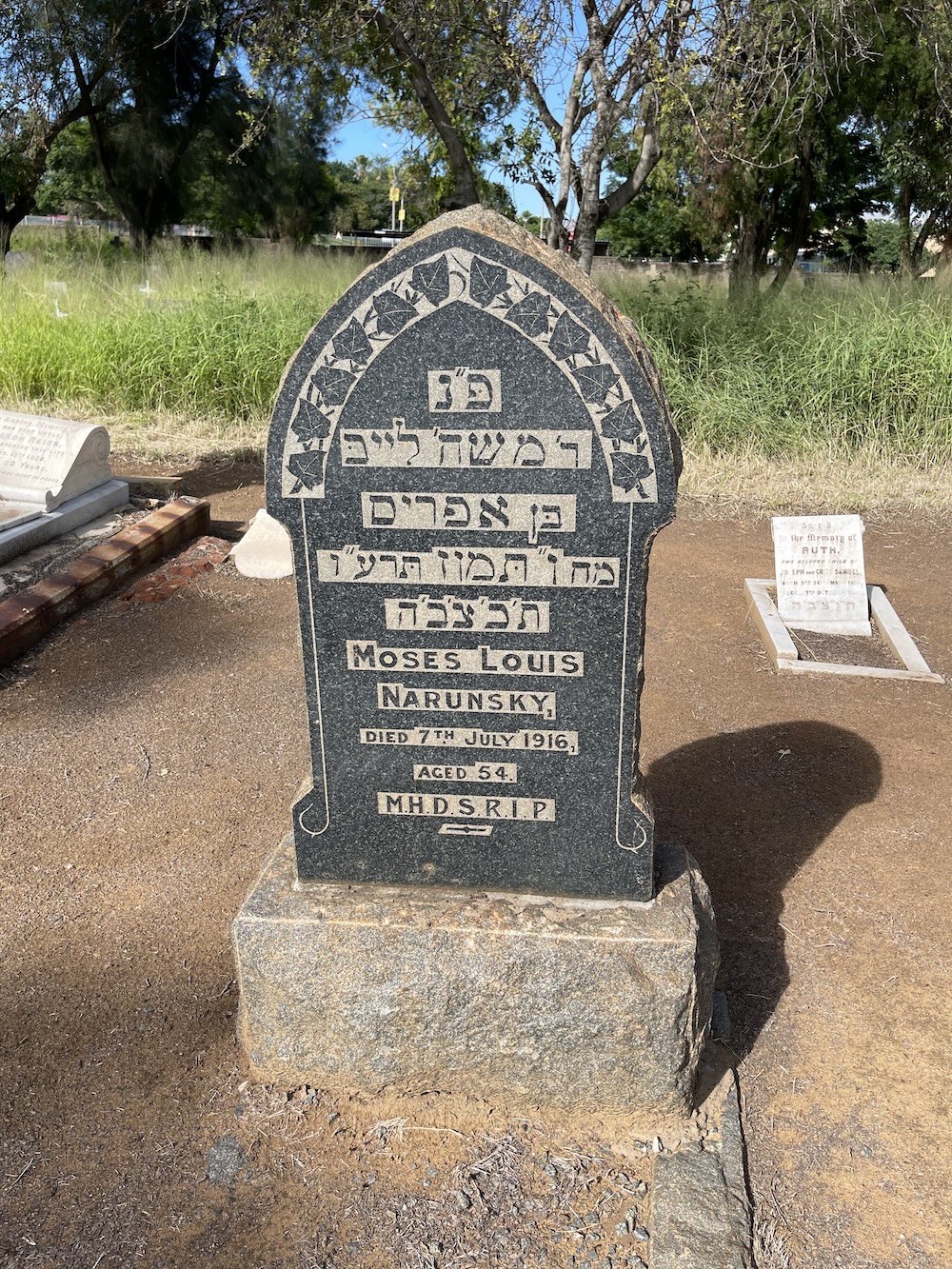
- Narunsky
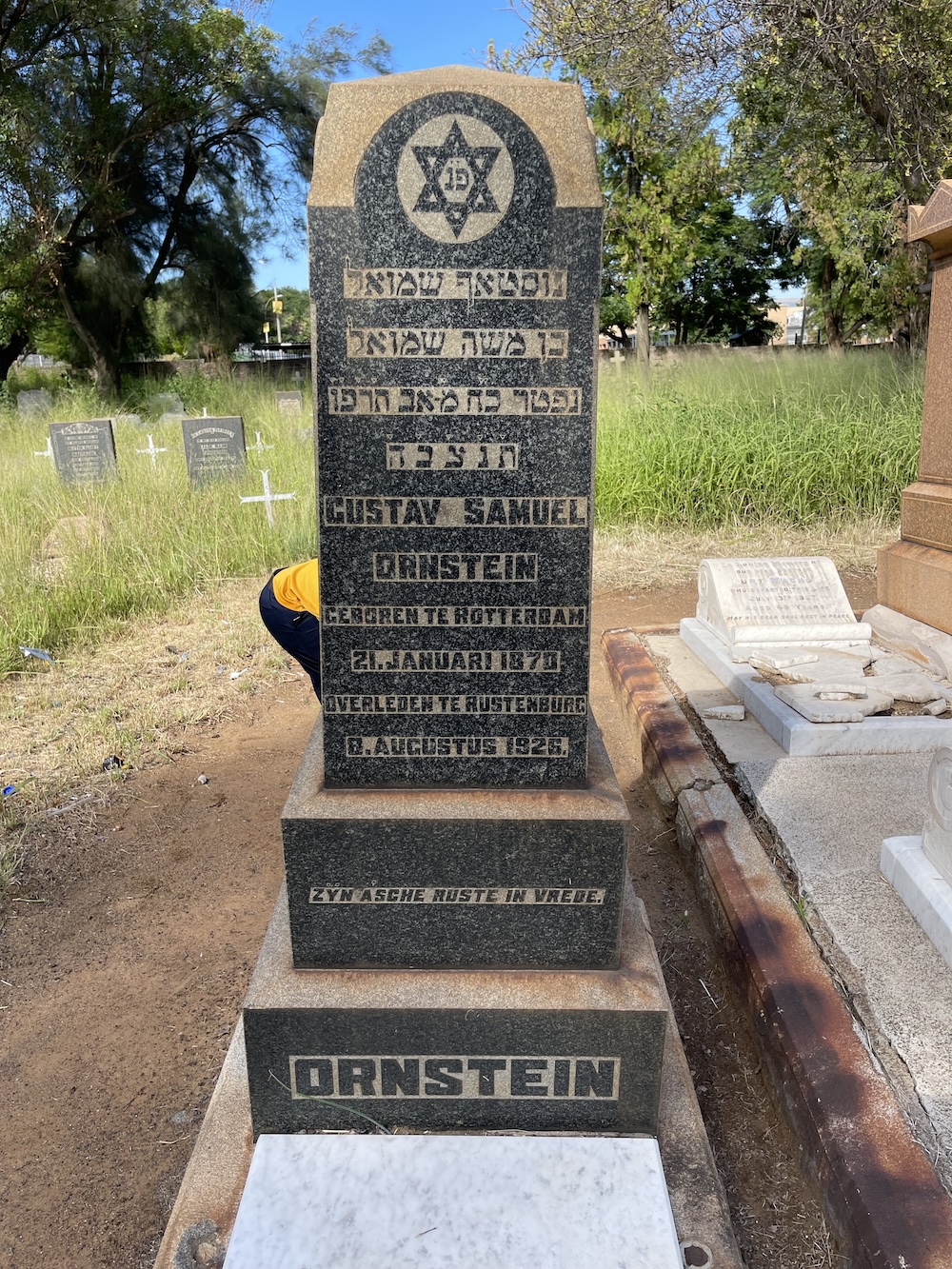
- Ornstein
- Oster
- Pastoll
- Pleskus
- Rabinowitz
- Ramokgadi
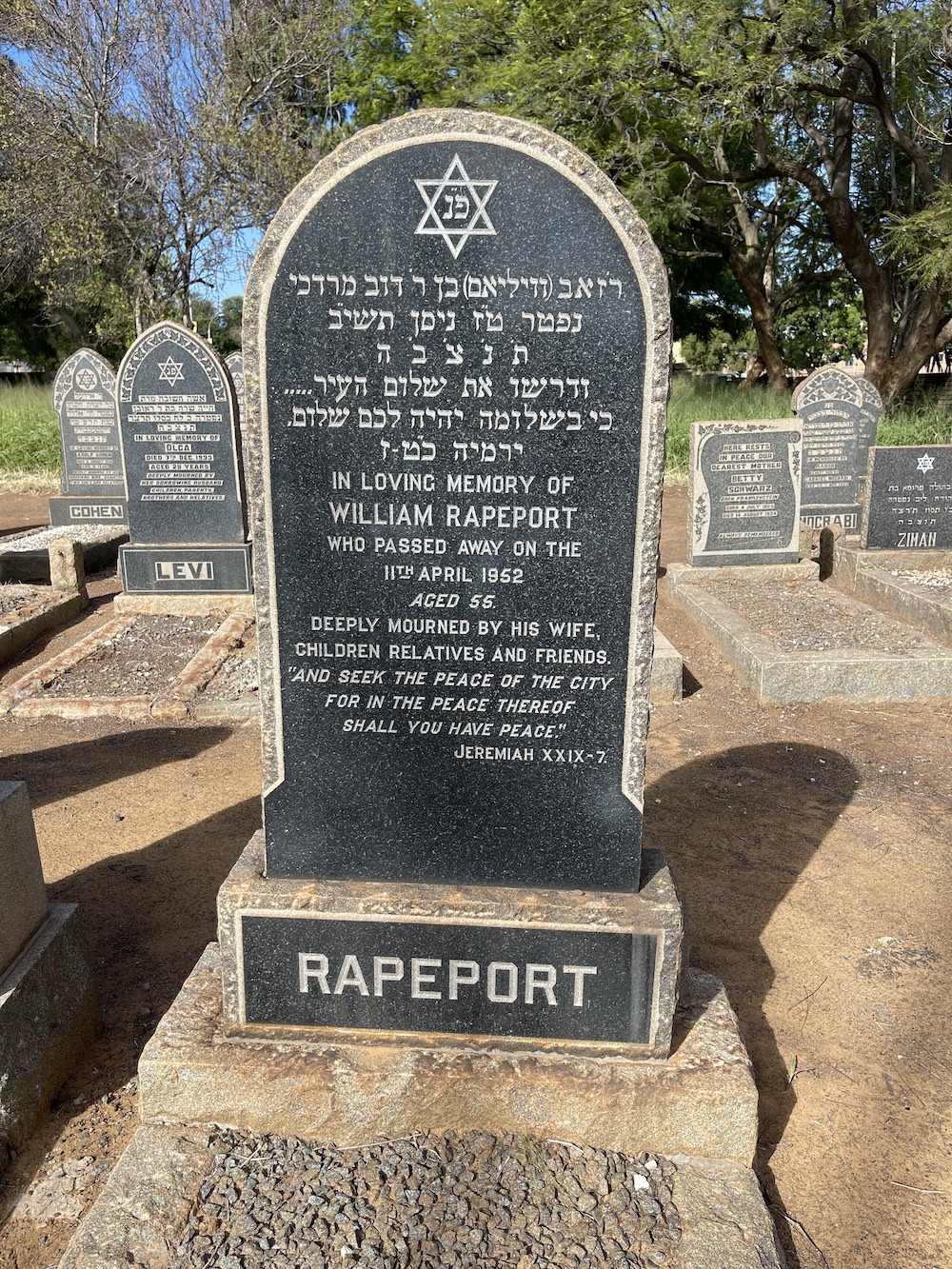
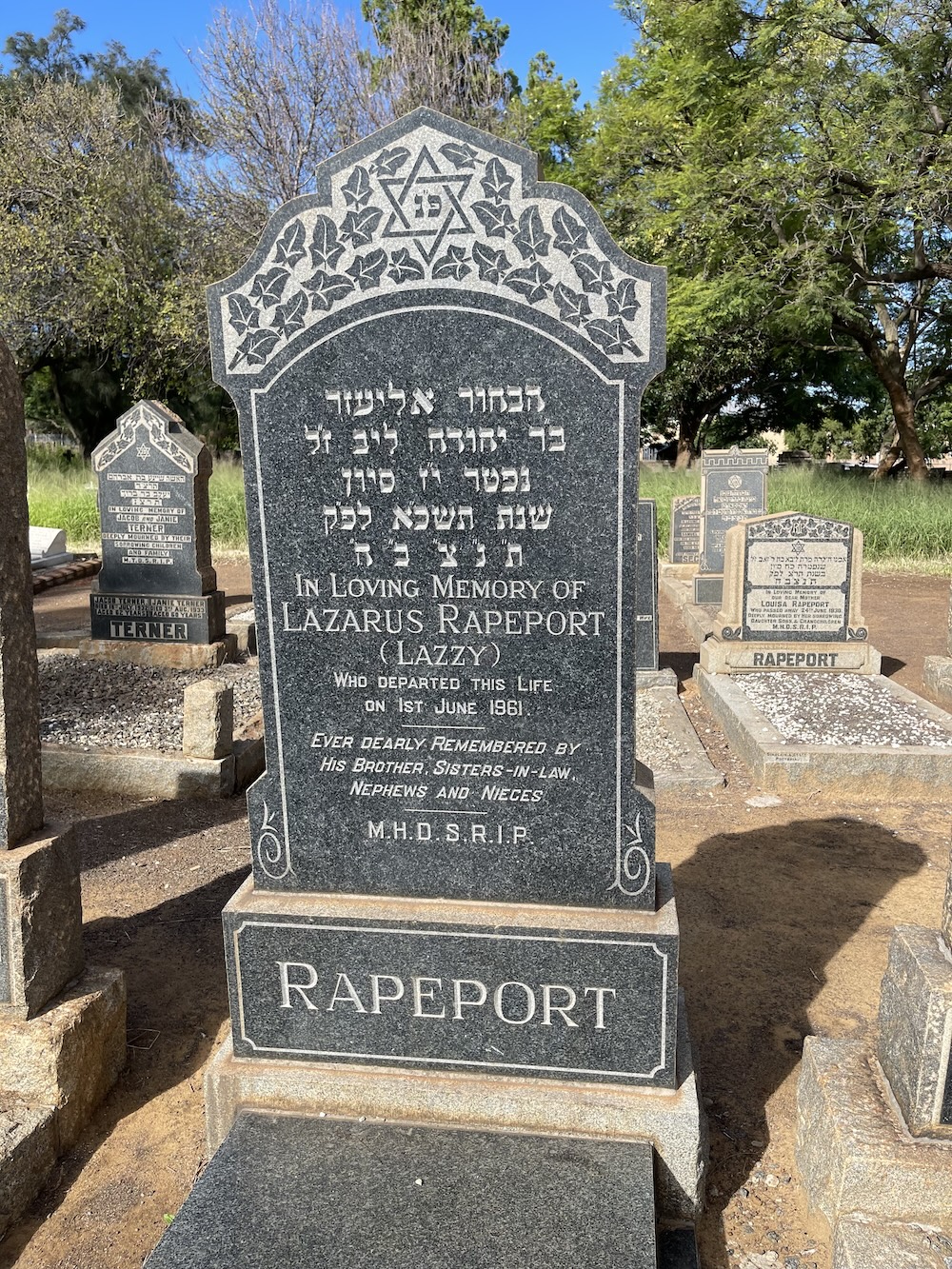
- Rapeport
- Rapeport, Jack and Zelda
- Raphael
- Reiss
- Resnick
- Ress
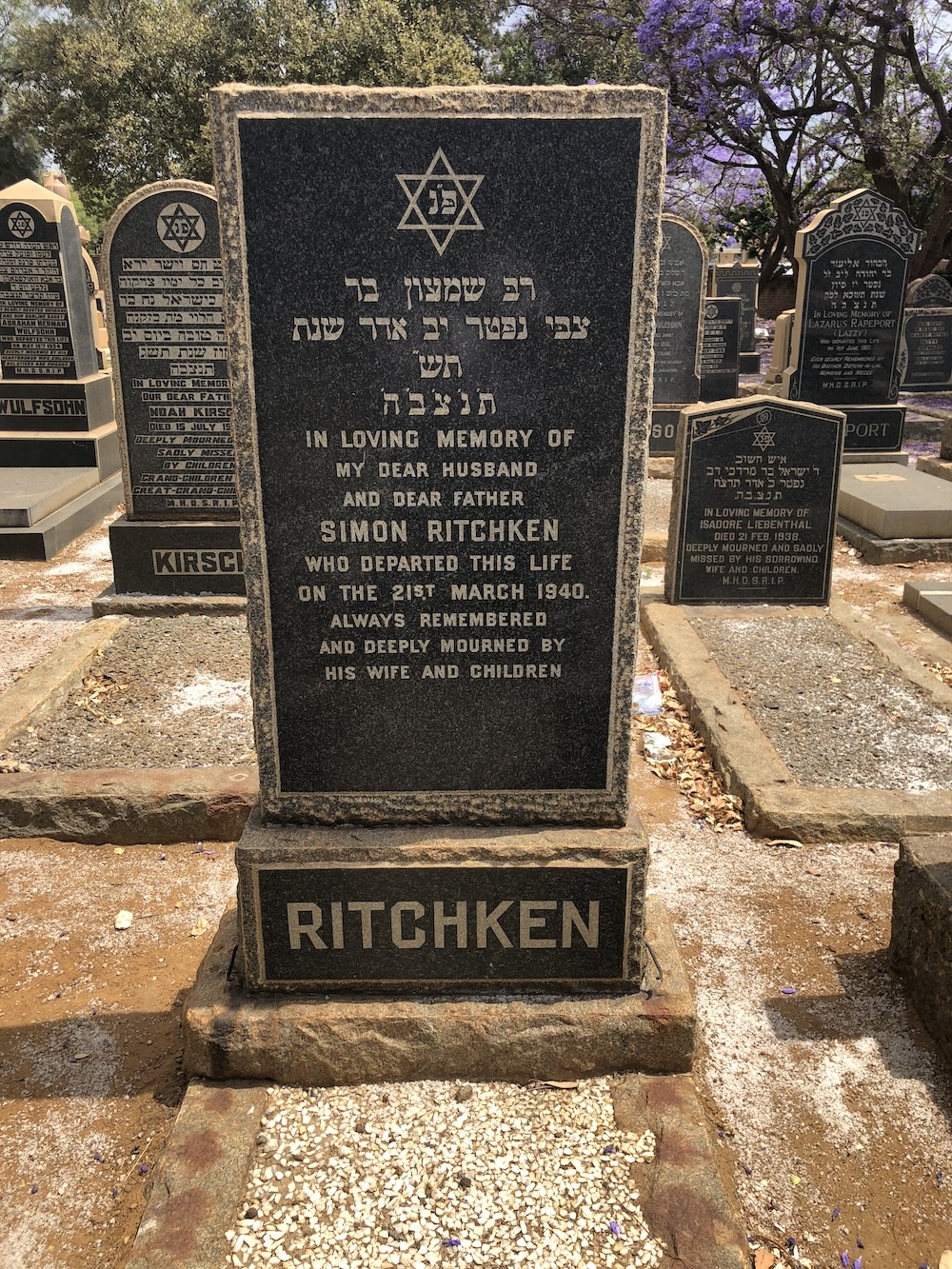
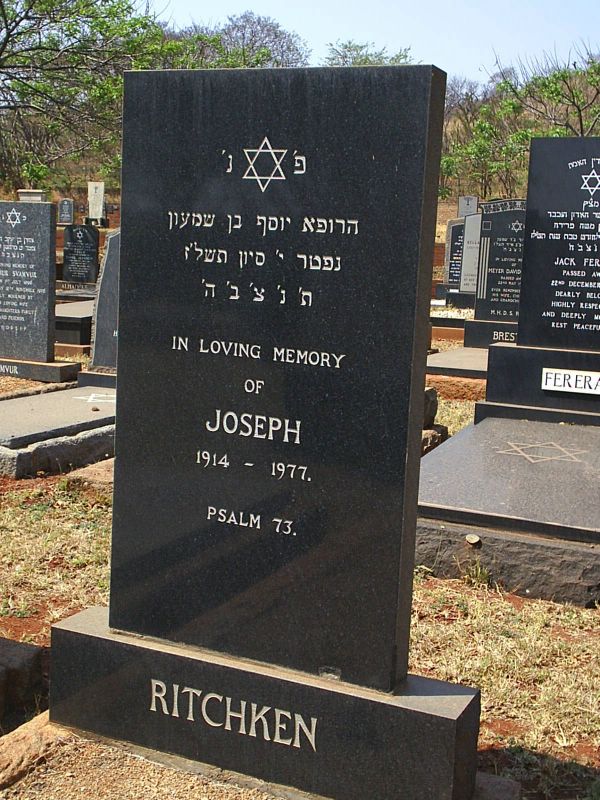
- Ritchken
- Roos
- Rosenstein
- Rosin
- Rosmarin
- Samuel
- Schumacher
- Schwarz
- Segel
- Sholomir
- Sichel
- Socher
- Solomon
- Sonnenberg
- Susser
- Swimmer
- Tabakin
- Terner
- Weinstock
- Weisberg
- Wolpe
- Wulfsohn
- Wulfsohn, Philip and Mary
- Zeffertt
- Ziman
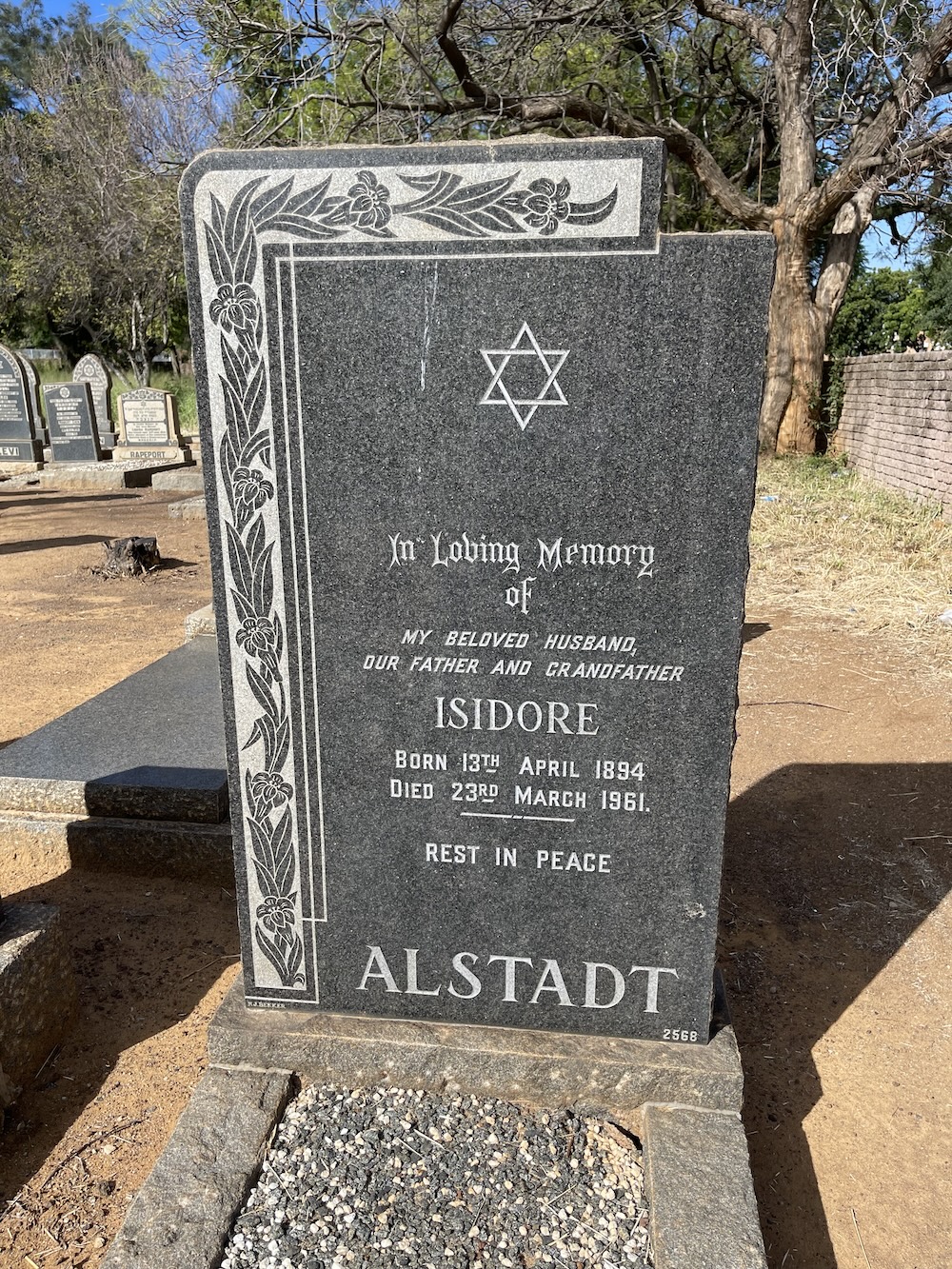
Alstadt, Isidore
(1894 Popelyan (Papilė), Lithuania - 1961 Rustenburg)
He was the youngest son of Isaac Alstadt (1859-1910) and Chani Alstadt. His parents were married in Popelyan and he had 4 siblings, Sophie (born 1883), Sam (1888-1962), Janie (born 1886) and Bertha (born 1890). The family emigrated from Lithuania to South Africa. His father was a housekeeper of a 'native eating house' and died in a railway carriage whilst travelling between Johannesburg and Krugersdorp.
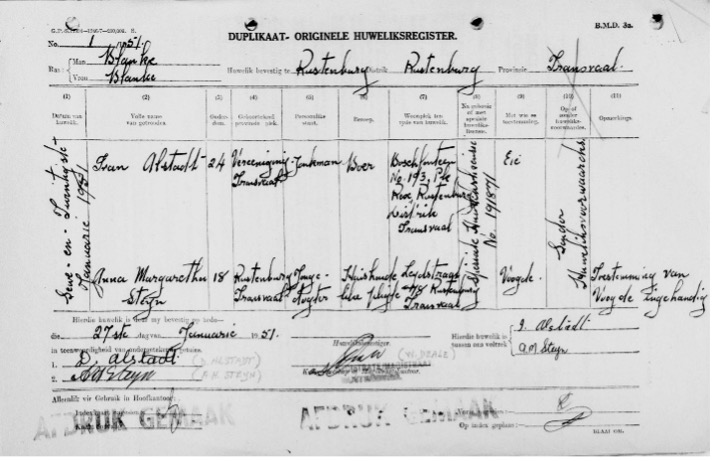
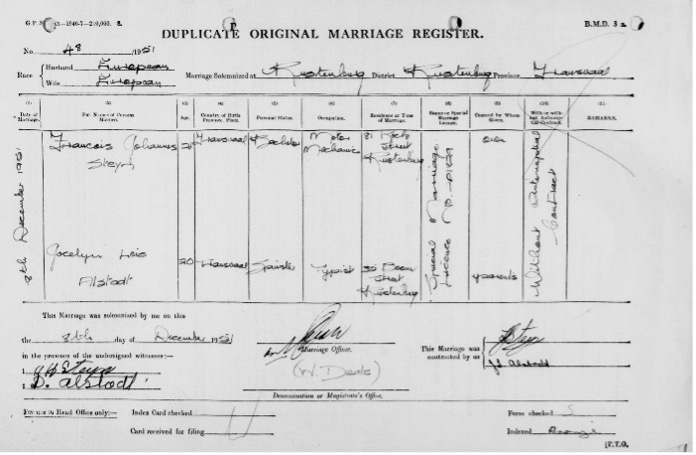
Isidore Alstadt was a shopkeeper and lived at Boschfontein, Rustenburg district. He and his wife, Delphine, had two children. Their son, Ivan Alstadt, named after his paternal grandfather, was born in 1927 in Vereeniging and their daughter, Jocelyn Lois Alstadt, was born in 1931. In November 1948 it was reported in the Rustenburg Herald that "Mr. I. Alstadt soloed successfully last week with Mr. Willy Rosenstein’s Flying School". Ivan Alstadt was a farmer at Boschfontein No. 193 Farm Rex. Both the Alstadt children were married in Rustenburg in 1951. Ivan Alstadt married Anna Margaretha Steyn of Rustenburg on the 27 January 1951. Jocelyn Lois Alstadt married Francois Johannes Steyn of Rustenburg (1930-1966) on the 8 December 1951.
Isidore Alstadt died in 1961 aged 66 years and is buried in the Old Cemetery. His wife Delphine died in 1970.
References:
- NASA:
- 1970 Alstadt, Delphine. TAB MHG_#_5062/70_ Predeceased spouse Isidore Alstadt.
- Lemoenplase op Boschfontein Nr. 193, Rustenburg, eiendom tot 'n aantal jare gelede van wyle Mnr. GW Rex Sr. en sy seuns. Die Rex gesin het hulle vroeg in die 1890-er jare hier kom vestig. (The farm Boschfontein belonged to President Kruger who gave it to his good friend George Rex (1840 Knysna – 1923 Rustenburg) in the early 1890s. It was an orange farm and is now the holiday resort, Hunters Rest.)
Baron, Reverend Eliezer Zeev
(1906 Vilna, Lithuania - 1998 Jerusalem, Israel)
He was the last Reverend to serve the Rustenburg community. He emigrated from Lithuania to South Africa and married Annie Solovei on the 17 June 1946 in Woodstock, Cape Town. He served as a Reverend for nearly 60 years in various South African communities. He made Aliyah to Israel and settled in Jerusalem. He is buried on the Mount of Olives – Har HaMenuchot.
Been family, including Rosin, Wilkov, Morris and Lurie
The history of the Been family, affectionately known in town as "Die Boontjies" (The Little Beans), illustrates the transition of a family from speculators and shop owners to professionals.
Founders: Solomon and Dobre Malka Been
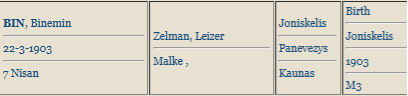
Solomon Been (1875 Joniškėlis, Lithuania - 1947 Johannesburg), known as Oom Zalman, arrived in South Africa from Joniškėlis, Lithuania, before the Second Anglo Boer War. He worked as a cattle speculator, partnering with Abraham Socher under the trade name Solomon and Socher. Solomon returned to Lithuania in 1902 to marry Dobre Malka Chait (1882 Šeduva, Lithuania - 1976 Rustenburg). In 1909, Malka and their eldest son, Benjamin, joined Solomon in Rustenburg. Raising seven children, the household embodied a unique cultural synthesis: the children spoke Afrikaans to one another and Yiddish to their parents. To guarantee her sons a university education, Malka opened a second-hand furniture store, Rustenburg Furnishing Company. Her sacrifice succeeded remarkably: four sons qualified as doctors and the youngest as a dentist.
The next generation
Dr. Benjamin Been (1903 Joniškėlis, Lithuania - 1961 Pretoria)
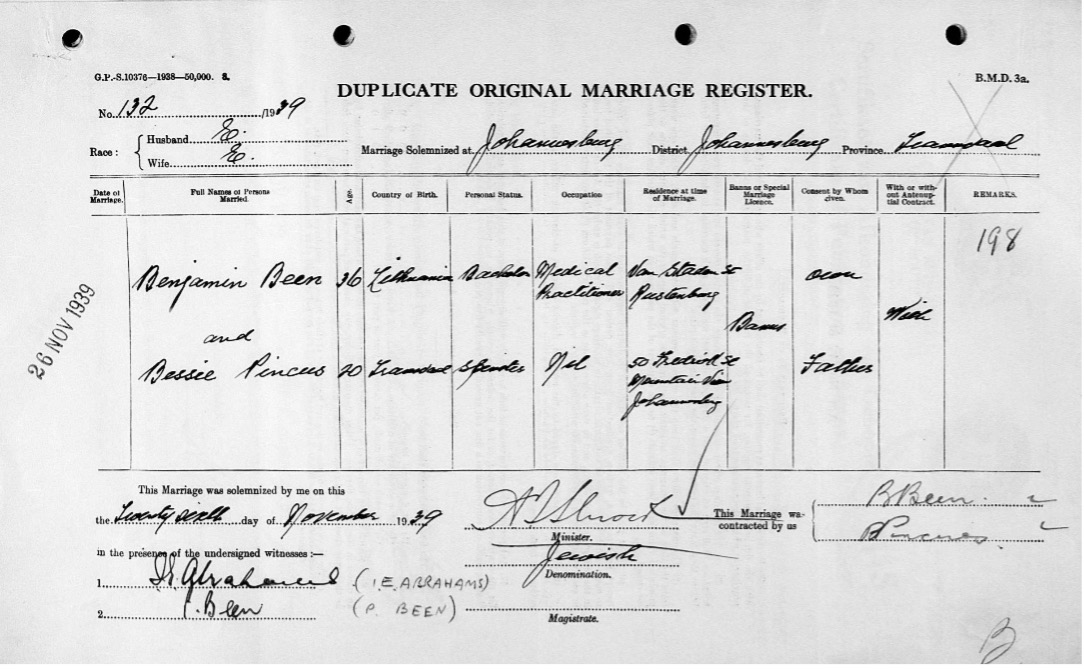
Known as Ben, he was born in Lithuania. He graduated as a doctor from the University of the Witwatersrand in 1929 and served as the mine doctor at the Waterval Platinum Mine, Rustenburg. He married Bessie Pincus in 1939. They had two daughters, Sally Anne and Rebecca. Their second daughter died as an infant in 1947. After Ben's passing, Bessie remarried and eventually made Aliyah to Israel to join her daughter, Sally Anne Goldberg.
Naomi Rose "Emmie" Rosin (1910 Rustenburg - 1984 Johannesburg)
The only daughter, Emmie, married Nachum Jacob Rosin in 1936 and they had four children, Hillard Rosin, Gabriel Rosin, Zelda Glazer and Gladys Schwartz. Nachum took over the management of his mother-in-law's second-hand furniture store. Following Nachum's death, Emmie retired to Johannesburg.
Philip "Fi" Been (1913 Rustenburg - 1986 Johannesburg)
He worked in the motor trade and married Rae Licker (1921 South Africa - 1992 Johannesburg). They had 3 sons, Michael, Stanley and Cyril. The family were active in the community and Rae was a member of the Rustenburg Women's International Zionist Organization (WIZO). Fi and Rae retired to Johannesburg.
Dr. William "Wiel" Been (1915 Rustenburg - 2006 Johannesburg)
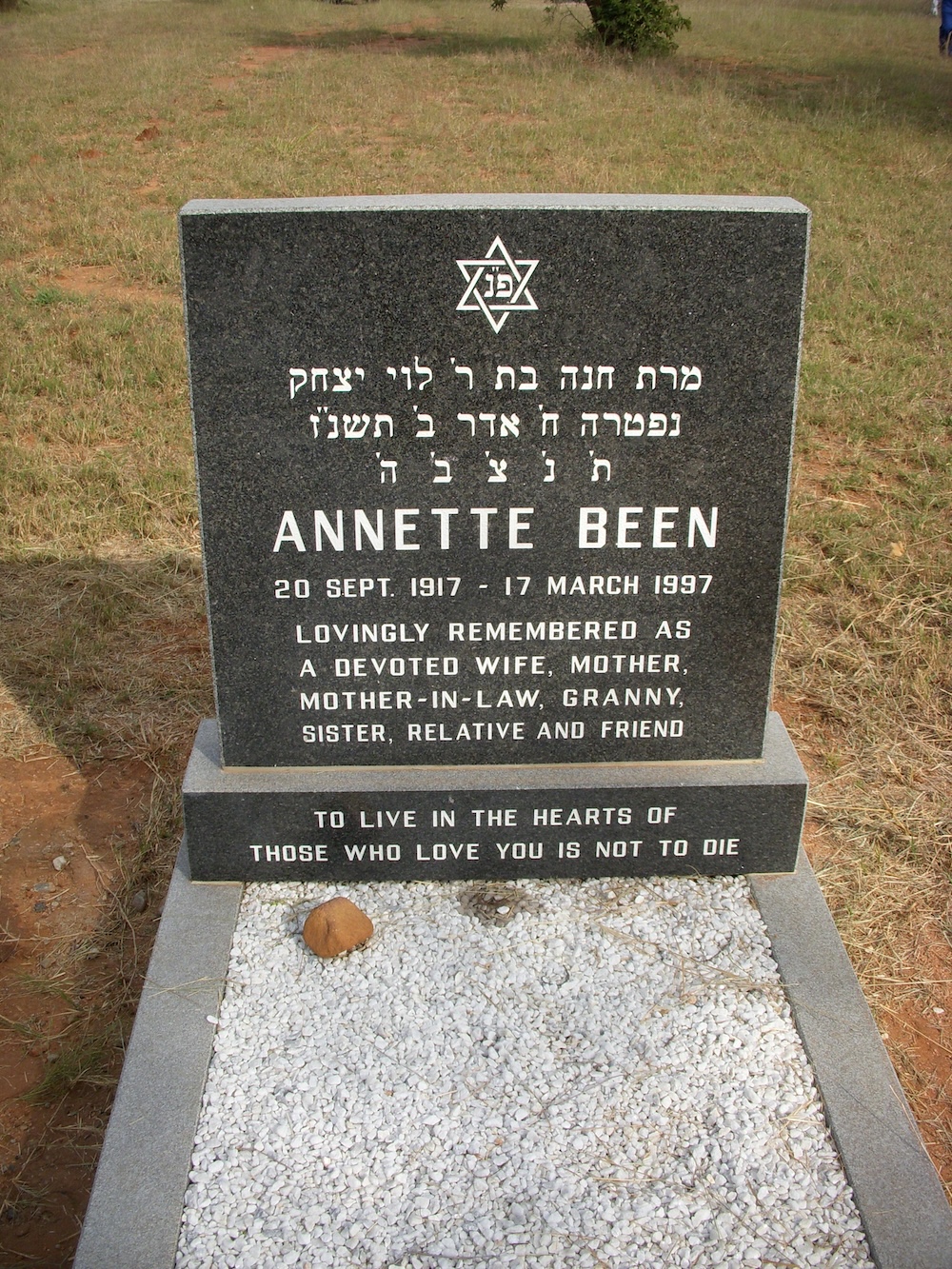
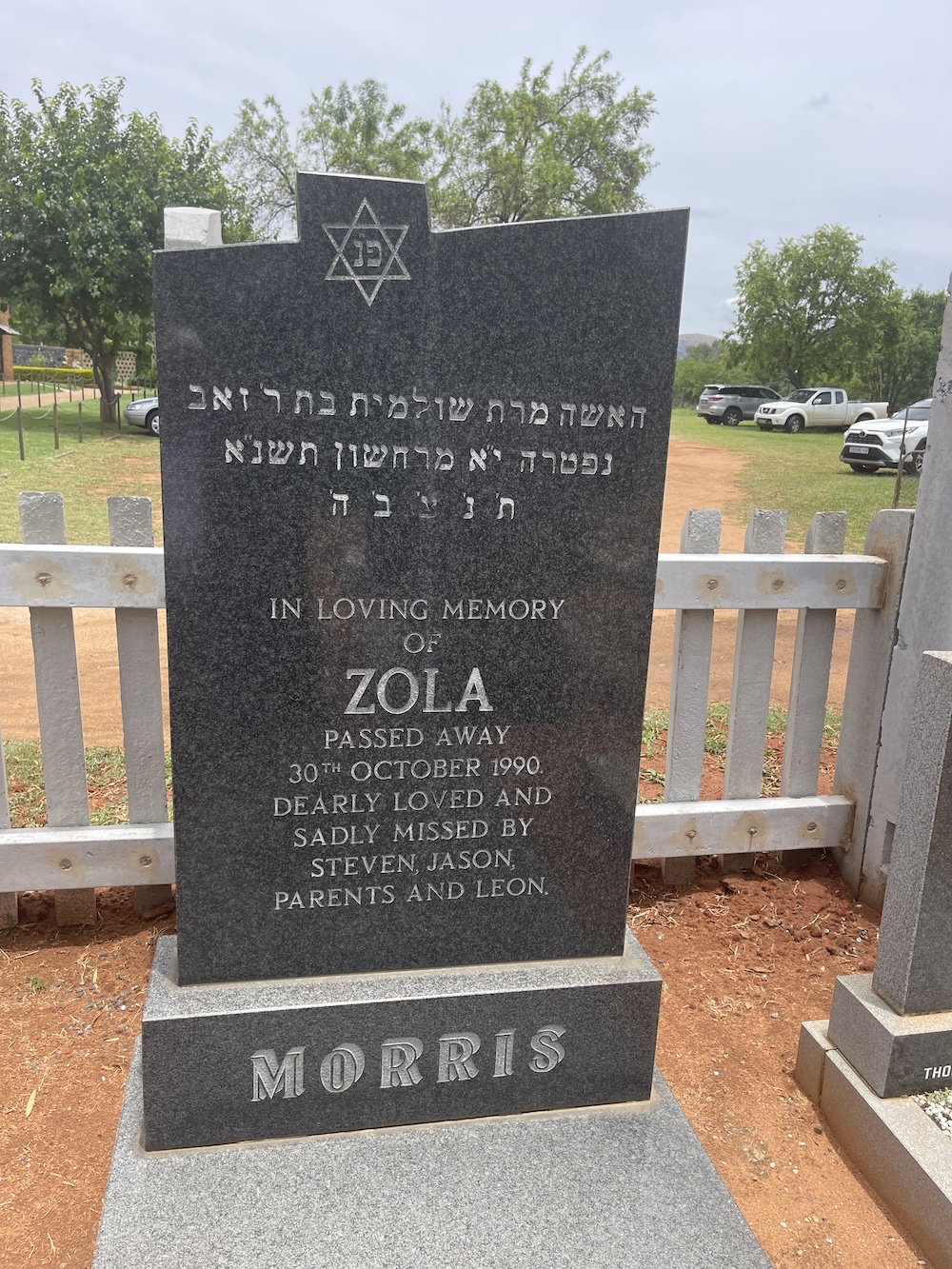
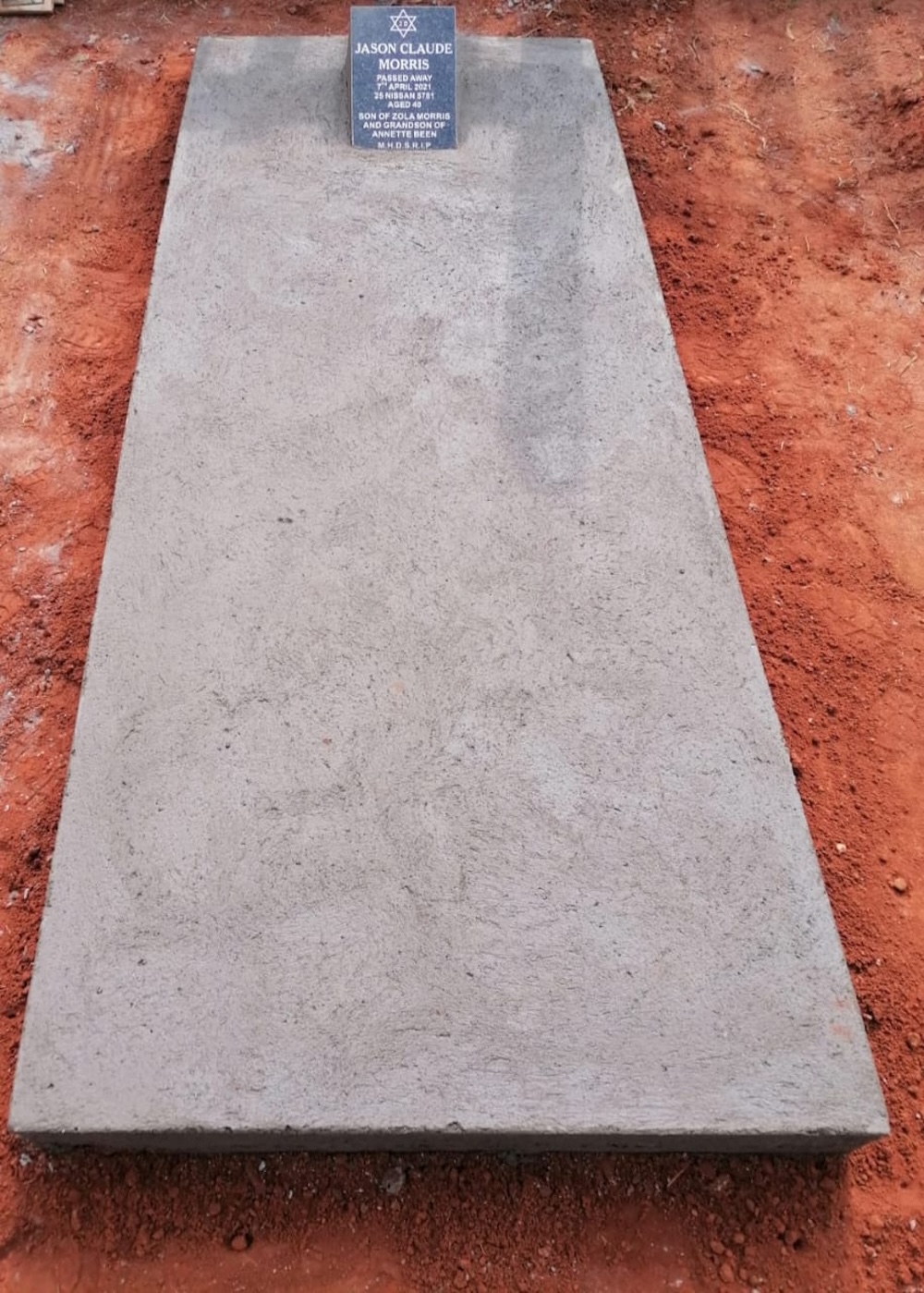
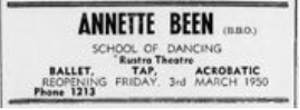
He graduated as a doctor from Wits in 1945 and served the region as a district surgeon. He married a Londoner, Annette Mirener (1917 London, England - 1997), a dancing teacher. The Annette Been School of Dancing was based at the Rustra Theatre and ballet, tap, acrobatics and mime were taught. Her students performed at numerous events, one of which was at the Rustenburg Flying Club Annual Dance. The Beens adopted 2 children, Zola and Leon, in the mid-1950s. The family lived on a plot outside town where Annette built a dance studio. The property became local folklore for housing a fleet of discarded old cars and a double-decker bus. Some of Annette's students preferred playing inside the double-decker bus over taking their dance lessons. Their daughter, Zola Morris (1958 South Africa – 1990 Rustenburg), lived in Rustenburg until her death in 1990; Zola's son, Jason Claude Morris, passed away in 2021. Annette, Zola and Jason are buried in the New Cemetery.
Dr. Joseph Banat Been (1916 Rustenburg - 2007 London, England)
He graduated as a doctor from Wits in 1941 and was a prominent general practitioner in Rustenburg, personally delivering many of the Jewish children born in the town. His wife, Clarice Been (née Sischy), was an active member of the anti-apartheid Progressive Party. Because of her political stance, the family faced harassment by the Special Branch of the South African Police, resulting in their leaving South Africa in the early 1960s for Scotland. Clarice's sister-in-law, the wife of her brother, Dr Benjamin Sischy, Claire Sischy née Rosin, was a member of the Black Sash, a white women's anti-apartheid resistance group. Following a direct warning from the Chief of Police in Johannesburg that an arrest was imminent, the Sischy family fled South Africa in the early 1960s and also settled in Scotland.
Dr. Lazarus "Leslie" Been (1918 Rustenburg - 1998 Cape Town)
In 1934, while only in Standard 9 (Grade 11), Leslie fast-tracked his education by writing the Cape Matriculation examination early so he could attend university alongside his brother, Joseph. The brothers graduated together in 1941 and earned Diplomas in Public Health the following year. Leslie later relocated to the Eastern Cape, marrying social worker Alma Joan MacKenzie (1927 Bloemfontein - 2007 Cape Town). They had 4 children. Leslie was promoted to Chief Health Officer for the Cape Province.
Dr. Ephraim "Efi" Been (b. 1921)
A talented rugby player and golfer, Ephraim served in the Union Defence Force during World War II, after graduating from Wits as a dentist in 1944. He and his wife, Sheila Gaydine Meyerowitz, and their 3 children emigrated to Israel. Sheila became a prominent educator, coordinating the English Department for Israel Educational Television for over 15 years and pioneering the English by Television curriculum.
Extended family branches
Nephew: Sam Been (1881 Lithuania –1961 Pretoria)
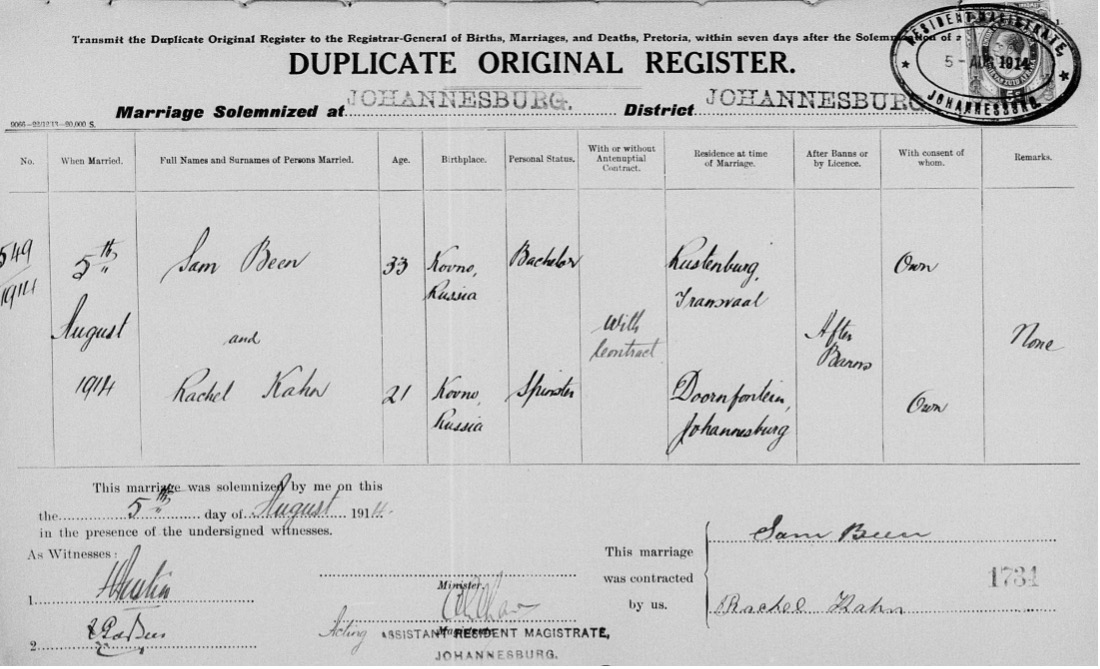
He was the son of Moshe Yehuda Been (1851-1933) and Chana Been née Shtein (1851-1935) of Joniškėlis. He settled in Rustenburg and married Rachel Kahn (1893-1971) in 1914. They lived in Marikana, near Rustenburg, where their two sons, who both went on to become medical doctors, were born. The family moved to Pretoria. Sam's three sisters remained in Lithuania, and all perished in the Holocaust.
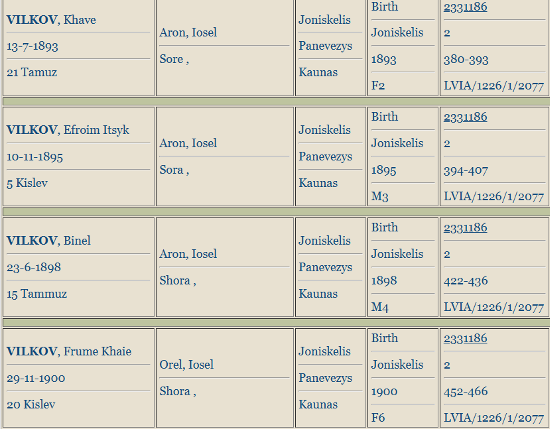
Sister: Sara Wilkov (1869 Lithuania - 1954 Johannesburg)
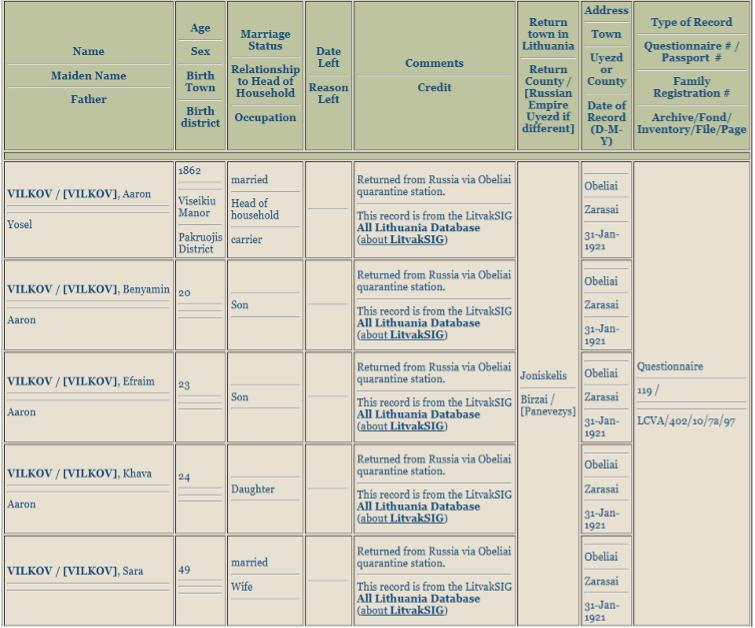
Solomon's sister Sara experienced the hardships of Jewish Lithuanian life firsthand, being exiled to the Russian interior with her family during WWI before returning to Lithuania via the Obeliai quarantine station in 1921. Following the death of her husband, Aaron Wilkov (1862 Pasvitinys - 1924 Joniškėlis), from tuberculosis, Sara, along with her daughter Chava 'Eva' Lurie (1893 - 1964) and son-in-law Nathan Lurie (1897 Panevezys - 1948 Johannesburg), emigrated to South Africa in 1927. They joined the family network in Rustenburg. The Luries' 3 children were Aaron 'Ockie' Lurie (1929 Rustenburg - 2022 Johannesburg), Hannah Weitzman née Lurie (1933 Rustenburg - 2004 Johannesburg) and Joseph Lurie.

References:
- Die Boontjies. Chapter 12. The Golden Years: A Memoir of old Rustenburg. Lionel Wulfsohn, 2011, Watermark Press, Plettenberg Bay, pages 86-91.
Rustenburg Herald entries:
- 1931.The General Dealers Business heretofore carried on Erf. No. 1061 Plein Street Rustenburg under the name of Malke Been, Trading as the Rustenburg Furnishing Co. has been transferred to Erf No. 103 Plein Street. Rustenburg as and from the 1st April 1931.
- 1944-08-04. Thanks to Doctor, sister and nurses. Congratulations to Mr. and Mrs. Rosin on the birth of a bonny son.
- 1948-09-17. In the estate of the late Nathan Lurie and surviving Spouse Eva Lurie (born Wilkov). No. 3756/48 Creditors and Debtors in the above-mentioned estate are hereby called upon to file their claims with, and to pay their debts to the undersigned within 30 days from date of publication hereof Kotze and Duffey, Attorneys for Executrix, Steen Street, Rustenburg.
- 1949-04-08. Engineering Machinery for Sale. Buyer can take over long lease of premises. Apply A Lurie, 44 Plein Street, Rustenburg.
- 1949-07-15. Unveiling of Tombstone Lurie. The unveiling of the tombstone in loving memory of my beloved husband and our darling father, Nathan Lurie, will take place on Sunday July 17 at 11 a.m. Relatives and friends kindly accept this invitation.
- 1950-06-23. To Mr. and Mrs. N. Rosin a bonny daughter at Sandra Nursing Home on 13th June. Both well.
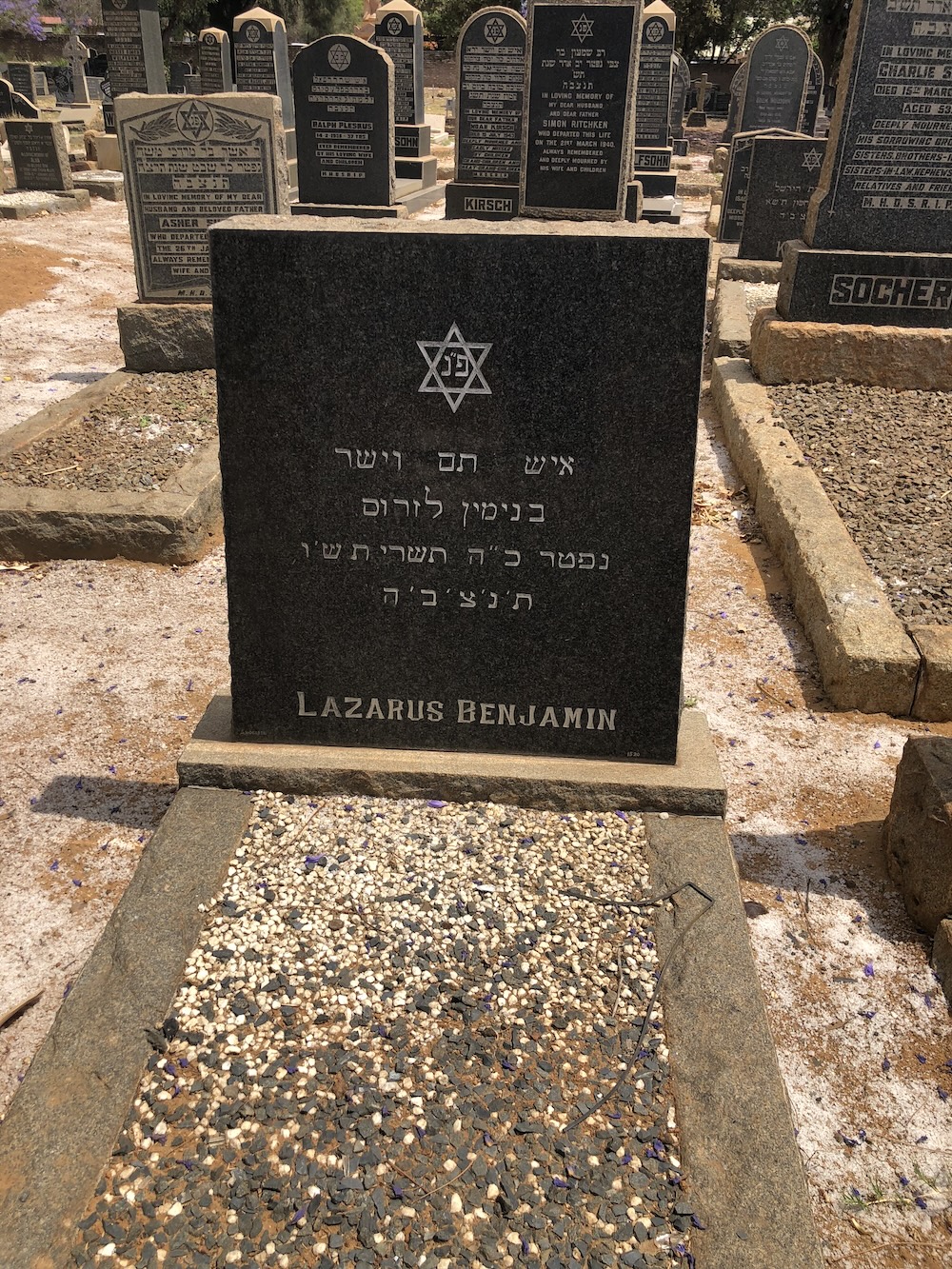
Benjamin, Lazarus
(1886 Lithuania – 1 October 1945 Rustenburg)
He was a bachelor and worked as a speculator. He died at the age of 59 at the Paul Kruger Memorial Hospital. He had no heirs as his sister, Sarah Rabinowitz, her husband and son were killed in 1942 in Lithuania during the Holocaust.
Rustenburg Herald entry:
- 1932-01-15. Notice is hereby given that the General Dealers Business heretofore carried on by Lazarus Benjamin at Mabieskraal No. 620, District Rustenburg, has been abandoned.
Berger family
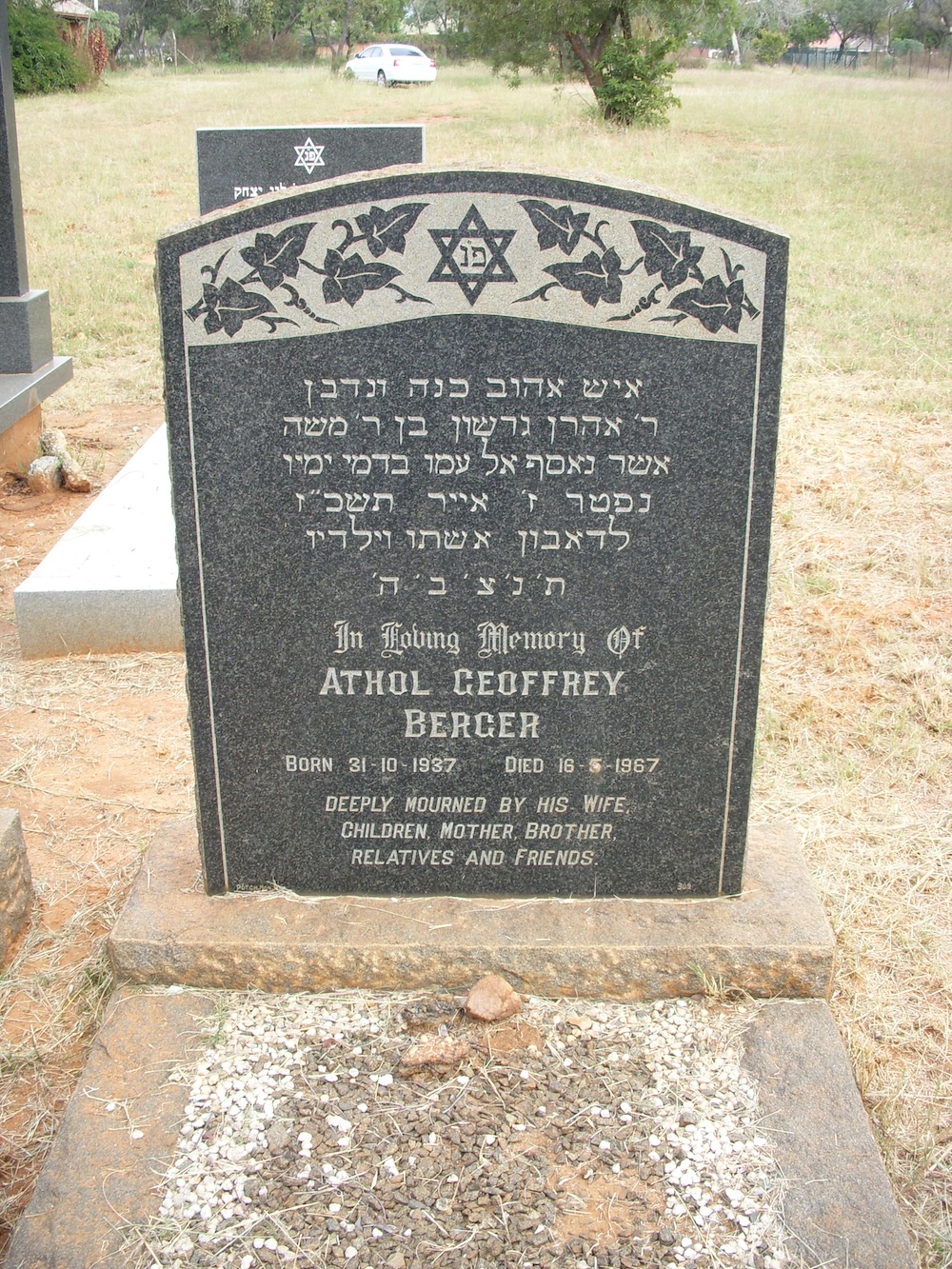
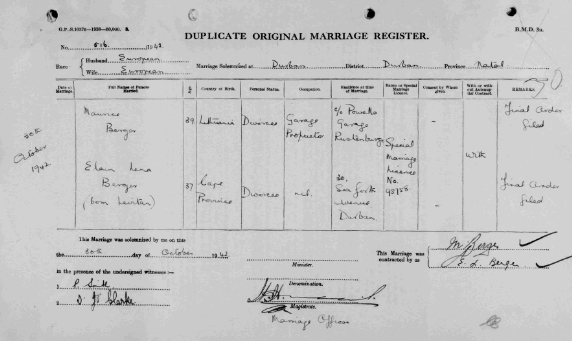
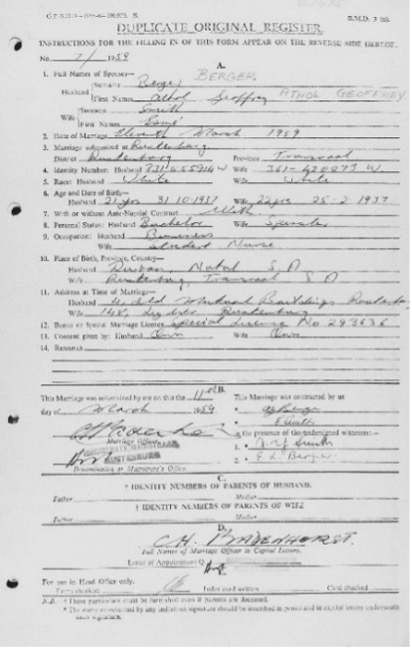
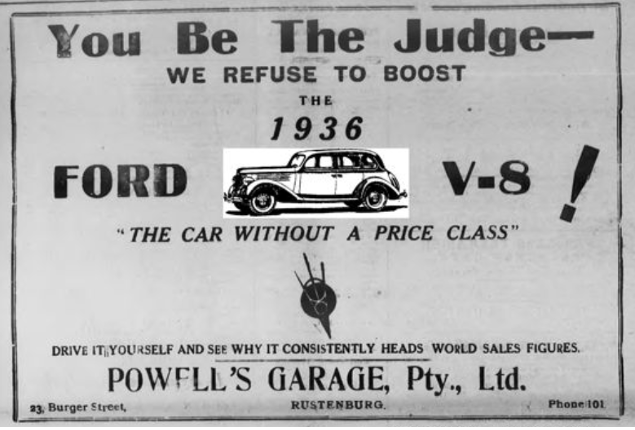
Maurice Berger (1903 Lithuania - 1958 Cape Town) emigrated from Lithuania to South Africa, initially settling in Vereeniging, where he was a garage proprietor. On 31 January 1935 he married Elain (Eileen) Lena Levitan (1905 Cape Province - 1984 Cape Town) at the Great Synagogue, Cape Town. They lived in Durban where their son, Athol Geoffrey (1937 -1967), was born on 31 October 1937. After a brief divorce and subsequent remarriage in 1942, the family settled in Rustenburg where Maurice was the proprietor of Powell’s Garage. He had the sole agency for Ford motor vehicles. In 1947 Maurice Berger changed the name of his garage to Berger's Motors. After developing lung cancer, Maurice sought medical treatment in Cape Town, where he passed away in 1958. Although he was resident in Rustenburg, he requested to be buried in Johannesburg. Following his death, his son, Athol, took over the management of the motor business. Athol married Esmé Smith (b. 1937), a student nurse from Rustenburg, on 11 March 1959 in Rustenburg. Their first child, Ian Maurice, was named after his paternal grandfather. Athol was tragically killed in a plane crash on his farm on 10 May 1967. He was 30 years old. He was survived by his wife, children, mother and brother, Michael Berger. His widow, Esmé, and their children left Rustenburg and settled in Durban.
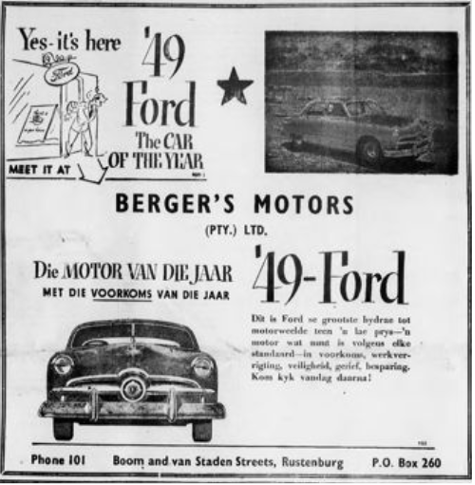
Rustenburg Herald entries:
- 1942 Notice is hereby given that the Motor Garage Business heretofore carried on by Powell’s Garage (Pty) Ltd at erf 8/107, Burgher Street, Rustenburg, has been sold to Maurice Berger, who has taken over all Assets and Liabilities, as at 1. 7. 1942 and who will carry on the business on his own account under the name and style of Powell’s Garage at the same address, as from that date.
- 1947. Notice is hereby given that the Motor Garage Business at present carried on by Maurice Berger at 23 Burger Street, Rustenburg under the name and style of Powell's Garage will as and from the 1st day of January, l947 be carried on by the said Maurice Berger at the same address under the name and style of Berger’s Motors.
Berkowitz, Izak 'Isaac'
(10 June 1876 Pakruojis, Siauliai, Lithuania - 17 December 1944 Elminie Farm, Enkeldoorn, Mashonaland East, Rhodesia)
He emigrated to South Africa in 1882 with his father and they lived in Wolmaransstad. During the Second Anglo Boer War he fought with the Rustenburg Commando. He was wounded and part of his tongue was shot away. He apparently suffered from shell shock after the war, resulting in him struggling to write.
After the war, he married Martha Sophia Magdalena Bosman née Bosman (19 September 1874 Witpoort Transvaal - 29 November 1947 Enkeldoorn, Rhodesia) on the 25 January 1910 in Wolmaransstad, Transvaal. His wife was the widow of Petrus Francois Bosman (7 June 1860 Beaufort West, Cape Colony – 12 February 1902 St Helena), a farmer from Driefontein, district of Wolmaransstad, who served under Boer Commander, General Piet Cronje (1836-1911) during the Second Anglo Boer War. He was captured at the battle of Paardeberg on the 27 February 1900, which was the last major battle of the war, when General Cronje and just over 4000 of his men surrendered to the British on the morning of 27 February 1900. Bosman was sent to St Helena Island and detained at Deadwood prisoner of war camp, where he died of dysentery. He was survived by his wife and a 5-year-old son, Petrus Francois Bosman (1897 Wolmaransstad – 1960 Enkeldoorn, Rhodesia).
Isaac and Martha Berkowitz's son, Nathan Elia Berkowitz (20 June 1911 Wolmaransstad - 16 February 1960 Enkeldoorn, Mashonaland East, Rhodesia) was born in Wolmaransstad. In 1917 the family moved to Enkeldoorn, Southern Rhodesia (Chivhu, Zimbabwe), an Afrikaner stronghold which was founded by Boer farmers in c. 1850 and has the distinction as the first white settlement established in Rhodesia. The Berkowitz family bought the farm Elminie, where Isaac farmed. In 1944 Isaac died on the farm aged 68 and was buried in a nearby family burial ground, Palestina Farm. The names of his parents and siblings, a brother and sister, are unknown.
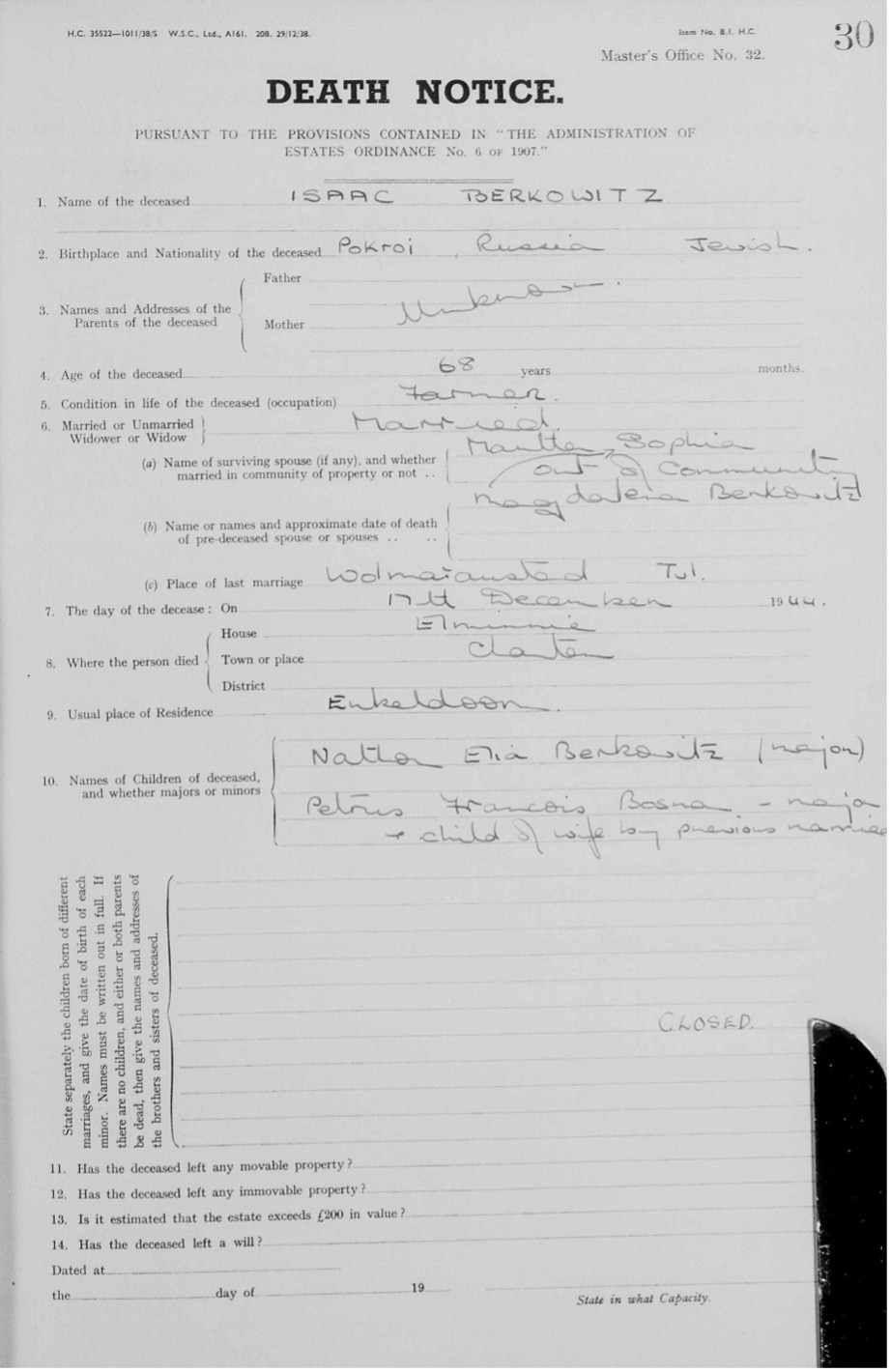
References:
- Correspondence, Ada Theodora Berkowitz, granddaughter.
Blecher family
Bernard Blecher (1929 - 1995 Johannesburg), known as Berny, was the son of Harry Blecher (1893-1961) and Rose Blecher née Gerstnera (1898 -1948). He married Ester Ressia Viljoen born Milner (1928 - 2009 Johannesburg). The Blecher family contributed to the building fund of the Jacob Finkel Cultural Hall in the early 1970s. Their son Harold Blecher (1962 Pretoria - 1981) died at the age of 18. Bernard and his son are buried in Pretoria, and his wife in Johannesburg. There is no trace of the family in Rustenburg.
Blumberg, Tabakin and Ziman families
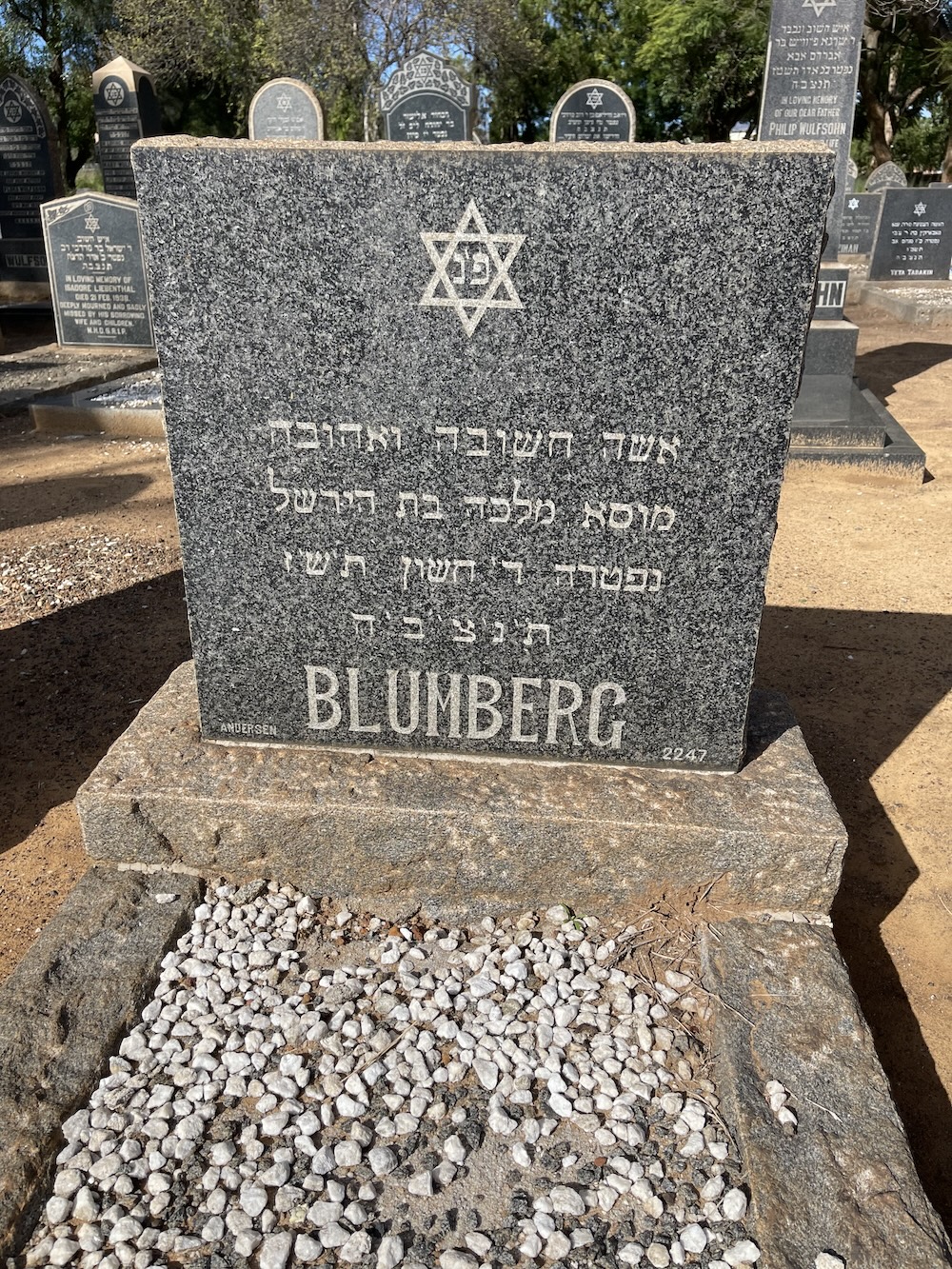
Hershel and Frooma Tabakin raised 5 children in the small town of Gruzdžiai, Lithuania. Like many families of their era, the children sought new horizons. Their son, Itze Lebe Tabakin, built a new life in New York City, USA, whilst the rest of their children, Nathan, Musa, Lena, and Yeta, emigrated to South Africa. Their eldest daughter, Musa Blumberg, and her family settled in Rustenburg and her brother, Nathan Blumberg (1873-1965), settled in Cape Town. The 2 younger Tabakin daughters, Lena and Yeta, made their way to South Africa in 1923.
Blumberg siblings:
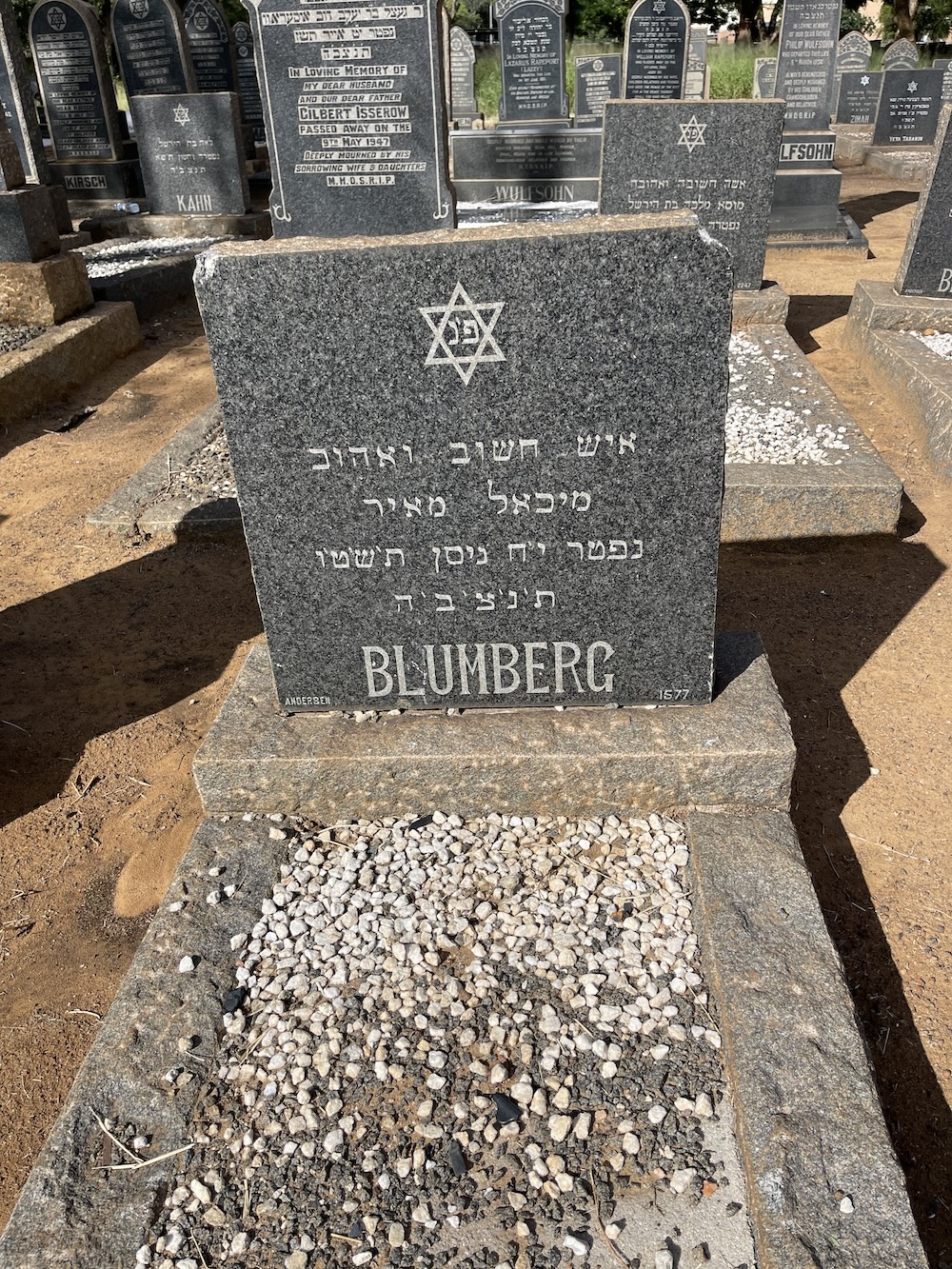
- Musa Malka Blumberg née Tabakin (1871 Lithuania - 1946 Rustenburg) married Micha (Michael) Meyer Blumberg (1861 Russia - 8 April 1955 Rustenburg) in Lithuania and they had two children, Moses and Asne Chaya. The family settled in Rustenburg, where Micha was a speculator. Following the death of Musa Malka in 1946, Micha lived at Saulspoort. A year after his death, his two children submitted an application for a butchery site at Saulspoort.
Their children:
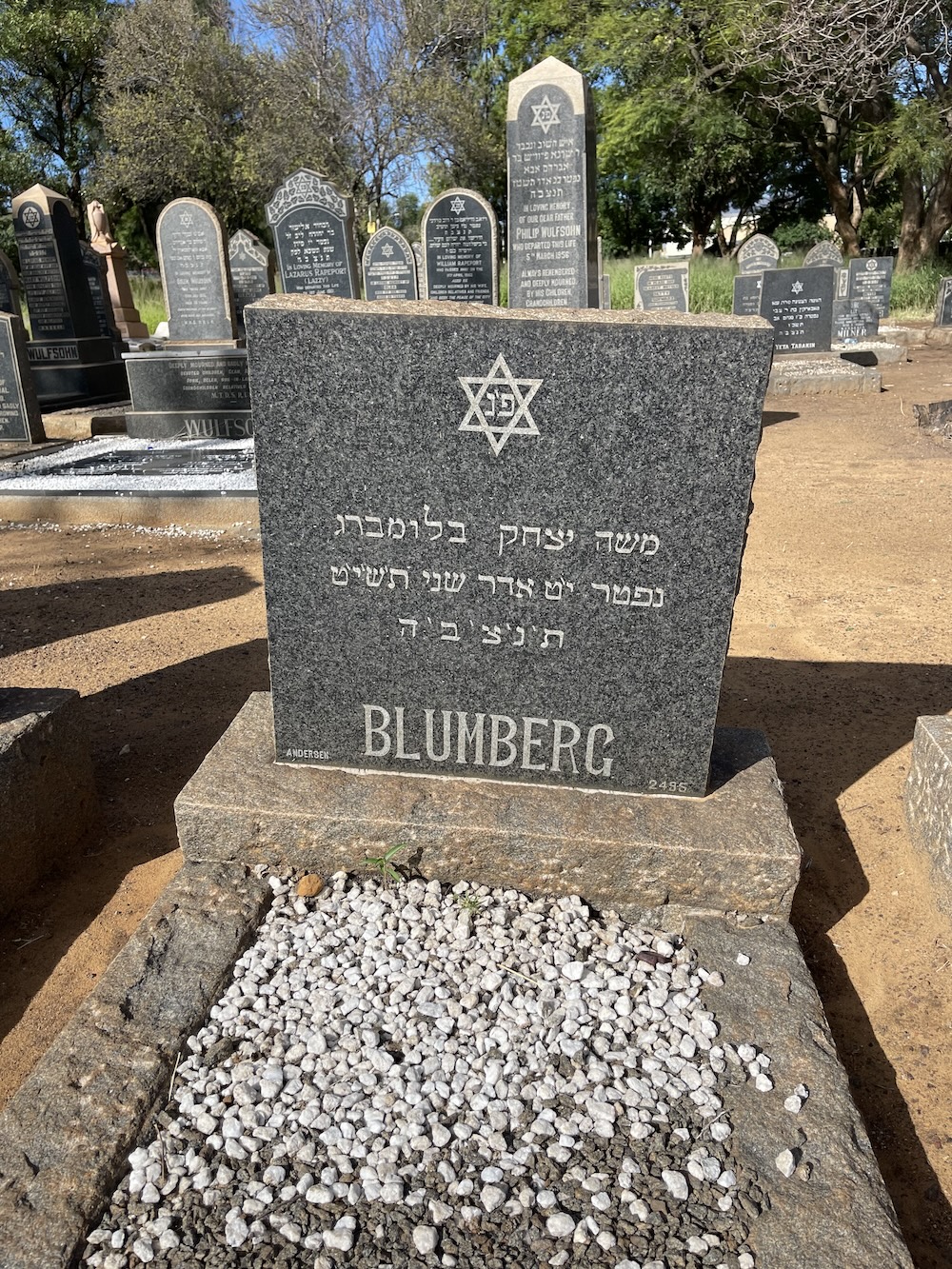
- Moses Blumberg (1892 Lithuania - 1959 Rustenburg) remained a bachelor and lived at 112 Kerk (Church) Street. At the time of his death, he was unemployed.
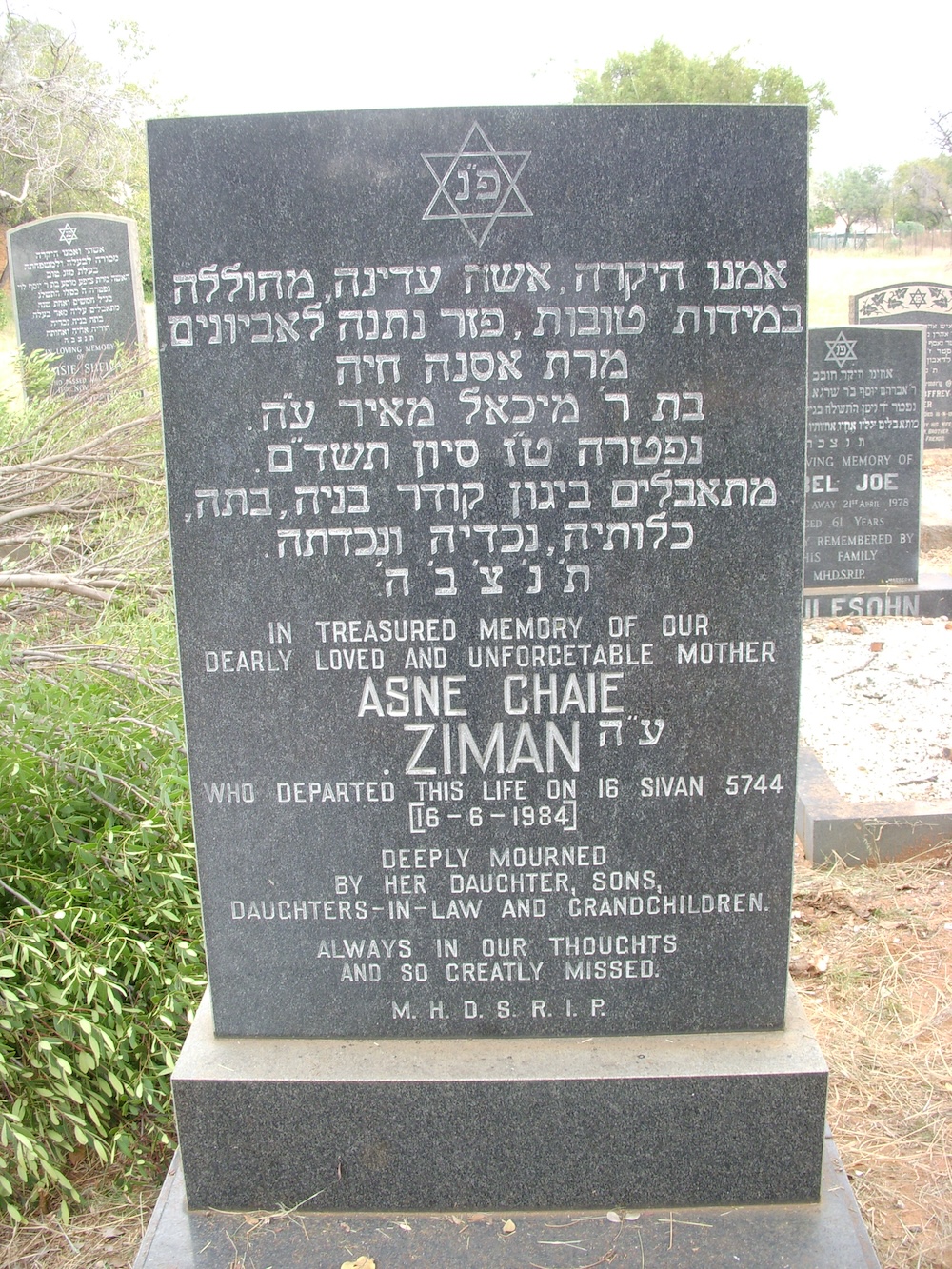
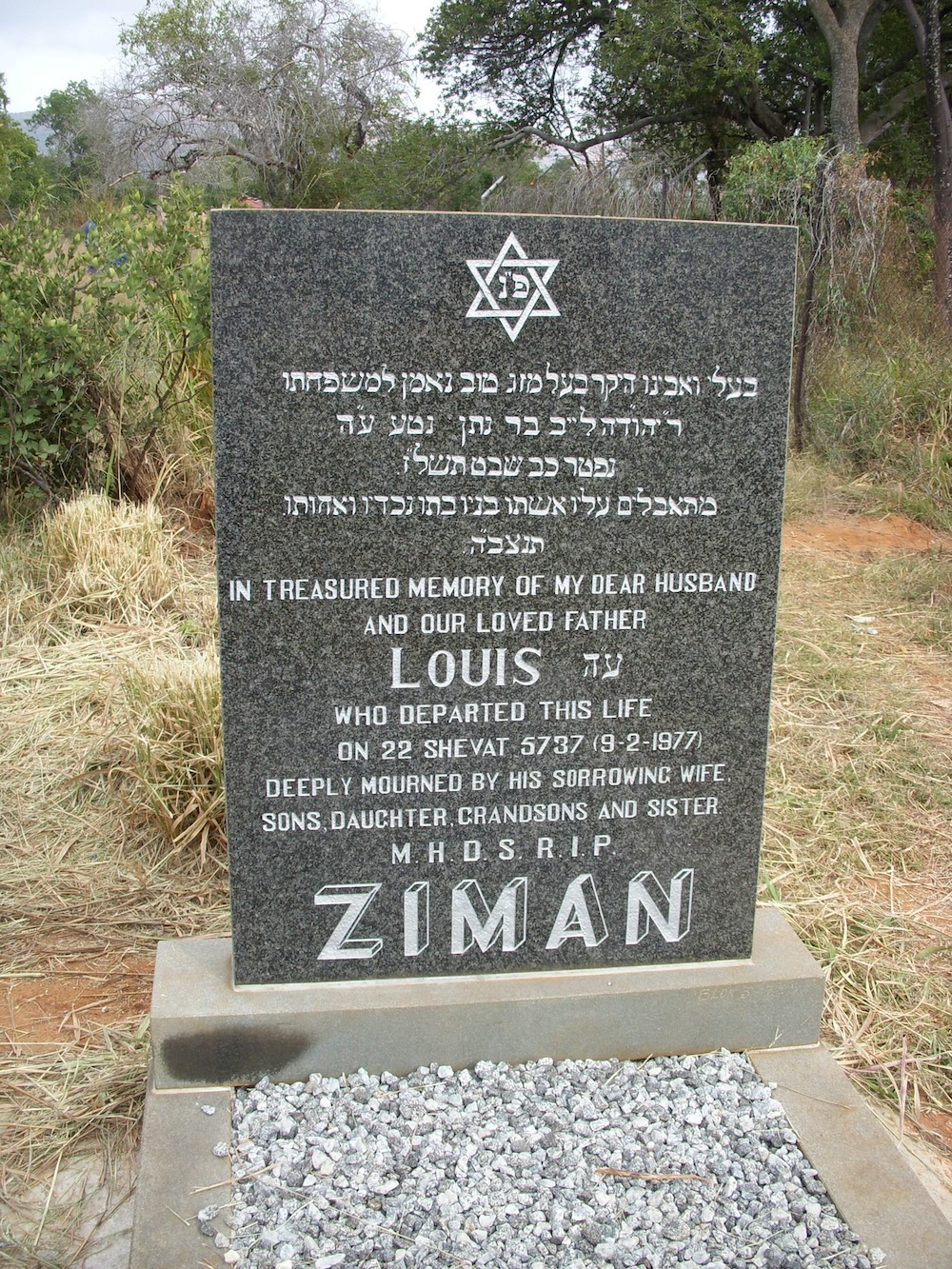
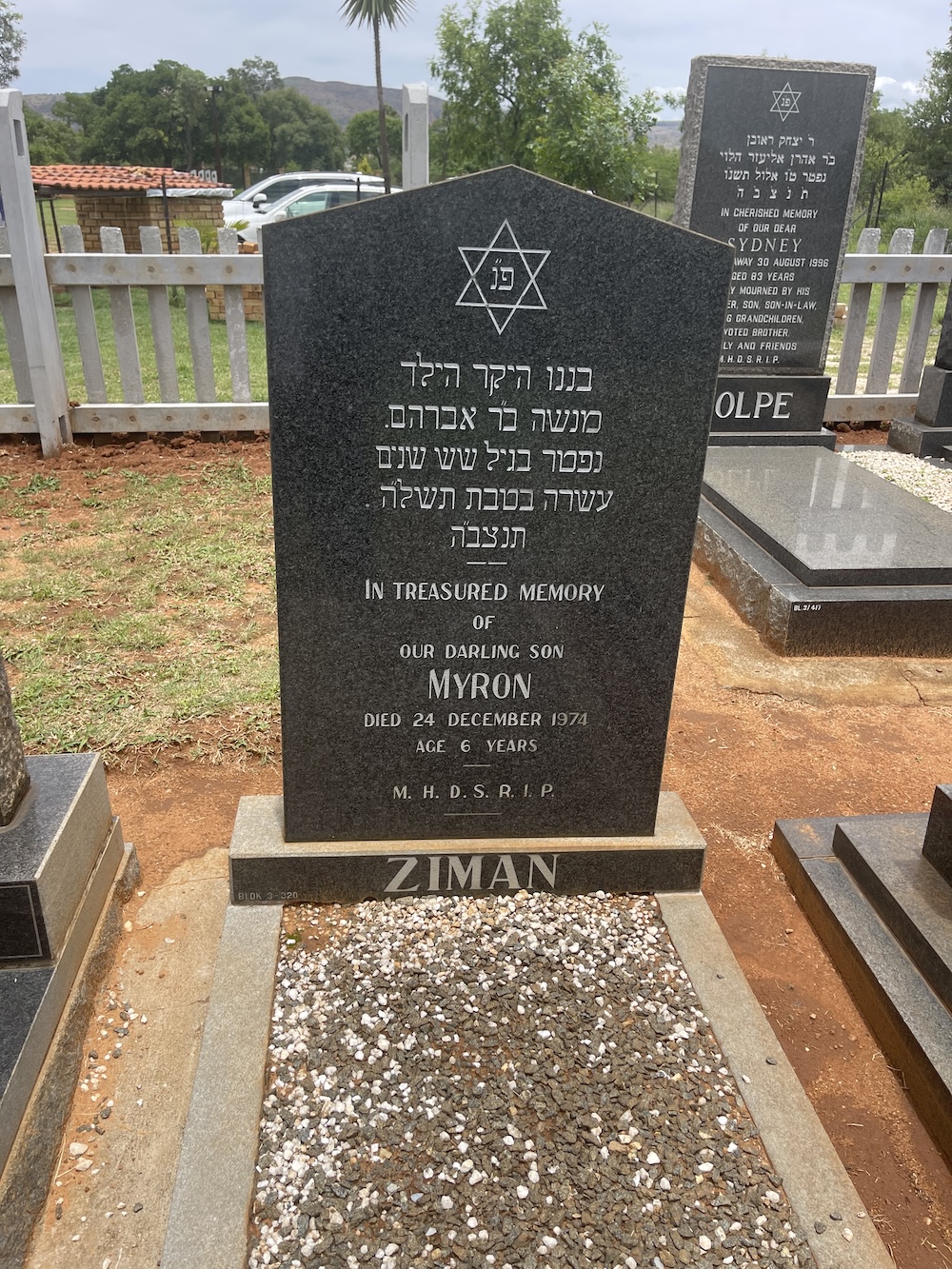
- Asne Chaya Ziman née Blumberg (1905 Lithuania - 1984 Rustenburg) married Louis Ziman (1898 Lithuania - 1977) on the 3 May 1926 in Rustenburg. Louis's family lived in Pretoria and had a general dealership. Louis established L. Ziman in Plein Street. Five children, three sons and two daughters, were born in Rustenburg. Their sons were Abraham Mitchell Ziman (1927 - 2013 Johannesburg), Harry Ziman (d. 2025 Melbourne, Australia) and Issy Ziman (1944 - 2014 Johannesburg). Their daughters were Frooma (1928-1935) and Hetty, known as Natalie, who was born in 1939. Tragically, their daughter, Frooma, aged 7, died from complications of epilepsy in 1935. Their son Abraham Ziman and his family lived in Rustenburg. His son Myron Blumberg (1968-1974), aged 6, died in a motor car accident and is buried in the New Cemetery. Louis and Asne Ziman remained in Rustenburg and passed away in 1977 and 1984 respectively.
- Moses Blumberg (1892 Lithuania - 1959 Rustenburg) remained a bachelor and lived at 112 Kerk (Church) Street. At the time of his death, he was unemployed.
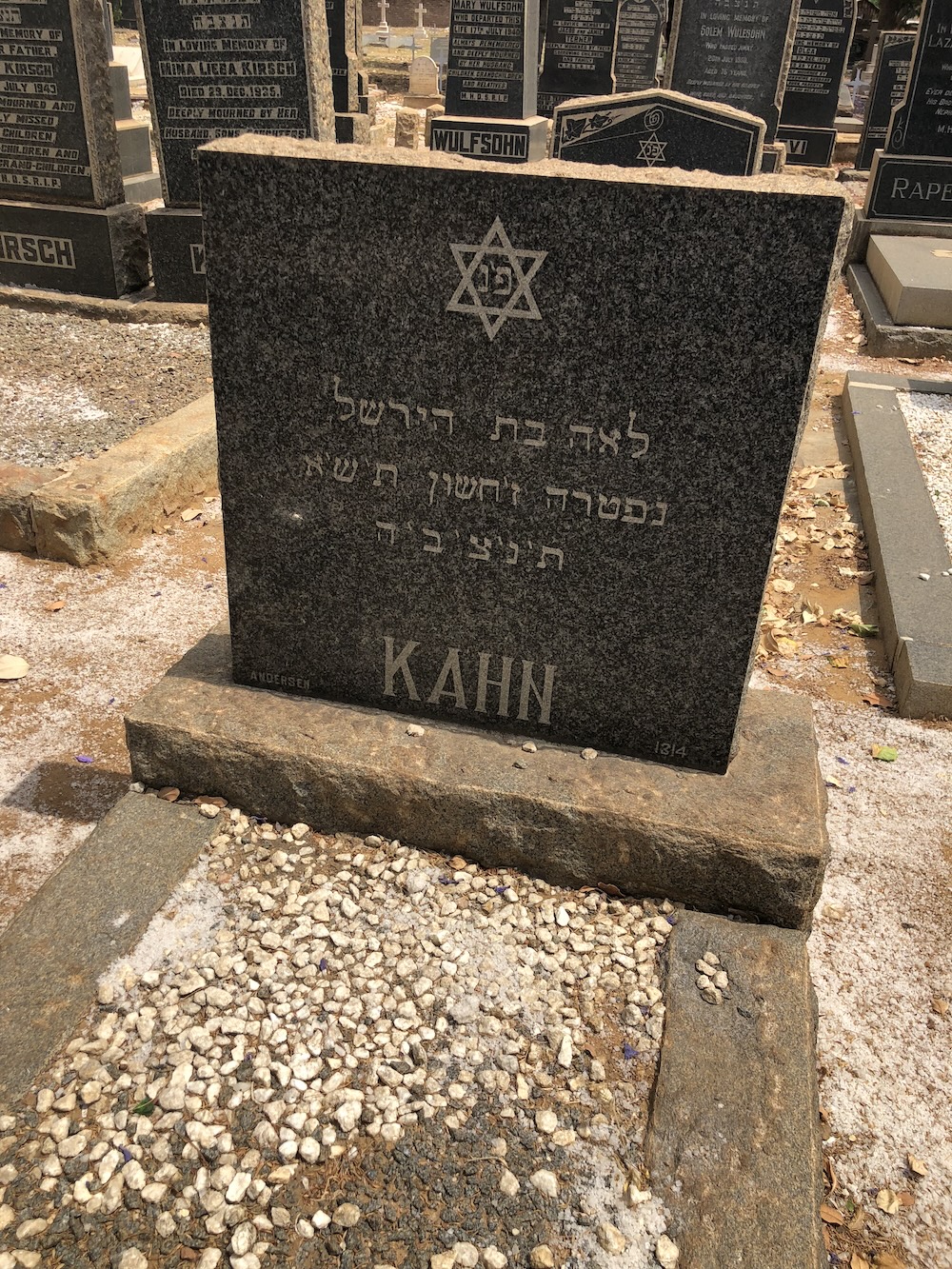
- Lena (Lea) Kahn née Tabakin (1880 Gruzdžiai - 1940 Rustenburg) emigrated to South Africa in October 1923 with her younger sister. Lena married Isaac Joseph Kahn (1875 - 1939 Bloemfontein), a storekeeper and contractor, and moved to Bloemfontein, where Isaac's parents and siblings were established. When Isaac died in 1939, Lena packed up her life and moved to live with her sisters in Kerk Street.
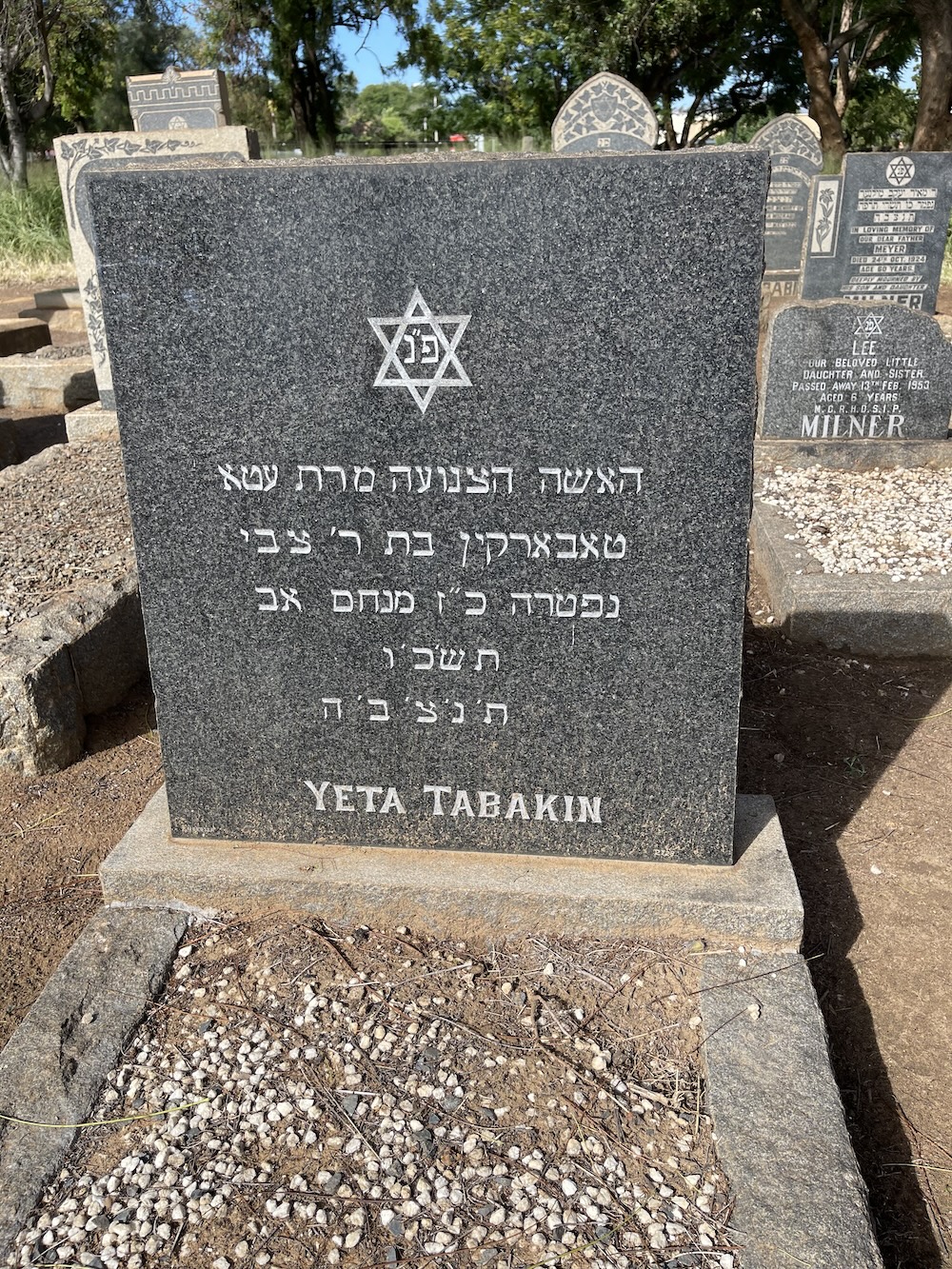
- Yeta (Ethel) Tabakin (1885 Gruzdžiai - 1965 Rustenburg) was a spinster. She lived at 110 Kerk Street and died in 1965 at the age of 80 years.
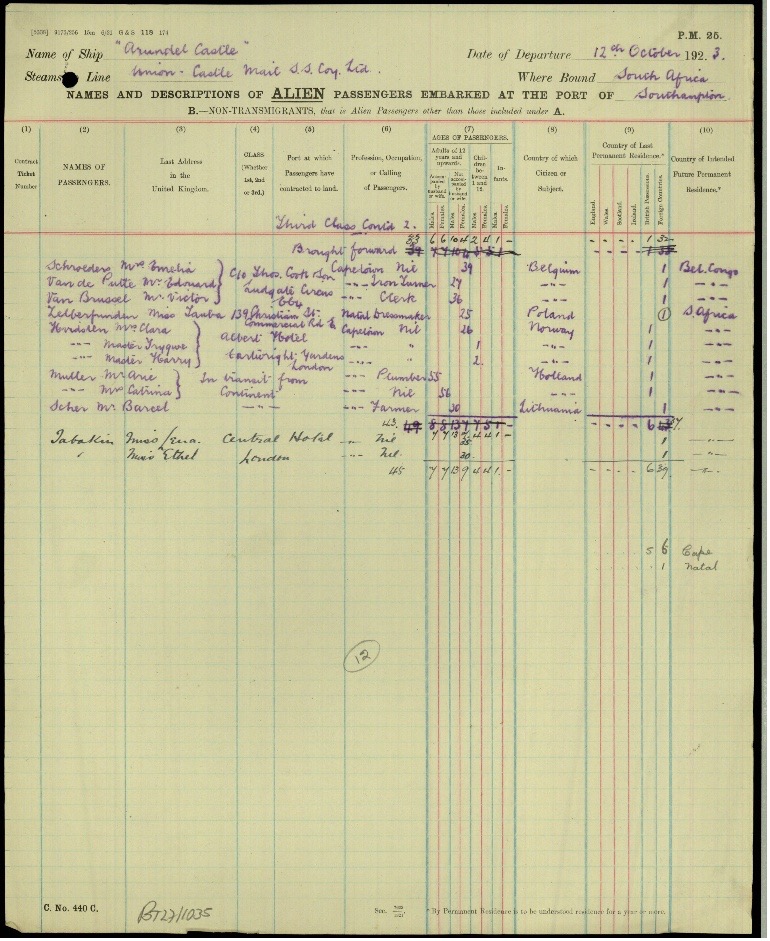
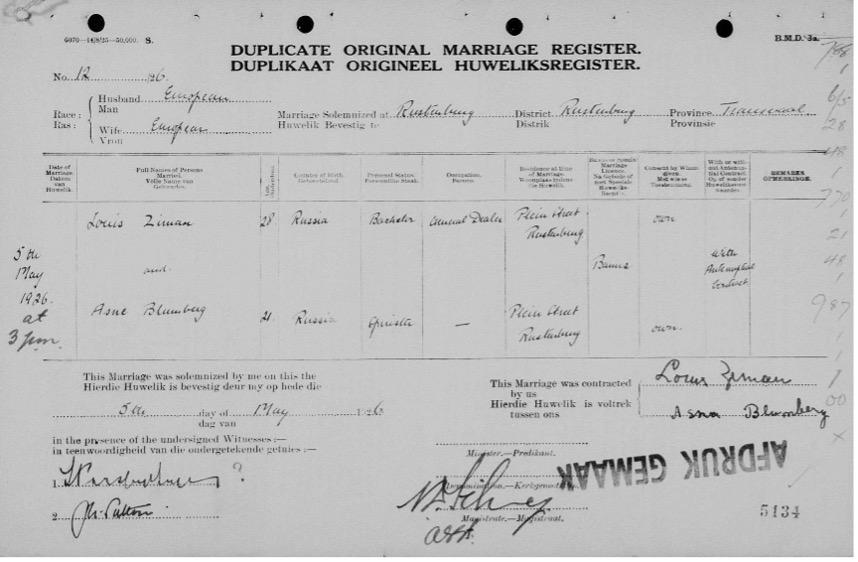
References:
- NASA: 1956. Application for a butchery site at Saulspoort. Moses Blumberg. Mev. A Ziman.
- 1956 Handelsterrein. Pilanesberg. Saulspoort. Mev. A Ziman.
Rustenburg Herald entries:
- 1930-08-29. The General Dealers Business known as L. Ziman and carried on at 87 Plein Street ,Rustenburg, has been moved to 85 Plein Street, Rustenburg, as from the 30th day of July, 1930.
- 1935-08-02. Mr and Mrs Ziman's little daughter, aged 7 years, died here last Saturday and much sympathy is expressed with the sorrowing parents. Mr and Mrs Ziman desire to thank all friends for the kindness shown to them in their sad bereavement.
Cantor family
Solomon 'Solly' Cantor (1899 Liverpool, England - 1982 Johannesburg) was the son of Barnett Cantor (1870 Russia - 1934 Cape Town) and Rachel Annie Cantor née Schneidermann (1874 Russia - 1951 Cape Town). He was born in England and grew up in South Africa. In 1926 he married Rose Harris (1902-1927), who died a year later following complications of childbirth in Johannesburg. In 1930, he married Rany 'Renee' Blieden (1909 Johannesburg - 1988 Johannesburg), daughter of Pesach Jacob Blieden (1877 Žagarė, Lithuania - 1955 Johannesburg) and Yetta Millie Rubin (1889 - 1928 Johannesburg). Her father was a Rand Pioneer.
The Cantors initially lived in Kimberley, where their son, Michael (12 January 1932 Kimberley - 1970 Maanhaarrand), and his twin, Lena Cantor, were born. His twin died 20 hours after birth on the 12 January 1932 and was buried in Kimberley. The family then moved to Muizenberg, where their second son, Barry Philip, was born in 1937. The family then moved from the Cape to Rustenburg in 1940. Their daughter, Ziona Dianne, was born in 1948 in Johannesburg.
Solly and Renee Cantor originally owned Transvaal Furnishers, a secondhand furniture business at 64B Plein Street. In 1945 Solly's mother, Rachel Cantor, purchased Maxwell Furnishers from Max Segel at Erf No. 72, Plein Street, and the business was managed by Solly. Two years later, in 1947, the business was transferred to Solly. The Cantors also continued to operate Transvaal Furnishers at 132 Plein Street.
The Cantors had a beautiful home at 194 Joubert Street. They were one of the few families who had a swimming pool, which was utilized by friends and family. They had a fishpond in the front garden, where many children collected tadpoles in glass bottles to take home. Renee was an amazing cook and was renowned for her fudge and chocolate mousse. The Cantors had an open house and entertained not only their extended family but also the Jewish community, who were always treated to a sumptuous feast. Solly served as Chairman of the Rustenburg Hebrew Congregation and Renee was a member of Rustenburg Women's Zionist Society and the Union of Jewish Women. Solly was also involved in Rotary.
Michael contracted poliomyelitis at the age of 22 months and was confined to a wheelchair. Despite his disability he had many varied interests. He was involved in the drama society in Rustenburg and directed a number of plays, including Shakespeare's Midsummer Night's Dream. He was involved in the Round Table. He had a wonderful seashell collection which was exhibited in large pull-out drawers.
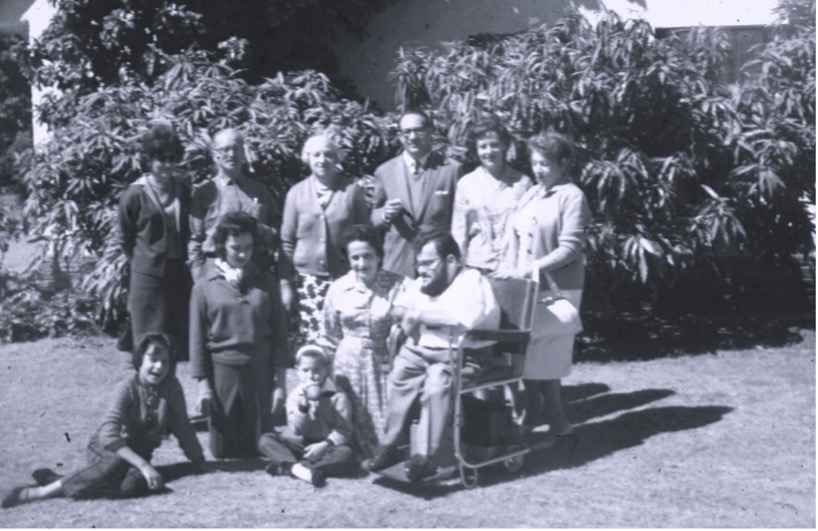
Back L-R: Bessie Meyer, Solly Cantor, Fanny Meyer, Julian Meyer, Zelda Rapeport, Sylvia Rapeport.
Front L-R: Wilma Rapeport, Ziona Cantor, Janice Rapeport, Renee Cantor, Michael Cantor.
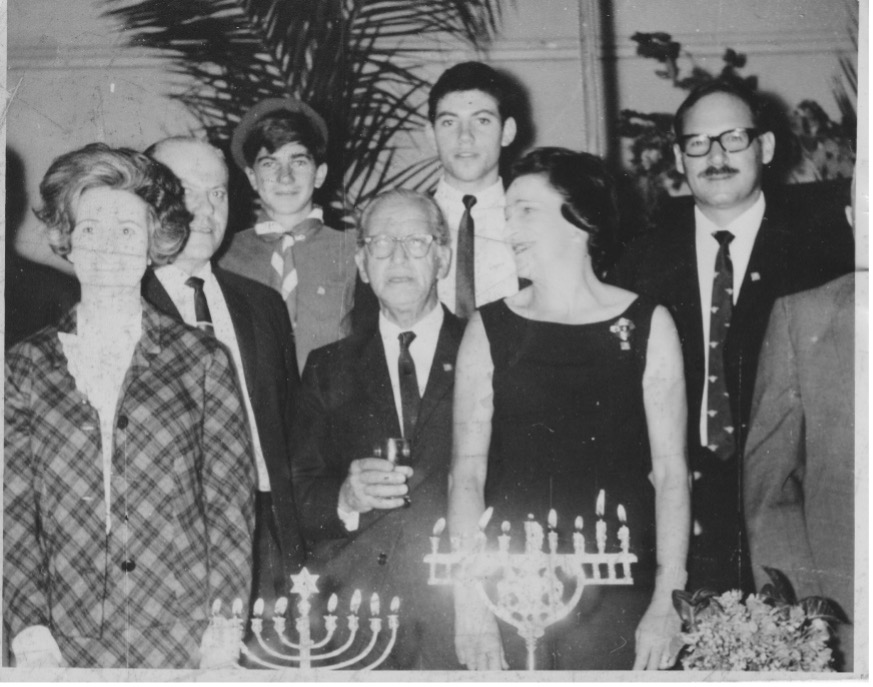
L-R: Ethene Wulfsohn, Sam Kramer, Selwyn Lichtenstein (in Habonim uniform), Solly Cantor (Chairman of the Rustenburg Hebrew Congregation), Julian Kramer, Renee Cantor and Jack Rapeport.
Barry was interested in restoring old motor cars and had a workshop and garage to house his vintage Bentley. He had a speed boat 'Glitzig', which he would launch at Buffelspoort Dam, and many people were entertained to an outing on the dam or waterskiing. After Barry got married in 1963, he and his young bride, Randi Jonas (1943-2021), lived in a house that abutted on the property of Solly and Renee. Barry's wife Randi was from Copenhagen, Denmark. During World War Two, in late September 1943, when Randi was 2 months old, her family was evacuated to Sweden by the Danish Resistance Movement, who managed to ferry 7500 of the 8000 Danish Jews across the Øresund strait from Zealand to Sweden in small fishing and sailing boats. When the Nazis conducted their raid in Copenhagen on the 1 October, they found fewer than 300 Jews left. Randi's parents would visit Rustenburg regularly. They were a fascination in that her father Helge Aron Jonas (1913-1984) did needle work and her mother, Cecilie Fanny Jonas (1907-1989), smoked cigarillos. The Cantors' 3 children, Debra, Michael and Judith (1973-2017), spent their infancy in Rustenburg, where Randi ran a playschool at the Girl Guide's Cottage, Joubert Street. In 1975 Barry, Randi and their children moved to Johannesburg. Randi's parents moved to Johannesburg from Copenhagen and are buried in the West Park Cemetery, Johannesburg. Barry and Randi subsequently emigrated to Sydney, Australia.
Ziona Cantor spent her formative years in Rustenburg and was sent to Girls' Collegiate School, Pietermaritzburg to do her high schooling. In 1967, she and her parents left Rustenburg for Johannesburg. She married Morris Scop and they had 2 children. Ziona has retained ties with numerous ex-Rustenburgers in Johannesburg.
At one time Renee's nephew, Gerald Kernoff, son of her youngest sister, Esther Kernoff, of Cape Town, stayed with the family in Rustenburg as he suffered from asthma. The dry Transvaal climate was conducive in reducing his asthma attacks.
The Cantor family were an integral part of the Rustenburg Jewish community during the 35 years that they spent in the town.
References:
- Barry Cantor, Sydney, Australia, and Ziona Scop née Cantor, Johannesburg, South Africa.
Rustenburg Herald entries:
- 1944-02-11. NOTICE. Notice is hereby given that the Secondhand Furniture business carried on by Renee Cantor, trading as Transvaal Furnishers at 64B Plein Street, Rustenburg, has been abandoned, as from December 31st 1943. R. Cantor, Box 43, Rustenburg.
- 1945-07-27. We regret to hear that Michael Cantor, son of Mr. and Mrs. Solly Cantor, is in the local hospital after having undergone an appendicitis operation. We wish him a speedy recovery.
- 1945-08-03. Notice is hereby given that the business general dealer, carried on by MAX SEGELL, at Erf No. 72, Plein Street, Rustenburg, under the name of MAXWELL FURNISHERS has been sold, with effect from 1st May 1945, to RACHEL CANTOR, who will carry on the said business under the same name and style at the same address. Dated at Rustenburg, 3rd July 1945. S. Cantor.
- 1947-12-12. Notice is hereby given that the business carried on under the name of MAXWELL FURNISHERS, at 72 Plein Street, Rustenburg by Rachal Cantor (widow) has been transferred to Solomon Cantor and will be carried on under the name of MAXWELL FURNISHERS at the same address. 12 December 1947. S. Cantor.
- 1948-05-07. Mr. and Mrs. S. Cantor are congratulated on the birth of a daughter at the Florence Nightingale Nursing Home on 6th April.
- 1950-02-10. NOTICE. Transfer business Renee Cantor to Solomon Cantor trading under style and name of Transvaal Furnishers at 132 Plein Street.
- 1950-01-27. Mrs. S, Cantor, accompanied by her son, has left for Durban on vacation. Mr. Cantor leaves by car to join her.
Chatzkelowitz family
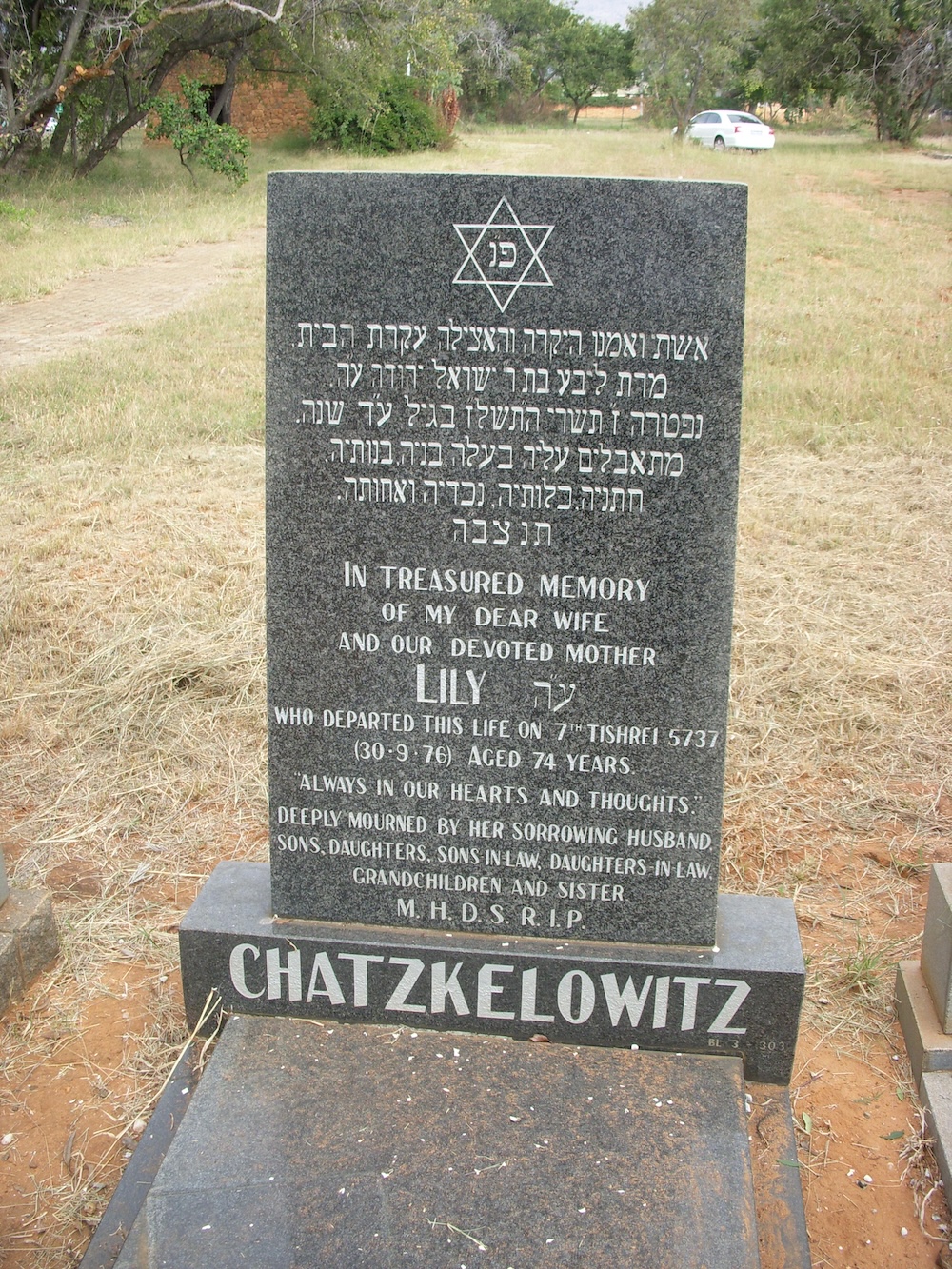
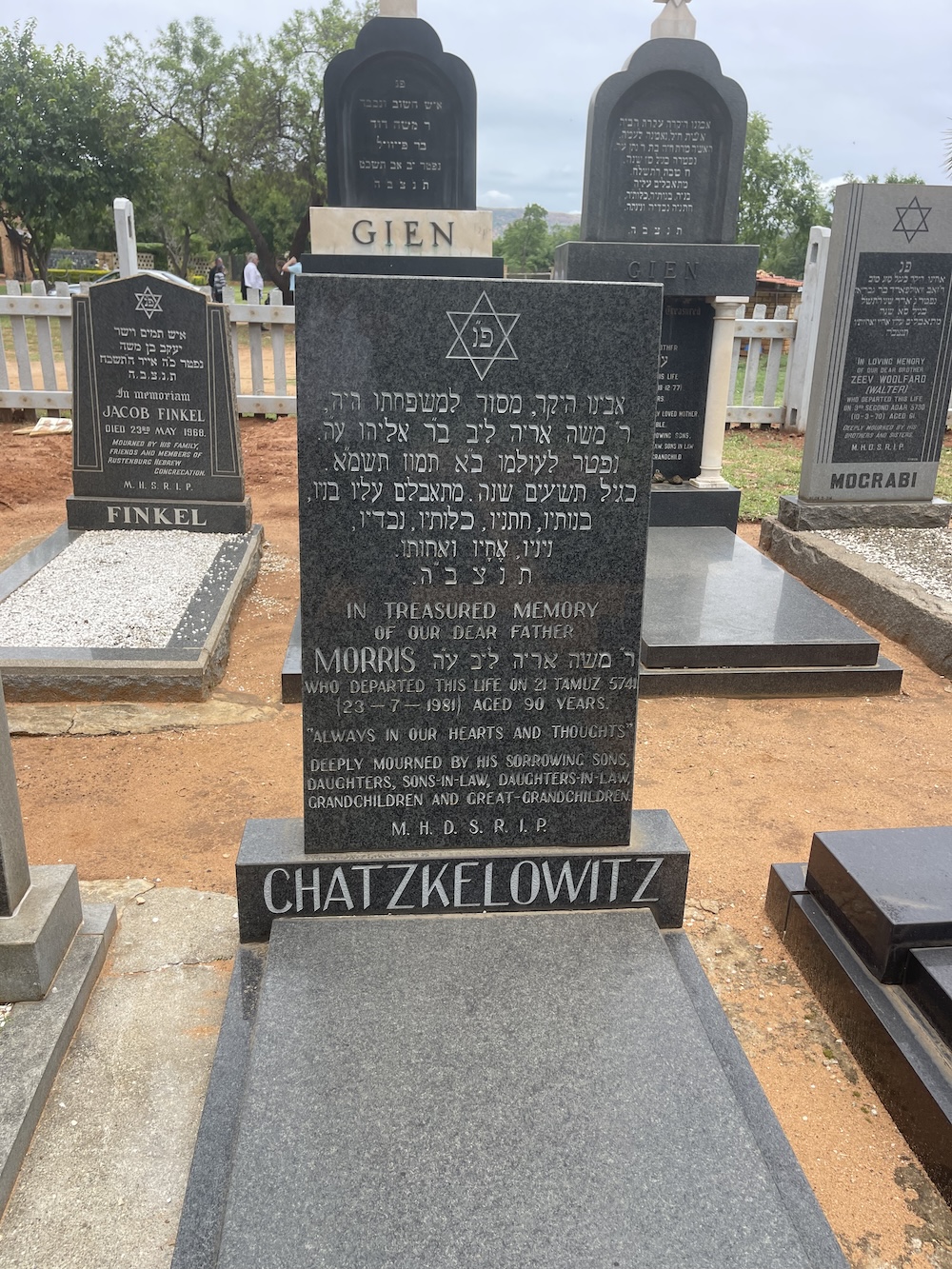
The story of the Chatzkelowitz family in South Africa began with Eliah Chatzkelowitz (1864-1938) and his wife, Eta Leah (née Trusfus) (1871-1939). Seeking a new future, the couple emigrated from Pašvitinys, Lithuania, and established a home in Mayfair, Johannesburg, where they raised eight children. Over the generations, numerous of their descendants shortened the family name to Chatz. It was their son, Morris Louis Chatzkelowitz (1891 Kovno, Lithuania - 1981 Kroonstad, Orange Free State), who planted the family's roots in Rustenburg. He lived in Angelo, Boksburg, and married Lily Shoot (1902 Dvinsk, Latvia - 1976 Rustenburg) on 7 September 1919 in Johannesburg. The newlyweds moved to Rustenburg, where they set up a home at 85 Kerk (Church) Street and they raised eight children. Together, the family became synonymous with the meat industry, operating butcheries. Following Lily's death in 1976, Morris spent his final years in Kroonstad with their daughter, Yetta, before passing away in 1981. He was returned to Rustenburg to be interred in the New Cemetery.
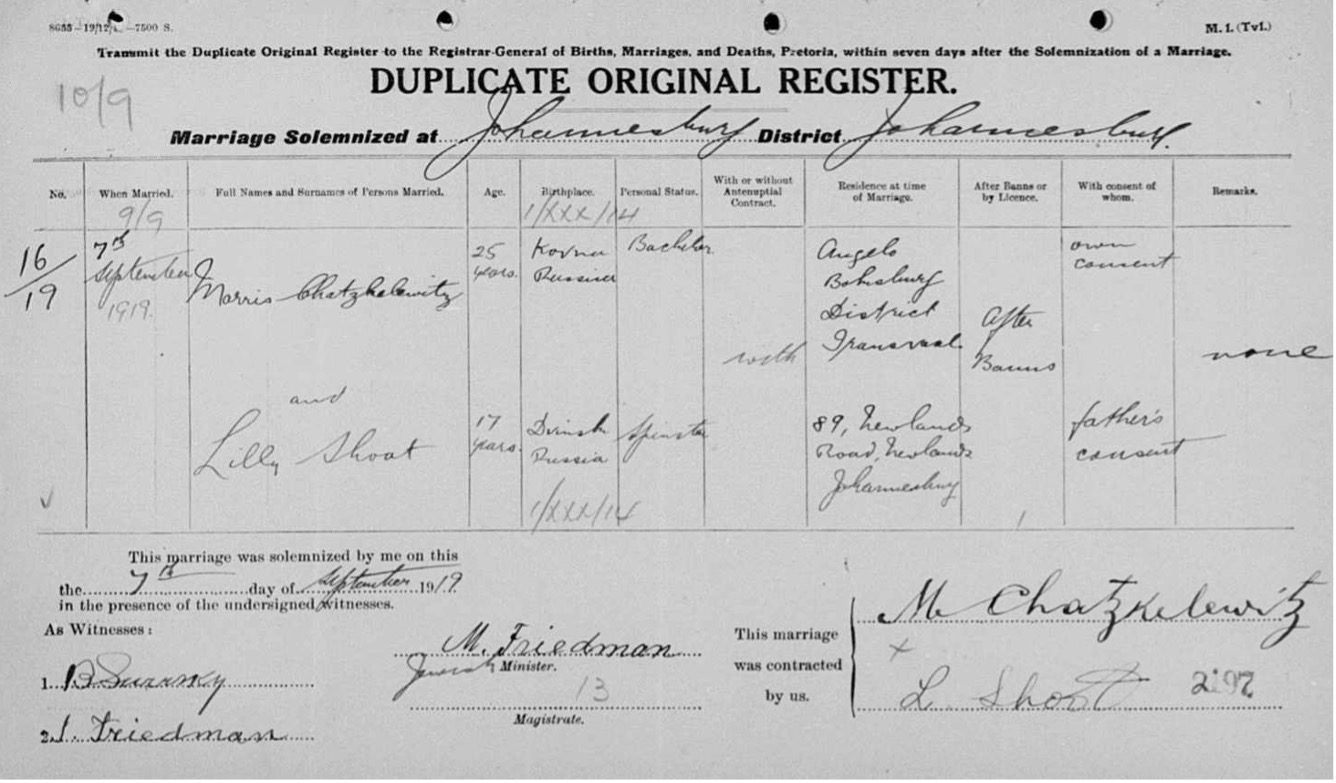
Their children:
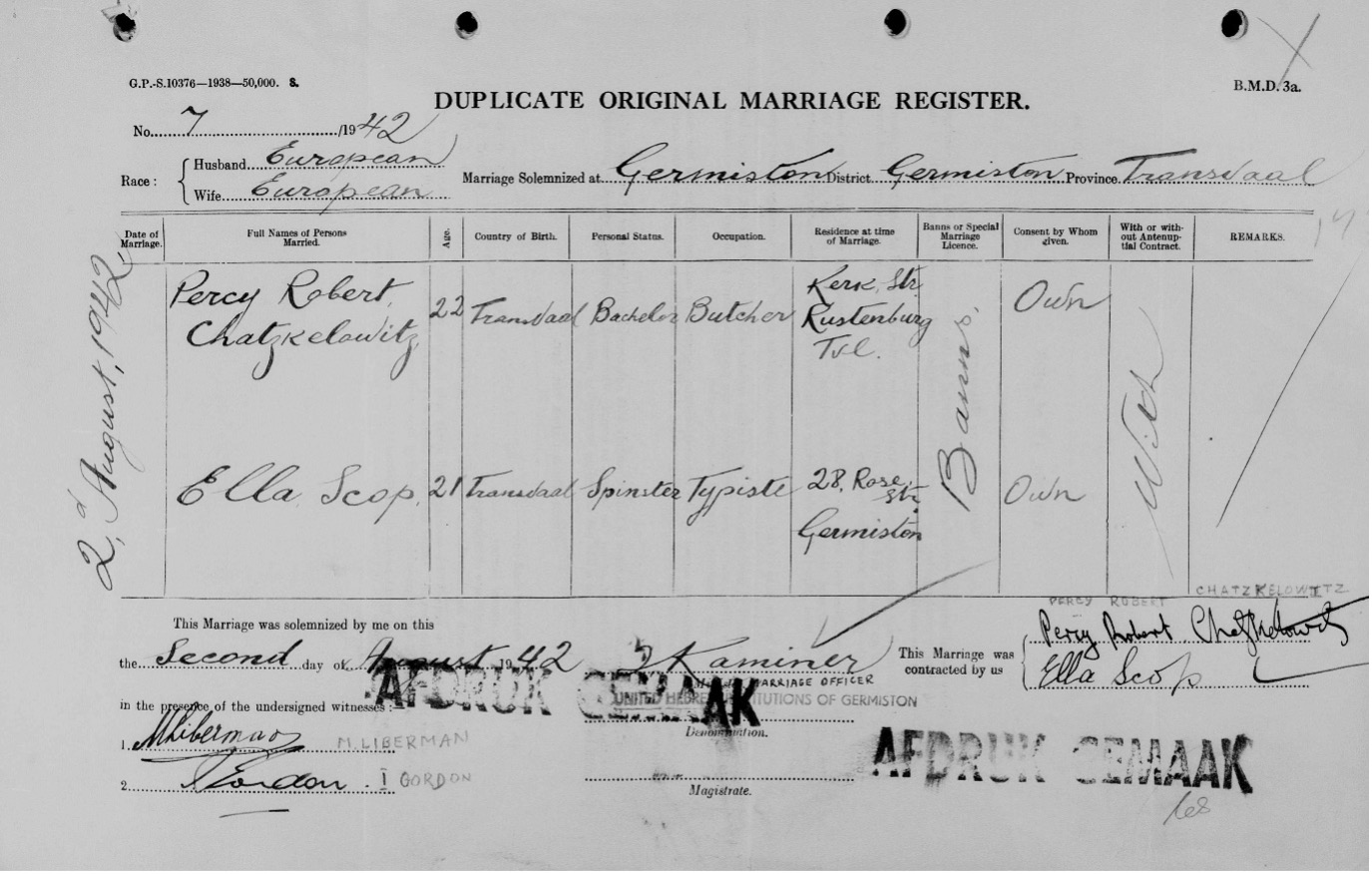
- Percy Robert Chatzkelowitz (1920–1979) followed the family trade as a butcher in Rustenburg. He married Ella Scop (1921-2012) in Germiston in 1942, and they raised their two children, Estelle and Jeffrey Eric, in Boksburg.
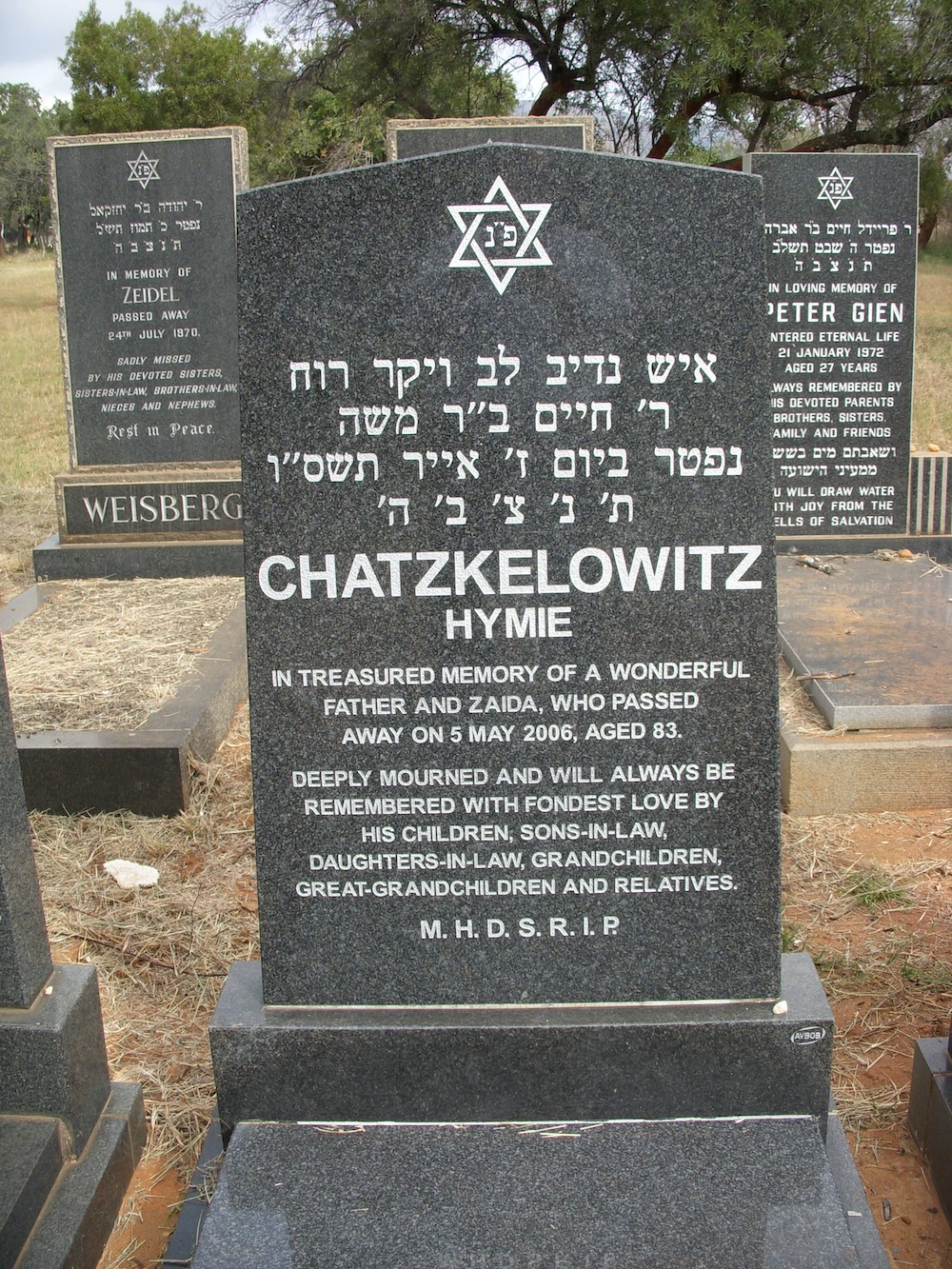
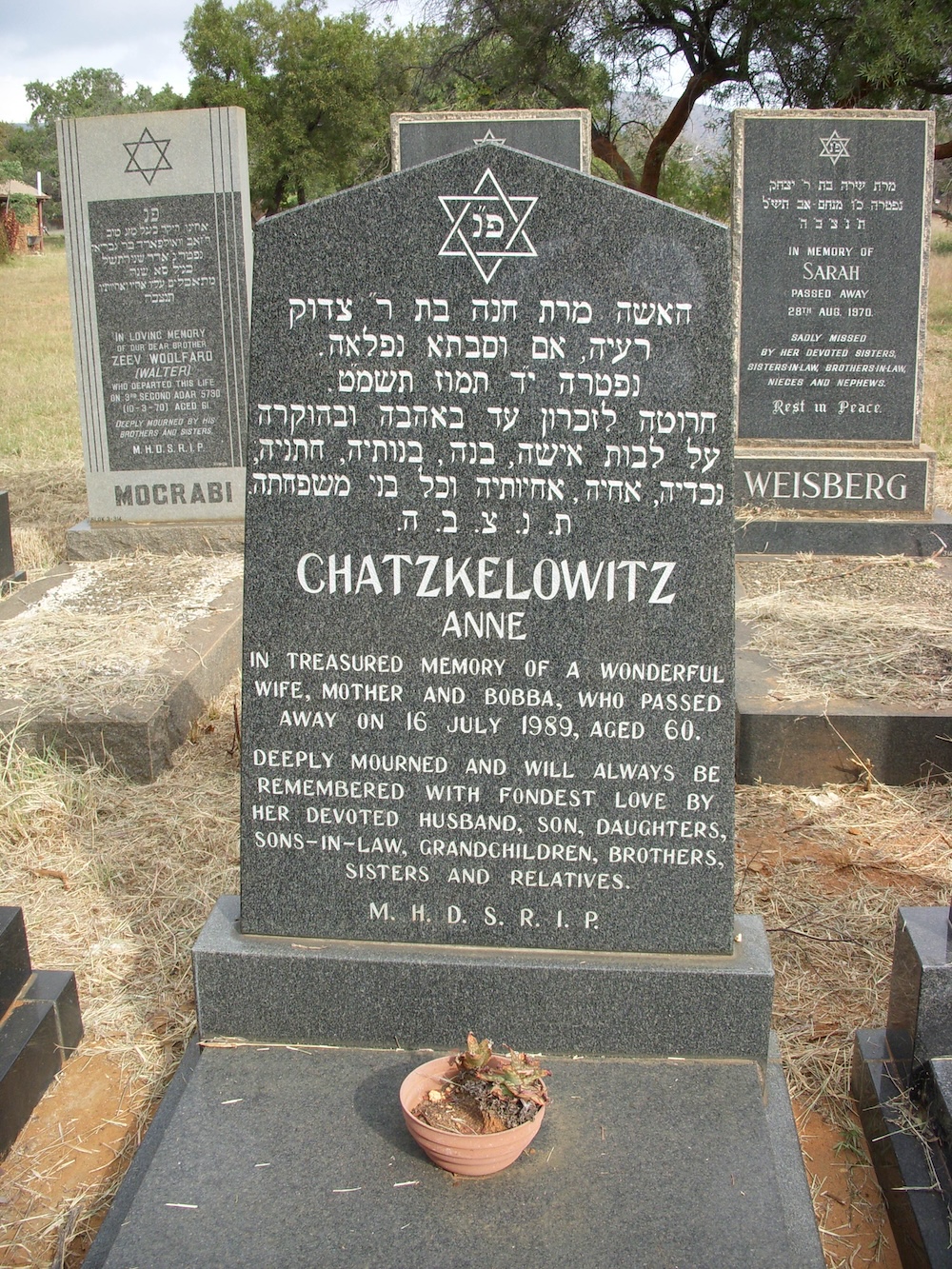
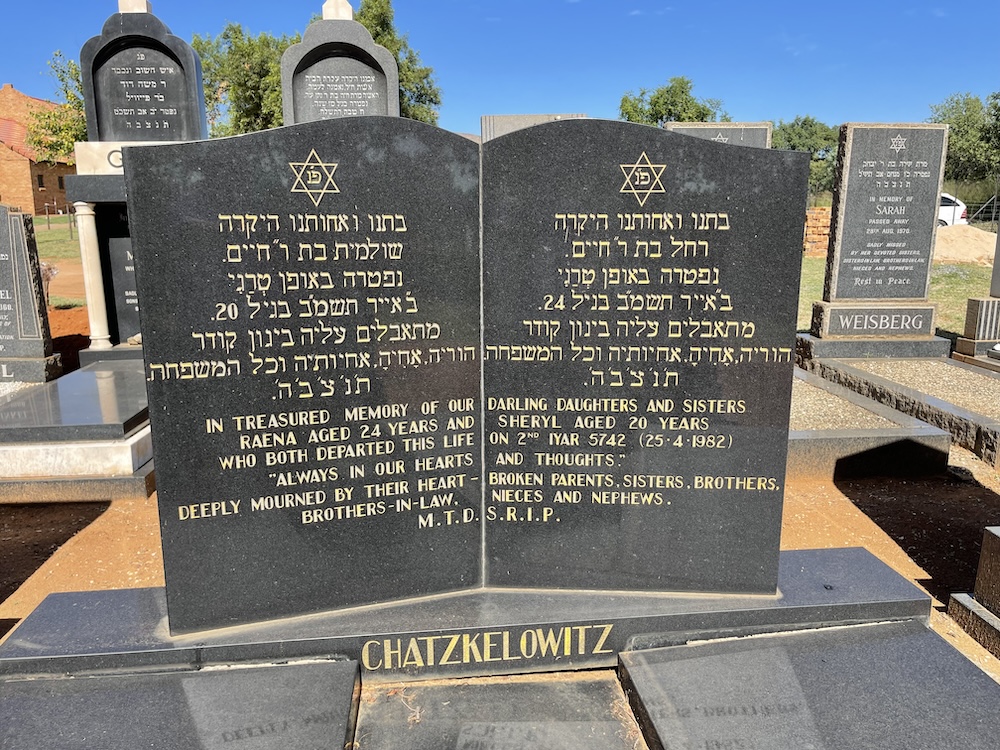
- Hymie Chatzkelowitz (1922–2006) was also a butcher and in 1966 he established a butchery on 'Native' Trust Ground. He lived opposite the local junior school with his wife, Anne Raik (1929-1989). They had eight children – 2 sons, David and Eric, and 6 daughters, Edna, Hiliary, Melanie, Phyllis (1956-2017), Raena (1958-1982) and Sheryl (1961-1982). Tragically their two youngest daughters, Raena and Sheryl, were killed in a car accident on 25 April 1982.
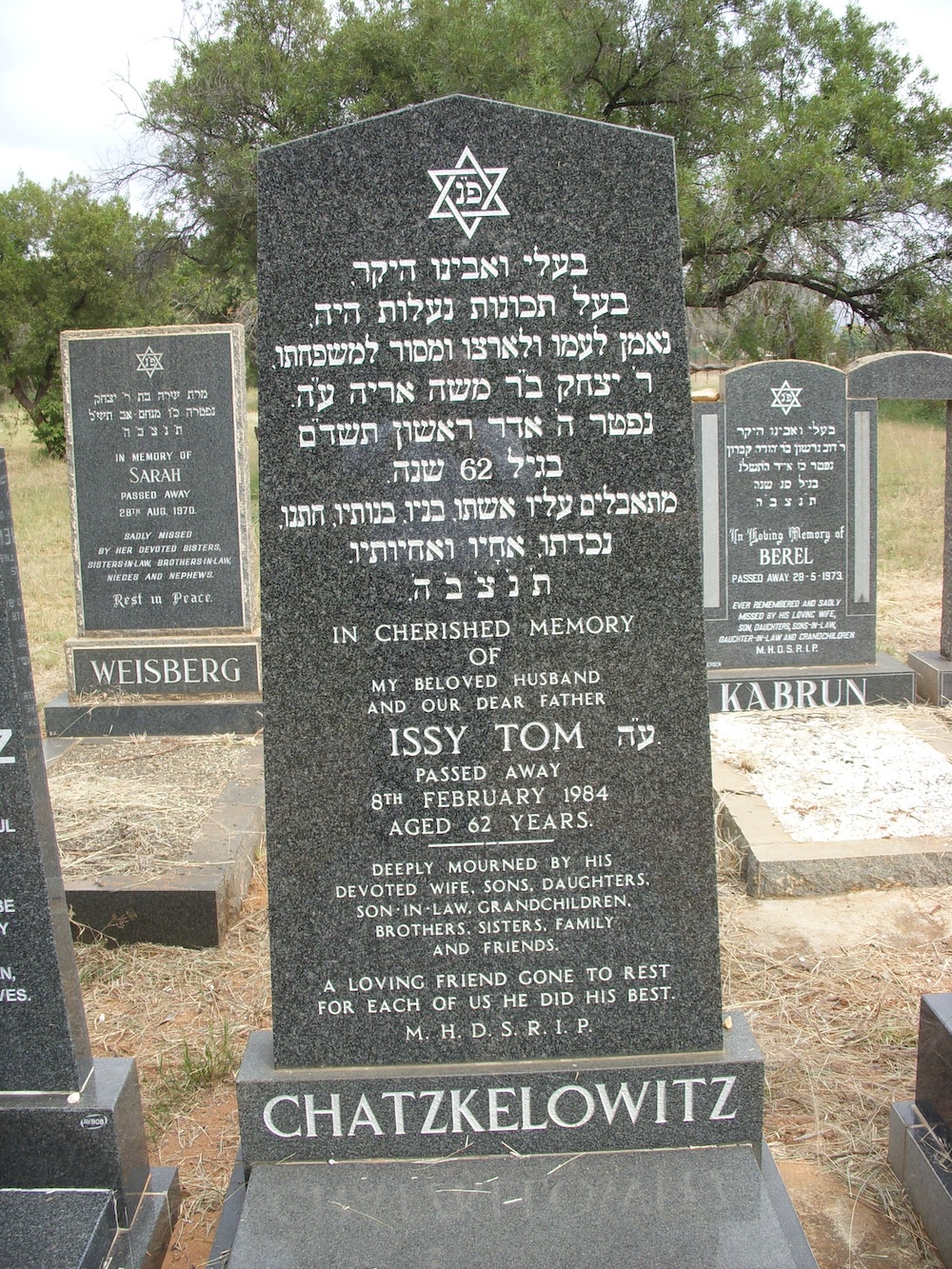
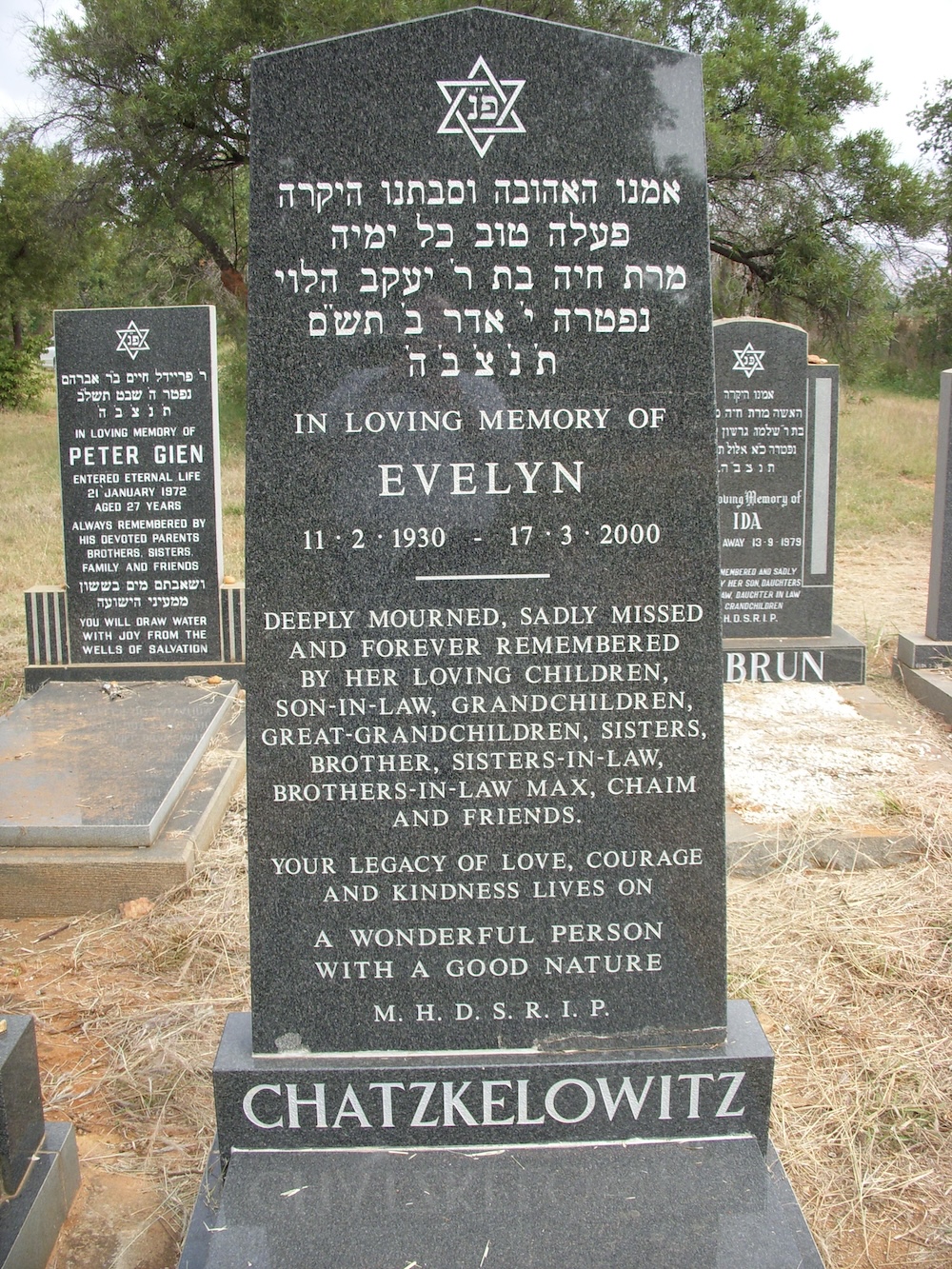
- Isidore "Issy" Tom Chatzkelowitz (1922–1984) and his wife, Evelyn Wainstein (1930-2000), raised five children whose paths moved between Rustenburg and Kroonstad. Both Issy and Evelyn are buried in the Rustenburg New Cemetery. Their son, Royden Tom Chatzkelowitz, who worked as a boilermaker and platinum miner, played a vital role in sustaining the Rustenburg Jewish community. He served as the lay preacher for the congregation, meticulously maintaining the synagogue and cemeteries until his eventual emigration to Israel.
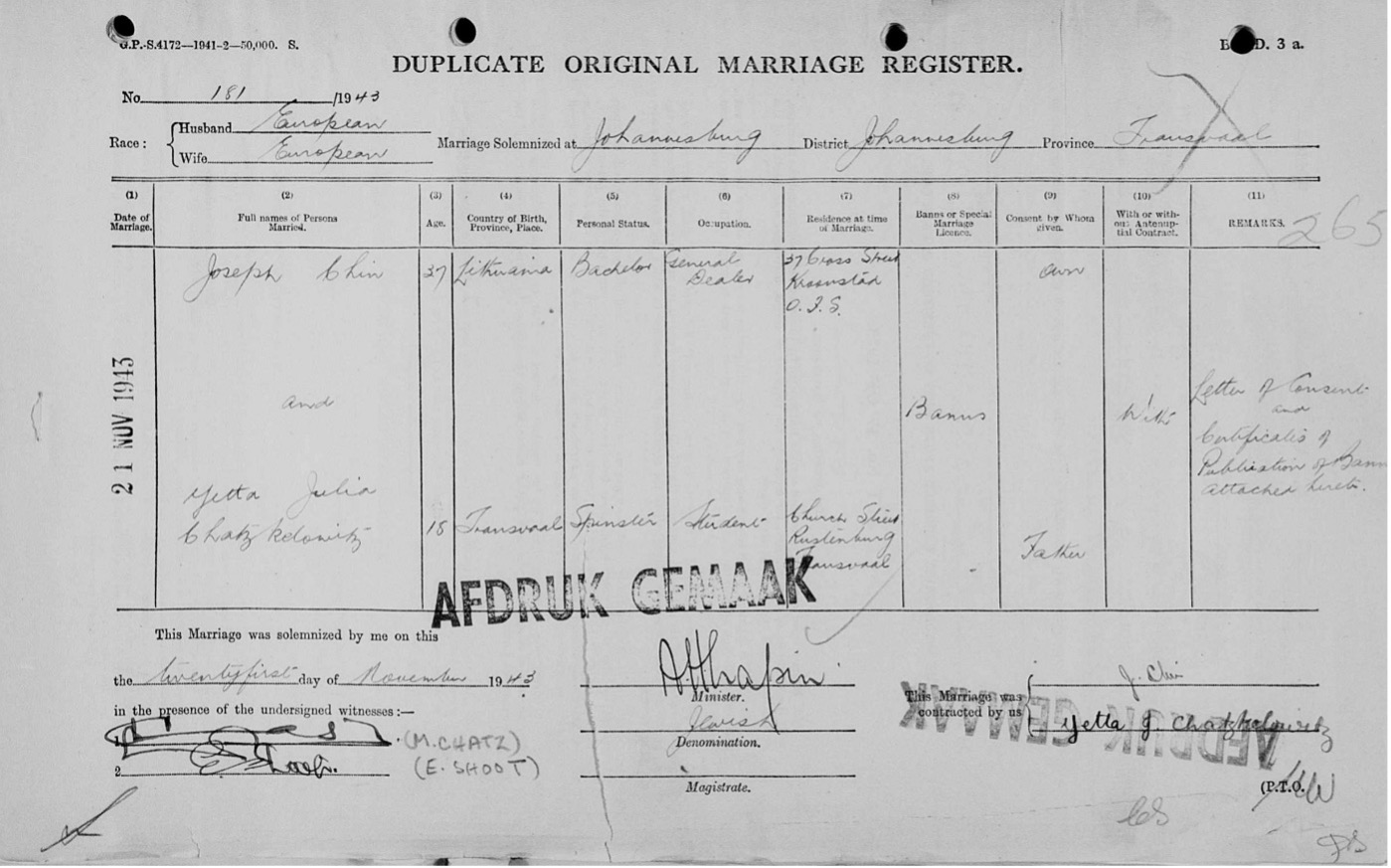
- Yetta "Julia" Chin née Chatzkelowitz (b. 1925) married Joseph Chin (1905-1983) in Johannesburg in 1943. Joseph was a general dealer in Kroonstad, where the couple settled and raised their four children.
- Jacob Chatzkelowitz (1926–1928) passed away at 17 months old at the Children's Hospital in Johannesburg.
- Thelma Stella Braude née Chatzkelowitz (b. 1929) married Hymie Braude, and the couple went on to raise three daughters: Rachelle, Elain, and Karen.
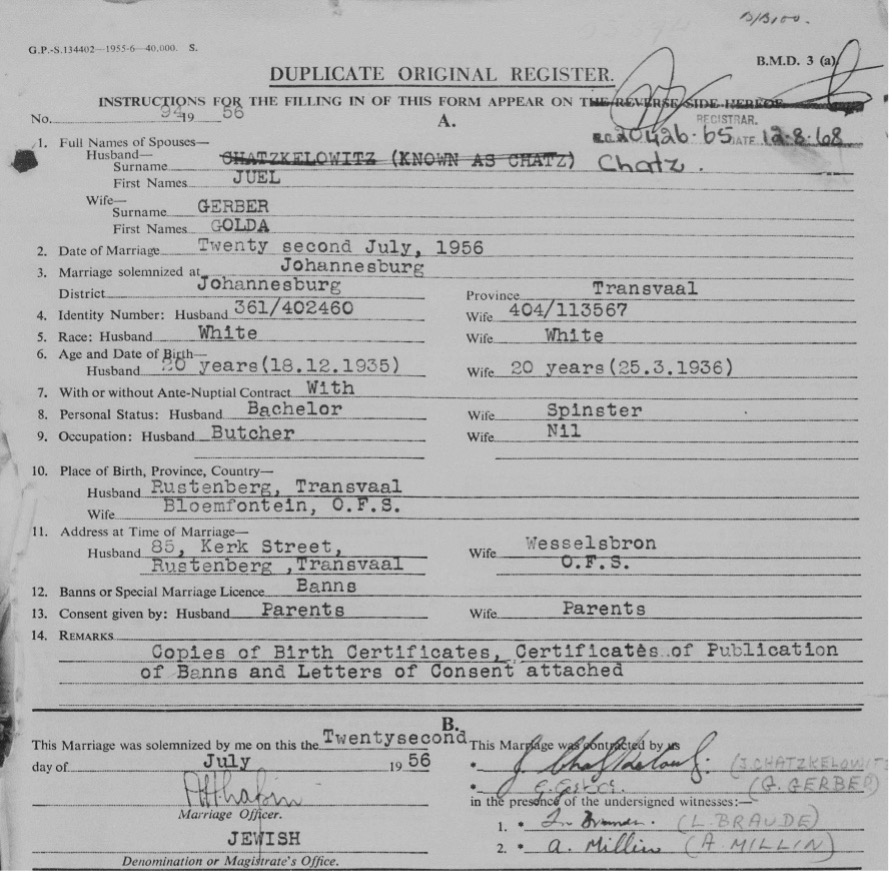
- Juel Edward "Juely Teddy" Chatz (b. 1935) married Golda Gerber in Johannesburg in 1956 and settled in Kroonstad to work as a butcher. Their son, Selwyn Chatz, has achieved widespread national prominence in South Africa as the CEO of Chatz Connect and Vodacom 4U, and is well-known today for his extensive collection of hypercars.
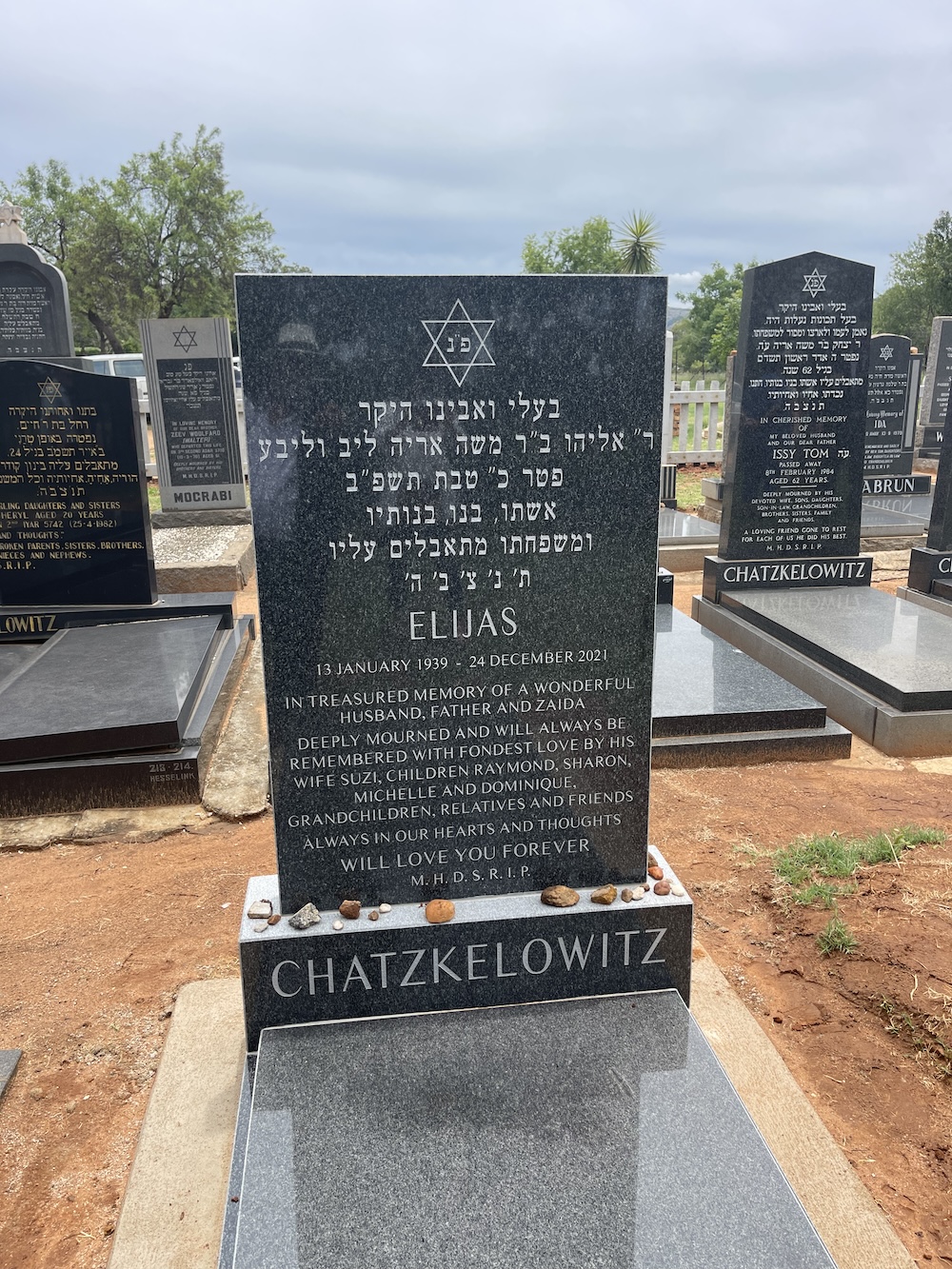
- Elijas Chatzkelowitz (1939–2021) married Suzi and became the head of the family enterprise, Vleisland Meat Supplies Butchery. Elijas passed away in 2021 and was buried in Rustenburg. To date his widow Suzi and son Raymond and his family are the last Chatzkelowitz family members living in Rustenburg.
References:
- The Travelling Rabbi: Journeys Continued. Rabbi Moshe Silberhaft, as told to David Saks. Batya Bricker Publishing, 2026, pages 145-149.
Cohen family
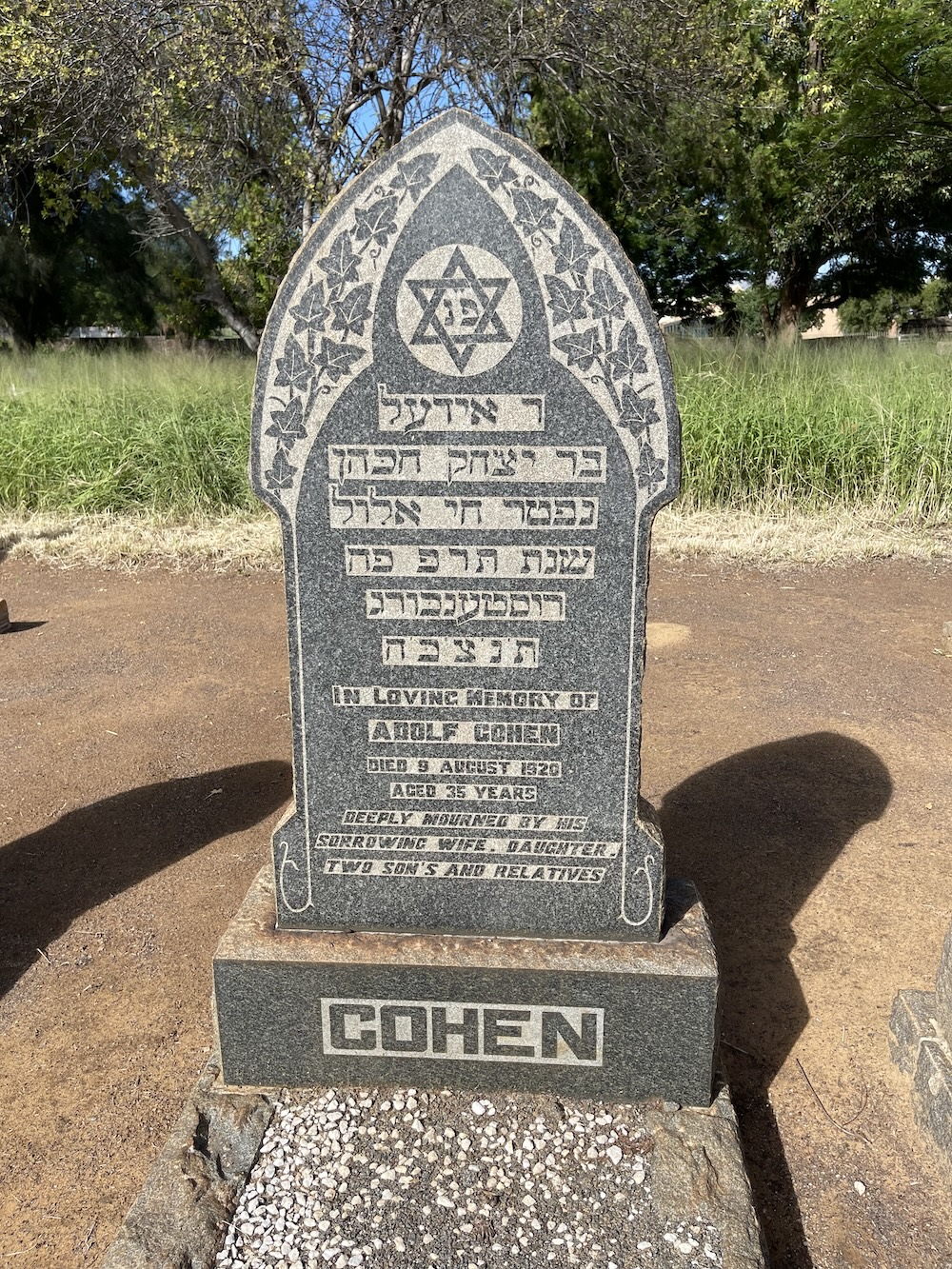
Adolf Yudel Cohen (1884 Papile, Lithuania - 1920 Rustenburg) was the son of Isaac Cohen (1850 Papile, Lithuania - 1922 Benoni) and Rachel Rebecca Cohen née Levin (b. 1852). He and a number of his siblings emigrated to South Africa. On 17 March 1911, while residing in Brandfort, Orange Free State, Adolf married Sarah Belnick (1886 Kelme, Lithuania - 1952 Rustenburg) in Johannesburg. The couple settled in Church (Kerk) Street, Rustenburg, where they raised three children. Tragically, Adolf passed away at the young age of 35. Following his untimely death, Sarah was a winkel einaares (shop owner) and ran the general and cycle dealer. In March 1948 she sold the business after successfully supporting her family. She died 4 years later at age 66.
The Cohen children were:
- Bernard Cohen
(1914 Rustenburg - 2001 Johannesburg)
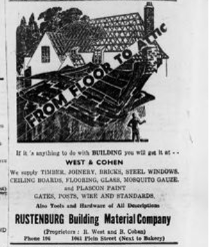
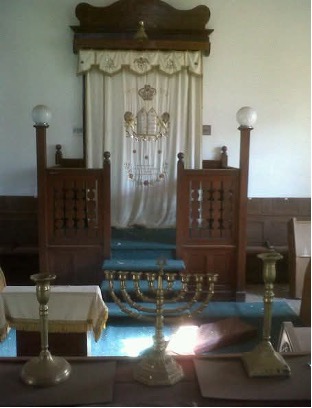
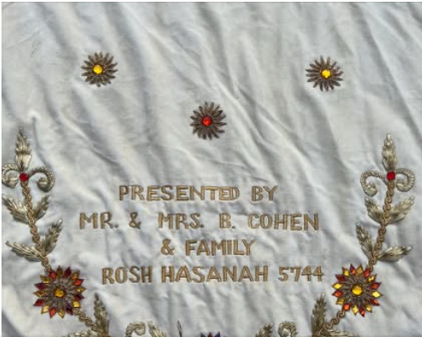
Known as Barney, he was a prominent local merchant who specialized in the building trade and in particular in supplying the regional mining industry. In 1946 he joined Johannes Jacobus Rabie West as a partner and they traded as "The Rustenburg Building Material and Hardware Company". On the 28 November 1948, he married Julia Esther Bloch (1927–2014) in Johannesburg, and they had three children: Harriet, Anthony, and Shareen. The family maintained close ties with the community. On Rosh Hashanah 5744 (1983), Barney, Julia, and their children donated a beautiful parocheth (Torah ark curtain) to the Rustenburg Hebrew Congregation. Julia was also an active member of the Rustenburg WIZO (Women's International Zionist Organization). After their children relocated, Barney and Julia retired to Johannesburg. - Rachel Schmaman née Cohen
(1916 Rustenburg - 2008 Johannesburg)
She was an accomplished pianist who at the age of 15 passed her final music exams. On 5 October 1941 she married Nathan Schmaman (1916–2011) in Johannesburg. Nathan, originally from Senekal in the Orange Free State, was a pharmacist. The couple had two sons, both of whom eventually emigrated to Australia. Rachel spent her later years in Johannesburg. - David Cohen
(1918 Rustenburg - 2005 Cape Town)
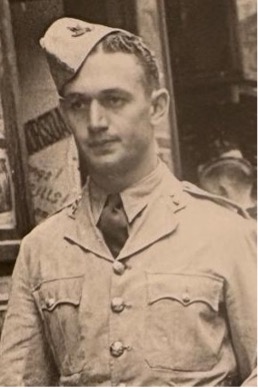
He attended Rustenburg Hoërskool and in 1934 passed the Junior Certificate Exam. During World War II he served in the Union Defence Force. In June 1942, he was captured at the fall of Tobruk in North Africa and sent to a prisoner of war camp in Italy. In a remarkable feat of survival, David escaped the camp and walked more than 1000 kilometres through enemy territory to successfully reach Allied lines. After the war, he worked as a merchant in Kroonstad. On 31 May 1953, he married Hilda Zilberg (1929–2023) in Cape Town. The couple ultimately settled and raised their family in Cape Town.
Rustenburg Herald entries:
- 1931-07-17. The following pupils of the Conservatoire of Music are to be congratulated on having passed the Harmony Examination which took place in April the results of which have just been received. Intermediate Division: Bertha Liebenthal, Rachel Cohen. Lower Division: Miriam Harmer, Jenny Lifman. The last three all obtaining Honourable Mention Marks.
- 1931-09-18. The Position in England Conservatoire of Music. Results of Practical Examination. Final Division Pianoforte: Rachel Cohen passed with 111 marks, Bertha Liebenthal 102 marks.
- 1931-09-25. It may not generally be known that Rachel Cohen who passed her Final Music Examination, as announced in last week’s Herald, is only 15 years of age. She is remarkably young to have succeeded in this somewhat stiff examination and consequently the more honour is due to her and her tutor, Miss J.J. Wedderburn of the Conservatoire of Music.
- 1933-10-06. Miss Rachel Cohen, who is only 17 years of age has to be heartily congratulated on passing the practical part of the Licentiate Piano Examination of the Trinity College, London. She obtained 84% marks, which in so an advanced an examination is exceedingly good.
- 1948. Notice is hereby given that the business of General and Cycle Dealer carried on by Sarah Cohen at Erf 78, Plein Street, Rustenburg, has been sold to Rustenburg Cycle Works (Pty.) Ltd. with effect from 1st March 1948 as from which date the said business will be carried on by the said firm under the style of "Rustenburg Cycle Works (Pty.) Ltd." at the same address. Rustenburg this 8th March 1948. De Villiers and Pohl, Attorneys for Parties, Box 146, Rustenburg.
Cohen, Paul and Stephne
Paul Cohen and Stephne Cohen (née Fain) are the founders of the Rucore Sustainability Foundation. He has a BSc in mechanical engineering and MPhil in sustainable development and Stephne has a BA in psychology and social sciences. The couple grew up in Johannesburg and were married by Rabbi Silberhaft. Shortly after Nelson Mandela's release from prison in February 1990, Paul's father was invited to a dinner party thrown by a member of his synagogue. A Black, rural, government primary school near Rustenburg was being threatened with closure because of a farm sale, and this friend was trying to save it. Paul created the Rural Education Development Corporation, and the organisation purchased 300 acres near Rustenburg where they established an experimental village Tlholego, meaning "something beautiful inspired by nature" in Tswana. The "barren wasteland" that the farm had become due to monocropping and overgrazing was rehabilitated.
References:
- The Travelling Rabbi: Journeys Continued. Rabbi Moshe Silberhaft, as told to David Saks. Batya Bricker Publishing, 2026, pages 145-149.
Cranko, Herbert
(1895 Transvaal - 1958 London)
He was the youngest child of Frederick Jacob William Cranko (1848 South Africa - 1899 Cape Town) and Bilah Solomon Cranko née Jacobson (1864 London - 1933 Johannesburg). He had an older sister, Muriel, and 4 brothers, Samuel Vere, James 'Jimmy', Frederick and William Abraham. His father died in 1899, when Herbert was 4 years old, and his mother was left to support the family. She married Maurice Platner (1870-1919), a hotelkeeper, and they lived in Johannesburg. Bilah Cranko was Jewish and the 6 children were brought up as Jews in the Platner household. Herbert and his older brother Jimmy Cranko were sent to law school and qualified as solicitors.
Herbert married Hilda Grace van Druten born Hinds on the 18 September 1923 in Johannesburg and they settled in Rustenburg, where their only child, John Cyril Cranko (1927 Rustenburg - 1973) was born. Herbert opened a law firm in Steen Street, next to Hermer Jeweller in Plein Street. In 1931 he was joined by Bernard Shapiro in the practice for a short period of time. In 1935 he was joined by Meyer Levitt (1913 Lithuania – 2004 Johannesburg), who then took over the law practice. Herbert Cranko left Rustenburg and joined his brother Jimmy Cranko and the Hyman brothers to form the legal firm Cranko and Hyman in Johannesburg. Many Rustenburgers continued to use his professional services, which were dealt with by the Johannesburg law firm. Herbert and his wife were divorced in 1946, and he later relocated to London, where he passed away in 1958.
His son, John Cyril Cranko, was a world-renowned ballet dancer and choreographer. He moved to London in 1946 to study with the Sadler's Wells Ballet School (later called the Royal Ballet). In 1959 he was prosecuted for homosexual activity and left the UK for Stuttgart, Germany. Biographers note that his father, Herbert, was remarkably open-minded for his era. He encouraged his son's early passion for puppetry, art, and ballet, and was exceptionally tolerant of his son's homosexuality. He later spent a significant amount of time helping John establish his early career in London.
Rustenburg Herald entries:
- 1931-07-31. Mr Bernard Shapiro, recently associated with Mr Cranko, has commenced practice in Johannesburg. Good luck to him.
- 1935-03-01 Mr Herbert Cranko is on a short visit to Rustenburg.
Donen - Rosin family
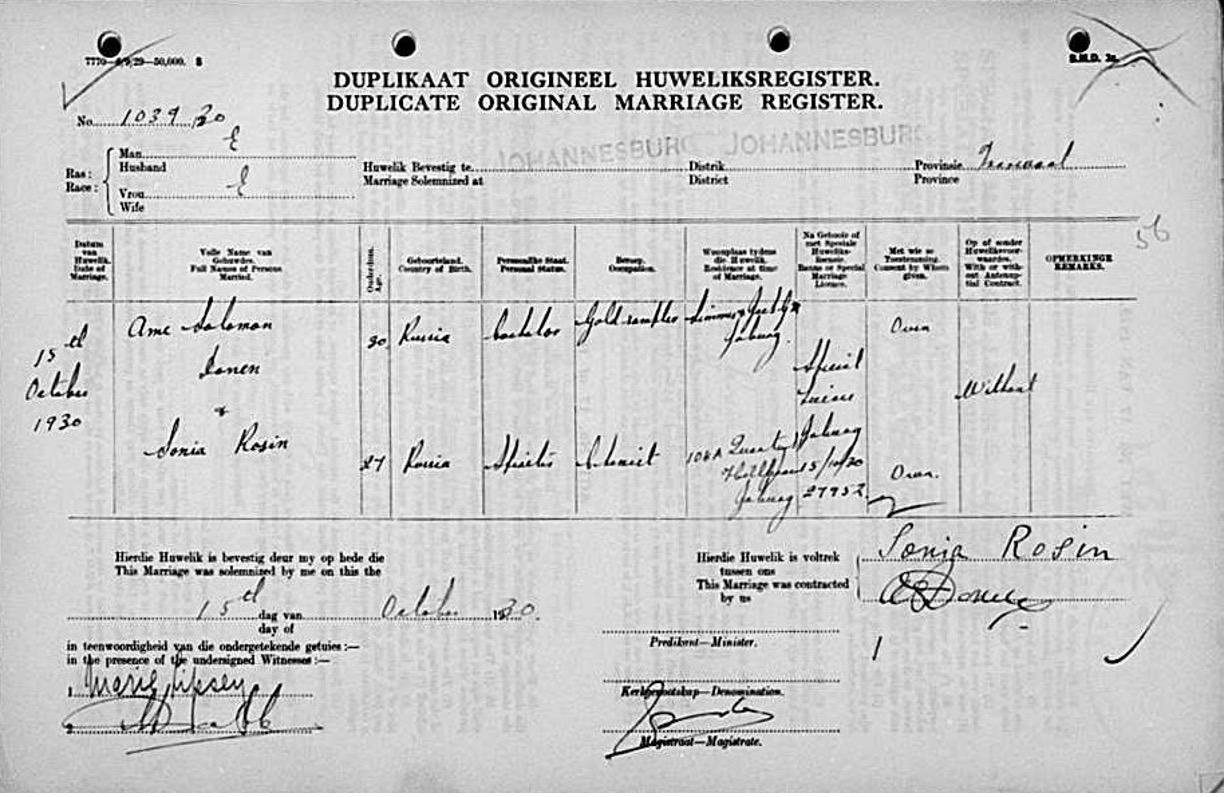
Ame Solomon Donen (13 June 1901 Lithuania - 16 August 1963 Rustenburg) was one of the five sons of Jack Donen (1869 Kelme, Lithuania - 1936 Tel Aviv, Palestine) and Chaie Donen née Sief. Seeking better opportunities, the Donen family emigrated to South Africa, where Jack established himself as a successful property owner. In his later years, Jack settled in the Mandate of Palestine, where he passed away in Tel Aviv in 1936.
Ame forged his own path in South Africa, finding work in the mining sector of Johannesburg as a gold sampler at the historic Simmer and Jack Mine. It was in Johannesburg that he met Sonia Yenta Rosin (1905 Lithuania - 1976 Johannesburg), a chemist and the daughter of Lithuanian immigrant Moses Aaron Rosin (1867 Lithuania - 1966 Johannesburg). The couple married on October 15, 1930.
Following their wedding, Ame and Sonia relocated to Rustenburg, where Sonia's brother Nochum Jacob Rosin resided. Ame spent over three decades in the community before his death on 16 August 1963 at the age of 62. Sonia remained in the town for many years, residing at 7 Kloof Gardens on Loop Street. In her later years, she returned to Johannesburg. She passed away at the age of 71 and was cremated.
Epstein family
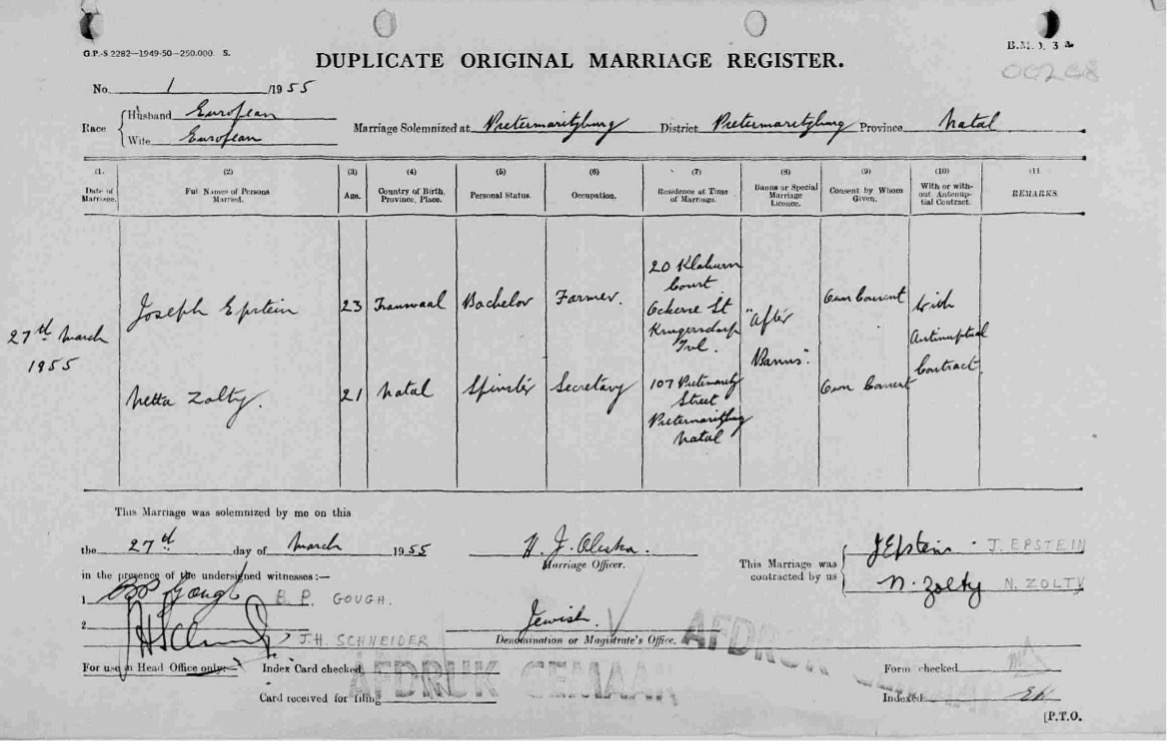
Joe Epstein (b. 1931) and Netta Epstein née Zolty (b. 1933) were married on 27 March 1955 in Pietermaritzburg. At the time of their marriage, he was a farmer and was based in Krugersdorp. They lived in Rustenburg on a farm outside the town with their 4 children, Jacqueline, Leon, Mark and Michelle. Joe was a swimming teacher and taught many of the children swimming. He used the swimming pool at the home of Karl Wulfsohn. Many children recalled that he used a gym horse which he immersed in the pool and placed them on to teach them how to swim. Netta was a cellist and played in concerts. Joe and Netta were involved in communal affairs. In 1971 the family left Rustenburg and settled in Pietermaritzburg, where they had a clothing shop. They then settled in Toronto, Canada, and Coral Springs, Florida. Their son Mark lives in Cape Town.
References:
- Communication, Jacqueline 'Jaci' Milwid, Canada, and Mark Epstein, South Africa.
Finkel, Jacob
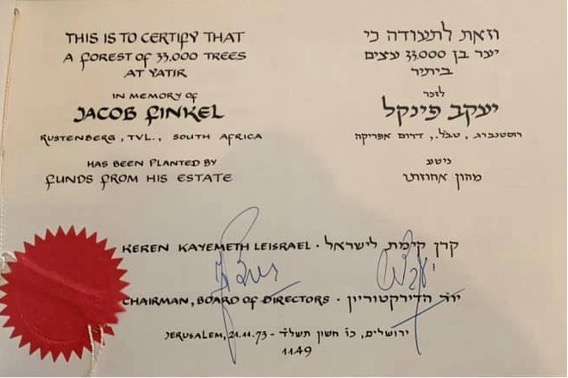
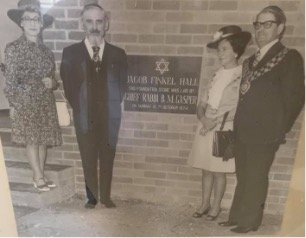
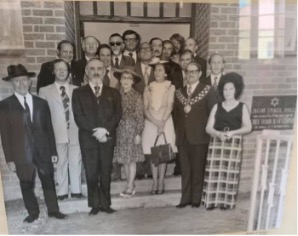
He was a bachelor and in the mid 1930's he and Solly Weinstock established Weinstock and Finkel, general dealers. In 1950 he applied for South African citizenship. He died on the 23 May 1968 in Rustenburg. He bequeathed part of his estate to Keren Kayemeth Le'Israel and a forest of 33000 trees was planted in his memory at Yatir, the largest planted forest in Israel, situated on the edge of the Negev Desert. He also made a substantial donation to the Rustenburg Hebrew Congregation and following additional contributions from a number of Rustenburg families, the Jacob Finkel Cultural Hall was built next to the shul. In 1974 the Jacob Finkel Cultural Hall was opened by Chief Rabbi Bernard M. Casper and the Mayor and Mayoress of Rustenburg, Councillor and Mrs J. Hattingh.
References:
- Rav Moshe Silberhaft's Post.
Rustenburg Herald entries:
- 1937. Removal Notice. Notice is hereby given that the General Dealers business carried on by Solly Weinstock and Jacob Finkel under the style of Weinstock & Finkel will be transferred from stand No. 100 Plein Street, Rustenburg to 103 Plein Street, Rustenburg as from the 1st March 1937.
- 1950. Notice of Intention to apply for a certificate of Naturalization as a South African citizen. I, Jacob Finkel, a General Dealer residing at 8 Kruis Street, Rustenburg, in the Province of Transvaal, hereby give notice that I intend to apply to the Minister of the Interior, in terms of Section Ten of the South African Citizenship Act, 1949, for a Certificate of Naturalization as a South African citizen. 21st March 1950.
Frankfurth, Jack (Jacob)
(1862 Vienna, Austria - 1936 Johannesburg)
Jack Frankfurth was born in Austria in 1862 to Emanuel Menachem Frankfurter (1814-1891) and Johanna (née Wertheimer) (1833-1900). In 1886, aged 24, he set sail for South Africa. Though he frequently relied on the catering trade to sustain himself, his true passion lay in prospecting and mining. Along his journey, he married Hungarian-born Marie 'Mizzie' Weiss (1875 Hungary – 1946 Johannesburg) in London, and they had 2 daughters, Fransiska (Franzi) Widrich (1905-1981) and Johanna Hansi Matzner (1911-2007).
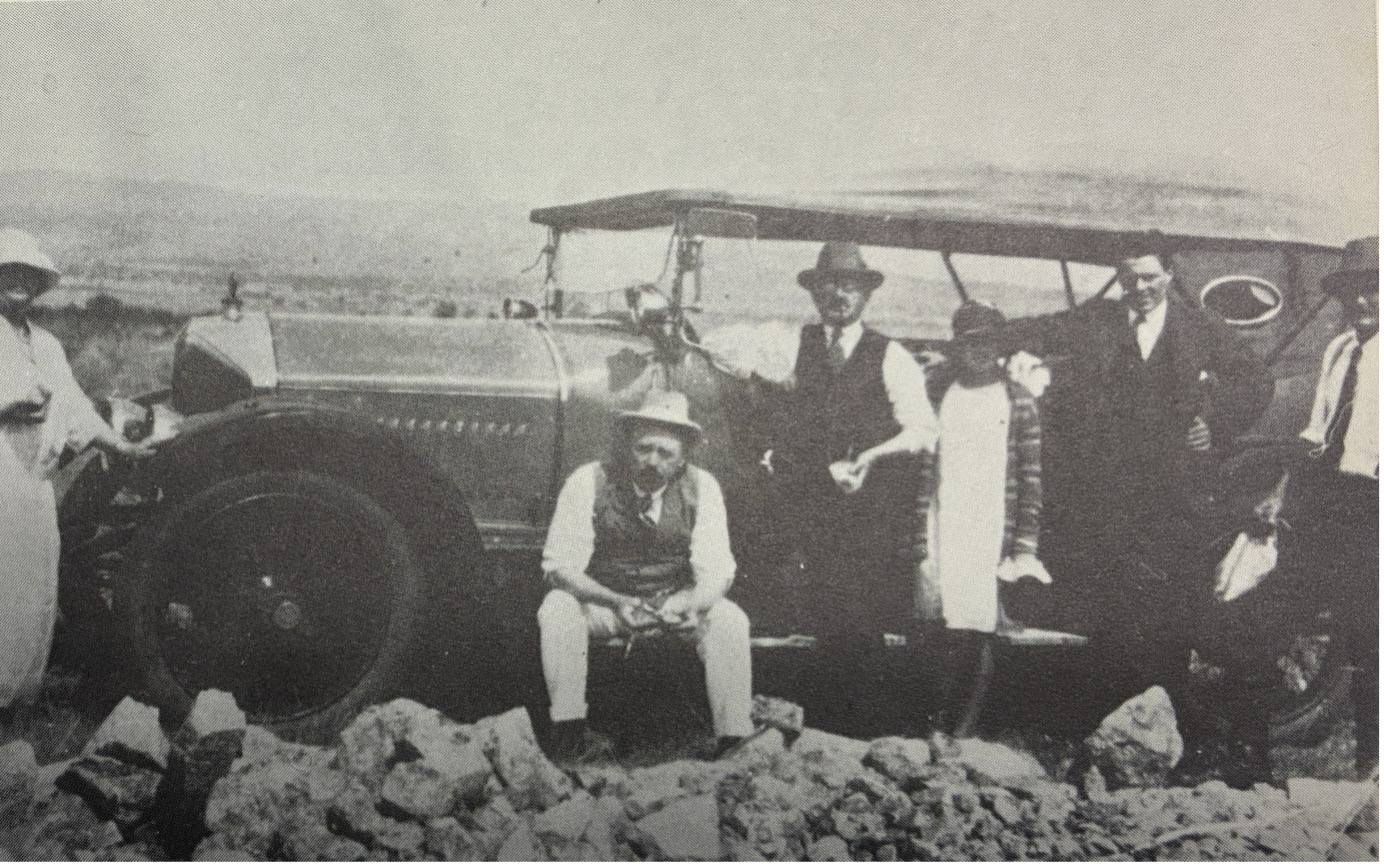
Frankfurth's early prospecting career was defined by tireless effort and narrow misses. When the Second Anglo-Boer War disrupted the region, he briefly returned to Europe, only to rush back to the Transvaal in 1902. He chased oil shale opportunities in Wakkerstroom, gold around Nigel, and asbestos near Kuruman in the Cape Province. When these ventures failed to yield fortunes, he humbly returned to catering in Johannesburg to support his family. His ultimate breakthrough came in 1924, driven entirely by his ability to forge deep friendships with local farmers in the Rustenburg district. On 24 September 1925, Frankfurth secured a prospecting contract with Willem Combrink, the owner of the farm Waterval No. 557. He signed a similar deal with the neighbouring farm, Arnoldistadt, and hired mining engineer J. F. Mills Davies to assess the land. His instincts were vindicated: they struck platinum.
As word of the discovery spread, Frankfurth caught the attention of the legendary geologist Dr. Hans Merensky, who became famous for mapping the world's largest platinum reserves. Decades later, Frankfurth's daughter, Hansi Matzner, vividly recalled the historic encounter between the two men at the Grand Hotel in Rustenburg:
"We were staying at the Grand Hotel in Rustenburg... while Merensky was at the Transvaal Hotel. They knew each other well. Coming up to my father, he said: 'Jack, what is this I hear about you having a reef and that it is so rich?' Then he added in German: 'You smell these things out like a dog' (Du riechst das aus wie ein Hund), adding that he would like to take over the proposition at a price."
A monumental deal was struck. The historic company, Waterval Platinum Ltd. was formed with a staggering capital of £250000, and the former caterer was appointed as a director of the company.
Jack Frankfurth passed away in Johannesburg in 1936 at the age of 74, with his official occupation proudly recorded as a retired mining geologist, a title he had spent a lifetime earning. He and his wife, Mizzie, who passed away a decade later in 1946, rest together in Johannesburg's Brixton Cemetery, leaving behind a legacy that permanently transformed Rustenburg into a global mining powerhouse.
References:
- NASA:
- 1902. Letters of Naturalization, Jacob Frankfurth.
- 1913. Mineral Oil Occurrences Investigation. Regarding indications on Farms "Roodepoort" Number 111, "Naauwhoek" Number 83, "Kikvorschfontein" Number 4, "Blinkwater" Number 342, and "Kafferskraal" Number 72, All District Wakkerstroom. Messrs van Boeschoten and Lorentz on behalf of J. Frankfurth. Forward copies of reports on the farms, together with certificates of analyses, etcetera.
- Rustenburg Romance: The History of a Voortrekker Town. Chapter 30. Mineral Hopes. Eric Rosenthal. Perskor Publishers, Johannesburg. 1979, pages 158-159.
- The Golden Years: A Memoir of Old Rustenburg. Lionel Wulfsohn, 2011, Watermark Press, Plettenberg Bay.
Friedman family
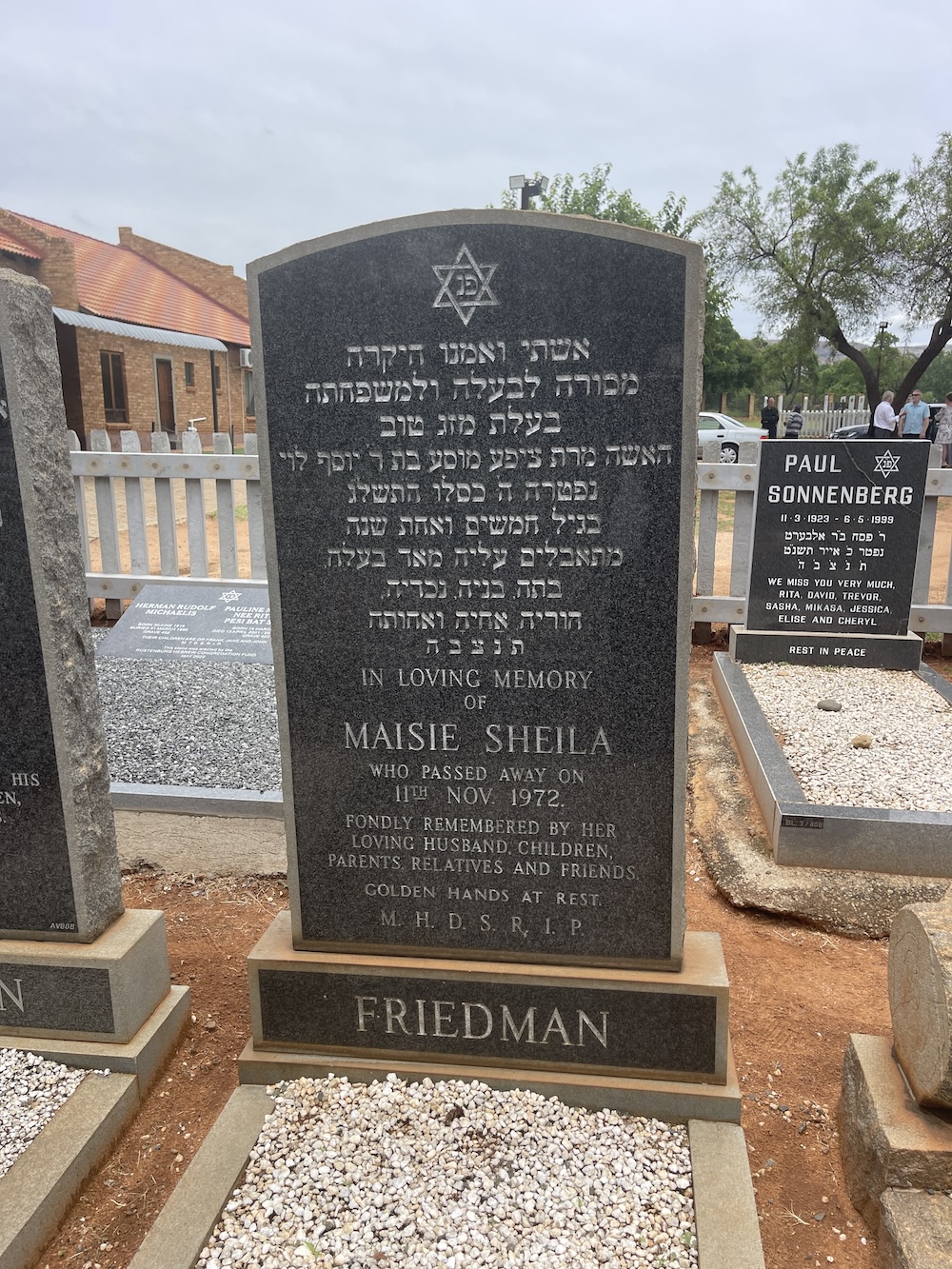
Louis 'Chappie' Friedman (1915 Transvaal – 11 August 1988 Rustenburg) and Maisie Sheila Friedman née Miller (1921 Cape Town – 11 November 1972 Rustenburg) were married on 25 May 1940 in Pretoria. At that time, they were resident in Durban. They had four children, a daughter Adele Henrietta Gillman née Friedman (1941-2021), and 3 sons, Aubrey Solomon Friedman (1943-2023), Edward (Teddy) Friedman (1944-1992) and Julian David Friedman (1950-2014). The family left Durban and settled in Rustenburg, where they ran trading stores on the mines. Aubrey's daughter, Chantal Valentine, wrote on Rav Moshe Silberhaft's Post on Facebook, "Friedman family, us, my grandparents and my aunt/uncle/cousins lived there. The old shul near the MOTH hall, and going for cheder lessons with the old rabbi in a little room off the shul. They later built a hall next to it that housed the Jewish preschool where my younger brother went. My dad and his family also ran some trading stores on the mines - I don't remember which mines but the stores were Elfried, Entabeni and Paardekraal. I remember there being a Kramer family but not specifics. I do remember the Chatzes - we lived next door to them for a bit. Other families I remember were the Wulfsohns, Resnicks, Osters, Belnicks and Sonnenbergs - Rita Sonnenberg taught me ballet (she held her lessons in the Anglican Church Hall I believe). This all in the 70s before we moved away."
References:
- Chantal Valentine, Rav Moshe Silberhaft's Post, 16 February 2026.
Gersh family
Aharon Gersh (1873-1944), a merchant, and his wife, Golda Gersh née Melnik (1881-1944), raised their family in Šiauliai, Lithuania. During World War Two, Aharon perished in the Stutthof concentration camp and Golda was murdered at Auschwitz. Fortuitously, three of their sons, Solly, Barney, and Victor, had already emigrated to South Africa, where they forged new lives. The siblings initially established themselves in Rustenburg.
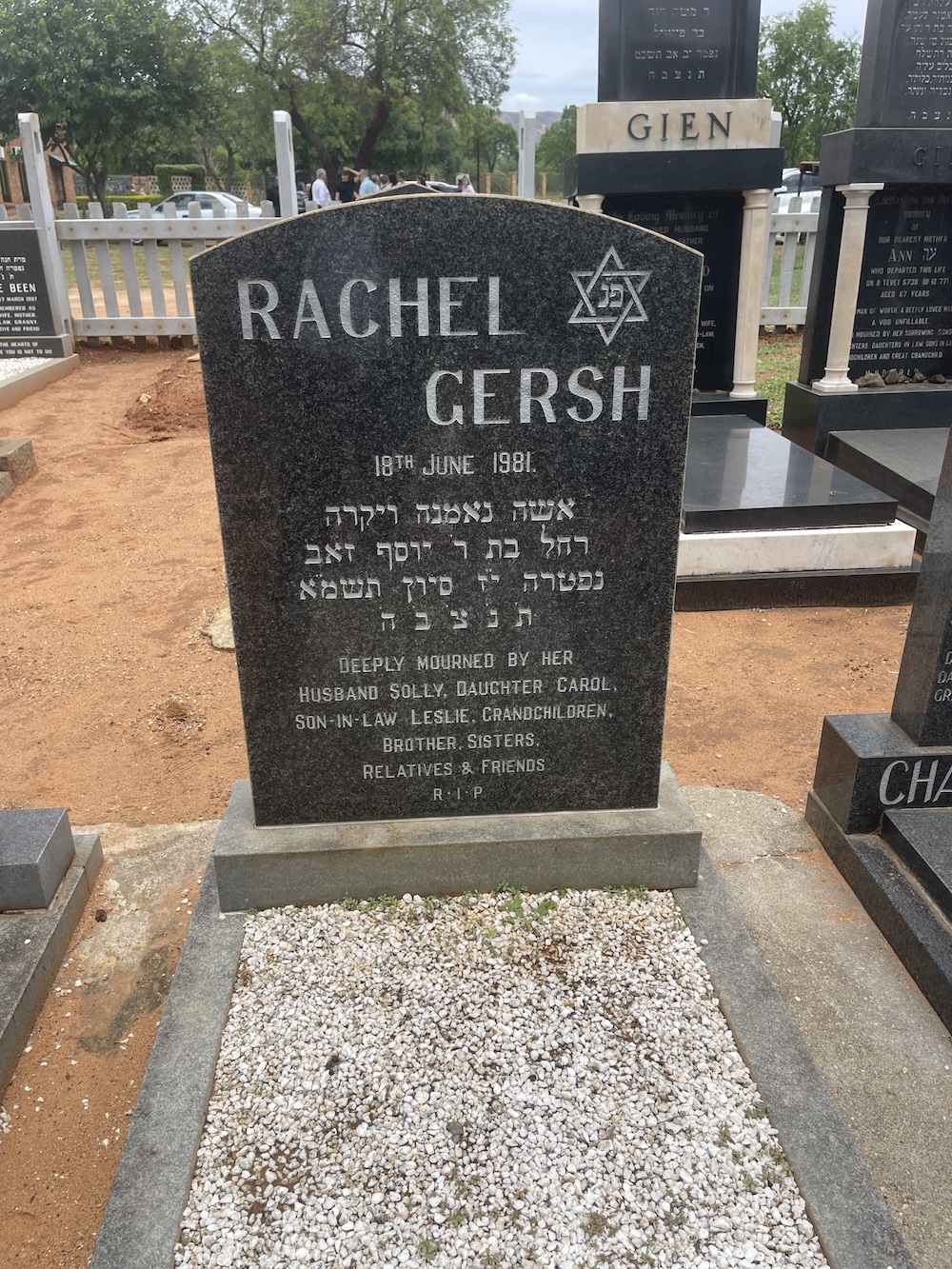
- Solly Gersh married Rae Rosen (1907 - 18 June 1981 Rustenburg) in Johannesburg on 15 November 1936, and they welcomed their daughter, Carol Anne, two years later. Moving his family to Rustenburg, Solly established himself as a successful general dealer and wholesaler, operating Tanda Bantu Wholesalers. Rae was a member of the Rustenburg Women's Zionist Society. She passed away in Rustenburg on 18 June 1981, marking the end of a chapter for the Gersh family.
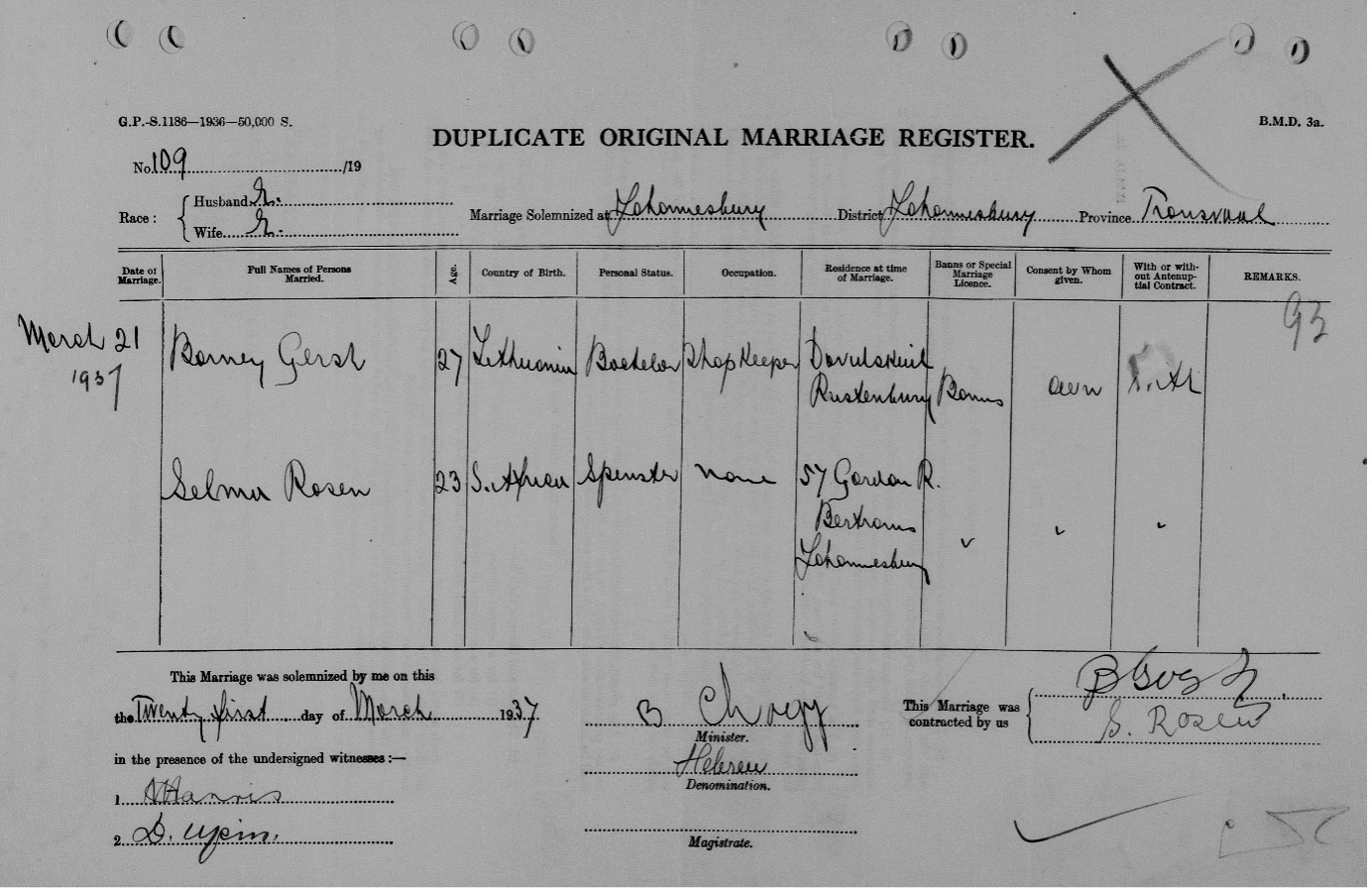
- Barney Gersh, born in 1910, initially carved out a living as a shopkeeper in Danielskuil, Rustenburg. In March 1937 he married Selma Rosen but their marriage was short-lived. In 1940, Barney partnered with Bernard Harris to take over a trading post, Saulspoort Cash Stores. He subsequently married Rae Herr (d. 1981) and settled in Potchefstroom.
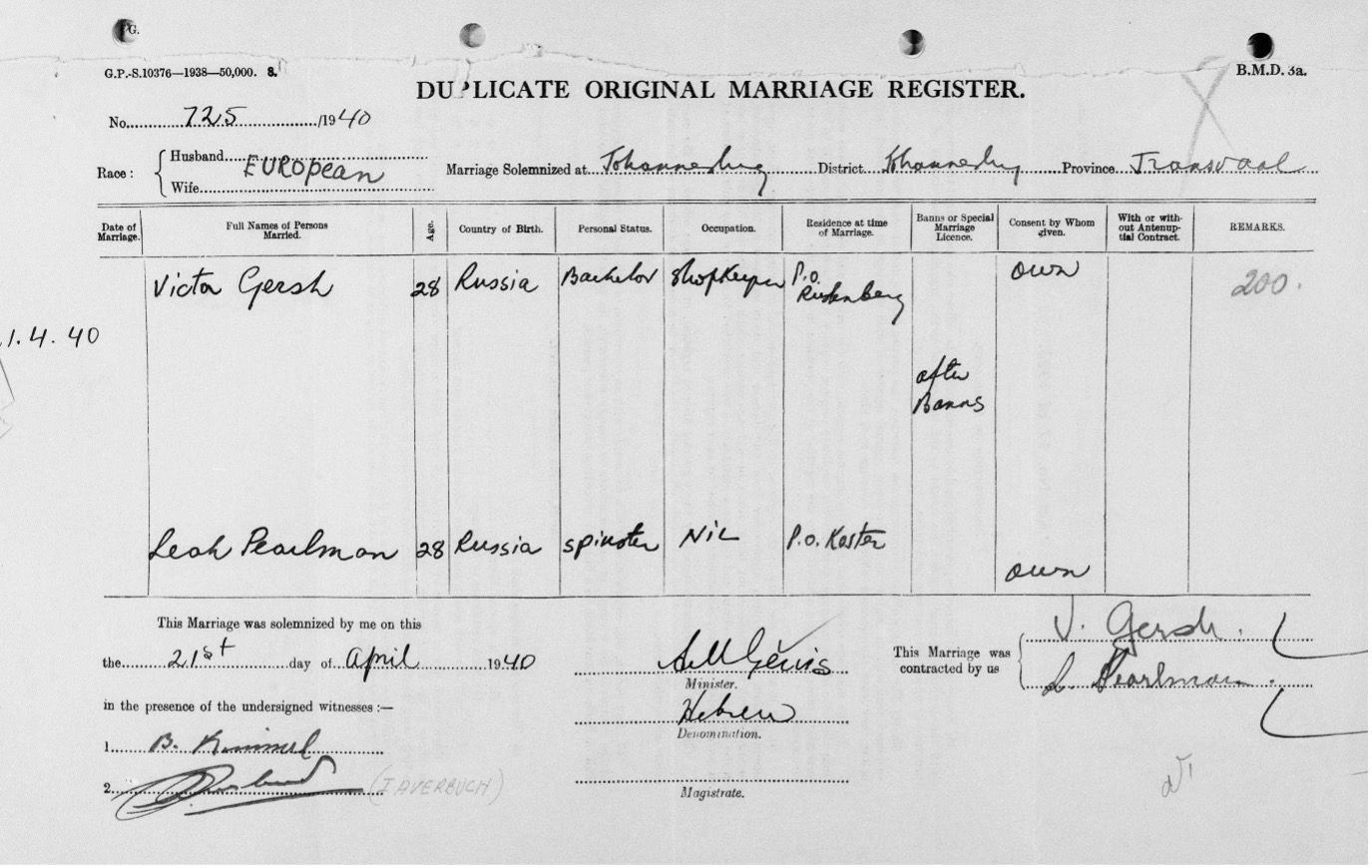
- Victor Gersh ((1911 Šiauliai, Lithuania - 31 January 1972 Welkom) began his South African journey as a shopkeeper. On 21 April 1940 he married Leah Pearlman (1906-1992) of nearby Koster. They had 3 children, Percy (1941-2021), Edith and Aron. In 1950 Victor took over Swartklip Handelshuis, a general dealership, from Cornelius Jacobus van der Merwe on the farm Zwartklip No. 988, district Rustenburg, and together with Carl Frederick Christoffel van Wyk they traded as G. V. Trading Company. When Victor's son Percy celebrated his Barmitzvah at the Rustenburg Shul in 1954, the family made a donation to the congregation. Victor and Leah eventually moved with their three children to Welkom in the Orange Free State. Percy Gersh went on to become a prominent businessman and the owner of Park Wholesalers in Welkom. Their youngest son, Aron, took a more academic and reflective path. He qualified as a psychologist. He is an author, avid cyclist and Yiddish speaker. He credited his early years living at his father's rural store near Rustenburg with exposing him to a rich tapestry of different languages and cultures. His book, The Grave Situations of My Lithuanian Ancestry: An Anti-War, Post-Holocaust Experience, captures the lasting psychological scars and survivor memories passed down through his family.
Rustenburg Herald entries:
- 1940-02-02. Notice is given that the business of General Dealer carried on by Mr. Joffe at Saulspoort, district Rustenburg, under the name of Saulspoort Trading Co, has been transferred to Bernard Harris and Barney Gersh from the 1st January 1940 and that they will carry on the business at the same place under the style of Saulspoort Cash Store Bernard.
- 1944-01-28. Notice is hereby given that the Partnership business hitherto carried on by Bernard Harris and Barney Gersh under the style of firm of the Saulspoort Cash Store has been dissolved as and from the 1st day of December 1943. The said BARNEY GERSH will henceforth carry on the said business for his sole account and benefit. Dated at Rustenburg this 21st day January 1944. D. J. KOTZE, Attorney for the parties, Steen Street, Rustenburg. 28/411
- 1945-12-21. GERSH: To Victor and Leah, a lovely son, Kloof Road Nursing Home on 16th December Both well. Thanks to Dr. and Nurses.
- 1950-05-12. Hiermee word bekendgemaak dat die Algemene Handelaarsbesigheid gedryf deur CORNELIUS JACOBUS VAN DER MERWE op die plaas ZWARTKLIP No. 988, distrik Rustenburg, onder die naam an SWARTKLIP HANDELSHUIS vanaf die 1ste dag van Mei 1950 oorgemaak is aan VICTOR GERSH en CARL FREDERICK CHRISTOFFEL VAN WYK wie dit op dieselfde plek en onder die naam van G. V. TRADING COMPANY vanaf gemelde datum vir hulle eie voordeel sal voortsit. PENZHORN, COETSEE & BRINK, Namens Partye, Steenstraat, Posbus 55, Rustenburg.
Gien families
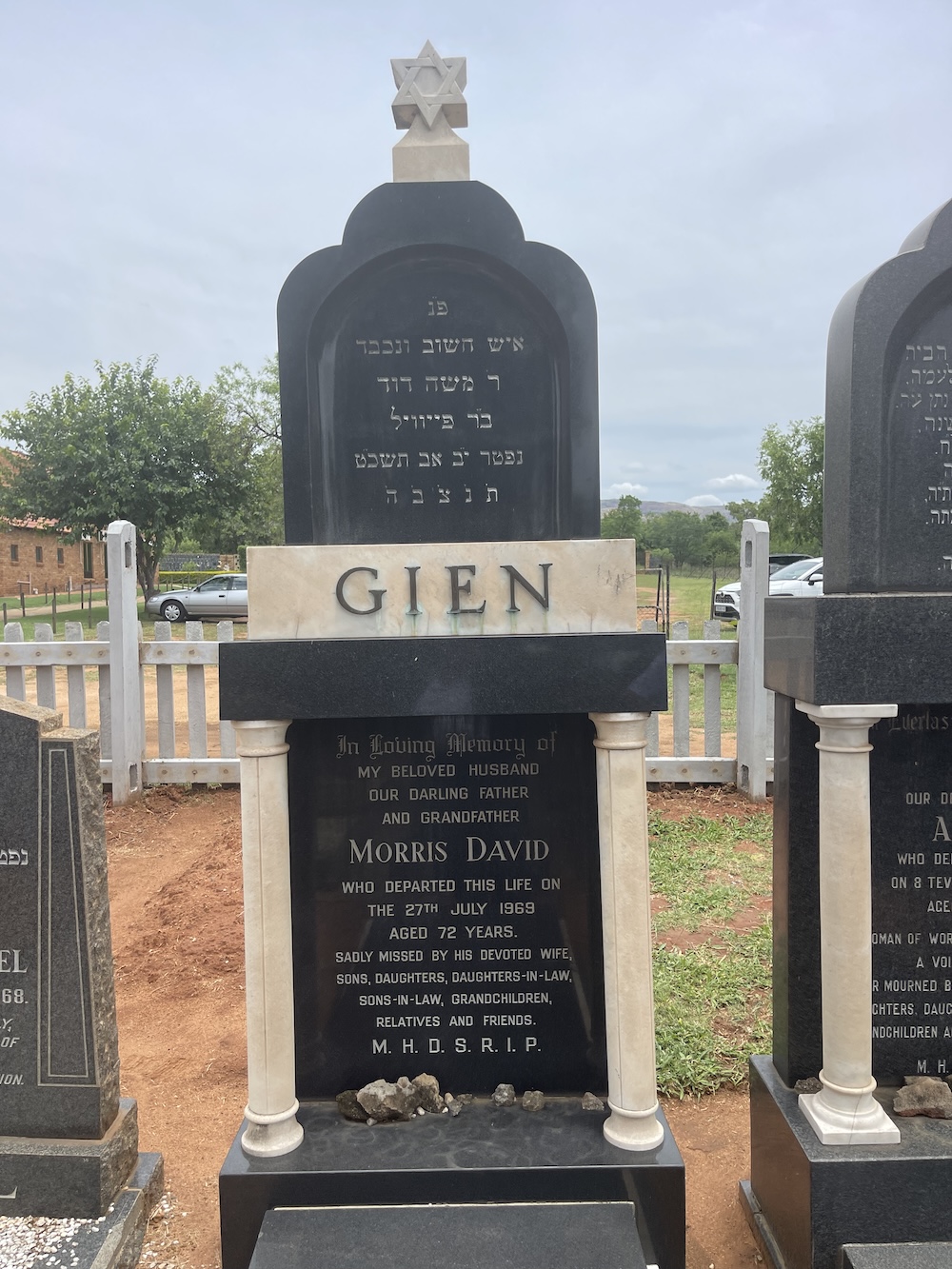
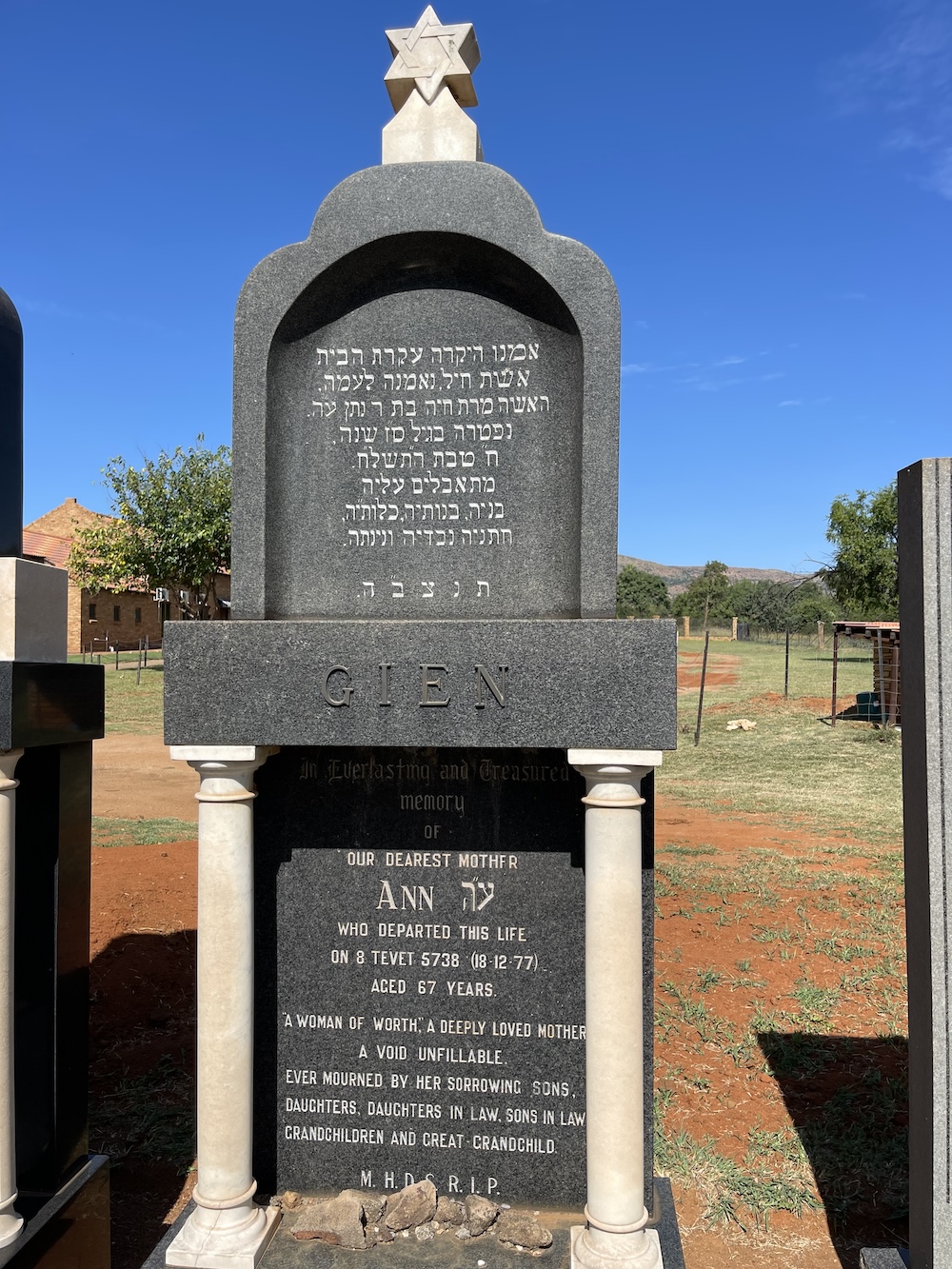
The Gien family originated from Kelmė, Lithuania. Three sons of Dov Ber Gien (1850-1909) and Seitel Gien née Wolpert of Kelmė emigrated to South Africa. They were Jacob Gien (1868-1906), Robert Gien (1871-1936) and Peter Gien (1883-1943). Their brother Shmuel Gien (1877-1933) remained in Lithuania. Robert Gien and his wife Sheina née Miller settled in Rustenburg. Over time, Rustenburg became a gathering point for the extended Gien clan. The daughter of Jacob Gien, Rebecca Lifman (née Gien), decided to leave Johannesburg and she and her husband settled in Rustenburg. The Gien family presence grew stronger when a cousin, Morris David Gien, a nephew of Dov Ber, brought his wife and children to settle in the town.
Robert Gien
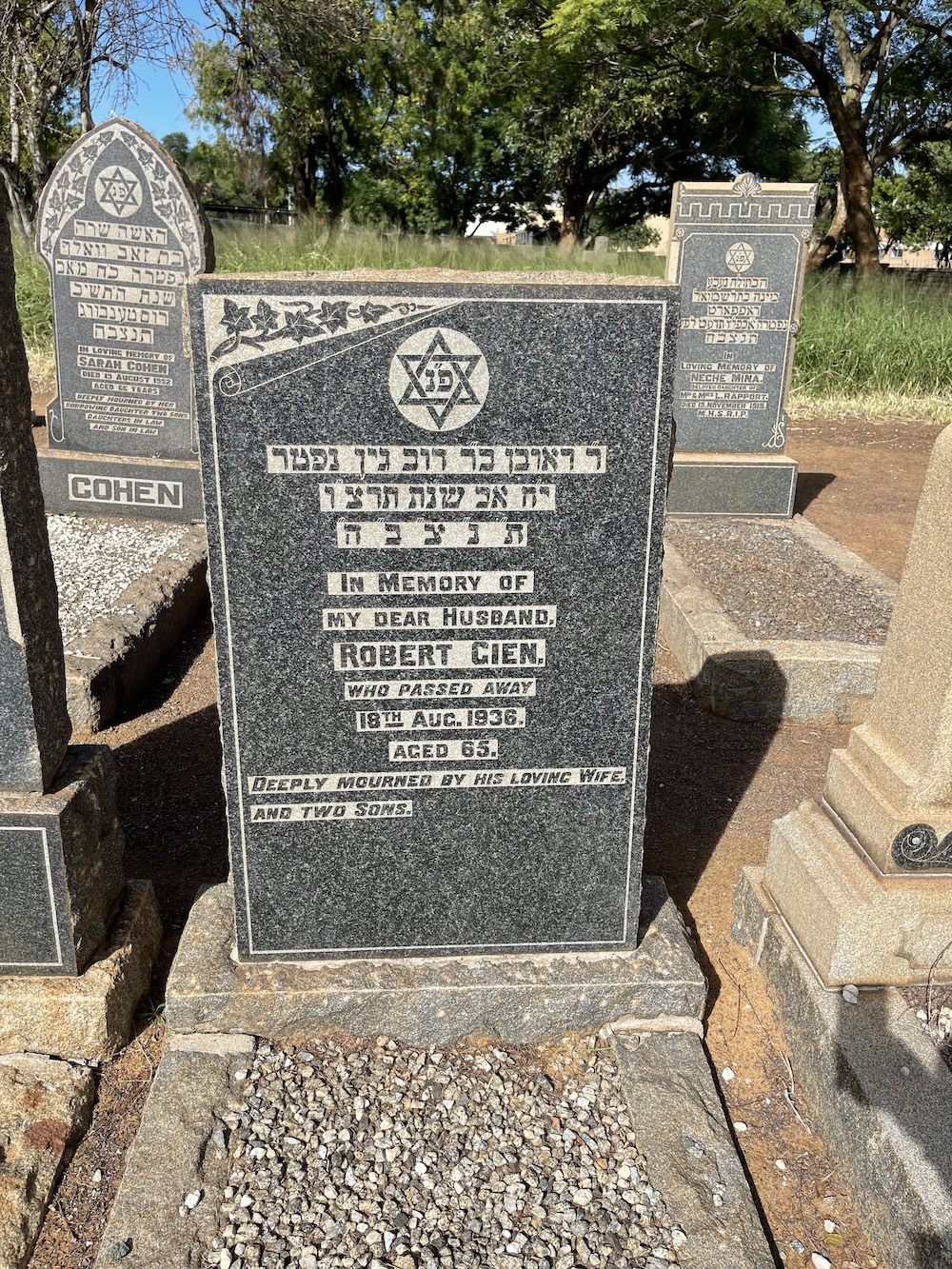
(1871 Kelm, Russia - 18 August 1936 Rustenburg)
He married Sheina 'Sarah' Miller (1864 Lithuania - 1952 Johannesburg) in Raseiniai, Lithuania, in about 1894. They had three children, Edward, David and Olga and the family lived in Burger Street. Robert Gien was a general dealer in Plein Street. He died in 1936 aged 65 and is buried in Rustenburg. Following his death, Sheina chose to leave Rustenburg and relocated to Johannesburg to be closer to her two sons. She lived there until her own passing in 1952 at the age of 88.
Children:
- Edward Gien (1899 Transvaal - 1980 Johannesburg) built a career as a speculator in nearby Zwartruggens. On 7 May 1924, he married Cecilia Johanna Roos (1904-1975) of Rustenburg. The couple eventually settled in Johannesburg. Following their passings both Edward and Cecilia were interred in the non-Jewish section at West Park Cemetery, Johannesburg.
- David Gien (1904 Cape Province - 1984 Johannesburg) moved to Johannesburg, where he married Annette Frame (1914-1984) on 20 July 1935. The couple remained in Johannesburg, passing away in the same year.
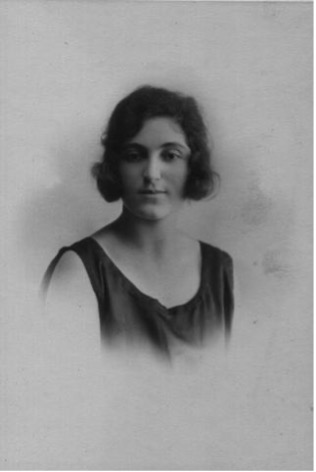
- Olga Levi née Gien (1905 Johannesburg - 1933 Zwartruggens) moved to Station Street in Zwartruggens after marrying David 'Alfred' Levi (1896-1970). In late 1933, just three weeks after giving birth to her third daughter, she passed away aged 28. She was survived by her husband and three young daughters: Gloria (born 1926), Betty (born 1928), and infant Eva (born 15 November 1933).
Peter Gien
(1880 Lithuania - 1943 Bronkhorstfontein, Marico)
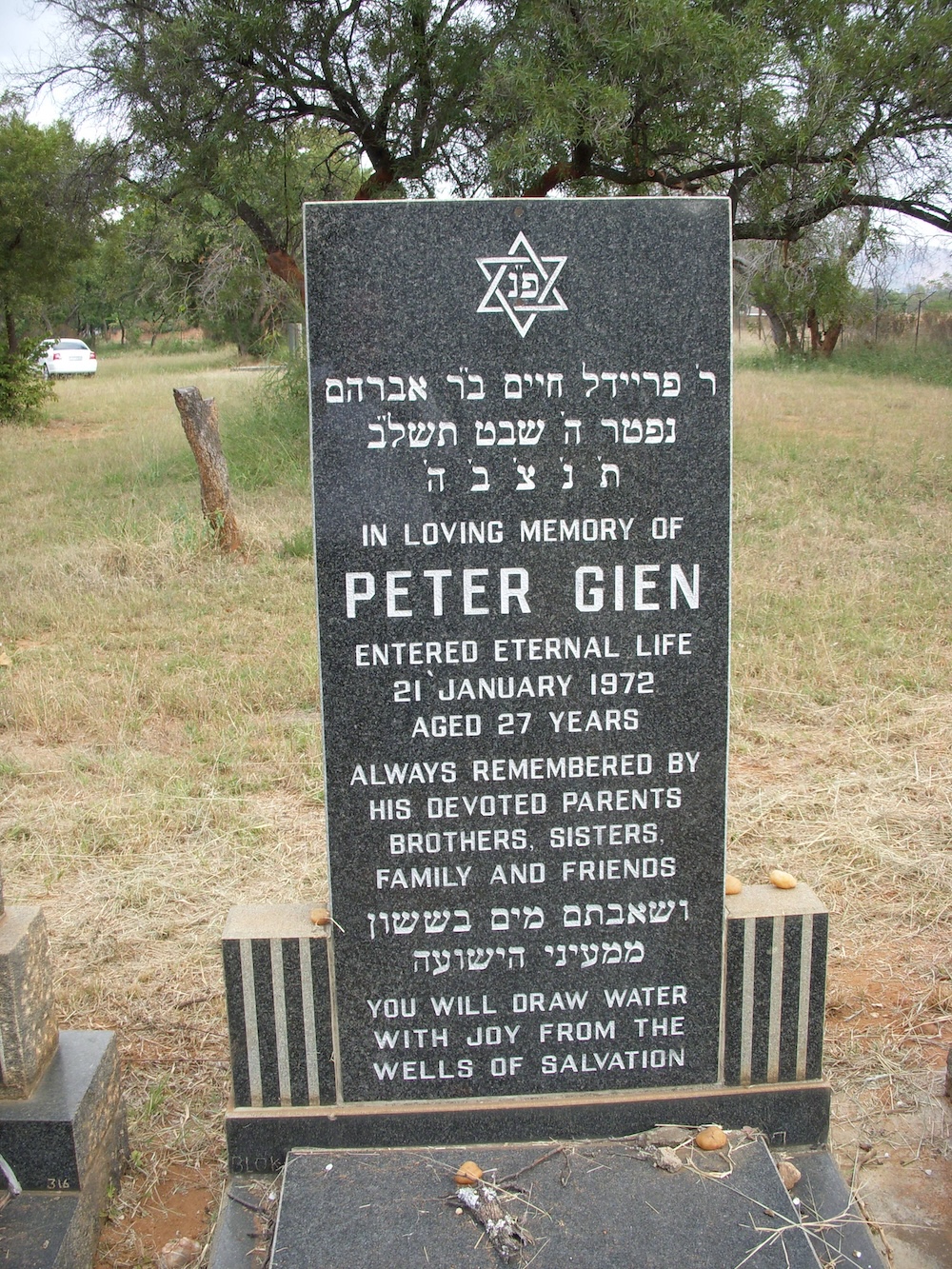
Peter and his wife, Jane Rachel Gien née Carpel (1891 London - 1972 Johannesburg), had 7 children. Their son Abraham Gien (1918 Johannesburg - 1994 Johannesburg), affectionately known to everyone as 'Mannie', was born in Johannesburg in 1918. He married Esther Gruzinsky (1923-2015) on 17 January 1942 and chose the life of a farmer in the Groot Marico area. In the 1940s Mannie began drilling on his farm. This was a decision that would set the foundation for a family enterprise. His son, Peter Gien, born in 1944 and named in honor of his grandfather, developed a fascination with his father's drilling equipment. Showing mechanical intuition, he modified a down-the-hole hammer inside the farm workshop, perfectly adapting and marketing it for the South African terrain. Driven by this success, Peter officially established P.G. Drilling. In 1964, the family imported a compressed air drilling rig from America, revolutionizing their operational capabilities. Tragically, Peter's life was cut short in 1972 due to complications following an injury sustained when a motorcycle fell on his leg. He was only 28 years old and was laid to rest in the Rustenburg Jewish Cemetery. His brothers, Bernard ('Barn') and Sidney ('Sakkie'), stepped forward to lead P.G. Drilling. Under their stewardship, the workshop venture grew into an international success, ultimately serving major clients across Southern Africa, Malawi, Ethiopia, the United States, and Sweden.Morris David Gien
(1892 Lithuania - 1969 Rustenburg)
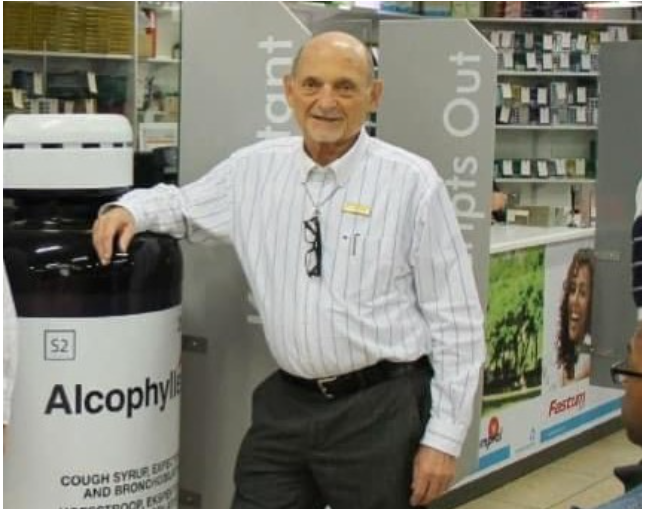
Born in Lithuania in 1892 to Feivel Gien, brother of Dov Ber Gien, Morris was brought out to South Africa by his cousin, Robert Gien. Morris initially struck out on his own, settling in Lichtenburg to work as a storekeeper. On 16 January 1927, he married Ann Hurwitz (1910 Russia - 1977 Rustenburg) in Johannesburg. Shortly after their wedding, the couple relocated to Rustenburg, setting up their family home at 22 Kruis Street. They had five children. In 1934, their eldest son, six-year-old Philip, contracted meningitis. He passed away at the Children's Hospital in Johannesburg and was buried in the city. Their remaining four children were Sylvia (1933–2010), Thelma (1935–2012), Mundel, affectionately known as Mannie (1936–2022), and Jack. Morris Gien owned New Modern Bakery on Erf No. 8 Church Street, and Modern Café on Erf No. 63 Plein Street. The family were active members of the Rustenburg Hebrew Congregation and donated a row of chairs to the Shul. Morris passed away in Rustenburg in 1969 at the age of 77 and Ann died in 1977. Their son Mundel 'Mannie' Gien studied pharmacy at Rhodes University and went on to establish the historic Springbok Pharmacy in Alberton. He earned a place in South African business history as the very first pharmacist in the country to discount medicine. He passed away in Johannesburg in 2022. Sylvia Abelowitz (née Gien), Thelma Greenstein (née Gien) and their youngest son, Jack Gien, emigrated to the United States.
Rebecca Lifman née Gien
(1895 Lithuania - 1966 Johannesburg)
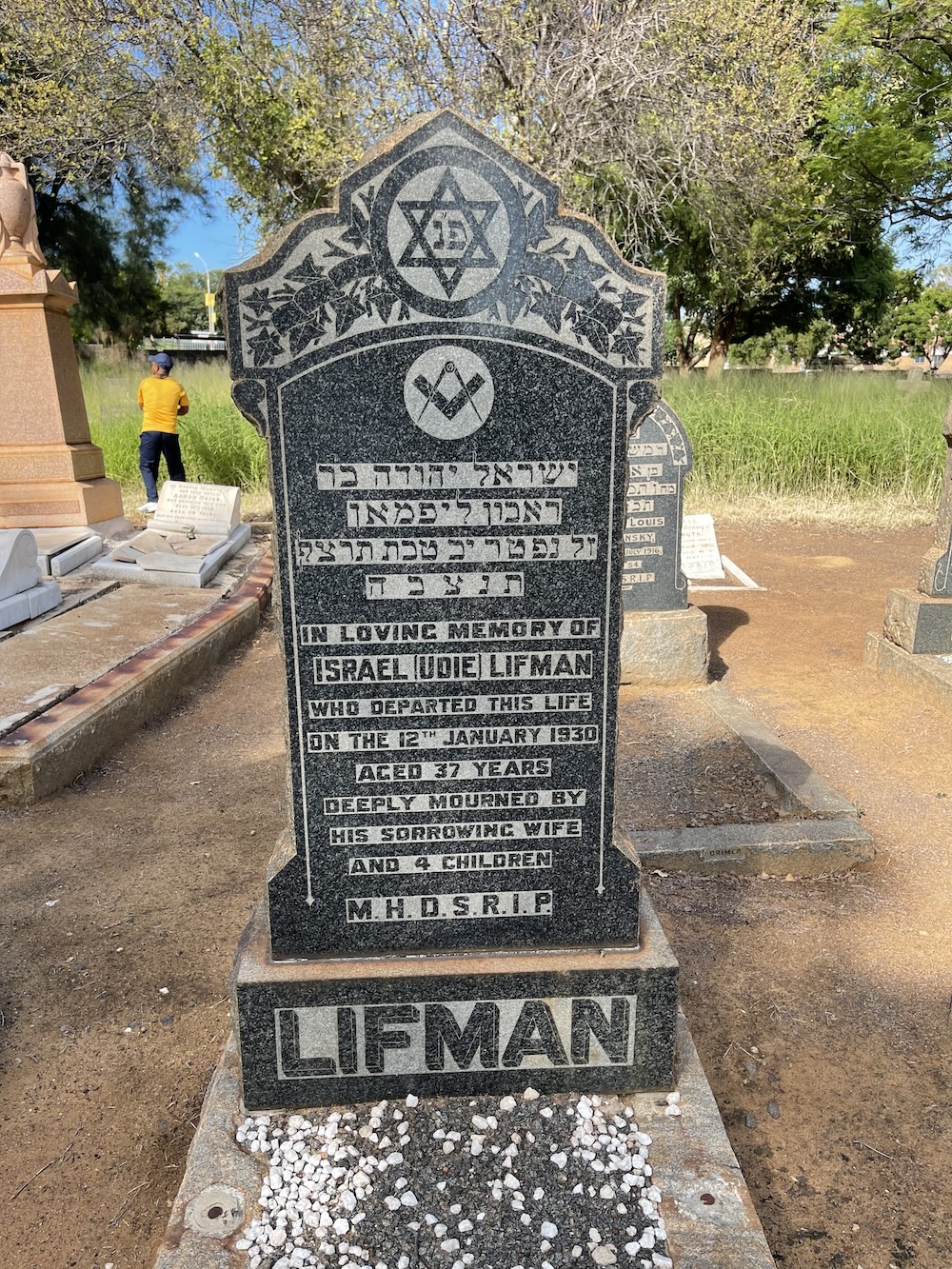
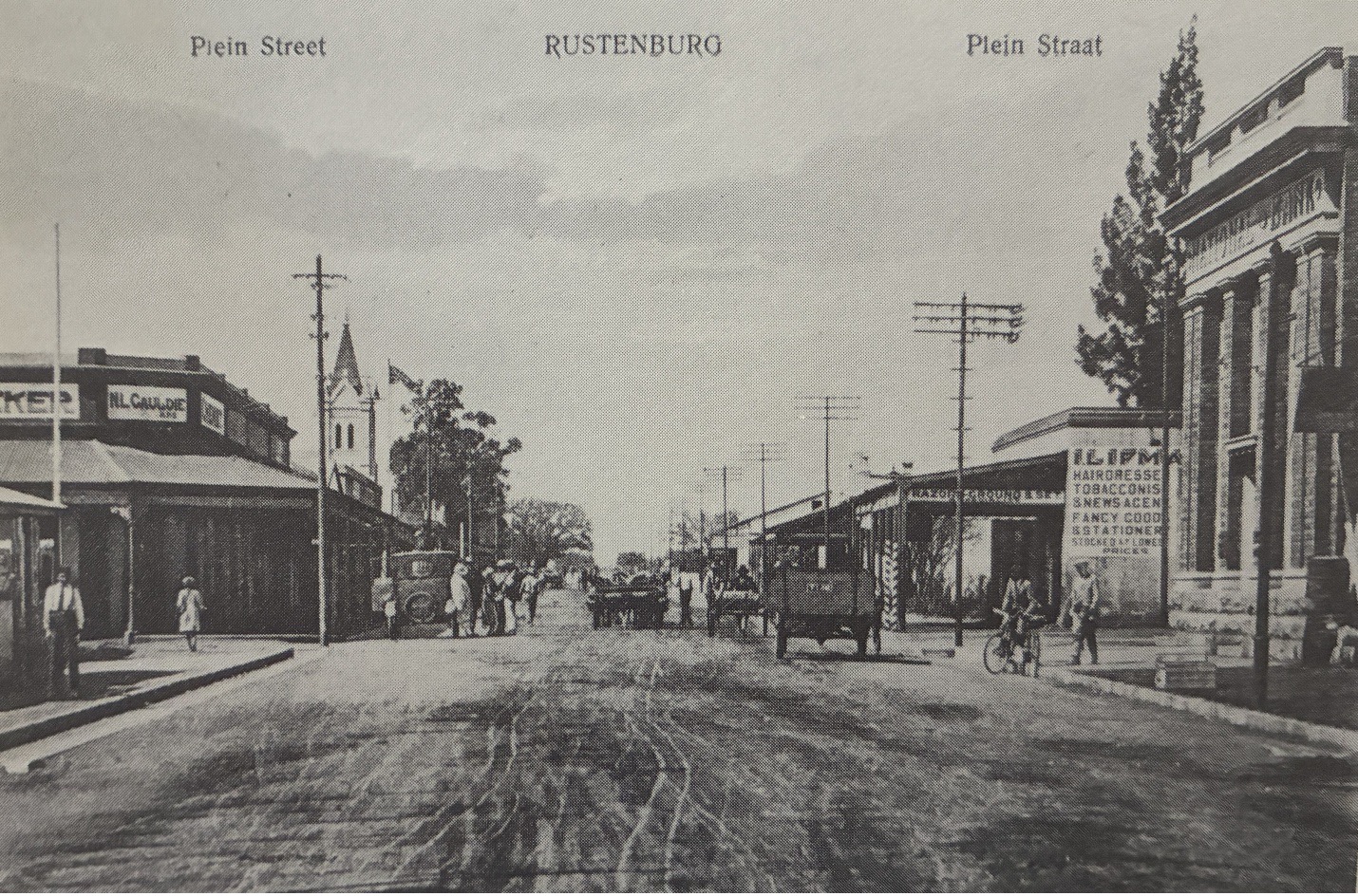
She was the daughter of Jacob Gien (1868 Kelmė, Lithuania - 1906 Johannesburg) and Fruma Gien née Mehl (1861 Russia - 1915 Johannesburg). The family settled in Booysens, Johannesburg, where her father worked as a general dealer until his death in 1906. On 18 August 1915 Rebecca married Israel 'Udie' Lifman (1893 - 1930), a native of Kovno, Lithuania. The couple initially started their married life in Johannesburg, where two daughters were born – Fruma in 1916 and Jenny in 1918. In the early 1920s the young family moved to Rustenburg after Udie purchased a local haircutting salon. The business traded as I. Lifman and was a little barber shop combined with a ladies' hairdressing salon and the local newspaper agency. The family lived behind the shop in a modest, prefabricated timber cottage. Rebecca gave birth to two sons, Robert Bernard in 1922 and Jeffery Dudley in 1927.
In 1930 tragedy struck the household when Udie passed away at the age of 37. A letter written to the Rustenburg Herald editor depicted the family's dire situation. "Sir, It was with sincere regret that I heard of the death last week of our old friend Mr Lifman. Mr Lifman had always been most obliging to his many customers and very well-liked by all who met him. It is earnestly to be hoped that his widow, who has, unfortunately, not been left in very happy financial circumstances will receive the whole-hearted support of the community. A. Playfair."
Left with young four children to support, Rebecca single-handedly ran the salon and newspaper agency, which traded as Lifman's Hairdressing Saloon. In 1945 she sold the business, which was renamed Plein Street Hairdressing Saloon and News Agency by its new owners.
Once the Lifman children finished school, they left Rustenburg to build their own lives. Fruma Jacobs (née Lifman), Jenny Katz (née Lifman), and Jeffery Lifman eventually settled in Cape Town. Robert Bernard Lifman qualified as a dentist and lived in Vereeniging. Rebecca Lifman left Rustenburg and passed away in Johannesburg in 1966.
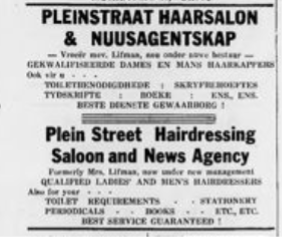
"Vroeër Mev. Lifman, nou onder nuwe bestuur."
("Formerly Mrs Lifman, now under new management."
Rustenburg Herald 1945.
References:
- The Golden Years: A Memoir of Old Rustenburg. Lionel Wulfsohn, 2011, Watermark Press, Plettenberg Bay, page 80.
Rustenburg Herald entries:
- 1936-08-07. The Late Mr R. Gien. Mr. Gien, who lived in Rustenburg for many years with his family died here yesterday. He was in hospital for quite a long time and passed away in his home shortly after leaving hospital. The funeral was attended by very many of his relatives and friends. Mr. and Mrs. Frame, of Johannesburg, Mr. Levy of Zwartruggens and Mr. Levy of Johannesburg, came over to attend the funeral. Our deepest sympathy is extended to Mrs. Gien and children.
- 1937. Notice is hereby given that the General Dealers Business carried on by Robert Gien in Plein Street, Rustenburg, has been made over to Mrs. Sane Gien as and from the 1st January 1937. 19265 T.P. Taylor. Attorney for Sane Gien, P.O. Box 82, Zwartruggens.
- 1937. Notice is hereby given that the Bakery and Restaurant and Tea Room Business heretofore carried on by Morris Gien under the name and style of "New Modern Bakery" on Erf No. 8, Church Street, Rustenburg, and under the name and style of "Modern Cafe" on Erf No. 63, Plein Street, Rustenburg, has been sold to Addo Palos as from the 6th of December 1937 and that all liabilities as from the 7th of December 1937 in the name of New Modern Bakery and Modern Cafe are liabilities of Addo Palos.
- 1940-06-28. ENGAGEMENT. The engagement is announced of Miss Jenny Lifman, daughter of Mrs R Lifman and the late Mr I Lifman, of Rustenburg, to Mr Louis Katz, of Johannesburg. BAR MITZVAH. Master Jeffrey Lifman wishes to thank all relatives and friends for good wishes and presents received on the occasion of his Bar mitzvah.
- 1940-10-04. The marriage of Jenny, younger daughter of Mrs R Lifman and the late Mr I Lifman, to Louis, eldest son of Mrs R Katz and the late Mr E Katz, of Johannesburg, will take place on Sunday 6th Oct at 7 p.m. at the Berea Synagogue. No cards. No reception. Congratulations, 41 Arma Court, Catherine Avenue, Berea, Johannesburg.
- 1945. Kennis word hiermee gegee dat die Algemene Handelaars en Haarkappersbesigheid bedryf deur REBECCA LIFMAN (gebore Gien) onder die naam Lifman's Hairdressing Saloon op gedeelte van Erf 65, Rustenburg, tesame met die bates daarvan, verkoop is aan en oorgemaak sal word aan, LOUIS GUSTAVES TRICHARDT, PAULUS WEIDEMAN en JACOB HERTZOG BEYERS TRICHARDT, handelende in vennootskap, wie die besigheid sal voortdrywe onder die naam Pleinstraat Haarkappers en Nuusagentskap op dieselfde plek vanaf die verloop van hierdie kennisgewing. van Velden & Lategan, Prokureurs vir die Partye, Bus 71, Steenstraat.
Gillis sisters – Norina Wulfsohn, Lily Lederman and Ethel Gawron
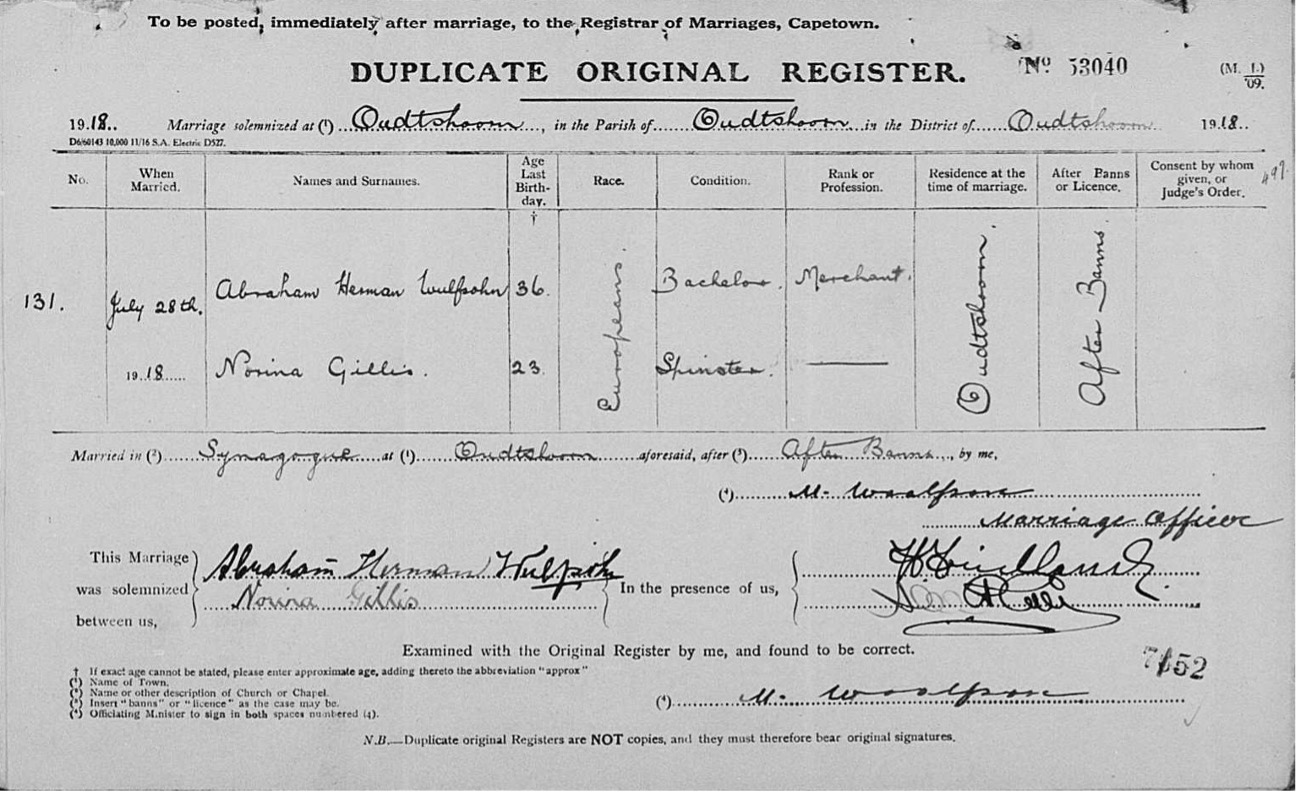
Solomon Gillis (1857-1904) and his wife, Augusta (née Sandman) (1858-1960), lived in Oudtshoorn and had 10 children. He was a feather dealer during the town's famous ostrich boom. When Solomon passed away suddenly in 1904 at the age of 47, Augusta was left to raise their seven sons and three daughters, all of whom were still minors, aged three to sixteen. After their eldest daughter got married and settled in Rustenburg, their two younger daughters moved to Rustenburg and established a family network in the town.
- Norina Wulfsohn née Gillis (1895 Oudtshoorn - 1976 Durban)
She married Abraham Herman Wulfsohn in 1918. The newlyweds immediately journeyed north and settled permanently in Rustenburg. (Refer to the Wulfsohn family.) - Lily Lederman née Gillis (1898 Oudtshoorn - 30 August 1997 Johannesburg)
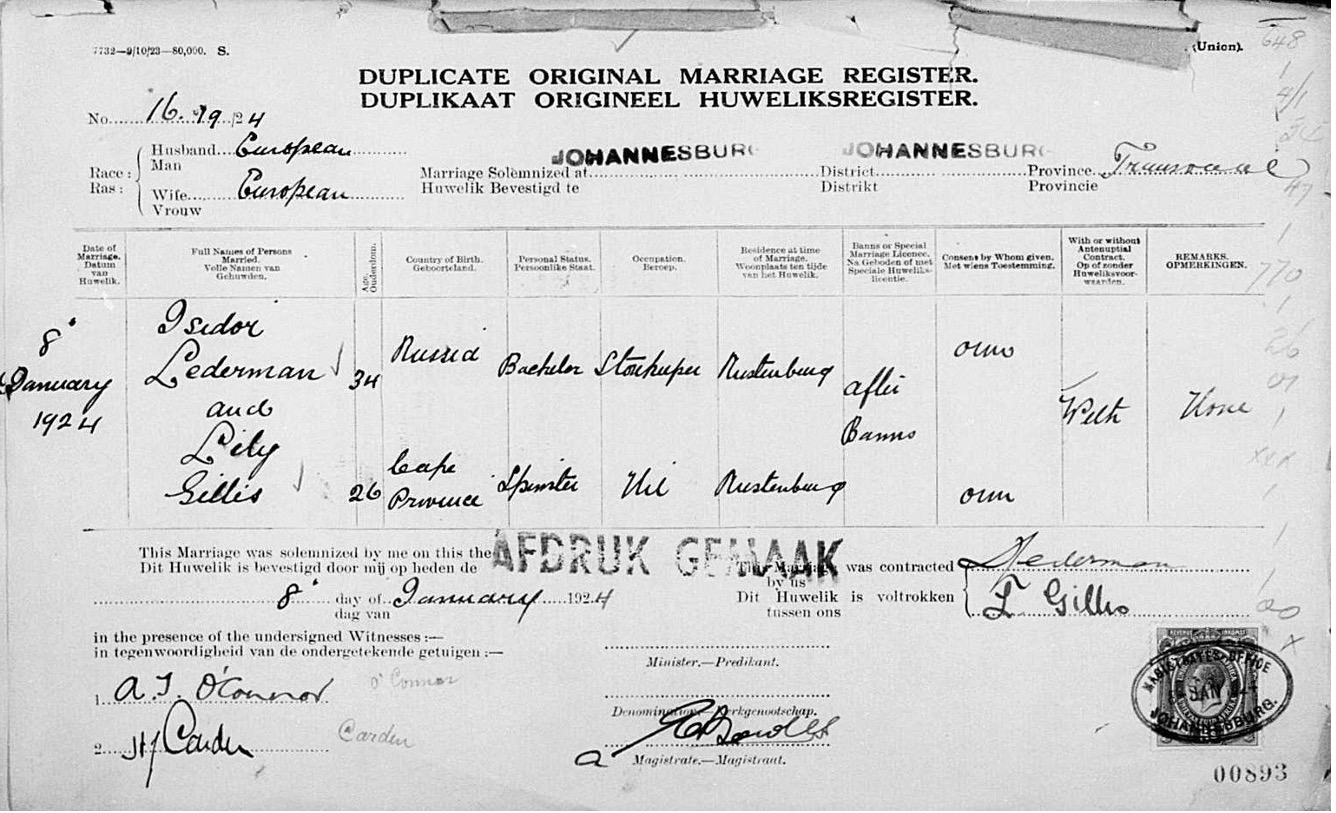
She moved up to Rustenburg shortly after Norina's departure to join her older sister. There she met Isador Lederman (1889 Lithuania - 1983 Johannesburg), a Lithuanian-born immigrant who was a shopkeeper in the town. The couple were married in Johannesburg in January 1924 and built their life in Rustenburg. They had two children, Hedley Lederman (1924 Rustenburg - 2003 Johannesburg) and Shirley Seligman née Lederman (1931 Rustenburg - 2009 Jerusalem, Israel). In the early years, Isador Lederman and his brother-in-law Harry Gawron were business partners in a number of ventures. The Ledermans subsequently moved to Johannesburg. - Ethel Gawron née Gillis (1899 Oudtshoorn - 5 June 1982)
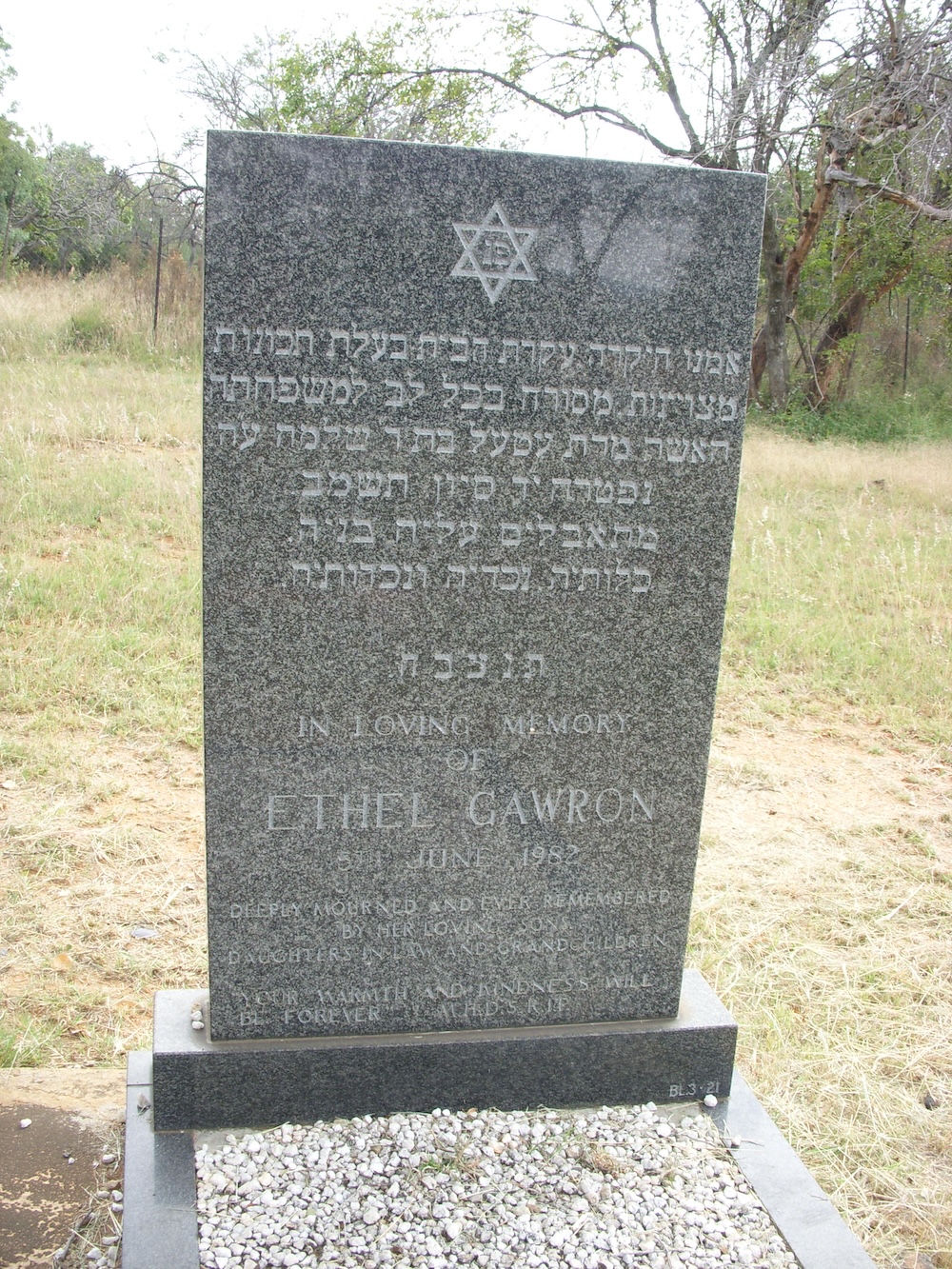
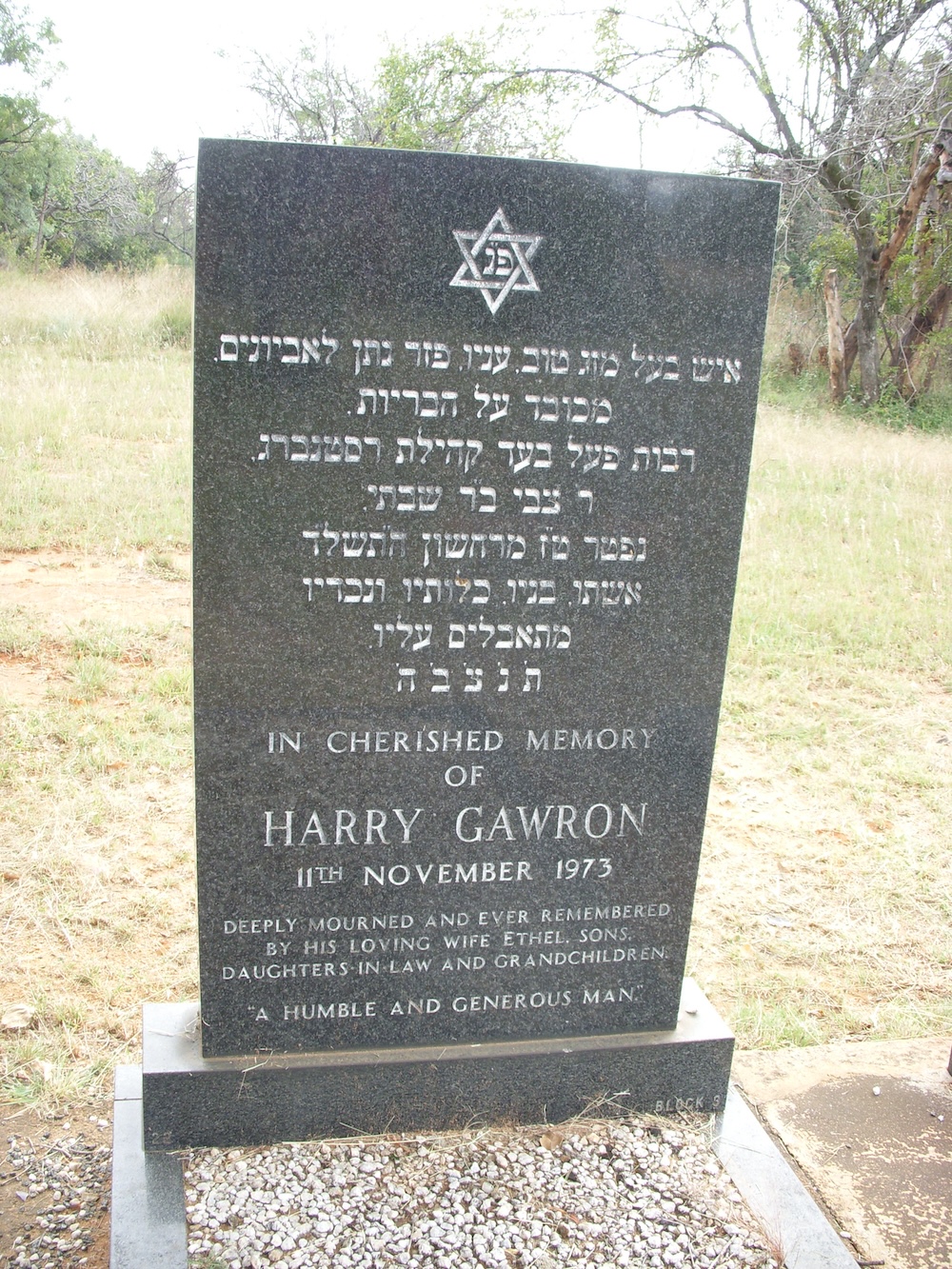
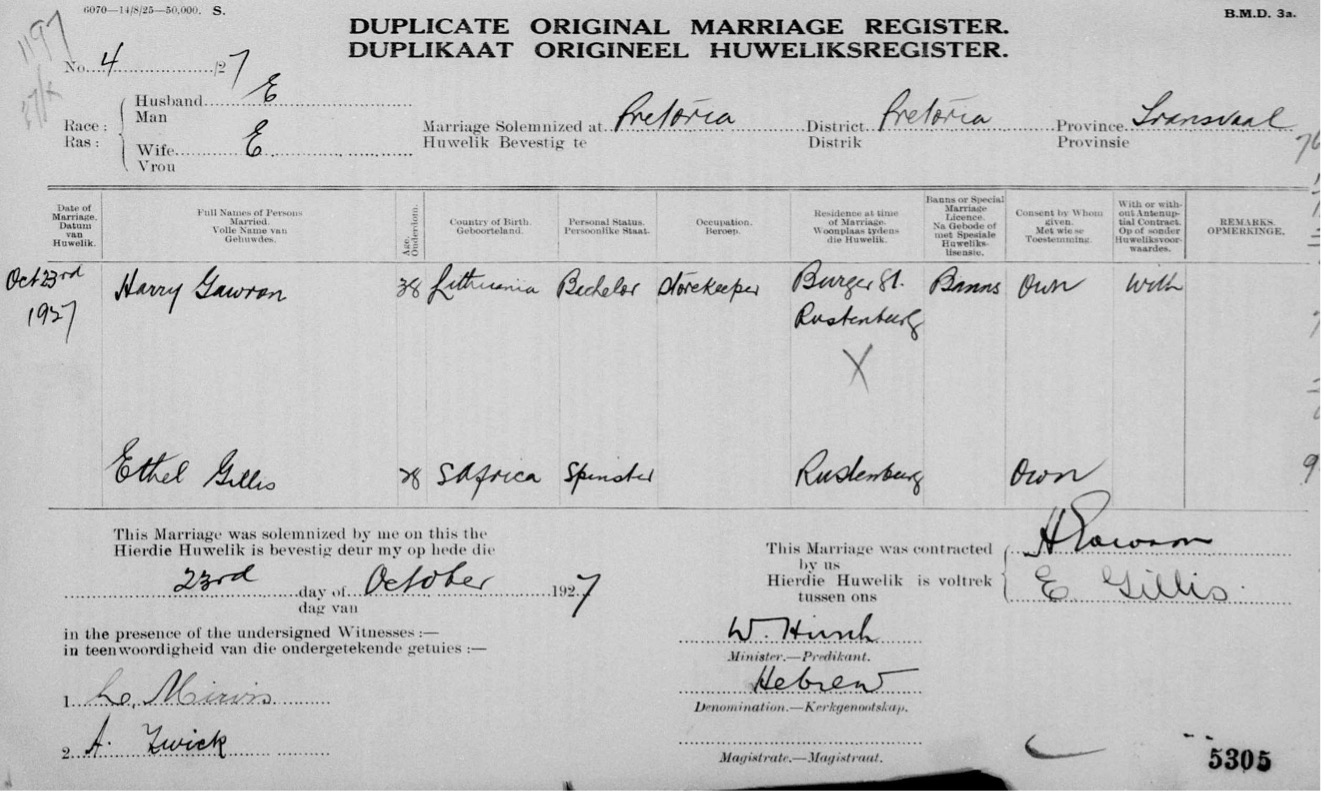
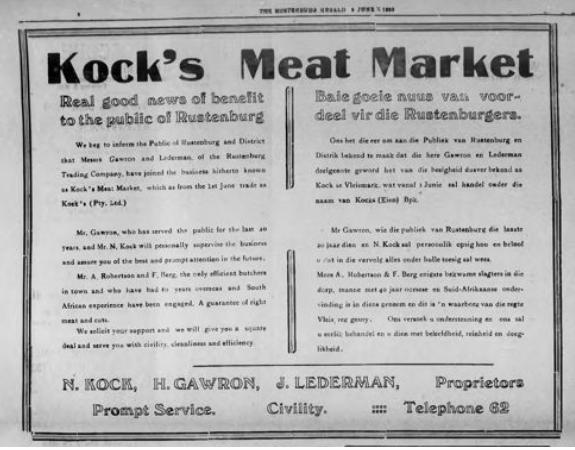
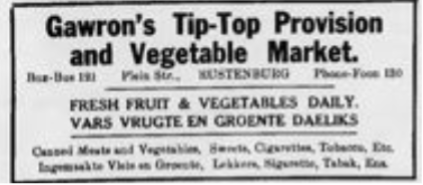
She was the youngest daughter and moved to Rustenburg to join her two older sisters. She married Harry Gawron (1899 Laizuva, Lithuania - 11 November 1973 Rustenburg) on the 3 October 1927 in Pretoria. Harry had emigrated from Lithuania and arrived in Rustenburg at the turn of the 20th century. He was a storekeeper on Burger Street and was a close friend of the Wulfsohn brothers. In 1930 Harry Gawron, his brother-in-law, Isador Lederman, and Michael Sholomir bought the Waterval Native Eating House and Butchery from Sarah Socher and Benny Girnun, and the 3 men traded as the Waterval Trading Company. In 1931 they abandoned the business. In 1932 a partnership with Michael Sholomir in Platinum Supply Stores situated on the farm Kroondal was dissolved. In 1933 the brothers-in-law Gawron and Lederman joined Kock's Meat Market. In 1938 their venture, Rustenburg Trading Company, was declared insolvent. Harry then set up Gawron's Tip-Top Provision and Vegetable Market supplying fruit and vegetables. The business included a bakery producing cakes, biscuits and confectionery which he then abandoned and continued his business as H. Gawron supplier of fruit and vegetables.
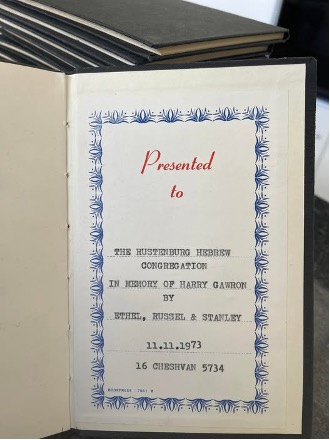
Harry Gawron served on the committee involved in erecting the shul and was a committee member of the Rustenburg Chamber of Commerce. The Gawrons had two sons, Stanley and Russel. Ethel and Harry remained dedicated, lifelong stalwarts of the Rustenburg Hebrew Congregation. When Harry passed away in 1973, Ethel and her sons honoured him by donating "House of Mourning" prayer books to the congregation.
Children:
- Their elder son, Stanley Gawron (17 January 1929 Rustenburg - 20 September 2022 Johannesburg) married Rita Schmidt on 23 March 1958 and settled in Johannesburg.
- Their younger son, Russel Michael Gawron (21 October 1932 Rustenburg - 12 October 2023 Toronto, Ontario, Canada) had his bris melah in Rustenburg. The event was reported in the Rustenburg Herald on 4 November 1932. 'BRIS MELAH. On Monday morning a large number of friends, both Jews and Gentiles, came together at the residence of Mr Harry Gawron to attend the Bris Melah of Mr and Mrs Gawron's infant son. The ceremony was performed by the Reverend Taylor of Johannesburg, assisted by the Reverend Mirkin. After this was duly carried out the friends present sat down to tables laden with eatables and drinks of every description. Addressing the company the Reverend Taylor gave the true meaning of circumcision and Mr Gawron in a short speech addressed the guests. May the young Gawron grow up to follow in his father's footsteps and be as popular as his Dad is.' Russell qualified as a dentist. Following his marriage to Cape Townian Rivea Kuntz (1938 Cape Town – 2025 Toronto, Ontario, Canada) in 1959, he returned to Rustenburg and established a dental practice. He and his wife emigrated Toronto, Canada in the 1960s.
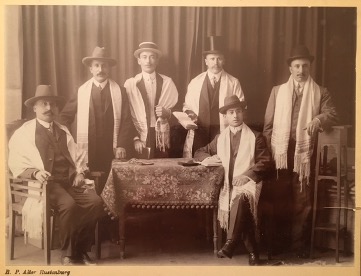
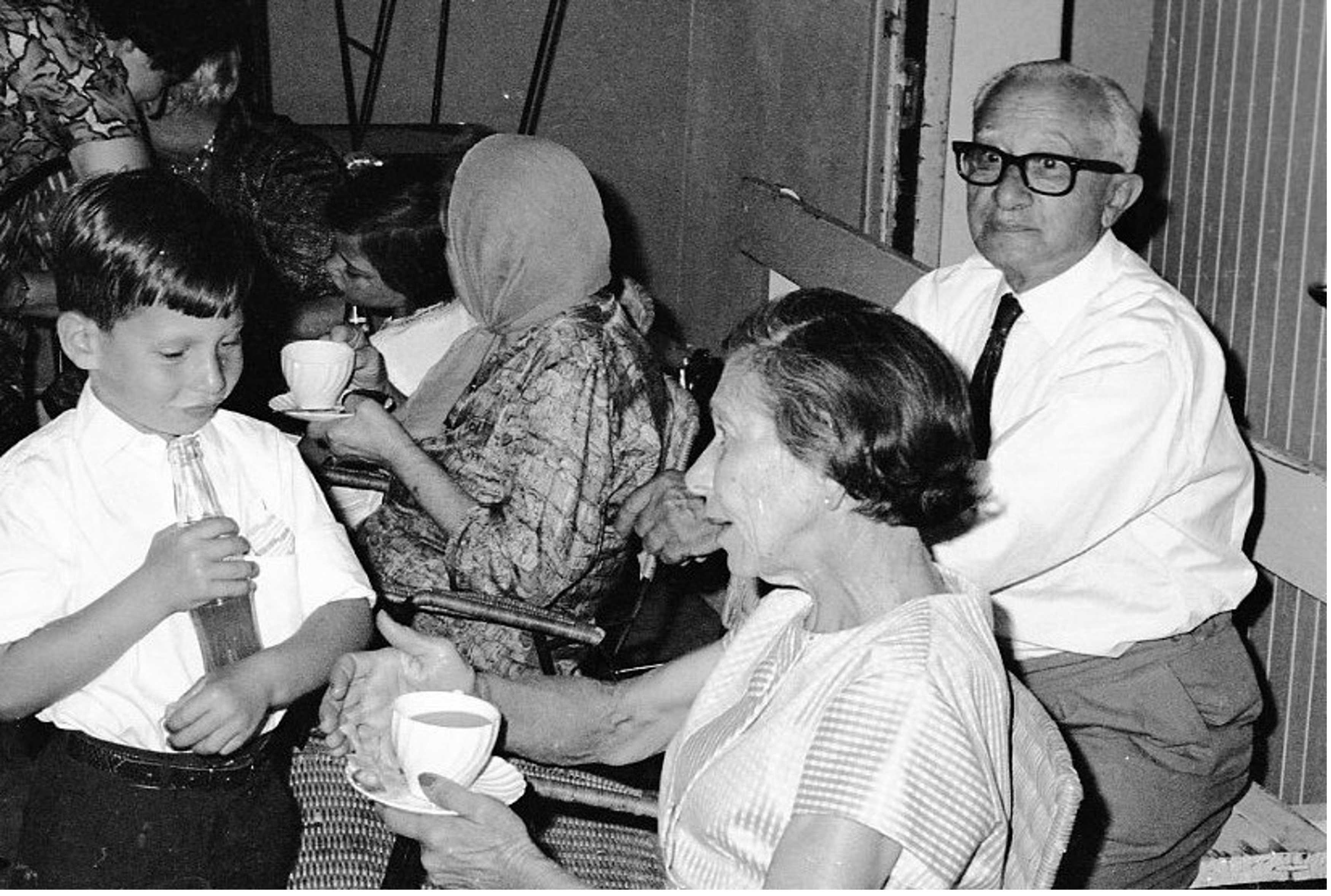
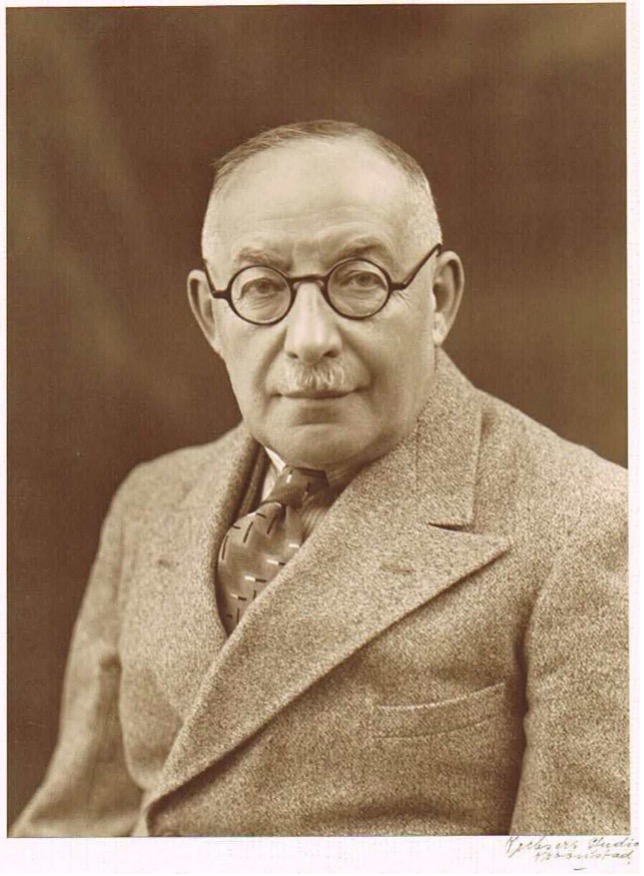
L-R: Moses Simon (seated), Abraham Herman, Solem Elias, Philip, Harry Gawron (seated) and Hyman Ber.
References:
- Rav Moshe Silberhaft's Post.
Rustenburg Herald entries:
- 1930. The Native Eating House and Butchery carried on by Sarah Socher and Benny Girnun, trading as the Waterval Native Eating House and Butchery, has been sold to Harry Gawron, Isodore Lederman and Michael Sholomir, trading as the Waterval Trading Company and will be transferred with effect from the 19th April 1930. Dated at Rustenburg this 5th day of April 1930. Herbert Cranko & Shapiro, Attorneys.
- 1931. The General Dealers Business of native eating, butchery and bakery carried on at Waterval 537 Dist. Rustenburg by H. Gawron, I. Lederman and M. Sholomir trading under the name and title of the Waterval Trading Company, will be abandoned with effect from 31 Dec. 1931. Rustenburg.
- 1931. The partnership carried on by M. Sholomir, H. Gawron and I. Lederman as General Dealers and Butchers on the farm Kroondal No 177 trading as Platinum Supply Stores has been dissolved from 1st May 1931. M. Sholomir is carrying on on his own accord and responsibly.
- 1933. We beg to inform the Public of Rustenburg and District that Messrs. Gawron and Lederman, of the Rustenburg Trading Company, have joined the business hitherto known as Kock's Meat Market, which as from the 1st June trade as Kock's (Pty.) Ltd. Mr. Gawron, who has served the public for the last 20 years, and Mr. N. Kock will personally supervise the business and assure you of the best and prompt attention in the future.
- 1936. In the Insolvent Estate of Harry Gawron & Isidor Lederman, General Dealers, Trading as "Rustenburg Trading Company" at Rustenburg. Transvaal Province. C/18316. Tenders are invited for the purchase of above business as a going concern or alternatively the undermentioned sets, consisting of:- Stock-In-Trade. Shop Furniture. Native Parcels. Live & Rolling Stock. Outstanding Debts. Immovable Property: Stand 31/113, with Brick Store-Room, Stable, Etc. Stand 28/112 with Brick Store thereon. Tenders marked, "Tenders Insolvent Estate, Rustenburg Trading Co. C/18316" must be lodged in duplicate with the Master of the Supreme Court, P.O. Box 441, Pretoria not later than noon on Wednesday, the 17th April 1936.
Goldblatt, Leon
(24 January 1883 Plunge, Lithuania - 29 July 1952 Pretoria)
He was the son of Hirsch Goldblatt (1860 Lithuania - 1928 Cape Town) and Leibeh Chaie Goldblatt née Shlom (1856 Lithuania - 1922 Bloemfontein). During the Second Anglo Boer War he served in the Rustenburg Commando. He was resident on the farm Wagenpadspruit, Rustenburg. On the 1 March 1901 he was captured by the British forces and was sent to a prisoner of war camp in Madras, British India. After the war, he was repatriated to South Africa.
He married Edna Kaplan (d. 1969 Pretoria) in 1913. They had 3 children and the family initially lived in Kroonstad, Orange Free State, before settling in Pretoria.
References:
- NASA. List of Boer prisoners of war. Leon Goldblatt.
Greenberg, Howard Barnett
(1910 Johannesburg - 1976 London, England)
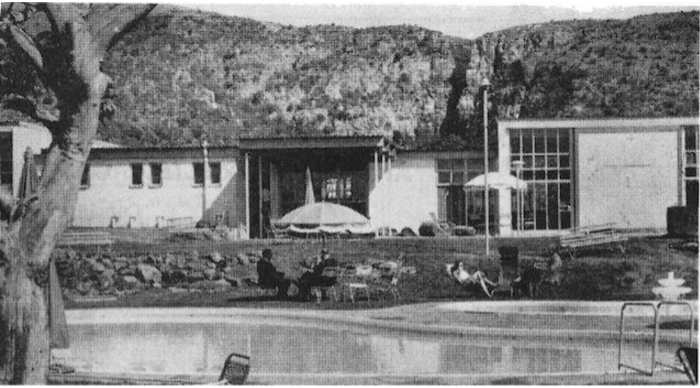
He was the son of Nathan Greenberg (1882-1950) and Ethel Greenberg née Goldsmid (1877-1952). His family lived in Pietersburg, where his parents were the proprietors of the Goldfields Hotel. He was educated at King Edward VII School, Johannesburg. In 1933 he married Millicent Rakusin (1909-1968) and they had 2 children, Valerie Lily (b. 1934) and Bernard Michael (1939-2015). Howard took over the management of the family hotel, Goldfields Hotel, from 1932 to 1947. During World War Two he served in the Union Defence Force. In 1947 the family moved to Johannesburg where he was Managing Director of Gifts Wholesale (Pty) Ltd until 1958. He subsequently moved to Rustenburg and conceived, built and operated the Safari Hotel near the Rustenburg Kloof, which opened in 1963. He and his wife moved back to Johannesburg. Howard died during a visit to London in 1976. Both Howard and his wife are buried in the West Park Cemetery, Johannesburg.
References:
- South African Jewry, 1967-68 Edition. A Survey of the Jewish Community; Its Contributions to South Africa; Directory of Communal Institutions; and a Who's Who of Leading Personalities. Feldberg, Leon (Editor). Greenberg, Howard Barnett, page 265.
- Greenberg family. Pietersburg. Bushveld. Jewish Life in the South African Country Communities, Volume 1: The Northern Great Escarpment, The Lowveld, The Northern Highveld, The Bushveld. The South African Friends of Beth Hatefutsoth. Page 144, 2002.
Hartley, Sybil
(15 April 1902 Krugersdorp - 6 October 1903 Rustenburg)
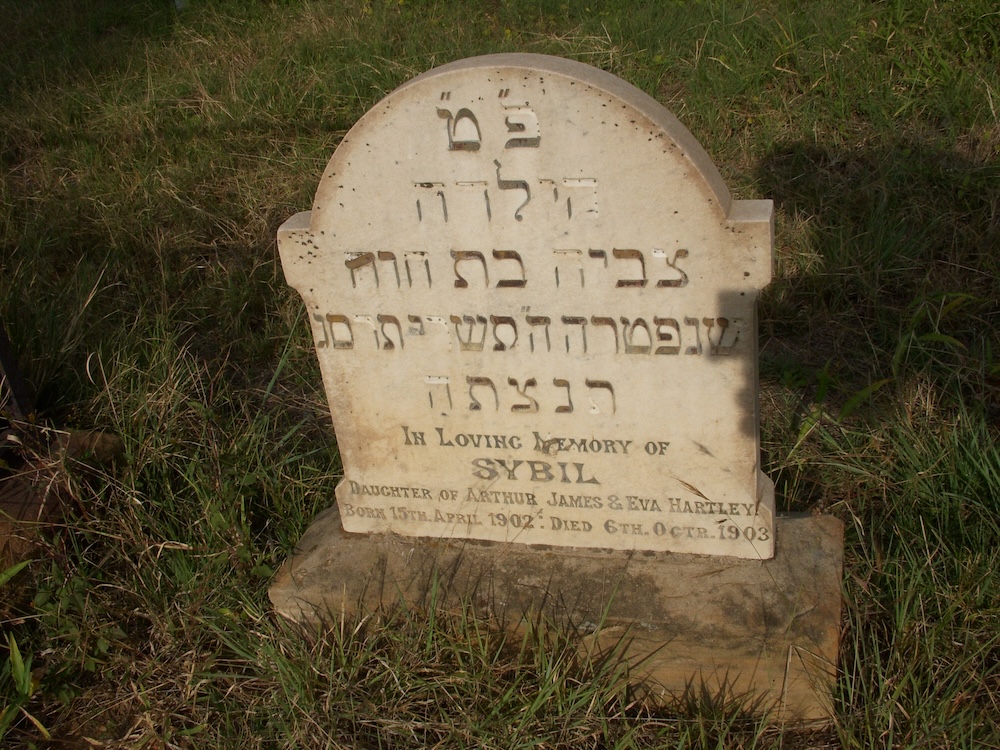
She was the third child of Arthur James 'Jack' Hartley (1873-1923) and Eva Hartley née Klisser (1864-1931) of Vaalbank, district Krugersdorp. Her great-grandfather, Henry Frederick Hartley (1815-1876), was the pioneer of the Magaliesberg tobacco industry. Her father, Jack Hartley, was born in Krugersdorp to parents Frederick Henry and Sarah Fanny (née Jennings). He was sent to Cape Town to school and attended the prestigious Diocesan College (Bishops), where he excelled as an athlete. In 1891, he achieved the highest honour in South African sports, playing as the youngest-ever Springbok rugby player to represent South Africa at international level. Upon returning to the Transvaal, Jack was the financial and managerial brain behind F. H. Hartley & Son, managing tobacco estates that stretched across the Marico and Magaliesberg regions. On the 29 July 1897 he married Eva Klisser in Johannesburg. She was born in Cape Town to Marcus Levie Klisser (1824-1883) and Sarah Klisser née van Gelder (1829-1898), Dutch Jews who had emigrated to the Cape Colony from Amsterdam.
The couple endured heartbreak when their daughter Sybil died of enteritis in Rustenburg in 1903. She was laid to rest in the Rustenburg Jewish Cemetery. She was survived by her parents and 2 siblings, Barnard Klisser (1899-1957) and Beatrice Dorothy Miller (1900-1951). Two brothers, Austin Wallace Hartley (1903-1977) and Maxwell Arthur Hartley (1906-1976), were born after her death.
The family's diverse religious roots were mirrored in their burial places. Jack Hartley passed away in Cape Town in 1923 and was buried in the Muizenberg non-Jewish cemetery. Eva died in 1931 in Johannesburg and was laid to rest in the Brixton Jewish Cemetery, Johannesburg.
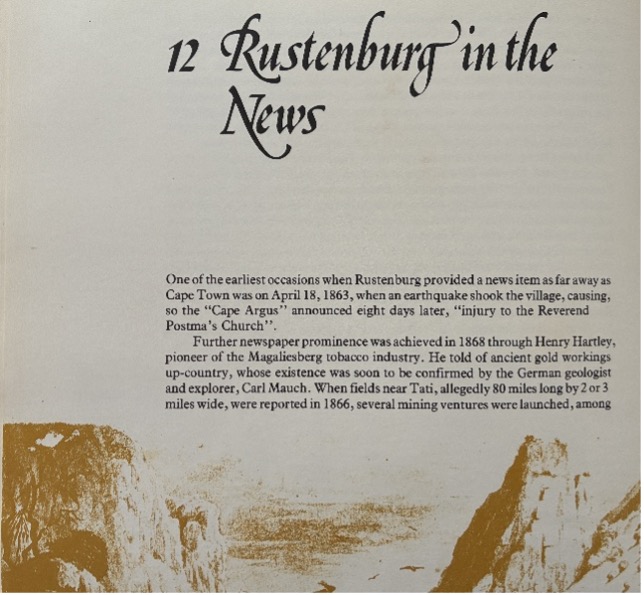
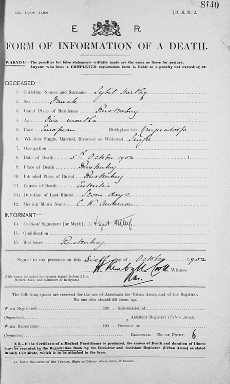
References:
- Chapter 12. Rustenburg in the News. Rustenburg Romance. The History of a Voortrekker Town. Eric Rosenthal. Perskor Publishers, Johannesburg. 1979.
Hermer family
Carl 'Charles' Hermer (1874 Lithuania -1957 Johannesburg), watchmaker and jeweller, and Sarah Frieda Hermer (née Graff) (1890 Lithuania - 1975 Johannesburg), daughter of jeweller Jacob Graff (1858 - 1922 Ermelo) and Jetta Ida Graff née Schmittke (1859 - 1929 Middelburg) of Ermelo, were married on the 20 March 1914 in Ermelo, Transvaal. They settled in Volksrust, where their 3 children were born - Manfred Hermer (23 March 1915 Volksrust - 20 January 2010 Victoria, B.C., Canada), Benjamin Samuel Hermer (24 May 1916 Volksrust – 2 July 2004 Johannesburg) and Miriam Stern née Hermer (23 November 1918 - 18 June 1989 Florida, USA).
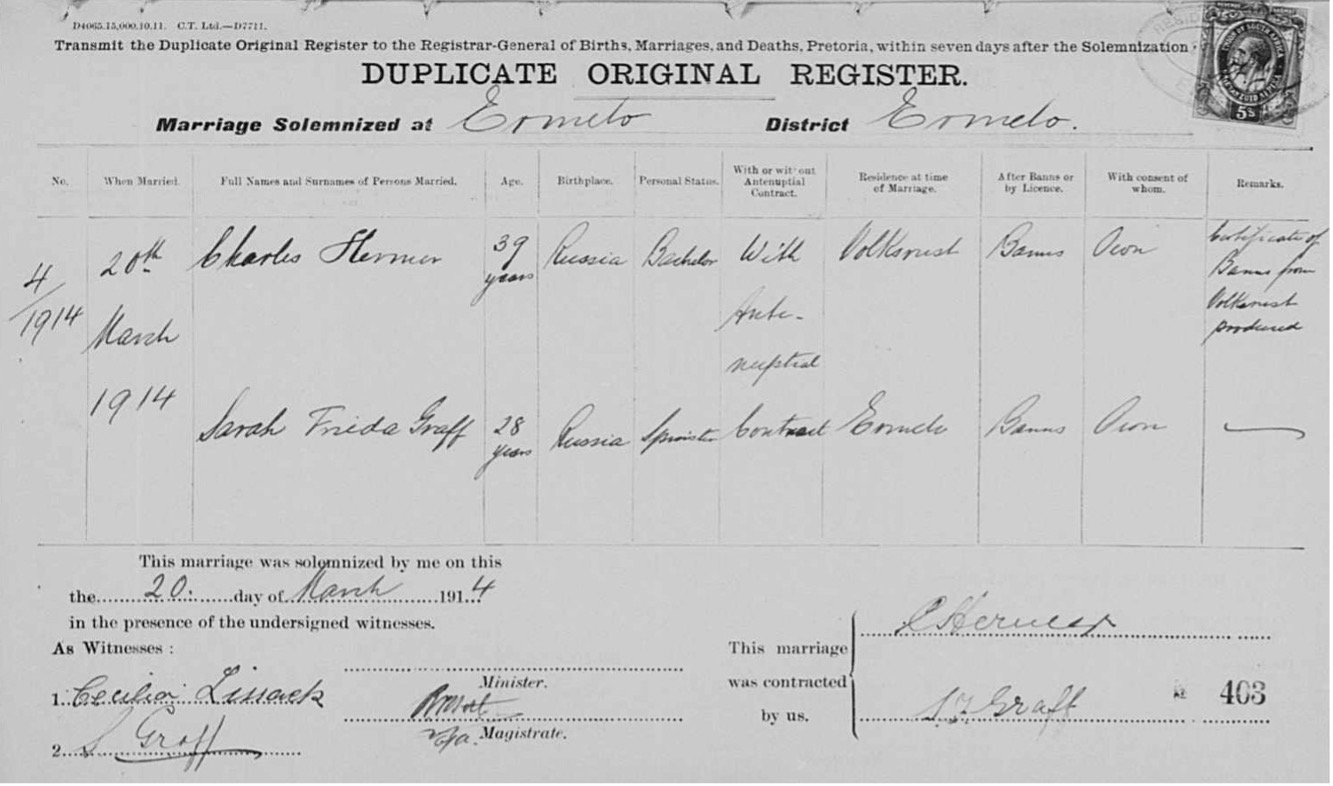
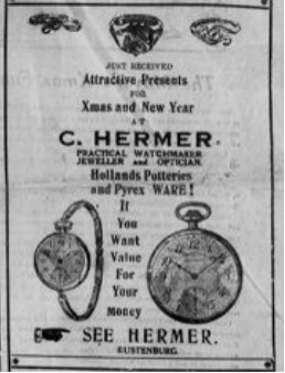
The family moved to Rustenburg, where Carl opened the business C. Hermer, a watch repair, jeweller and optician store in Plein Street. The 3 children attended Rustenburg High School and following their schooling, the two sons, Manfred and Benjamin, studied at the University of the Witwatersrand. Manfred qualified as an architect and Benjamin as a doctor. In 1939 the Rustenburg Herald reported "Mr B.S. Hermer, son of Mr and Mrs C. Hermer, well known Rustenburg residents, has qualified as a Doctor of Medicine at the Witwatersrand University. Dr Hermer was a student at the Rustenburg High School and has done exceptionally well, being now only twenty-two years of age."
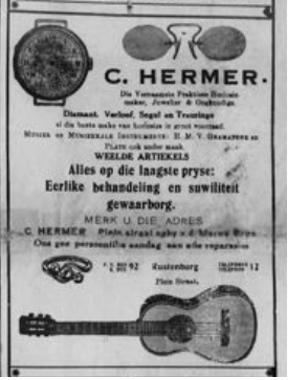
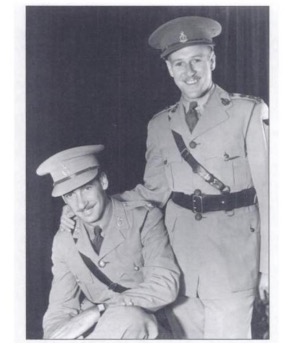
During World War Two the Hermer sons volunteered in the Union Defence Force and both served with distinction. Captain Manfred Hermer served with the South African Corps of Signals in East and North Africa. Captain Benjamin Hermer served with the South African Medical Corps. During the fall of Tobruk in June 1942 Benjamin was captured and imprisoned in Benghazi. He was awarded the Member of the Most Excellent Order of the British Empire for alleviating the prisoners' conditions in the PoW camp following the breakout of dysentery. Whilst waiting to board a prisoner-of-war ship to Italy, he planned an escape and managed to trek through the desert until he was able to rejoin the South African forces. Prior to the war, he had fallen in love with Olda Mehr (24 February 1919 Kroonstad – 30 May 1991 Johannesburg), a concert pianist who during a visit to Germany with her parents in 1939 was arrested with her parents and they were interned. Her father died and Olda and her mother were eventually released as part of a prisoner exchange agreement and sent to the British Mandate of Palestine. Olda was then sent to Egypt on war service and one day whilst walking in the street she passed Captain Benjamin Hermer. Their war adventures and love story made international headlines in Time magazine when they were married on the 22 December 1942 in Cairo.
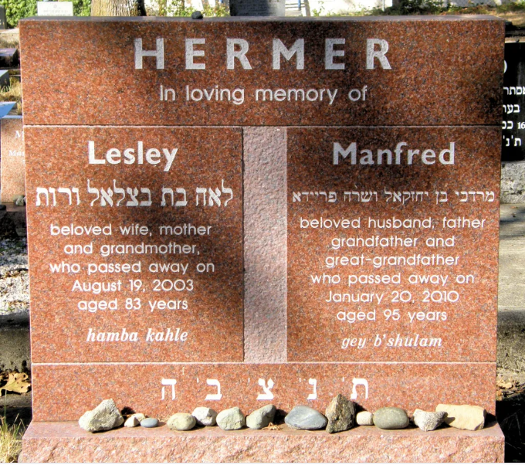
After he returned from the war front, Manfred Hermer married the war widow Lesley Dorette Jacobs née Lazarus (1920-2003) on 24 September 1943. The family resided in Johannesburg, where he worked on numerous architectural projects, particularly involving the building of theatres. He served as Chairman of the South African Jewish Ex Service League and was President of the Jewish Guild. He and his wife had 3 children, and they eventually emigrated to Canada to join their children.
Benjamin and Olda Hermer returned to Johannesburg and had 3 children. He was known as Dr Bennie Hermer and was a well-respected general practitioner in the city. A year prior to his death in 2004, The Piano War was published detailing his and Olda's life story. Olda died in 1991 aged 72 and Bennie in 2001 aged 87. They remain united, buried alongside each other in West Park Cemetery.
Miriam Hermer married German-born Herman Charles Stern (b. 1900 Germany) in 1942 in Johannesburg and they had 4 sons. The family lived in Port Elizabeth, where Herman was a director of companies, and their 2 older sons were born in the city. In 1956 the family emigrated to the USA.
Carl and Sarah Hermer left Rustenburg and settled in Johannesburg. He died in 1957 aged 82 and Sarah in 1975 aged 84. They are buried alongside each other in West Park Cemetery. There is no trace of the family in Rustenburg. However, their sojourn in the town has been preserved in numerous publications, including the Rustenburg Herald newspaper.
References:
- The Piano War. Graeme Friedman, 2003. ISBN: 0 86486 643 7.
Hirschowitz family
Nathan Hirschowitz (9 July 1876 Kemel, Lithuania – 30 October 1958 Windhoek, Namibia) and Sarah Lena Hirschowitz née Levy (1878 Neustadt, Lithuania – 17 April 1964 Windhoek, Namibia) emigrated to South Africa in the late 1890s. Nathan had a weak chest and was advised to move to a drier climate. He and his fiancee, Sarah Levy, left together and they settled in the Rustenburg district. When they got married on the 25 September 1899 in Rustenburg, Nathan was resident at Doornpoort and Sarah at Cyferfontein, district Rustenburg. The newlyweds lived on the farm Doornpoort where Nathan worked as a shopkeeper. During the Second Anglo Boer War, they were arrested and sent to Klerksdorp Refugee Camp 'Concentration Camp' on the 22 June 1901. They were listed as Russian subjects and Nathan's stock was left on the farm. Four days later, they were sent to the Krugersdorp Refugee Camp. After they were released, they settled in Krugersdorp, where their 3 children were born. Following severe financial hardship, as well as health issues, they moved to South West Africa in 1916.
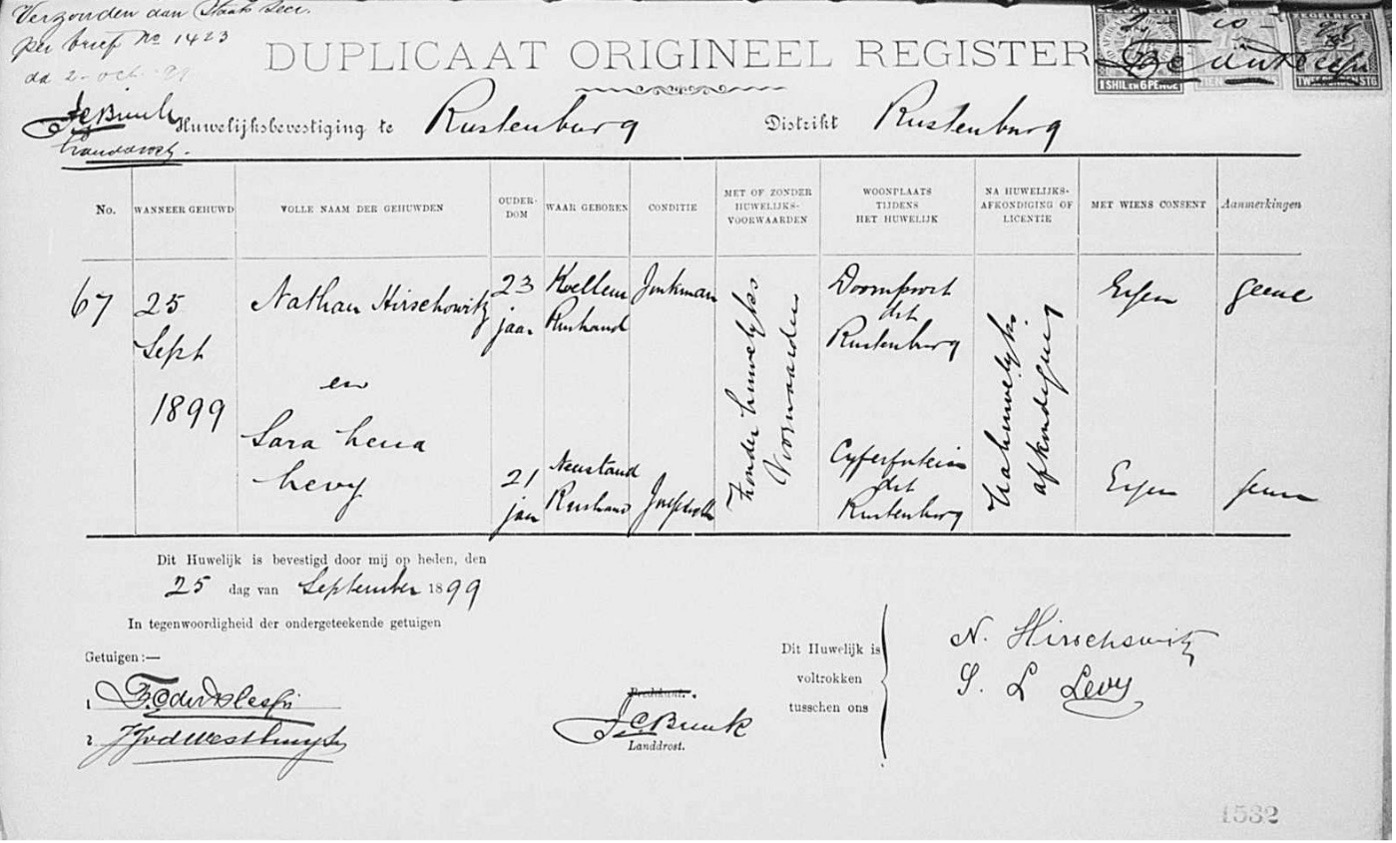
References:
- Jewish Life in South West Africa/Namibia: A History. Authors: Pearle Horwitz, June Horwitz, Richard Newman, Joachim 'Joe' Pütz, Perri Caplan, David Saks, Harold Pupkewitz, Moshe Silberhaft, Candy Müller, Heidi Müller. Windhoek Hebrew Congregation, Windhoek, Namibia, 2014. ISBN 9789994578948.
Hovsha Family
Eliezer Yeshayahu Hovsha (24 April 1909 Skuodas, Lithuania - 1985), known as Leizer, was born to Chaim Aharon Hovsha (1869 - 1930 Skuodas) and Khaya Hovsha née Bay (1875 - 1929 Skuodas). His grandfather was a famous Rabbi in Skuodas and his father was a teacher who founded both the primary and high schools in Skuodas and dedicated his life to teaching.
Leizer emigrated from Lithuania to South Africa, where he met and married Flora Galinsky (1926-2021). The couple settled in Rustenburg. In 1944 he purchased Rustenburg Jewellers in Plein Street from Benjamin Louis Lichtenstein. The Hovshas raised three sons: Hymie, named after his paternal grandfather, Joseph, and Michael. The family were involved in the Rustenburg Jewish community. Despite a dwindling community, Flora continued to run a strictly kosher home, infusing her children and grandchildren with a love of Judaism. Decades later, her granddaughter, Nicole Salkow, wrote:
"I left Rustenburg when I was 11. I attribute my knowledge of Judaism to my bobba's love and dedication to the religion. We were one of the few remaining Jewish families left in Rustenburg when I was a little girl, but this never stopped my bobba from keeping a meticulously kosher home and following all the rich festivals."
When Leizer Hovsha died in 1985, he was interred in Har HaMenuchot, the Mount of Olives cemetery in Jerusalem. Flora moved to Johannesburg, spending her final years at the Sandringham Gardens Old-Aged Home before passing away during the Covid-19 pandemic in 2021. Through the dedicated efforts of the Chevra Kadisha, Flora was flown to Israel to be laid to rest alongside her husband at Har HaMenuchot. Leizer's tombstone carries the inscription "From the city of Rustenburg, South Africa", confirming the family's presence in Rustenburg. Flora was survived by two sons, seven grandchildren, and six great grandchildren.
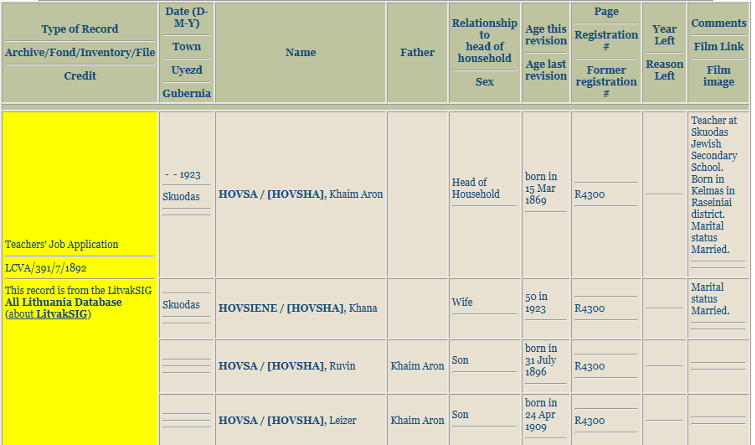
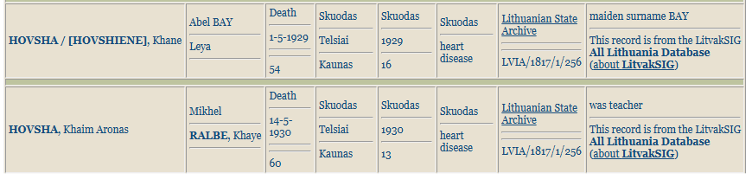
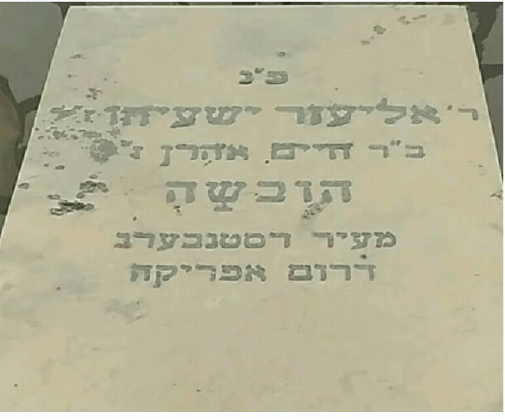
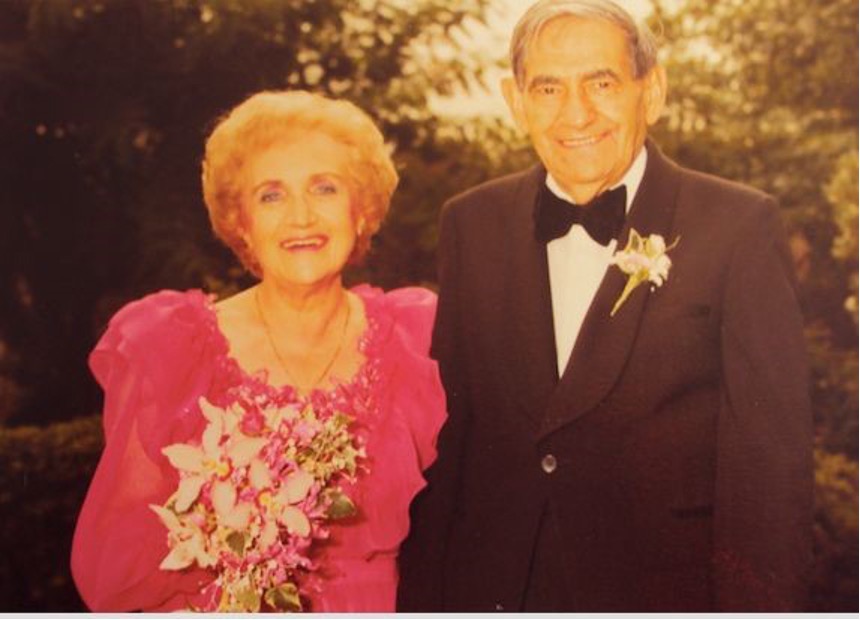
Rustenburg Herald entries:
- 1944. Notice is hereby given that the General Dealer’s Business carried on by Benjamin Louis Lichtenstein as The Rustenburg Jewellers at Plein Street, Rustenburg, has been transferred to Leizer Hovsha as from 1st January 1944. The liabilities of B. L. Lichtenstein are not being taken over by Leizer Hovsha. LEIZER HOVSHA, Box 192, Plein Street, Rustenburg.
Isaacs, S.
Mr S. Isaacs served on the committee responsible for the erection of the shul.
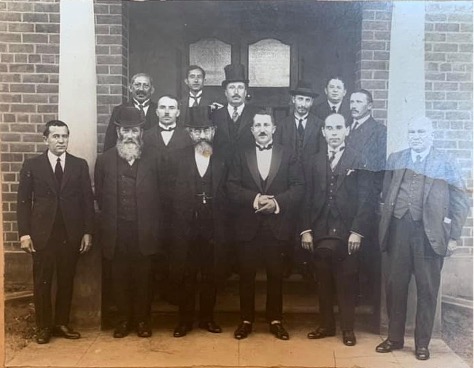
Back row: S. Isaacs, H. Gawron, M. Wulfsohn, F. Sholomir.
Front row: M. Sholomir, N. Kirsch, B. Harris, Chief Rabbi Dr. Landau, H. Wulfsohn, Rev. D. Leibovitz, M. Kadey, P. Wulfsohn, S. Mundel.
Isserow, Gilbert
(1901 Lithuania – 9 May 1947 Rustenburg)
Gilbert Isserow and his younger brother, Hymie Isserow (1905 - 1971 Johannesburg), emigrated from Žeimelis, Lithuania, to South Africa. He initially was a general dealer in Geduld, district Springs. In September 1932 he married Fanny Dolistovsky (1904 - 1973 Johannesburg) in Johannesburg. The family settled in Rustenburg and lived at Kruis Street. They had two daughters, Joy and Murial. Gilbert was a butcher and died suddenly at the age of 48. He was buried in Rustenburg.
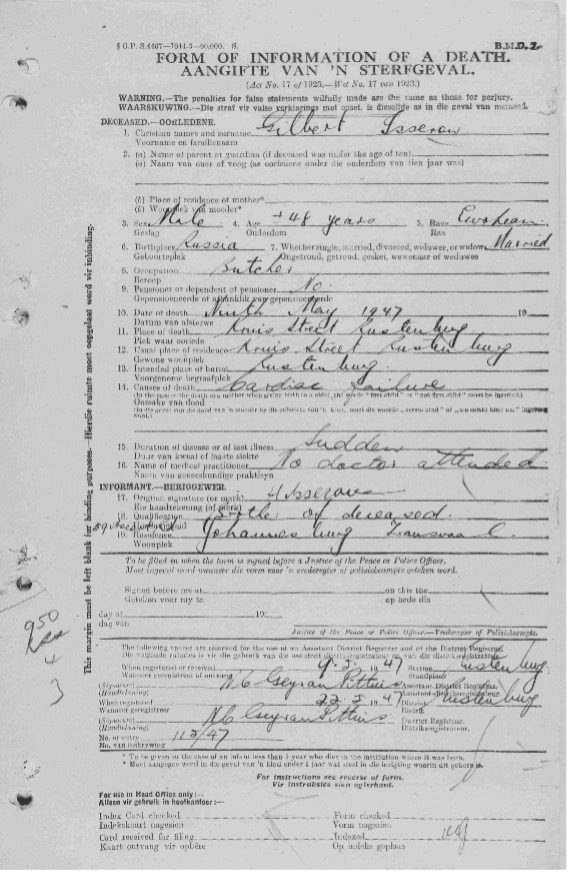
Rustenburg Herald entries:
- 1948. TRANSFER OF BUSINESS. Notice is hereby given that the General Dealer's Business carried on by FANNY ISSEROW on Erf No. 1034, corner of Smit and Van Zyl Streets, Rustenburg has been sold, with effect from 1st September 1948 to HENRY HOFFMAN who will under his account carry on the business name on his own account. de Villiers and Pohl, Attorneys for the parties, Steen Street, P. O. Box 146. Rustenburg.
Jacobsohn, Friedenthal and Laserstein families
Numerous family members from Posen Province, Kingdom of Prussia, German Empire, settled in Rustenburg. One family was the descendants of Joseph Jacobsohn and Auguste Jacobsohn née Friedenthal (1806-1886) of Gollantsch, Prussia (Gołańcz, Poland). Two of their children, Jacob Jacobsohn (1837 Gollantsch, Prussia - 1898 Berlin, Germany) and Flora Friedenthal née Jacobsohn (1840 Gollantsch – 1915 Berlin, Germany), had connections with Rustenburg.
Jacob Jacobsohn and his wife Ida Jacobsohn née Rice (1841-1890) emigrated to South Africa in the 1860s. Their 8 children were all born in South Africa - Oscar Jacobsohn (1868 Burghersdorp - 1941 Middelburg), Annie Saenger née Jacobsohn (1869 Cape Colony - 1955 Cape Town), Joseph Edward Jacobsohn (1870 Burghersdorp - 1967 Boksburg), Kurt (Kauffman) Jacob Jacobsohn (1872 Fauresmith - 1959 Vereeniging), Fritzie Koenigsbert née Jacobsohn (b. 1874 Fauresmith), Max Jacobsohn (1875 Barkly West - 1936 Brits), Martin Jacobsohn (1876 Transvaal - 1964 Pretoria) and Traugot Jacobsohn (b. 1885 Transvaal). The family initially settled in Burghersdorp, Cape Colony, in the early 1860s. The family then moved to Fauresmith, Orange Free State, then on to Barkly West, Cape Colony, and finally to the Transvaal Republic. In the 1880s Jacob Jacobsohn, his wife and some of their children went to Germany. Jacob Jacobsohn returned to South Africa in February 1887 with his nephew, Joseph Friedenthal, the son of his sister, Flora Friedenthal. Jacob's wife, Ida, returned to South Africa in September 1888 from Berlin with her children Annie aged 20, Kurt 13, Fritzie 12, Max 11, Martin 10 and Traugott 3. The Jacobsohn family were resident in the Rustenburg district when Ida Jacobsohn died in September 1890. She was the first person to be buried in the Rustenburg Jewish Cemetery. Jacob Jacobsohn returned to Germany. In July 1893 he announced the engagement of his daughter Fritzie to Bernhard Koenigsbert in Johannesburg in the newspaper, Berliner Tageblatt. At that time, he was living in Langsberger Street, Berlin. Jacob Jacobsohn died in 1898 in Berlin. During the Second Anglo Boer War, his son Kurt Jacobsohn served with the Boers. Kurt was captured in the Waterberg district and sent to Bermuda.
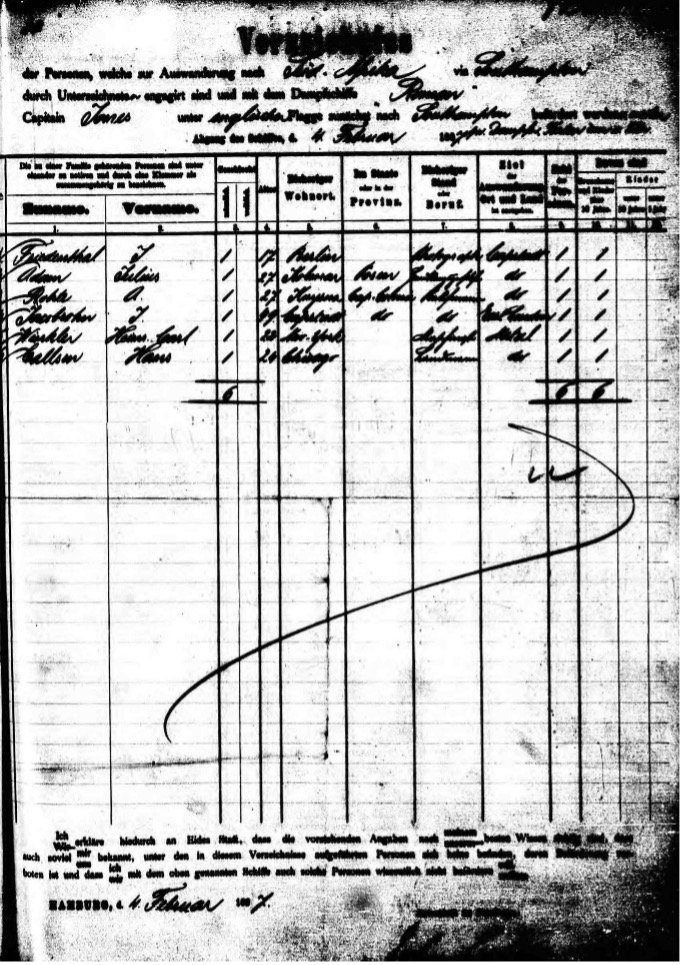
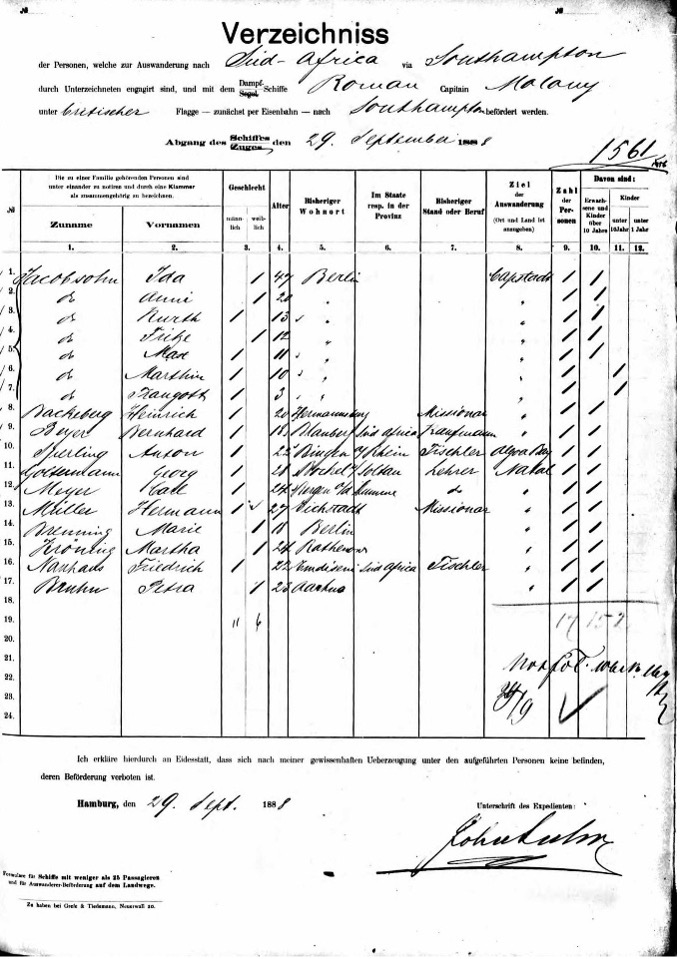
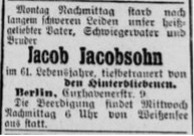
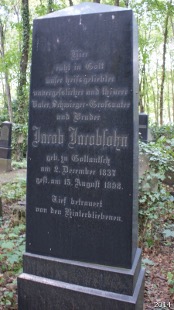
Jacob Jacobsohn’s sister, Flora Jacobsohn, married Simon Friedenthal, and two of their children, Lea Laserstein née Friedenthal (1865 Germany – 1915 Berlin, Germany) and Joseph Friedenthal (1869 Berlin – 1937 Springs) emigrated to South Africa. When Jacob Jacobsohn returned to South Africa from Germany in February 1887, his nephew, Joseph Friedenthal, aged 17, accompanied him. Joseph’s sister, Lea Friedenthal, emigrated to South Africa on the 10 May 1889 from Hamburg via Southampton for Cape Town. She settled in Commissie Drift, Rustenburg. On the 3 June 1890 she married Oskar Laserstein (1856 - 1935 Berlin, Germany) in Rustenburg. Laserstein had emigrated to South Africa in 1882. He was a merchant (Kaufmann) and travelled from Hamburg, Germany, via London to Cape Town and settled in the village of Rustenburg. One of the witnesses at the Laserstein - Friedenthal marriage was Kurt Machol, a Prussian Jew, whose mother was from Gollantsch, Prussia. Laserstein was a mineral water manufacturer and was the owner of the bar in the village. In 1894, when the National Bank of the Zuid Afrikaansche Republiek opened a branch in Rustenburg, Laserstein and Kurt Machol were among the bank's first customers. After the Second Anglo Boer War in 1903 Laserstein submitted a claim for compensation as he was a foreign subject from Rustenburg. In 1908 the Lasersteins returned to Germany, leaving from Natal on the Union Castle liner Kenilworth Castle via Southampton, England. They settled in Berlin. Lea Laserstein died at the age of 50 on the 8 June 1915 in Berlin. She was childless. Following her death, Oskar married Betti Lazarus née Heimann on the 3 April 1919 in Berlin. Oskar died at the age of 78 on the 25 June 1935 in Berlin.
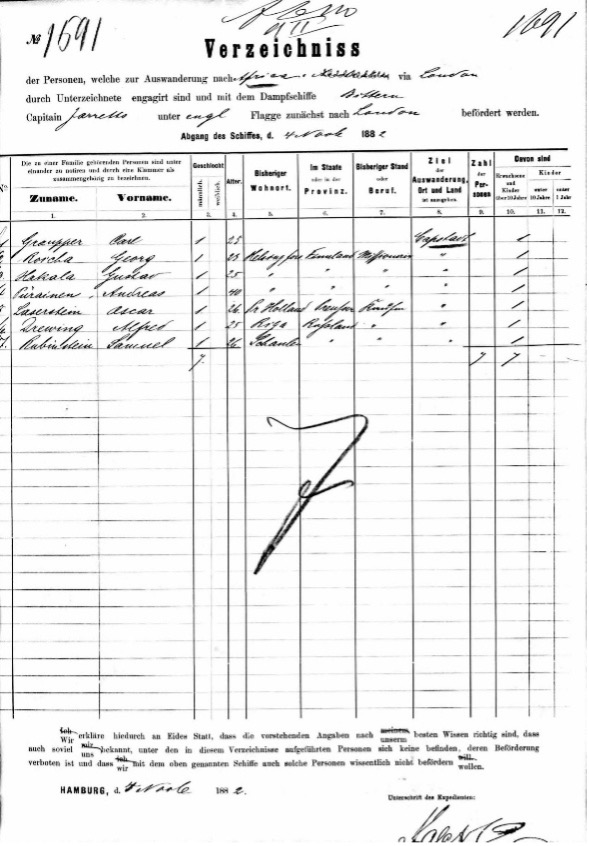
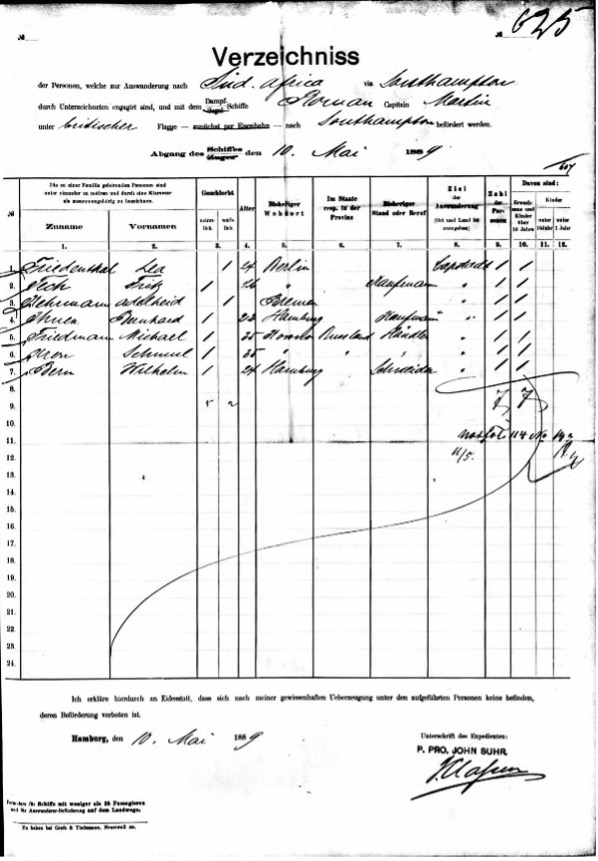
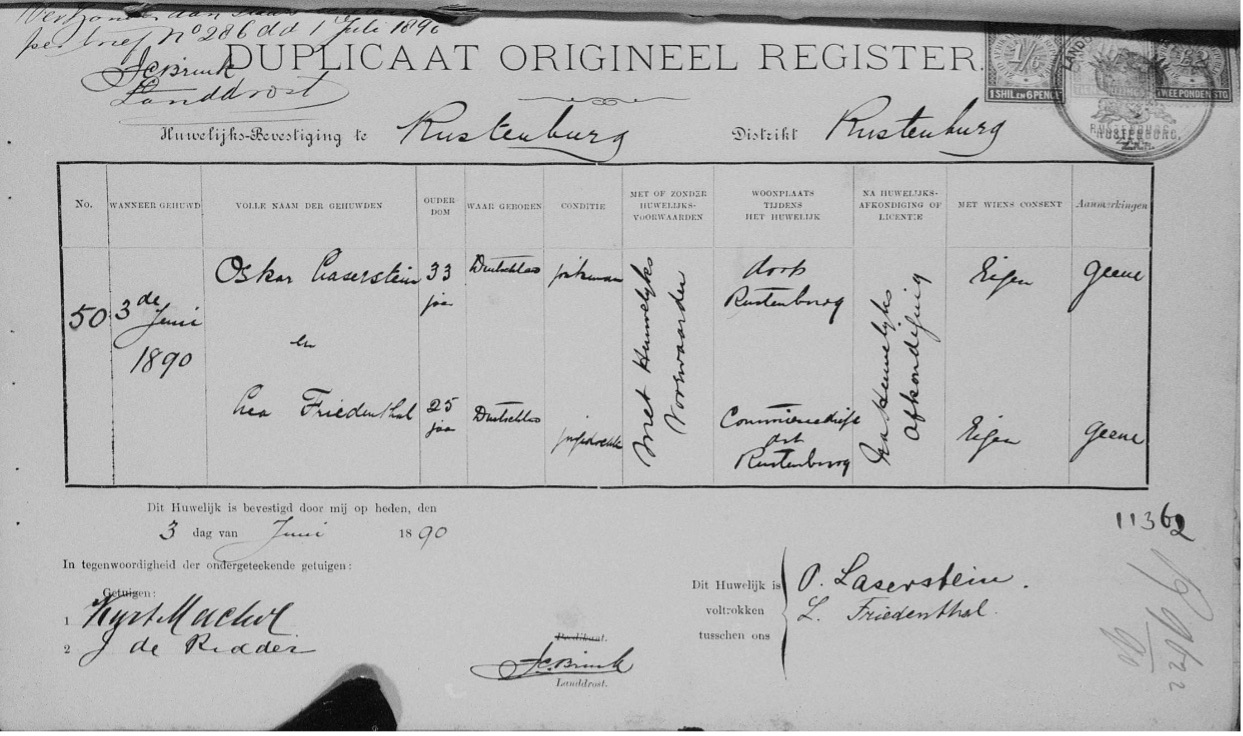
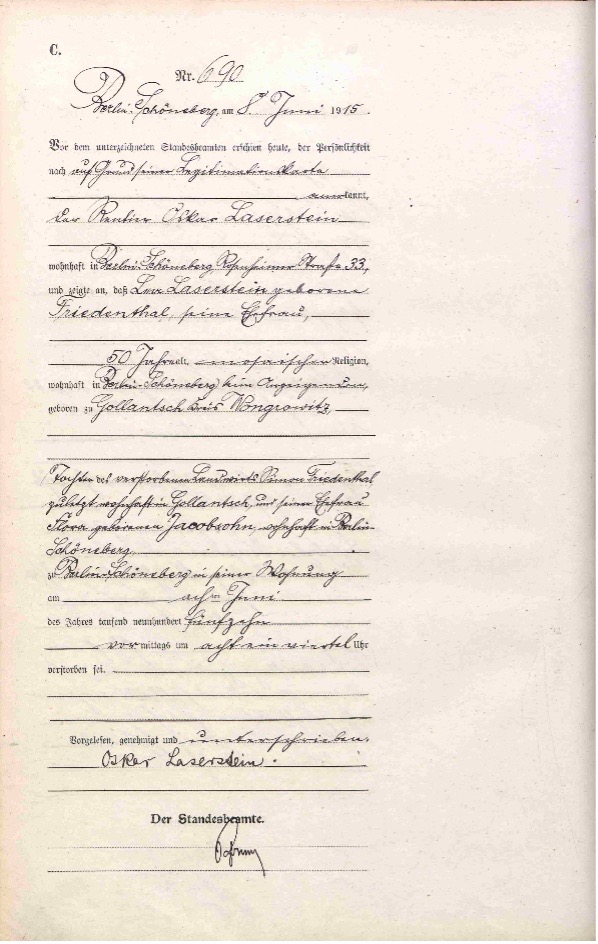
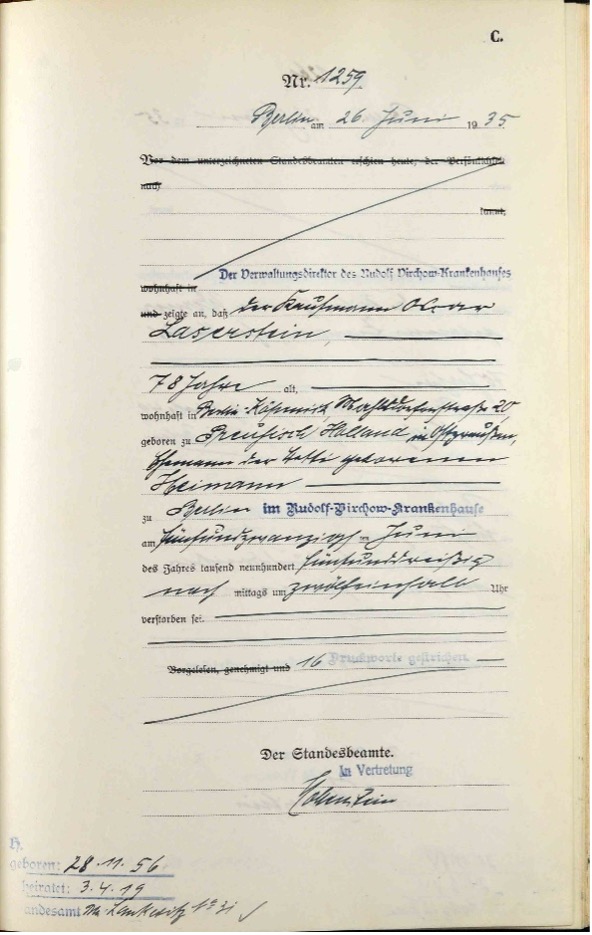
Joseph Friedenthal remained in Rustenburg, where he was a general dealer. After the Second Anglo Boer War in 1903 he also submitted a claim for compensation as he was a foreign subject from Rustenburg. He married Louisa Florence Lily Rahn in 1912 in Pretoria. At the time of their marriage, his wife was resident on the farm Kameeldrift, district Rustenburg. The Friedenthals had 5 children. The family subsequently moved to Dunnottar, Nigel. Joseph Friedenthal died in 1937 and is buried in Springs.
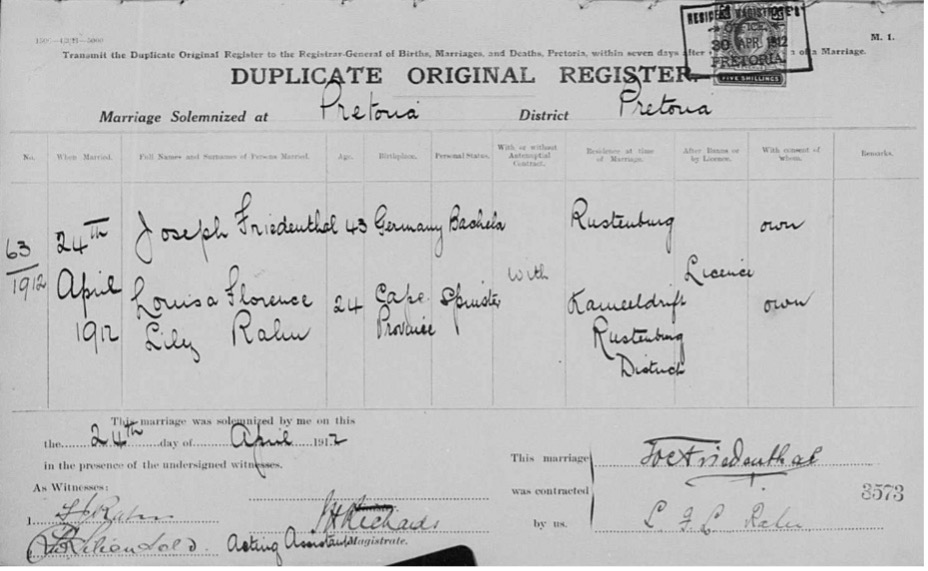
No descendants of the Jacobsohn, Friedenthal or Laserstein families remained in Rustenburg. The only trace of their presence in the village was the grave of Ida Jacobsohn and numerous archival documents.
References:
- Chapter 21. Into the 20th Century. Rustenburg Romance: The History of a Voortrekker Town. Eric Rosenthal. Perskor Publishers, Johannesburg. 1979, page 115.
- NASA:
- 1891. Publieke aanklager Rustenburg. Zendt verklaring van Oscar Laserstein in zake coach diefstal Rustenburg Pretoria.
- 1891. Publieke aanklager Pretoria. Zendt terugtrekking borgtocht van Joseph Jacobson door Laserstein.
- 1895. Duitsche Consul Pretoria. Zendt in een schrijven van O. Laserstein, Rustenburg, waarin hij klaacht dat van hem 5 Pond is opgecommandeerd en van anderen, waarom der de grootste koopluislechts 3 pond - vraagt terugbetaling der 2 pond.
- 1900. Hoofd Inspecteur van Kantoren Pretoria. Landdrost Rustenburg zendt in rekeningen K Machol en Company $95 voor Laserstein $11 en G.H. Malan $24.
- 1901. Mr Friedenthal's request to Military Governor to get a parcel of business books back, which he left by Mr Laserstein and a Native Chief J Mogalie from Bethani.
- 1903. Claims for compensation Foreign Subjects. Rustenburg. Oskar Laserstein.
- 1903. Claims for compensation Foreign Subjects. Rustenburg. Joseph Friedenthal.
- 1909. J Friedenthal, District Rustenburg. Immunisation of Mules.
Joel, Louis
(1867 Samotschin, Germany (Szamocin, Poland) - 5 August 1910 Rustenburg)
He was the eldest son of Markus Joel and Johanna Annie Joel née Aufrecht of Samotschin and emigrated with a brother to South Africa. On the 30 August 1892 he married Esther 'Hester' Rachel Klisser (1872 Cape Town - 1932 Johannesburg) in Johannesburg. His wife was the youngest daughter of Marcus Levie Klisser (1824-1883) and Sarah Klisser née van Gelder (1829-1898), Dutch Jews who had emigrated to the Cape Colony from Amsterdam. The couple settled in Rustenburg and lived at Erf No. 79 Loop Street with their 2 daughters, Olga, b. 1893, and Eileen, b. 1900. Esther Joel's older sister, Eva Hartley née Klisser (1864-1931), lived nearby in Vaalbank, where her husband, Arthur James 'Jack' Hartley (1873-1923), a farmer, managed vast tobacco estates. Esther Joel's infant niece, Sybil Hartley, was buried in the Rustenburg Jewish cemetery. Following Louis Joel's death at the age of 43 years in 1910, the Joel family moved to Johannesburg.
Kabrun family
Berel Kabrun (20 July 1910 Pakruojis, Lithuania - 28 May 1973 South Africa), son of Yehud Kobrin and Ella (née Maister) of Linkuva, emigrated to South Africa with his brother Philip Kabrun (1904-1981). Berel initially settled in Johannesburg before moving to Cape Town, where he worked as a butcher. His wife, Ida Froom, born on 29 April 1916, in Altoona, Pennsylvania, USA, grew up in a household of seven sisters. When Ida was 3 years old, her father, Samuel George Fromm, aged 30, passed away. Her mother, Fanny Fromm (née Raff) (1883-1950), made a decision to leave the United States, and the family emigrated to South Africa and settled in the coastal town of Muizenberg.
On 3 September 1942, Berel Kabrun and Ida Froom were married in the Great Synagogue, Cape Town. They had four children, Dr Selwyn Kabrun (b. 1946) and three daughters, Reinet Belnick née Kabrun (b. 1944), Felicity Glazer née Kabrun (b. 1948) and Fay Smolinksy née Kabrun (b. 1951). The family left Cape Town and settled in Klerksdorp. The family ultimately moved to Rustenburg. Ida passed away in Rustenburg on 13 September 1979, having been preceded in death by Berel on 28 May 1973. They are buried in the Rustenburg Cemetery.
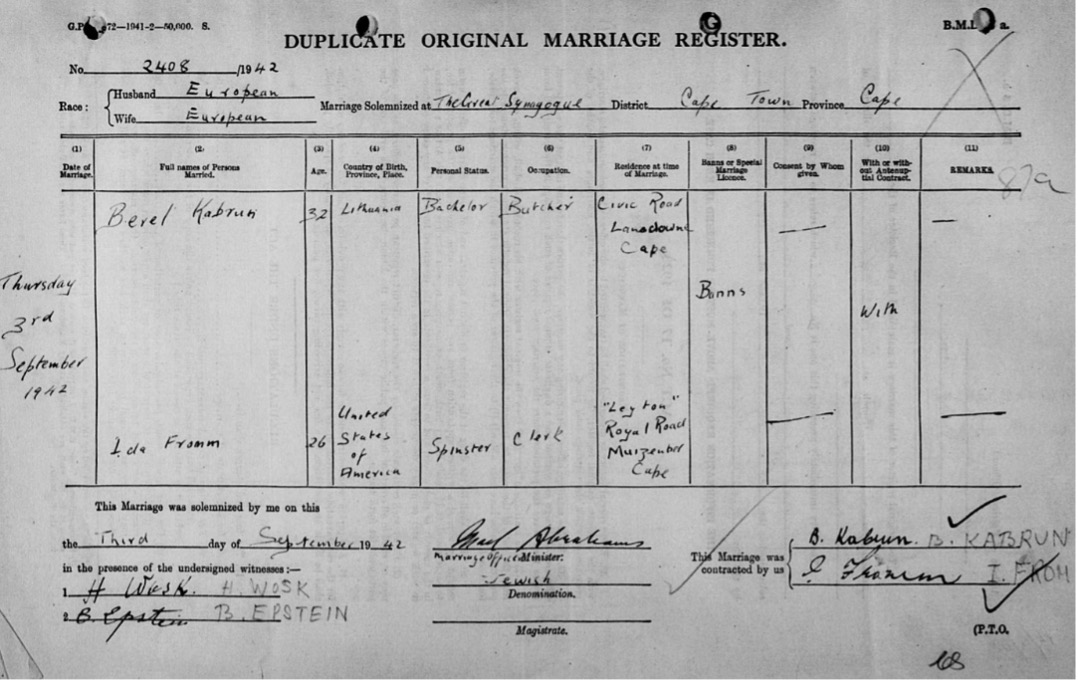
Kadey family
Two sons of Julius Kadey (originally Kadishewitz) (1861 Russia - 1934 Piet Retief) and Leah Kadey née Wies (1867 Panevėžys, Lithuania - 1929 Johannesburg) of Piet Retief, lived in Rustenburg.
- Morris David Kadey (1890 Lithuania - 1984 Johannesburg), a watchmaker, married Rally Lazarus (1896 Russia - 1959 Bulawayo, Rhodesia) on the 25 January 1923 in Johannesburg. They settled in Rustenburg and in 1924 he served on the committee responsible for building the Rustenburg Synagogue. The Kadeys had 3 children, Jeanette Hackner née Kadey (1924 - 2008 Durban), Heleen Graham née Kadey (1927 - 1997 Cape Town) and Leonard Kadey (1934 - 2007 Cape Town). Morris and Rally Kadey moved to Rhodesia to be near to their daughter, Heleen, who lived in Bulawayo. Following Rally's death in Bulawayo in 1959, Morris remained in Rhodesia and remarried. After his second wife, Hannah Ethel Kadey, passed away in Bulawayo in 1968, Morris returned to South Africa to live out his final years. He passed away in Johannesburg in 1984 at the advanced age of 94.
- Jack Kadey (1898 Lithuania - 21 February 1976 Johannesburg) resided in Rustenburg for a period of time. He was a commercial traveller. In March 1939, at the age of 40, he married the widow Annie Apple née Bernstein (1906-1987 Johannesburg) in Johannesburg. In September 1939 the Rustenburg Herald reported that 'Mr. Jack Kadey, formerly of Rustenburg, now of Johannesburg, is in town for a few days'.
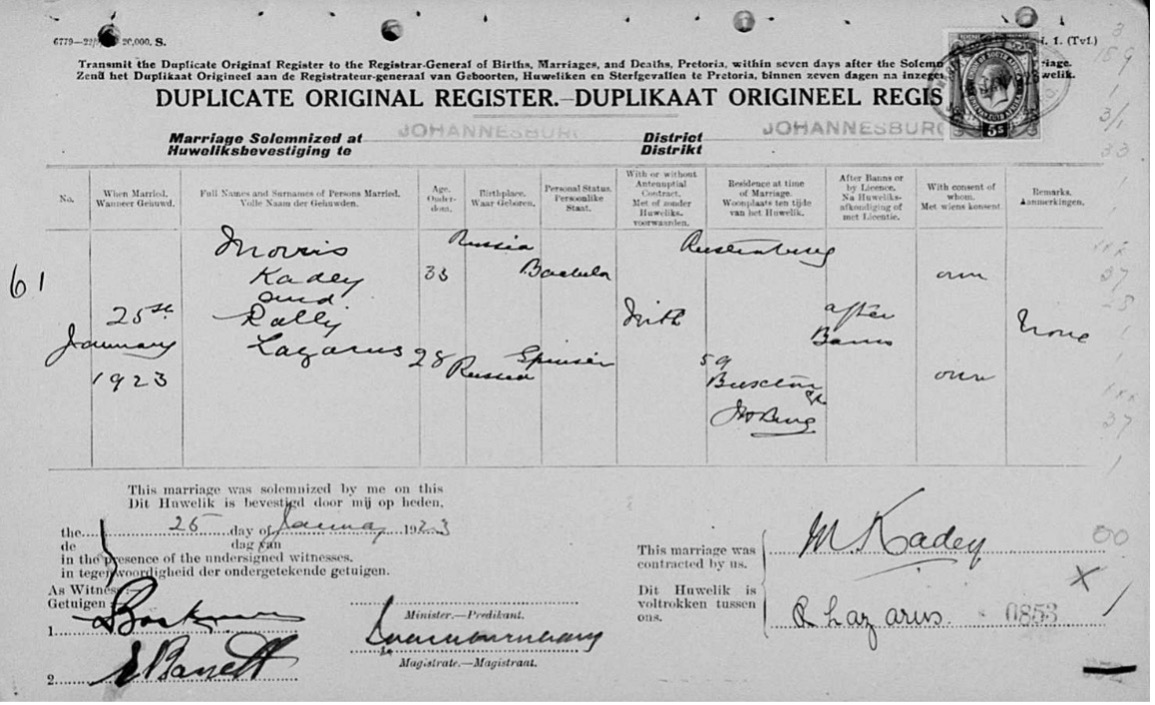
Back row: S. Isaacs, H. Gawron, M. Wulfsohn, F. Sholomir.
Front row: M. Sholomir, N. Kirsch, B. Harris, Chief Rabbi Dr. Landau, H. Wulfsohn, Rev. D. Leibovitz, M. Kadey, P. Wulfsohn, S. Mundel.
Kahn, Frume Leia
(1871 Keidan, Lithuania – 7 August 1941 Rustenburg)
She was the daughter of Chaim Yacov and Khaya Kushner of Kedainiai. In 1899 she married Yakov Ber Kagan. Their surname was changed from Kagan to Kahn upon their arrival in South Africa. They lived in Kerk Street, Rustenburg. She died at the age of 70 in the Rustenburg Hospital and was buried in the Old Cemetery. Her tombstone was inscribed stating that she was from the town Keidan.


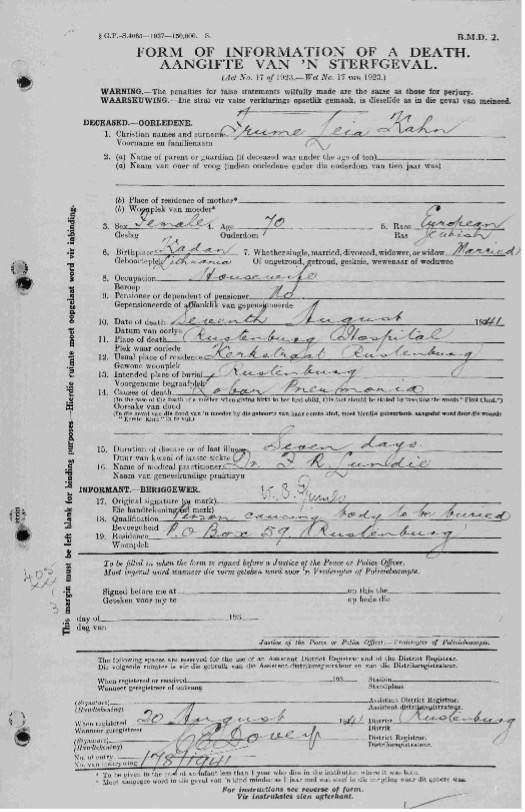
Karstaedt, Benno 'Bennie' David
(12 June 1920 Dordrecht, Cape Province – 15 February 2003 Johannesburg)
He was the son of Noah and Annie Karstaedt née Berghaus. He grew up in the Eastern Cape and qualified as a chemist. In the 1940s, he ran B.D. Karstaedt, Rustenburg Pharmacy, at 137 Plein Street. In 1945 he moved to Springs. He remained a partner in Rustenburg Pharmacy until 1950, when the partnership was dissolved.
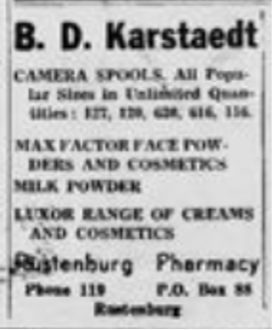
Rustenburg Herald entries:
- 1945-07-20. Mr. B. Karstaedt, formerly of Rustenburg and now residing in Springs, was in town on Sunday, and wishes to be remembered to all his friends. He still considers "Rustenburg home!"
- 1950-07-01. Notice is hereby given that the partnership business hitherto carried in by HARRY STERN and BENNO DAVID KARSTAEDT under the style or firm of Rustenburg Pharmacy at 137 Plein Street, Rustenburg has been dissolved with effect as at the 30th June 1950. And further take notice that as and from the 1st July 1950 the said HARRY STERN and BARNEY RESS will continue to trade in partnership under the same style and firm and at the same address for their joint benefit. All the assets and liabilities will be taken over by the said STERN and the said RESS. B. STERN & CO. Attorneys for Parties. 29 Sauer's Bldgs. Loveday St., Johannesburg.
Katz, Aaron 'Koppie' Hyman
(1909 Seda, Lithuania - 29 November 1949 Rustenburg)
He was the son of Moses Katz (1877 - 1942 Cape Town) and Sara Rosa Katz née Selikowitz (d. 1920 Lithuania). Following the death of his mother, Aaron and his father emigrated to South Africa and they settled in Cape Town. His sister Rochel (1904-1942) remained in Lithuania and perished in the Holocaust. Aaron worked as a produce merchant in Cape Town and in April 1932 he married Annie Hoffman (1913-1984). Their daughter Rosalind 'Babsie' Thora Katz (1934 Cape Town - 2015 USA) was born two years later. The family moved to Rustenburg, where he worked as a general dealer. They lived in Loop Street. Koppie died of a heart attack at the age of 40. His widow and daughter Babsie moved to Johannesburg. Babsie qualified as a doctor at the University of the Witwatersrand and married Dr. Elliot Chelser (1932-2019). The Chelsers emigrated to the USA in 1977.
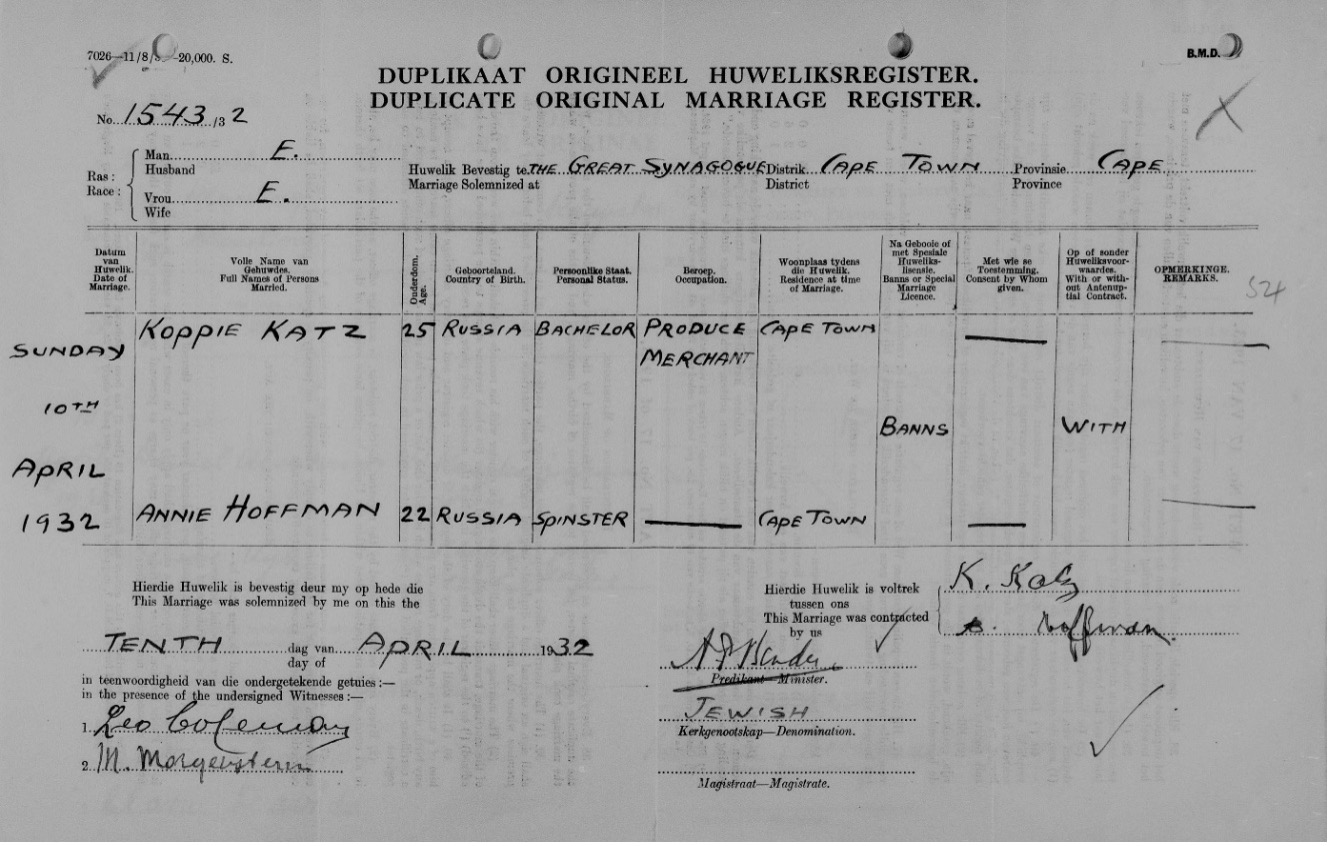
Katzenellenbogen family
Lawrence Katzenellenbogen (25 May 1913 Pretoria - 16 July 1985 Rustenburg) was the son of Goodman Katzenellenbogen (1890 - 1969) and Maisie Katzenellenbogen née Melman (1894 - 1980) of Pretoria. His wife, Florence 'Flo' Goldberg (1916 Cape Town - 2009 Johannesburg), was born in Cape Town to Jackson Goldberg (1887 - 1973) and Lily Goldberg (1893 - 1968) and her family lived in The Strand or Somerset West.
During World War Two Lawrence served in the Union Defence Force. He was a Sergeant Major in a supply unit and was sent 'up North'. Whilst on active service, he married Florence Goldberg on the 23 January 1944 in Cape Town. They had two children, Ivan and Merlene, and the family lived in Rustenburg. They were active members of the congregation and Flo was a member of the Rustenburg Women's Zionist Society Their son, Ivan, and his family live in Cape Town and their daughter, Merlene Daniels, lives in Johannesburg. Following the death of Lawrence in 1985, his widow Flo moved to Johannesburg.
Kirsch, Liebenthal and Harris families
Noah Kirsch (2 September 1859 Lithuania - 15 July 1943 Rustenburg) and Mina Leiba Kirsch née Katz (1859 Lithuania - 1935 Rustenburg) had 8 children - 4 daughters and 4 sons: Sarah, Olga, Lena, Meyer, Harry, William, Louis, and Polly. When the family emigrated to South Africa, their eldest daughter, Sarah Nowitz (d. 1975), and her husband, Rubin 'Robert' Nowitz (1883-1961), remained in Latvia and only emigrated to South Africa after the birth of their 3 children, Samuel (d. 1990), Freda (1914-1996) and Rashel (1914-2011). Their second daughter, Olga Appelstein, emigrated to America with her 4 children and their third daughter, Lena Liebenthal, remained in Latvia until 1921, when she joined the family in South Africa.
Noah, his wife, and 2 of their 8 children, William Kirsh and Polly Kirsch, settled in Rustenburg in about 1904. William opened a coffee bar tearoom and tobacconist in Plein Street. When William left to settle in Potchefstroom, his father, Noah, took over the running of the business. Noah was an observant Orthodox Jew and spent his time studying the Torah and Talmud. He was very involved in the Jewish community, serving on the committee responsible for building the synagogue and at one time served as President of the Rustenburg Hebrew Congregation.
Children:
- William Kirsh (1889 Pakruojis, Siauliai, Lithuania - 1948 Johannesburg) left Rustenburg and settled in Potchefstroom, where in 1921 he founded the first malt factory in the town. He returned to Lithuania in 1929 to marry Dveire Pessa Greenblatt (1906-1981) in Siauliai. The newlyweds returned to Potchefstroom, South Africa, and they had four children, Solomon, Naphtalia (Natie), Isaac and Edith (Ete). When William died at the age of 58, his wife continued to manage the malt factory and was assisted by their son Natie. In 1958 Natie launched his first own venture, founding a corn milling and malt business in Eswatini. Today, Natie is a billionaire businessman and philanthropist.
- Lena Liebenthal (1889 - 15 July 1970 Johannesburg), her husband, Isadore Liebenthal (1875 Tukums, Latvia - 21 February 1938, Rustenburg), and their 3 children, Bertha aged 8, Benzion Chaim aged 2 and Myer aged 1, emigrated from Latvia to South Africa in 1921. Isadore Liebenthal took over the management of the family's tearoom 'Restaurant Keepers' in Plein Street from Noah Kirsch in the early 1930s. When Isadore passed away in 1938, his wife ran the tearoom. Their daughter Bertha (1916-1980) became an accomplished pianist and music composer, and married Aaron Marks. Their son Myer Liebenthal (10 December 1919 Latvia - 31 December 2009) settled with his family in Cape Town. Their middle son, Benzion Chaim (Hyman) (1918 - 1944 Potchefstroom) was institutionalised at the Witrand Institution for Feebleminded, a mental hospital in Potchefstroom, where he died at the age of 26 in 1944. Lena Liebenthal subsequently left Rustenburg and died in Johannesburg.
- Polly Kirsch (1898 Russia - 20 February 1993 Johannesburg) was the youngest child and lived with her parents in Rustenburg. In 1917 she married Bernard Harris, a fellow Lithuanian immigrant who had arrived in Rustenburg in 1908 and was a shopkeeper. They were married on the 18 February 1917 in Pretoria. The couple had 4 children and the family initially lived on the corner of van Staden and Berg Street. Their children were Nathan, Jean, Raie and Max. Bernard Harris served with his father-in-law on the committee responsible for the erection of the Rustenburg Synagogue.
- Nathan Harris (14 February 1918 Rustenburg - 31 March 2014 Toronto, Canada) served in the South African Engineering Corps during World War II and was seconded to the Royal Engineers in North Africa. He was badly wounded and had to have his leg amputated. At the end of the war he married Joyce Marcus (1919-1998) on the 26 June 1945 in Johannesburg. Turning his personal adversity into a lifelong mission of empathy, he served as the chairman of the Avalon Home for the Disabled. He lived to the age of 96, spending his final decades in Toronto, Canada.
- Jean Harris (16 December 1919 - 7 December 2010 Johannesburg) married Harold Bernstein, whose younger brother Lionel Rusty Bernstein (1920-2002) was an anti-apartheid activist and co-drafter of the Freedom Charter. Their daughter, Ann Bernstein, is the founder and executive director of the Centre for Development and Enterprise (CDE), a leading think tank which focuses on South Africa's economic growth and democratic consolidation.
- Raie Harris (d. 20 September 2023) married Harry Maloon (1920-2003), a widower, and they lived in Germiston. They had 4 children and two of their sons qualified as doctors.
- Max Harris (23 February 1922 - 6 June 2016 Johannesburg) qualified as a mechanical engineer at the University of Witwatersrand. He enlisted in the Union Defence Force in early 1943 and was wounded in Italy in June 1944. He married Rosalind Pearl Gordon (d. 1973) on the 21 October 1948 in Johannesburg and they had 3 children. He was an industrialist and founded the first electrolytic manganese plants in South Africa - Electrolytic Metal Corporation (Emcor) in Krugersdorp and Delta Manganese in Nelspruit.
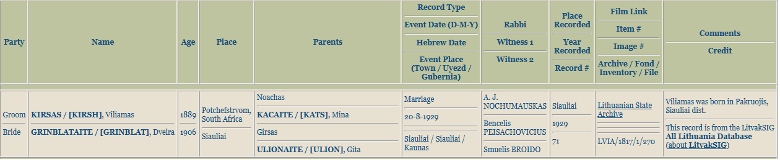
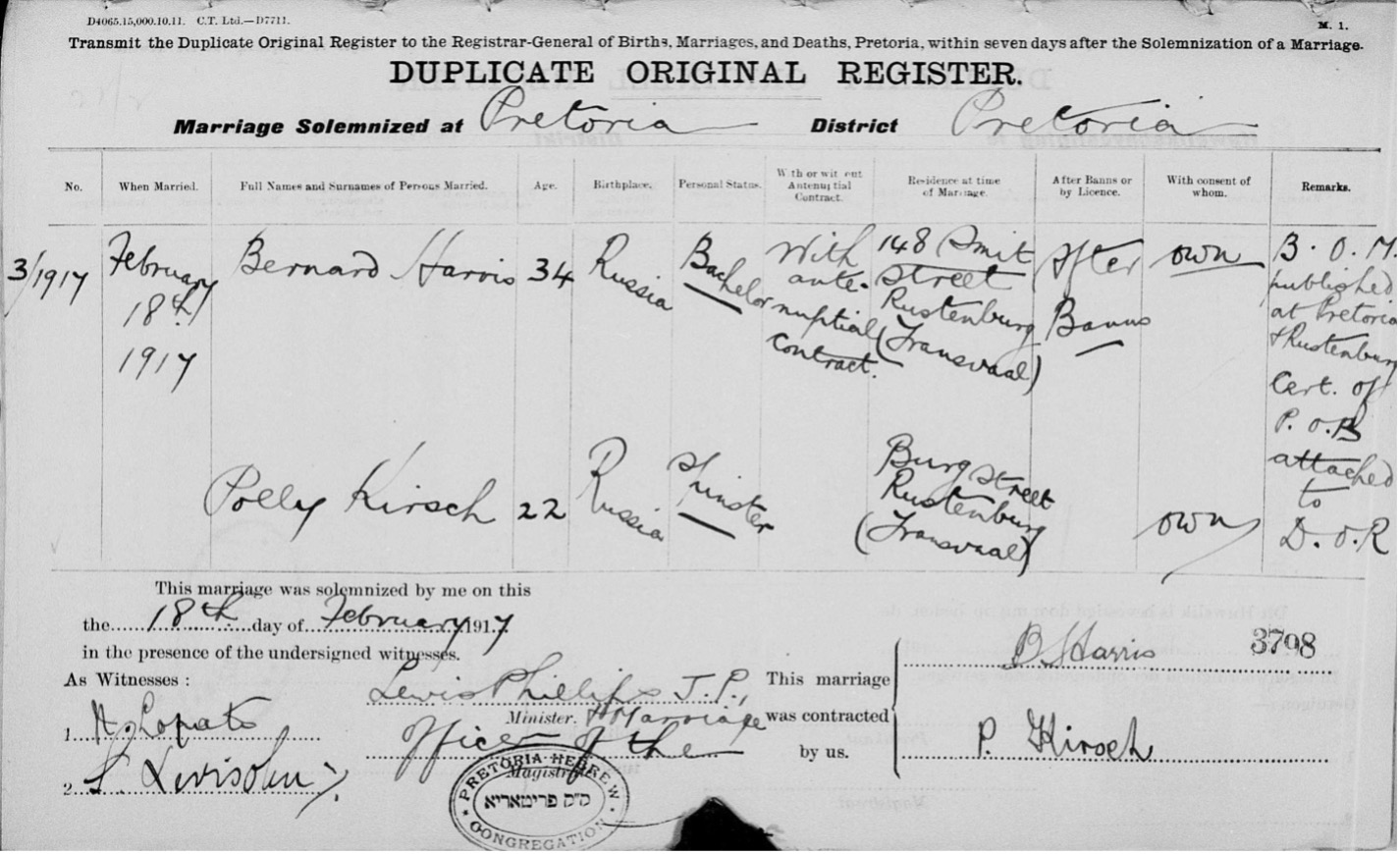
Harris children:
Back row: S. Isaacs, H. Gawron, M. Wulfsohn, F. Sholomir.
Front row: M. Sholomir, N. Kirsch, B. Harris, Chief Rabbi Dr. Landau, H. Wulfsohn, Rev. D. Leibovitz, M. Kadey, P. Wulfsohn, S. Mundel.
When Noah Kirsch died in 1943, he bequeathed to his daughter Lena Liebenthal his portion of Erf No. 47 Rustenburg and his interest in the tearoom, 'Restaurant Keeper' in Plein Street. He was concerned about the long-term care of his disabled grandson, Benzion Chaim, and instructed that upon her death all that was bequeathed to her was to devolve and become the property of her son. The rest of his estate was distributed equally amongst his other 20 grandchildren.
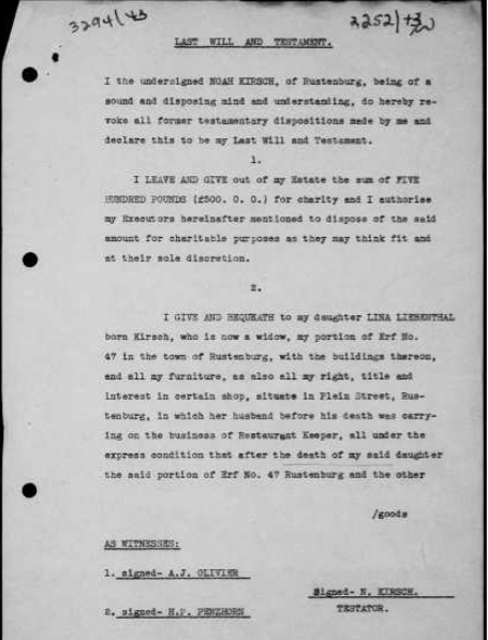
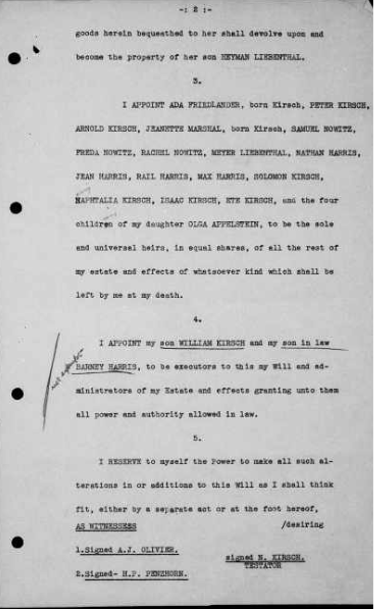
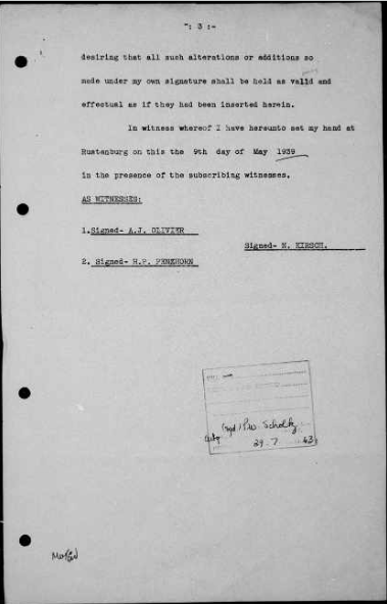
References:
- Harris M., Meyer D. M., Auerswald K. The production of electrolytic manganese in South Africa. Journal of the South African Institute of Mining and Metallurgy, February 1977, pages 137-142.
- The Golden Years: A Memoir of Old Rustenburg. A Jewish Father Christmas. Chapter 11. Lionel Wulfsohn, 2011, Watermark Press, Plettenberg Bay, pages 82-85.
Rustenburg Herald entries:
- 1944-06-23. Mr. Meyer Liebenthal, youngest son of Mrs. L. Liebenthal, of Rustenburg, was married, on Sunday, in the Berea Synagogue to Miss Ann Herr of Johannesburg.
Kopelowitz, Ivan
(1933 Transvaal - 19 November 1948 Zwartruggens)
He was a scholar and was the son of Benzion Kopelowitz (1894-1952) and Leah Kopelowitz née Skuy (1913-1995) of Zwartruggens. He had a brother, David. His father was a storekeeper and farmer. Ivan died at the age of 15. He was electrocuted when he accidentally touched a live electrical wire. He was buried in Rustenburg as there was no Jewish cemetery in the village of Zwartruggens.
Kramer and Kacev families
Two brothers, Zundel 'Sidney' Kramer and Shmulia 'Sam' Kramer and their families lived in Rustenburg during the mid-20th century, where they ran a concession store on one of the platinum mines. They were joined by the family of Berel Kacev, brother-in-law of Sidney Kramer.
Kramer family:
Yudel Kramer (1872 – 1926 Salat, Lithuania) married Cerna Levitan (b. 1878) on the 28 February 1902 in Pasvalys, Kaunas, Lithuania. He was a tradesman and they had 5 children, Zundel 'Sidney’ born 1905, Esther born 1907, Khaya born 1909, Shmulia 'Sam' born 1916 and Girsh born 1918. During World War One, in May 1915, the family was exiled from Kovno Gubernia, and they spent 6 years in Kharkov, Ukraine. Their two younger sons were born during this period. After the war, the family returned to Lithuania, passing through the frontier quarantine station in Obeliai where Yudel Kramer had to fill out a questionnaire as to why he was returning to Lithuania. The family were allowed re-entry to Lithuania in September 1921 as Yudel owned a house in Lithuania and his father was resident in the country.

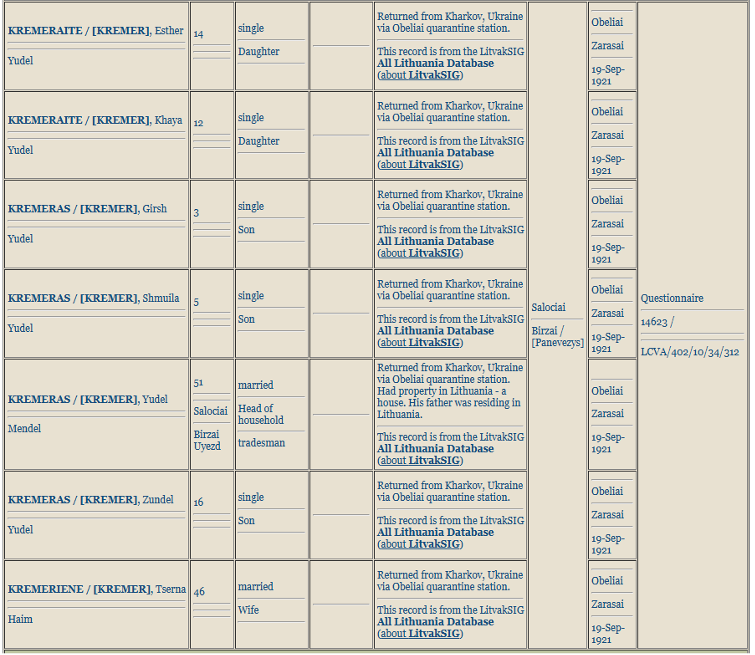
The Kramers' two sons, Sidney and Sam, subsequently emigrated to South Africa and settled in Springs. The families then moved to Rustenburg and subsequently to Klerksdorp.
- Sidney Kramer (1905 - 1994) married Channah Kacev (27 December 1916 - 15 June 2007), an immigrant from Plungė, Lithuania. They had 4 sons, Julius 'Jules', Theo, Cecil and Russell. The family initially lived in Springs. In 1964 Sidney and Channah moved to Rustenburg with their youngest son, Russell. Their son Theo subsequently moved to Rustenburg in the late 1960s. The family were involved in the Jewish community and Channah ran the children's programme at the shul. Their third son, Cecil, who served as a volunteer in the Six-Day War in Israel, died tragically in a motor vehicle accident in 1970 and was buried in Pretoria. In the 1970s Sidney, Channah and their son Theo and his family contributed to the building fund for the Jacob Finkel Cultural Hall. Sidney and Channah subsequently settled in Klerksdorp. Sidney Kramer died in 1994 and was buried in Klerksdorp. Channah passed away in 2007 and was buried in Pretoria, next to her son Cecil.
- Sam Kramer (1917-2011) was born in Sevastopol, Russian Empire (Ukraine), while his family were in exile. He married Evelyn Buskin (1922 Johannesburg - 2010) on the 27 October 1946 in Springs. At that time, he was working as a general merchant in Dunnottar, Springs. They had 4 children, Julian Yehuda, Melvyn Hilton (1951-2017), Serna and Colin. Their daughter was named after her paternal grandmother. Their eldest son, Julian, was a prefect at Rustenburg High School and then studied anthropology. He moved to Norway and worked at the University of Bergen. His research in the late 1970s and 1980s focused on minority populations within Norwegian society and in particular he studied the integration of Punjabi immigrants in Drammen. In the 1970s the Kramer family left Rustenburg and moved to Klerksdorp. The 2 brothers, Sam and Sidney, were once again involved in running concession stores on the mines. Sam was the doyen of the Klerksdorp Jewish community and was involved in running the shul services. Their son Melvyn Kramer lived in Klerksdorp and was also active in the Jewish community. Serna moved to Johannesburg and their youngest son, Colin, settled in France. Sam and Evelyn are buried in the Klerksdorp cemetery.
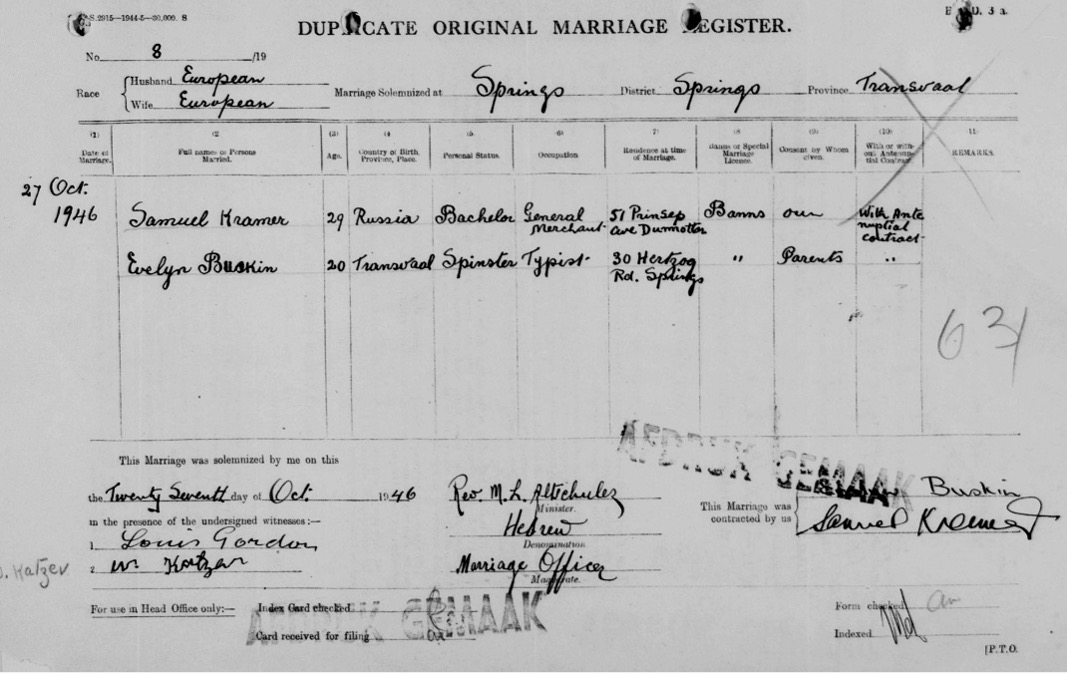
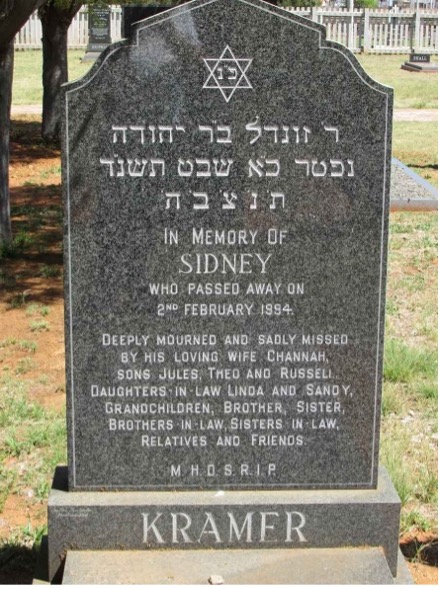
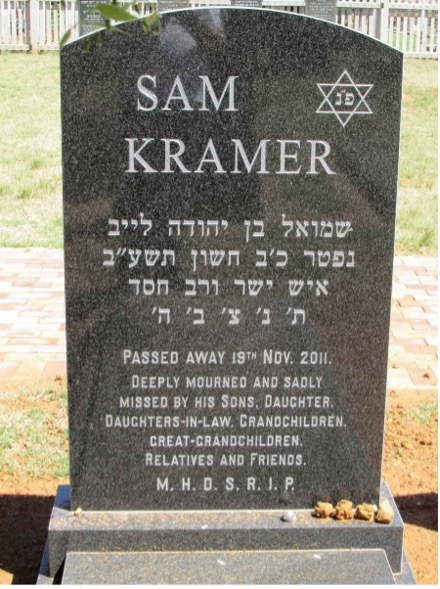
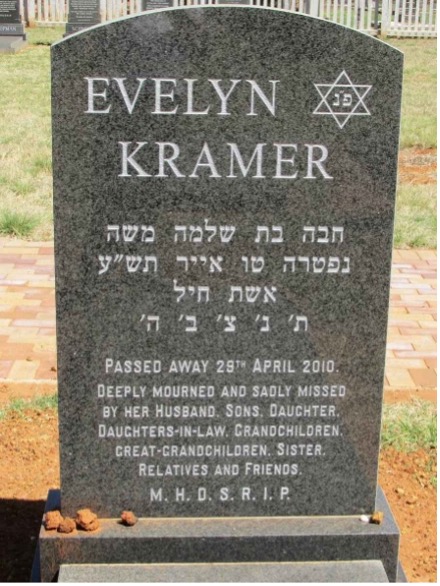
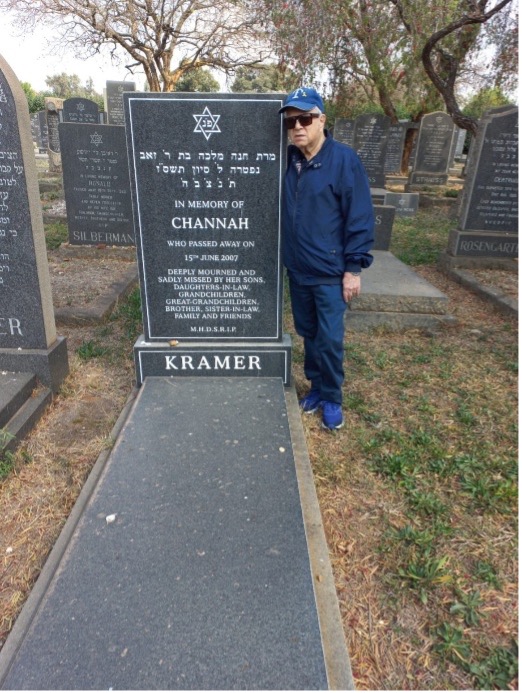
Kacev family:
Welve Kacev (d. 1963) and Esther Taube Kacev (1883-1962) had 5 children, 4 sons and a daughter, and they lived in Plunyan (Plungė), Lithuania. Their children were Alfred Samuel Kacev (1912-2001), Berel Yankel Kacev (1915 Lithuania - 1993 Johannesburg), Channah Kramer née Kacev (1916 -2007), Issy Kacev (1920-2009) and Chaim (Hymie) Kacev (b. 1925). In 1929 Welve and his eldest son emigrated to South Africa and they settled in Brits. In 1934 the rest of the family joined them in South Africa. Many years later, in 1995, Channah vividly recalled her departure from Plungė in the winter of 1934. The Kacev family settled in Pretoria. Two children, Berel Kacev and Channah Kramer and their families, resided in Rustenburg in the 1960s and early 1970s.
Berel Yankel Kacev (1915 Lithuania - 1993 Johannesburg) married Chaya Perlstein (1924 Palestine - 2005 Israel) on the 7 November 1948 in Johannesburg. The family lived in Pretoria before settling in Rustenburg in 1960. They had 4 children - 3 daughters and a son - Leah Poliak née Kacev, Sheila Menachemson née Kacev, Adele Joffe née Kacev and David Kacev. Once their children finished school and left Rustenburg, Berel and his wife moved to Klerksdorp before retiring in Johannesburg. Their three daughters live in Israel and their son in Australia.
References:
- Theo Kramer, son of Sidney and Channah Kramer, Johannesburg, South Africa.
- Communication with the Kacev family.
- Two paths from Plunyan. Telfed, August 1995, Vol 21, page 3.
- JewishGen.
Kramer family - Silent Valley, Rustenburg district
(1871 Keidan, Lithuania - 3 March 1937 Johannesburg) and Amelia Bertha Kramer née Maurer (1883 Russia - 1959 Johannesburg), Lithuanian immigrants from Kovno, resided in the Rustenburg district in the 1920s and 1930s. They had 4 children, Julius Kramer (1903 - 1962), Annie Miller née Kramer (1904 - 1986), Gabriel Kramer (1907 - 5 October 1991 Johannesburg) and Gertrude Shiller (1911 - 1998).
Their son, Gabriel Kramer, farmed livestock on the farm Silent Valley, Grootvlei No. 1041. He married Bekey Selesnik (1913 - 1991 Johannesburg) on the 18 October 1935 in Johannesburg and they lived on the farm. When Gabriel's father, Nathan Kramer, died, he bequeathed his farm in Rustenburg and all his cattle to him.
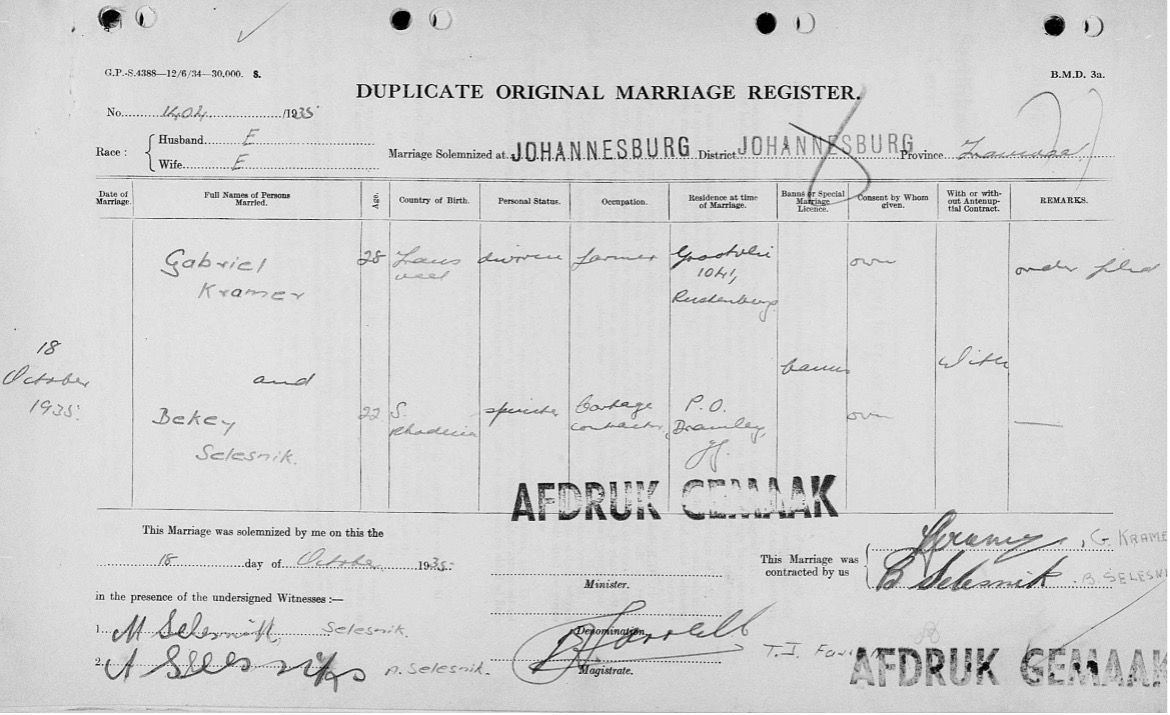
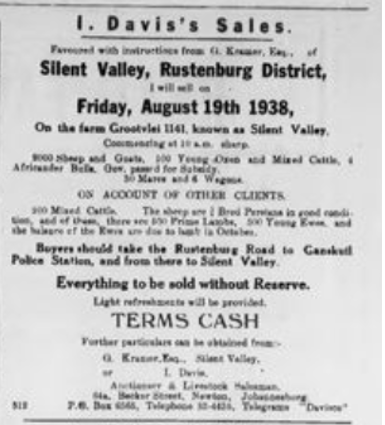
Rustenburg Herald entries:
- 1935-10-04. Nathan Kramer, a clerk employed at the Witfontein Store, Holfontein, district Rustenburg, in the Province of Transvaal, hereby give notice that I intend to apply to the Minister of Interior, in terms of Section 19 (1) (a) of the British Nationality in the Union and Naturalization and Status of Aliens Act of 1926, for a Certificate of Naturalization under that Act. N. Kramer.
- 1941-07-25. Notice is hereby given that the Milling business carried on by Gabriel Kramer on the farm Grootvlei 1041, Rustenburg District has been sold and will be transferred to Willem Adriaan Cilliers as from the first of August 1941. Signed G. Kramer.
- 1948-01-16. FARM FOR HIRE OR ON SHARE BASIS. Farm at Hekpoort near School, bus, post, rail, main road. 25 morgen under permanent irrigation. Own Furrow out of river, water unlimited. Good for tobacco, and wheat. Farm has been planted last 5 years with vegetables. Ground exceptionally fertile. Will now give wonderful tobacco results. Tobacco oven, cellar and sheds available. Inspection invited. G. Kramer, Phone 731, Hekpoort, P.O. Foothills.
Kuming family
Joe and Fanny Kuming lived at the Transvaal Hotel, Rustenburg in the late 1920s. Joe's sister, Mina Kuming, who was resident in Rustenburg at the time of her marriage, married Morris Carr on the 8 June 1930. Their wedding made headlines in the Rustenburg Herald as it was the first Jewish wedding held in Rustenburg.
'A very pretty wedding took place on Sunday the 8th June, when Miss M. Kuming, sister of Mr. Joe Kuming of the Transvaal Hotel, Rustenburg was married to Mr. Carr of the Inns of Courts, Johannesburg. The Synagogue was crowded with both Jewish and gentile friends, while many relations and friends from Brits, Johannesburg, Benoni and Bloemfontein were present. The bride looked charming in a pretty grey travelling costume and was given away by Mr. and Mrs. J. Kuming, and the bridegroom by Dr. and Mrs. Monk of Johannesburg. Mr. H. Kuming of Bloemfontein was best man, and Mr. H. Cohen and H. Hirsch were the pole holders. The reception at the Transvaal Hotel was attended by hosts of relations and friends. The tables were tastefully decorated with sweetpeas given by Mrs. S. Mundel. At six o'clock the bride and bridegroom departed by car for Johannesburg. Among the visitors were Dr and Mrs Monk, Mrs Salkinder, Mr. H. Cohen, Mrs. and Miss Silverston, Mr. and Mrs. Goldman, Mr. and Mrs Jacobson, Miss Jacobson from Benoni, Mr. H. Kuming, Mr. and Mrs I. Cohen from Brits and many others, and many local friends. This is the first Jewish wedding solemnised in Rustenburg and was really in every way very smart and fashionable.'
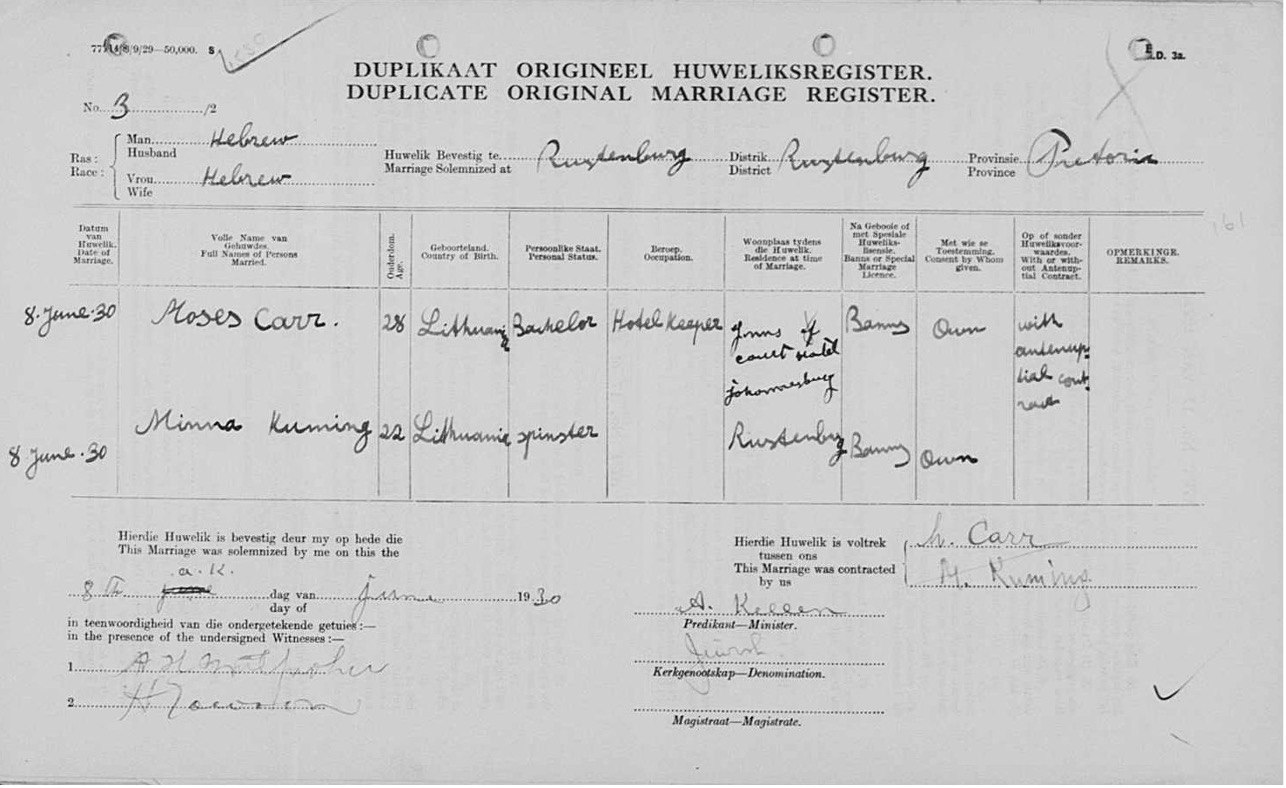
Kuming family tree:
1. Michael Kumenas Kuming b. 1873, Lithuania; d. March 24, 1938, Springs, Transvaal, South Africa
+ Malke Kuming b. 1884, Latvia; d. August 13, 1950, Johannesburg, South Africa
2. Joseph (Boris) Kuming b. 1896, Riga, Latvia; d. March 2, 1934, Johannesburg, South Africa
+ Fanny Mosselson formerly Kuming b. 1906; d. June 21, 1994, Johannesburg, South Africa m. October 14, 1925, Johannesburg.
2. Chaim Kuming b. 1904, Lithuania; d. August 18, 1951, East London, South Africa
+ Frieda Kuming b. 1906, Germany; d. April 7, 1981, Johannesburg, South Africa; m. March 15, 1936, Springs, Transvaal, South Africa
2. Minna/Mina Carr b. January 4, 1906, Russia (Russian Federation); d. February 24, 1964, Springs, Transvaal, South Africa
+ Morris Carr; m. June 8, 1930, Rustenburg, South Africa
Landy, Rabbi David
Rabbi David Louis Landy (1915 England - 1987 Toronto, Canada) was born in Liverpool, England. He studied at the Liverpool Hebrew Institute and graduated at the Liverpool Theological College, where he was ordained. He married Joan Elsa Speculand (1931 Scotland – 2017 Toronto, Canada) on the 14 February 1950 in Merthyr Tydfil, Glamorganshire, Wales, and their eldest son, Keith Malcolm Landy (1951-2017), was born the following year in Coventry. The family emigrated to South Africa, where Rabbi Landy was the Rabbi of the Oudtshoorn Synagogue. He subsequently served as the Rabbi of the Rustenburg community. The family then moved to Salisbury, Rhodesia, where he served as Rabbi from 1967 to 1970. The family then emigrated to Brantford, Ontario, Canada, where he served as Rabbi and Principal of the Hebrew School. In 1973 he accepted the position of Rabbi and Principal of the Hebrew school of the Regina Hebrew Congregation, Saskatchewan, Canada. He later was a Congregational Rabbi in Toronto. He died in 1987 and was survived by his wife and 3 children, Keith, Cheryl and Ian.
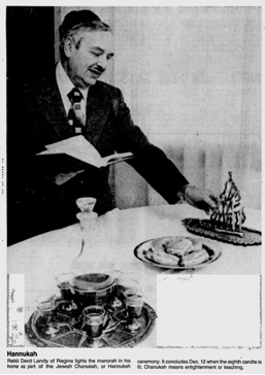
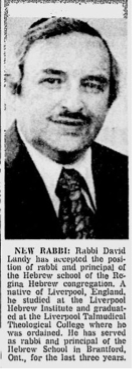
His eldest son, Keith Landy, was a Canadian lawyer and served as National President of the Canadian Jewish Congress, Vice-President of the World Jewish Congress and Governor of the Canadian Council of Christians and Jews. He was a delegate to the UN World Conference Against Racism, Racial Discrimination and Xenophobia in Durban in 2001. He stated that "It was my first time back to South Africa since the apartheid years." "It was highly unusual and hard in a sense to see what life was like after 30 years. Durban was a hate-fest, but until then, it was a tremendous place of opportunity."
References:
- The Leader Post, July 7, 1973, Regina, Saskatchewan, Canada. Rabbi David Landy appointed to Regina Hebrew Congregation, bringing experience from Brantford.
Lazarus family
Mark Lazarus (1870 England - 20 December 1935 Pretoria) and Rose Lazarus née Goldberg (1869 Hull, England - 10 January 1919, Johannesburg) were married in England and emigrated to South Africa. They had 3 children, Philip (15 February 1896 England - 1969 South Africa), Alfred and Cissie Sarah Lazarus. Their eldest son, Philip, was named after his maternal grandfather, Philip Goldberg from Leeds. The family settled in Johannesburg, where Mark Lazarus was a hotel manager. After the death of his wife, Mark moved to Rustenburg and then to Pretoria, where he worked as a barman.
His son Philip Lazarus settled in Rustenburg and worked as head barman at the Transvaal Hotel. He was nicknamed 'Phil of the Transvaal'. On the 3 December 1934 Philip married Anna Jacoba Susanna Estherhuizen in Krugersdorp. Their son, David Philip Lazarus, was born on the 31 July 1942 and 6 months later, on the 17 January 1943, both Philip Lazarus and his son were baptised in the Dutch Reformed Church, Rustenburg. Philip died in 1969 and was survived by his widow.
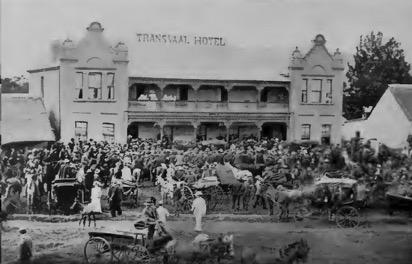
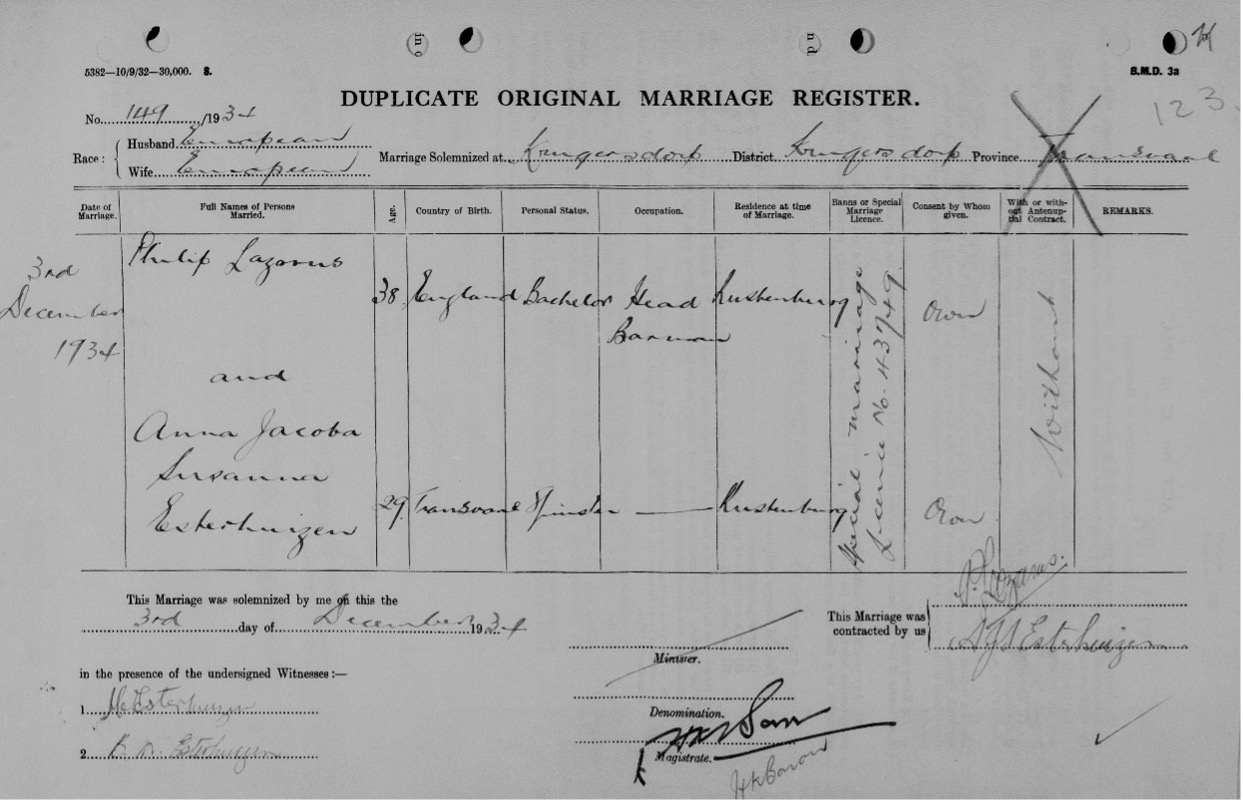
Cissie Sarah Lazarus (1912 South Africa - 29 July 1984 Port Elizabeth) married Leo Aronson (1912 South Africa - 13 April 1992 Port Elizabeth), a general dealer in Kirkwood, Cape Province, on the 25 July 1937 and they settled in Port Elizabeth. It is unknown what happened to her brother, Alfred Lazarus. Mark Lazarus was buried in the Rebecca Street Jewish Cemetery, Pretoria, his wife, Rose Lazarus in Braamfontein Jewish Cemetery, Johannesburg, and their daughter, Cissie, and their son-in-law are buried in Port Elizabeth.
References:
- NASA. 1969. MHG Reference 2072/69. Lazarus, Philip. Surviving spouse Anna Jacoba Susanna Lazarus (born Esterhuizen).
Rustenburg Herald entries:
- 1935-01-18. Phil of the Transvaal, otherwise known as Mr Philip Lazarus, has returned from his holiday and resumed duty at the Transvaal Hotel.
- 1935-04-12. Mr M. Lazarus, formerly of Rustenburg, arrived here last Sunday evening to stay with his son. On Monday morning Mr Lazarus was not feeling well and consulted a local doctor. The doctor advised Mr Lazarus to return immediately to Johannesburg where he will have to undergo a serious operation.
- 1935-12-20. The Late Mark Lazarus. The death took place at Pretoria Hospital this morning of Mr Mark Lazarus, father of Mr Philip Lazarus, of the Transvaal Hotel. The deceased was 69 years of age and had been ill for some time. The funeral will take place at Pretoria this afternoon. Sincere sympathy is extended to Mr and Mrs Philip Lazarus and the other members of the family.
- 1937-10-08. Mr. Phil Lazarus, of the Transvaal Hotel, and Mrs. Lazarus are going on a holiday trip.
- 1949-04-08. Mrs. P. Lazarus and David will be spending the school holidays at Pretoria.
- 1950-01-13. Mr and Mrs P. Lazarus and David are at Margate on holiday.
Leibowitz, Reverend David Hessel
(1891-1948)
In 1924 when the Rustenburg Synagogue was consecrated, he was the Reverend of the Rustenburg Hebrew Congregation. He married Hannah (Hennie) Lang (1890-1959) and the family moved to Parys, Orange Free State, where he served as the Reverend of Parys. He passed away in 1948 at the age of 57. Following his death, his widow moved to Johannesburg and passed away in 1959.
Back row: S. Isaacs, H. Gawron, M. Wulfsohn, F. Sholomir.
Front row: M. Sholomir, N. Kirsch, B. Harris, Chief Rabbi Dr. Landau, H. Wulfsohn, Rev. D. Leibovitz, M. Kadey, P. Wulfsohn, S. Mundel.
Levi - Lapping family of Zwartruggens
Agnes Levi née Lapping (15 July 1872 Courland - 20 May 1946) was the daughter of Isaac Lapping (1836-1914) and Eva Lapping née Feldmann (1843-1933). Her family emigrated to South Africa and settled in the district of Aberdeen, Cape Province, where her father farmed at Koppieskraal. On the 14 February 1894, Agnes married German-born trader Louis Levi (18 March 1864 Frankershausen, Hessen, Germany - 4 March 1930 Johannesburg) in the Cape Town Synagogue. The couple had 4 children, who were all born in the Cape Province. The family moved to the Transvaal and lived in Potchefstroom before settling in Krugersdorp. In the mid-1920s they finally settled in the village of Zwartruggens, which was also known as Rodeon. Louis Levi worked as a carpenter / furniture maker in the village. He died in 1930 in Johannesburg aged 66 and was buried in Brixton Cemetery. Agnes remained in Zwartruggens and lived with her bachelor brother, Simon Lapping, at the family home in Scheepers Street. Agnes died in 1946 aged 73. She was buried in the Rustenburg Old Cemetery.
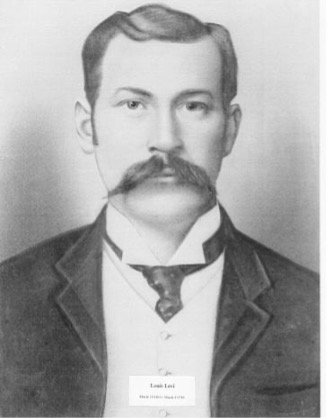
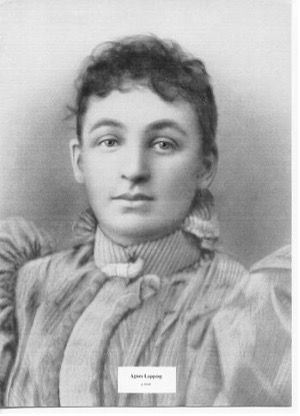
Children:
- Robert Levi (1895 Cape Town - 1970 Johannesburg)
He was the eldest son and served in the Union Defence Force during World War One in South West Africa. During World War Two he served in the National Volunteer Brigade. He was a general dealer in Zwartruggens when he married Jenny Gertie Myers (1905 Cape Town - 1993 San Diego, CA, USA) on the 6 December 1927 in Cape Town. Her family were from Piketberg, Cape Province. The Levi family lived in Zwartruggens, where their 2 daughters were born. Jenny Levi's sister, Isabelle Milner née Myers (1912-2008), lived in nearby Thabazimbi. Robert was an accomplished carpenter, having learnt the trade from his father. - David Levi (1896 Port Elizabeth - 1970)
He was the second son and lived on Station Street with his wife, Olga Gien (1905 Johannesburg - 1933 Zwartruggens). Tragically, Olga died in late 1933 at age 28, just three weeks after giving birth to their third daughter. She was survived by her husband and three young daughters: Gloria (born 1926), Betty (born 1928), and infant Eva (born November 15, 1933). - Mina Goodman (1898 Cape Town - 1976 Johannesburg)
She married Zwartruggens resident, Harry Louis Goodman (1889 Lithuania - 1968 Johannesburg) in Krugersdorp in 1923. - Gertrude Ginsberg (1900 Port Elizabeth - 1982 Cape Town)
She married English-born Joseph Ginsberg (1894 England – 1982 Bulawayo) in Krugersdorp in December 1926.
Agnes Levi’s brother:
Simon Lapping (1880 Goldingen, Latvia - 4 November 1934 Rodeon)
He was a merchant in the village and lived with his older sister, Agnes Levi. He died at the age of 54 and was buried in Rustenburg. He was survived by his sisters, Agnes Levi of Zwartruggens and Johanna Mitchell née Lapping (1890-1956) of Port Elizabeth, and his brother, Jack Lapping (1882-1943) of Bloemfontein.
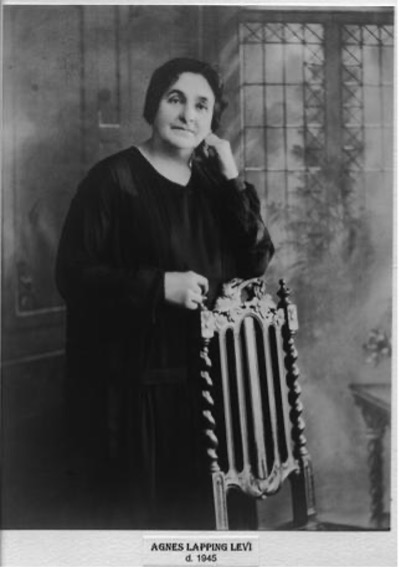
Levitt, Myer
(1913 Lithuania – 2004 Johannesburg)
He was educated at Pretoria Boys' High School and Pretoria Law School. In 1935 he joined solicitor Herbert Cranko in his law firm in Rustenburg and the law firm was renamed Herbert Cranko & Levitt. The partnership lasted only a few months as Cranko moved to Johannesburg shortly afterwards. Levitt continued in practice until 1941, when he volunteered in the Union Defence Force. Although the practice was kept open as M. Levitt and Jaffit with Mr Jaffit in charge of the practice, the practice did not survive. After the war, Meyer Levitt did not return to Rustenburg. He got married in 1944 and the family lived in Johannesburg.
References:
- South African Jewry 1967-68 Edition. A Survey of the Jewish Community; Its Contributions to South Africa; Directory of Communal Institutions; and a Who's Who of Leading Personalities. Feldberg, Leon (Editor). Levitt, Myer, page 333.
Rustenburg Herald entries:
- 1941-10-03 We learn that the legal practice formerly carried on by Mr. M. Levitt who is at present on active service has been re-opened as M. Levitt and Jaffit and that Mr. Jaffit will be in charge of the practice.
Levy, Hayman
(April 1876 Lithuania - 2 June 1956 Cape Town)
He was the second son of Saia Bendar Levy (1843 Lithuania - 1927 Cape Town) and Taube Levy (1847 Lithuania - 1919 Cape Town) of Skuodas, Lithuania. His older brother Moshe 'Maurice' Leib Levy (1871 Lithuania - 1948 Cape Town) was the first to emigrate to South Africa and sent money back to the family in Lithuania. In 1896 Hayman was able to emigrate to Cape Town using the money sent by his brother to pay for his passage to South Africa. He initially worked as a smous selling drapery in Cape Town. He then moved up to the Transvaal and after an unsuccessful venture in Johannesburg left him stranded, he moved to Rustenburg where he worked as a smous for a landsman (fellow countryman), Mr. Arenfred. Hayman subsequently branched out on his own as a smous, travelling back and forth to Johannesburg to acquire new merchandise. Upon his return to Rustenburg, he would stay with President Paul Kruger's son-in-law, Theunis Eloff (1852 Rustenburg - 1934 Boekenhoutfontein) on the farm, Boekenhoutfontein. When the Second Anglo Boer War broke out, Hayman joined the Rustenburg Commando under the command of Casper du Plessis (1847 Potchefstroom - 1905 Rustenburg). Hayman was captured by British forces at Elands River on the 19 November 1900. After the war, he returned to the Cape and married Lily Kuhlmann (1879-1956) on the 20 January 1903 in Simonstown. They had 2 children. Hayman passed away at the age of 80 in Cape Town on 2 June 1956. His son, Sam Levy, wrote down the story of Hayman's early life in South Africa and in 2020 the document was compiled by Geraldine Auerbach.
Lichtenstein family
Benjamin Leib Lichtenstein (10 October 1910 Lithuania - 23 October 2001 Johannesburg) and Leah Lichtenstein née Galaun (9 November 1909 Worna, Lithuania - 29 April 1997 Johannesburg) emigrated to South Africa from Lithuania. Benjamin settled in Benoni, where he was a jeweller, and Leah lived in Johannesburg with some of her siblings. Their civil marriage took place in Benoni on the 3 December 1937 and their religious wedding took place 5 months later on the 18 May 1938 at the Berea Synagogue, Johannesburg. By that time, Benjamin Lichtenstein was resident in Rustenburg, where he opened a jewellery store, Rustenburg Jeweller.
Leah's parents, Yaacov Galaun (d. 1938 Varniai, Lithuania) and Chaia Michle Galaun née Groll (1879-1942), remained in Lithuania and in 1938 her father died. In 1942 her mother, Chaia Michle, was murdered in the Holocaust.
The Lichtensteins had four children, Joyce, Selwyn, Molly Ann and Hyman 'Hymie' Hillel. Their two younger children were named after grandparents, Molly after her maternal grandmother and Hymie after his paternal grandfather. In 1943 Benjamin Lichtenstein sold his jewellery store to Leizer Hovsha. The family lived out of town on a plot and they were active members of the Rustenburg Jewish community.
Their eldest daughter, Joyce, moved to Bethlehem, Orange Free State, following her marriage to Isidore Kaplan (1923 Bethlehem – 2003 Hadera, Israel) and years later they made Aliyah to Israel. In 1969, whilst a student at the University of the Witwatersrand, Molly compiled the biography Rustenburg Magisterial District. In 1974 Hymie qualified as a doctor at the University of Pretoria. Benjamin and Leah Licthenstein left Rustenburg and settled in Johannesburg. Their children Selwyn Lichtenstein, Molly Aires and Hymie Lichtenstein live in Johannesburg.
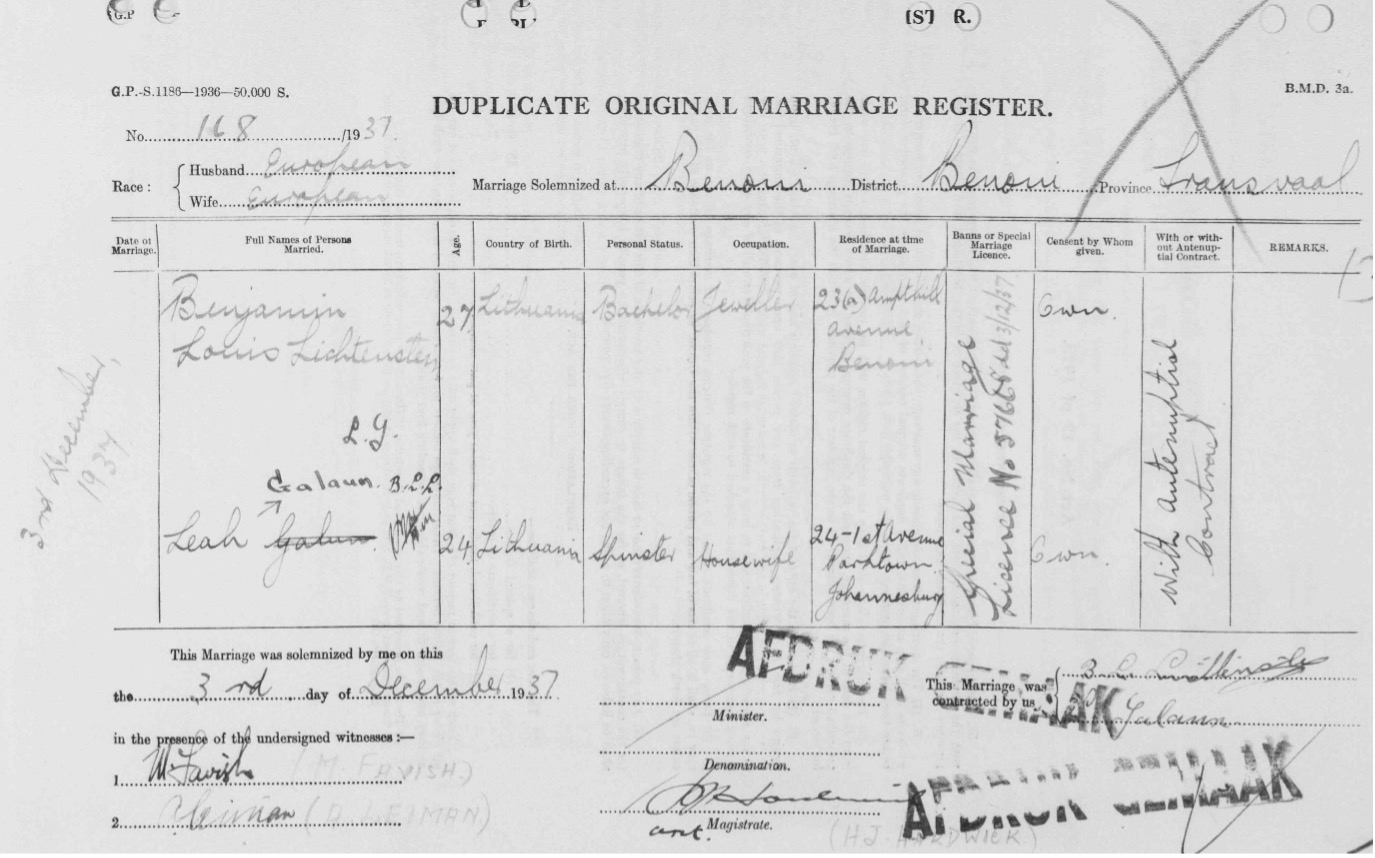
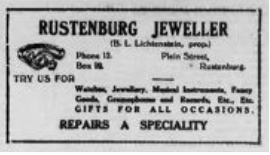
Rustenburg Herald entries:
- 1938-05-13. The marriage of Miss Leah Glaun, of Johannesburg, to Mr. B.L. Lichtenstein, of Rustenburg, is to take place at the Berea Synagogue on the 18th of May at 7 p.m. Congratula-tions.
- 1944. Notice is hereby given that the General Dealer's Business carried on by Benjamin Louis Lichtenstein as the Rustenburg Jewellers at Plein Street, Rustenburg, has been transferred to Leizer Hovsha as from 1st January 1944. The liabilities of B. L. Lichtenstein are not being taken over by Leizer Hovsha. LEIZER HOVSHA, Box 192, Plein Street, Rustenburg.
Lipman, Solomon 'Solly'
(4 August 1893 Johannesburg - 14 February 1966 Johannesburg)
He was the eldest son of Alfred Lipman (1859-1933) and Rosalie Lipman née Alexander (1868-1912). His parents were from Germany and were married in Johannesburg in 1892. He had 3 younger brothers. His father was a stockbroker and the family lived at 7 Ockerse Street, Hospital Hill. Solly served in the Union Defence Force in World War One and after he was demobilised, he worked as a hotel manager in Witbank. On the 3 July 1922 he married Rachel Aida Herman (1894-1950) in the Great Synagogue, Cape Town. They settled in Rustenburg soon afterwards, where he ran the Grand Hotel on Church Square. His wife assisted him in the running of the hotel. Solly was a golfing luminary and was nicknamed Krommie by the caddies as he walked with a limp. The Grand Hotel was known as the '19th hole' of the golf club. The hotel was prominently advertised in the Rustenburg Herald as it was placed on the front page beside the name of the newspaper. In 1936 the Lipmans sold the hotel as they needed to rest or do something less strenuous. They bought Wharrams Bottle Store and they traded as The Rustenburg Bottle Store. Solly was involved in civic affairs and served on the committee of the Rustenburg Chamber of Commerce.
The Lipmans left Rustenburg and settled in Johannesburg. In January 1947 Mr. 'Solly' Lipman and his son, Mr. Bobbie Lipman, paid a brief visit to Rustenburg. Rachel Lipman died in 1950 and was buried in the West Park Cemetery. Solly remarried a widow, Evelyn Dorothy Jackson born Kanter. He died 16 years later in 1966 and was cremated.
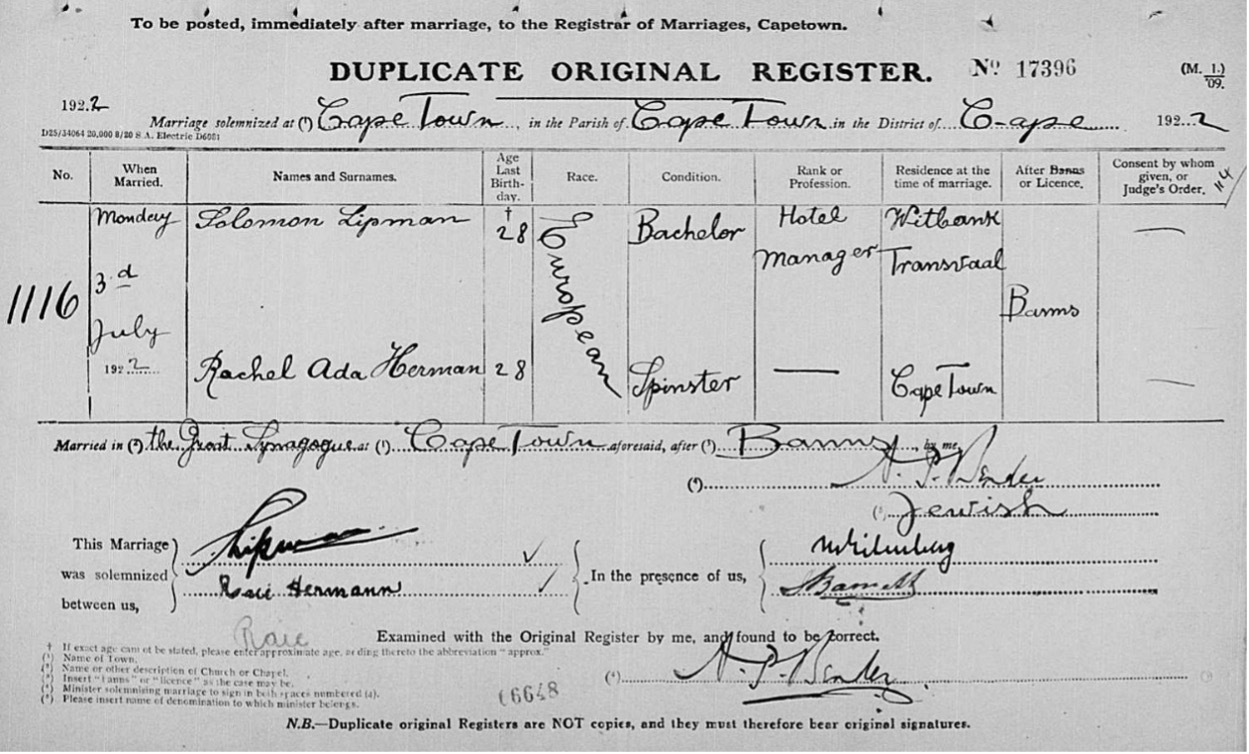
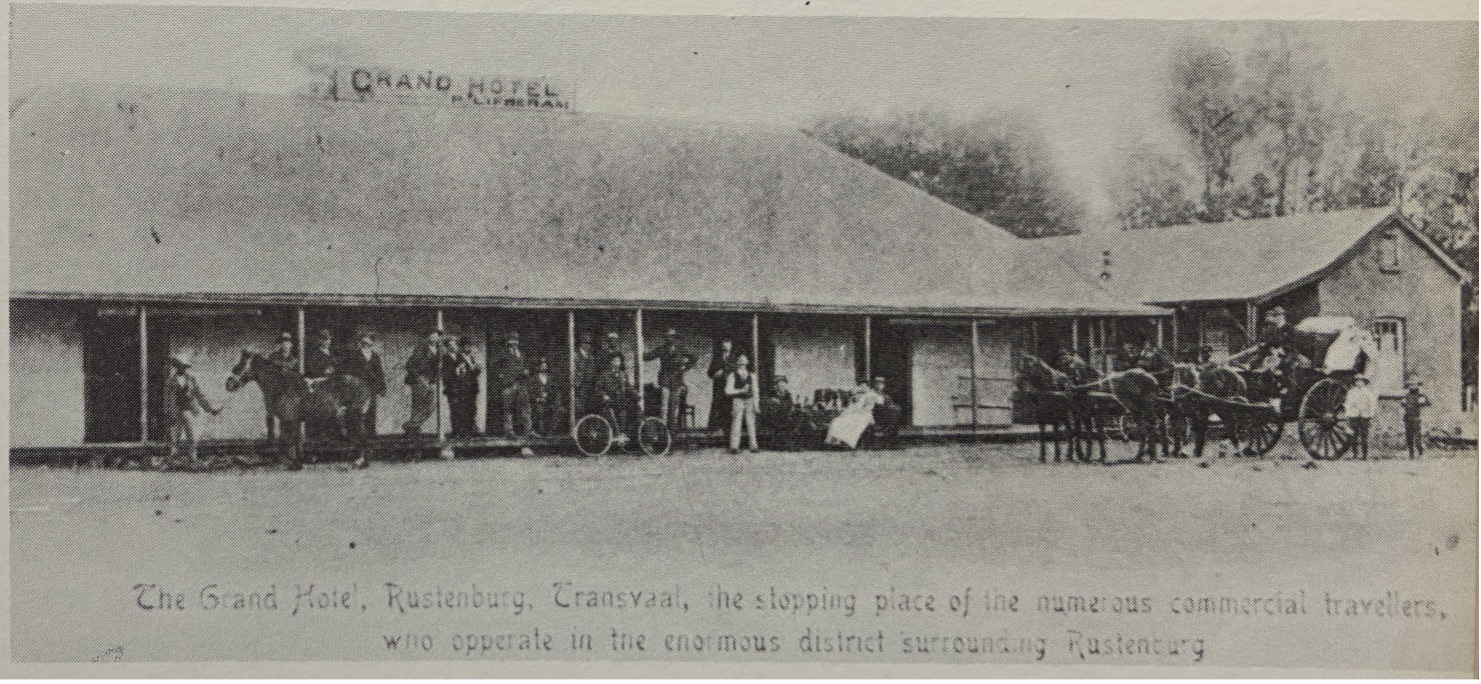

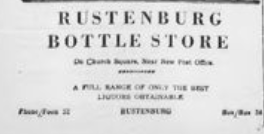
Rustenburg Herald entries:
- 1930-02-07. The Rustenburg Chamber of Commerce was again brought into being and it was decided that it shall in future take an active part in the affairs of the town. The following gentlemen were elected as a committee and as they are all well-known businessmen, a forward policy may be anticipated: - Mr. Herman Wulfsohn (Chairman), Messrs. S. Lipman, Philip Wulfsohn and Harry Gawron, with Mr. Felix Hill as Secretary.
- 1931-10-30. Liquor Licensing Board District Rustenburg Renewal Hotel and Bottle ... 7. Solomon Lipman, Grand Hotel, Erven Nos 93 & 91, Church Square, Rustenburg.
- 1936-07-31. A Popular Hotelkeeper Takes Over Wharrams Bottle Store. It may safely be stated that there is no one better known in Rustenburg than Mr. Solly Lipman, the host of that popular hostelry, the Grand Hotel. Mr. and Mrs. Lipman have been here for many years, and he has been fortunate in having the services of his good spouse to assist him in the management of the hotel. But they both consider that they need a rest or rather something less strenuous and therefore Mr. Lipman has acquired Wharrams Bottle Store which in future will be known as The Rustenburg Bottle Store.
- 1936-12-25. Our Advertisers by the Editor. We shall therefore begin at the beginning. The Grand Hotel, whose advertisement occupies a place of honour next to the name of the paper, for at least the last ten years, is now better known as the "19th bole" because the former proprietor, Mr. Lipman, made it a home for golfers and travellers. It is all Scotch on and behind the counter.
- 1947-01-07. Mr. "Solly" Lipman and his son, Mr. Bobbie Lipman, paid a brief visit to Rustenburg during the week.
Machol, Reiss and Lewy family members
Some of the earliest Jewish residents who settled in the district of Rustenburg were the children of two brothers, Marcus Machol and Joseph Machol of Friedheim, Posen, Preußen (Kingdom of Prussia), German Empire, and their uncle, Aaron Reiss, brother-in-law of Marcus Machol.
Marcus Machol's family
Marcus Machol (1833 - 1874 Schneidemühl, Posen, Prussia) and Nathalie Machol born Reiss (1838 Gollantsch, Posen, Prussia - 1912 Berlin, Germany) of Friedheim had 8 children. They were Kauffman Machol (1859-1907), Johanna Machol (1861-1924), Nathan Machol (1862–1939), Moritz Machol (1864-1889), Leo Lewin Machol (1867-1936), Flora Wolff née Machol (1869-1933), Frieda Solomon née Machol (1878-1915) and Nanette Lewy née Machol (1858-1939). Five of the children emigrated to South Africa and they all settled in Commissie Drift near Rustenburg. None of the South African family members had offspring. One daughter, Flora Wolff, who resided in Berlin, Germany, was the only child to have offspring - 2 sons, Kurt and Emil Wolff.
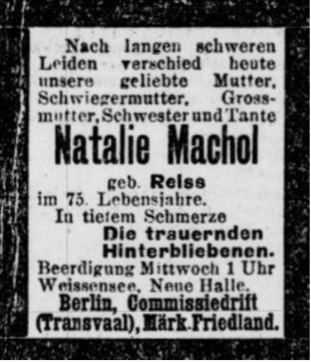
(1859 Friedheim, Posen, Prussia – 13 July 1907 Pretoria)
Kauffman was known as Kurt and was resident in Schneidemühl, Posen, Prussia, prior to his emigration to South Africa. In December 1883 he and his younger brother, Leo Machol, travelled to East London, South Africa, from Hamburg, Germany, via Southhampton, England. Kurt settled in Commissie Drift where he traded as K. Machol and Company. He was in partnership with his maternal uncle, Aaron Reiss. They were "proprietors of an important tobacco industry situated on the southern slopes of the Magaliesberg range at Commissie Drift. This was established in 1891 for the purpose of working and manufacturing local tobaccos and distributing them throughout South Africa, in addition to which they export both to London and Berlin. The plant used 'Legg’s Patent', quite up to date and capable of handling 10 000 lbs of tobacco a day. In the factory the tobacco is put up in three strengths – strong, medium and mild – and packed in ¼ lb., ½ lb., and 1 lb. bags suitable to the requirements of the market. The tobacco from this factory enjoys an excellent reputation and the trade done is of sufficient importance to necessitate the services of a representative who travels throughout South Africa … A retail store is attached to the business, carrying a stock valued at £7 000. The entire premises, built over an area of one and a half acres, comprise a store, warehouses, factory and dwellings. The partners are Messrs. Kurt Machol and Aaron Reiss, both native of Germany who have been resident in the district for many years". In 1894, when the National Bank of the Zuid Afrikaansche Republic opened a branch in Rustenburg, Kurt Machol was one of its first clients. Numerous business transactions regarding K. Machol and Company were registered with the Chief Inspectorate, Pretoria. Kurt Machol died at the age of 48 at the Hollandische Hospitaal, Pretoria. He is buried in Rustenburg.
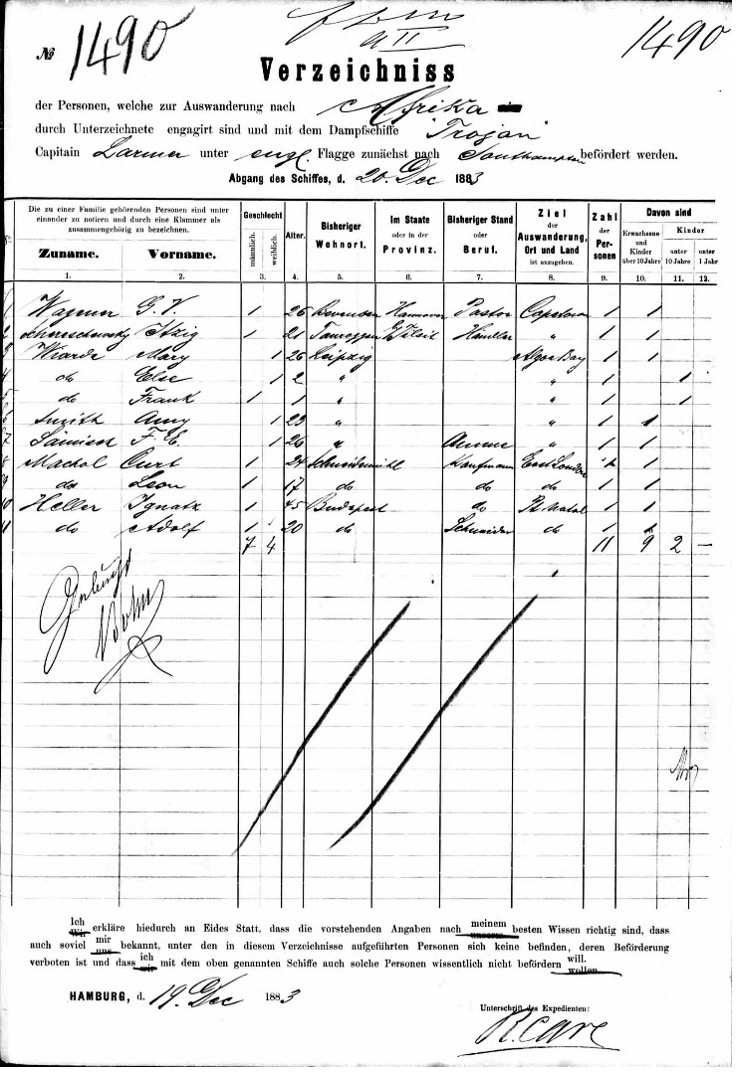
(1861 Friedheim, Posen, Prussia - 1924 Commissie Drift)
She was a spinster. She lived with her siblings at Commissie Drift and was responsible for running the household. She is buried in Rustenburg.
(1862 Friedheim, Posen, Prussia - 1939 Pretoria)
In 1891 he applied for an alcohol licence at the Landdrost Zeerust with M. Kohn and H. Rogaly. On the 5 November 1896 he made enquiries to the Landdrost Rustenburg regarding naturalization. He was a shopkeeper in Commissie Drift and lived with his siblings. In 1902, after the Second Anglo Boer War, he applied for a permit as he was an ex burgher. He married the widow Else Boley née Schwarz (1885 Rexigen, Germany - 1927 East London) on the 22 March 1915 in Bloemfontein. He was widowed 12 years later. He died at the age of 76 in Pretoria and is buried in the Rebecca Street Cemetery. He left his estate to the only offspring of the Machol family, his 2 nephews, Kurt and Emil Wolff, the sons of his sister Flora Wolff, who lived in Germany.
(1867 Friedheim Posen, Prussia - 1936 Pretoria)
He emigrated to South Africa with his older brother Kurt in 1883. He resided in Commissie Drift. During the Second Anglo Boer War he went to Barkly East, Cape Colony. He was a witness in a court case regarding high treason in Barkly East during the war and was paid witness expenses by the Attorney General, Cape Town. In 1901 the Acting District Commissioner of Rustenburg granted him permission to return to Rustenburg by convoy. He worked as a tobacconist and commercial traveler. He died in Pretoria at the home of his cousin, Dr Albert Machol. He is buried in the Rebecca Street Cemetery, Pretoria.
(1878 Friedheim, Posen, Prussia - 1915 Pretoria)
She lived with her siblings at Commissie Drift. On the 4 June 1911 she married Bernard Solomon in Johannesburg. Her husband was born in Oudtshoorn, Cape Colony, in 1883 and at the time of their marriage he was also resident in Commissie Drift. He was a tobacconist and the couple went to live in Jagersfontein, Orange Free State. Frieda died in the Victoria Maternity Nursing Home, Pretoria. Her estate was left to her siblings, Johanna Machol, Nathan Machal, Leo Machol, Flora Wolff and Nanette Lewy. She is buried in Rustenburg.
Joseph Machol's family
Joseph Machol (1840-1872) and Rosalie Machol née Hirschfeld had 9 children. Three children emigrated to South Africa. They were Eugen Machol (1860-1933), Nanette Machol (1865-1949) and Dr Albert Machol (1869-1944).
Dr Albert Oser Machol
(1869 Friedheim, Posen, Prussia - 1944 Johannesburg)
He studied medicine in Berlin and at the University of Leipzig, where he qualified as a doctor in 1893. He emigrated to South Africa shortly thereafter and settled in Rustenburg, where he practiced for 9 years. Numerous archival documents from 1895 to 1901 relate to his stay in Rustenburg. During the Second Anglo Boer War (1899-1902) he provided medical assistance to the Boer Commando. In 1899 he received a telegram in Rustenburg to proceed to Derdepoort as there were many seriously ill in that district. 'Dr Machol Rustenburg. Telegram maakt beswaar om naar Derdepoort te gaan aangesien er vele ernstige zieken in het distrikt zyn.' Albert Machol applied for permission to leave Rustenburg and on the 15 January 1900 the Landdrost Rustenburg granted him permission to depart. On the 22 October 1901 a permit to reside in Pretoria was granted to him. He moved to Pretoria with his siblings and they lived at 263 Skinner Street. He was regarded as one of the best and most successful general practitioners in Pretoria. His older brother Eugen worked as his medical assistant and his sister Nanette performed household duties. Albert married Rosalie Nast (1870 Germany - 1913 Pretoria) on the 24 June 1913 in Cape Town. She died 5 months after their marriage. His brother Eugen married Pauline Rozenberg (1868 San Francisco, CA, USA - 1936 Pretoria) in San Francisco, CA, USA. Neither brother had any children. The family were joined in South Africa by Bettina Alice Machol née Stein (1881-1973) and her 2 children. She was the widow of their younger brother Heinrich Jehuda Chayim Machol (1871 Friedheim - 1930 Baden Germany) and she and her two children lived with Albert, Eugen and Nanette in Pretoria, serving as their housekeeper. Eugen died in 1933, Albert in 1944 and Nanette in 1949. All the Machol family members were buried in the Rebecca Street Cemetery, Pretoria.
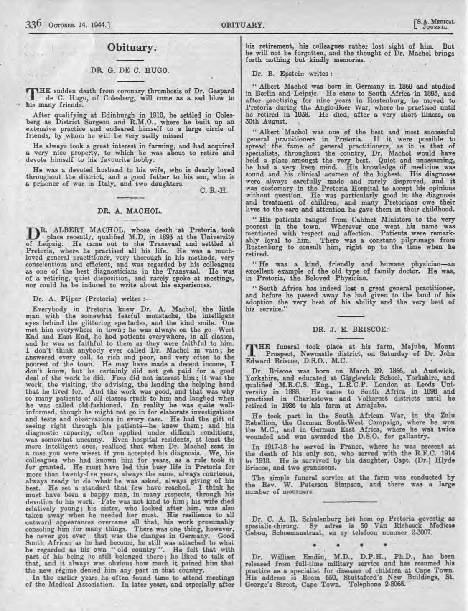
(1848 Gollantsch, Posen, Prussia - 1908 Commissie Drift, Rustenburg)
He was a bachelor and was the son of Gabriel Jacob Reiss and Fritze Reiss née Kaufmann. His sister was Nathalie Machol (1837-1912), mother of the Machol children who resided in Commissie Drift. He initially emigrated to Cincinnati, Ohio, USA, where he lived for 9 years from 1865 to 1874. He left the USA in July 1874 for Bremen, Germany, and then emigrated to South Africa, where he settled in Commissie Drift, district Rustenburg. He was a partner with his nephew Kurt Machol in K. Machol and Company, which was established in 1891. In 1903 Aaron Reiss applied to the Consul of the United States at Pretoria for an American passport. He stated that he had been resident in Johannesburg since 1902. He died in 1908 at the age of 60 at Commissie Drift and is buried in Rustenburg. His tombstone is inscribed 'In loving memory of our dear uncle Aarons Reiss'. His death notice stated that he was a general dealer. He bequeathed his estate to his niece Johanna Machol and two nephews, Leo and Nathan Machol. £3000 was paid to his niece and £973.13 to each nephew. He stipulated in his will that if his nephew Nathan Machol married Goldie Koenigsbert ‘he shall forthwith deliver to the said Leo Machol the whole of such inheritance’. His nephew Nathan followed his uncle's wishes and did not marry Goldie Koenigsbert (1896-1994), who was the daughter of Fritze Koenigsbert née Jacobsohn and Bernardo Koenigsbert (1857 Poland - 1921 England) of Johannesburg and granddaughter of Jacob and Ida Jacobsohn, who had previously resided in Rustenburg.
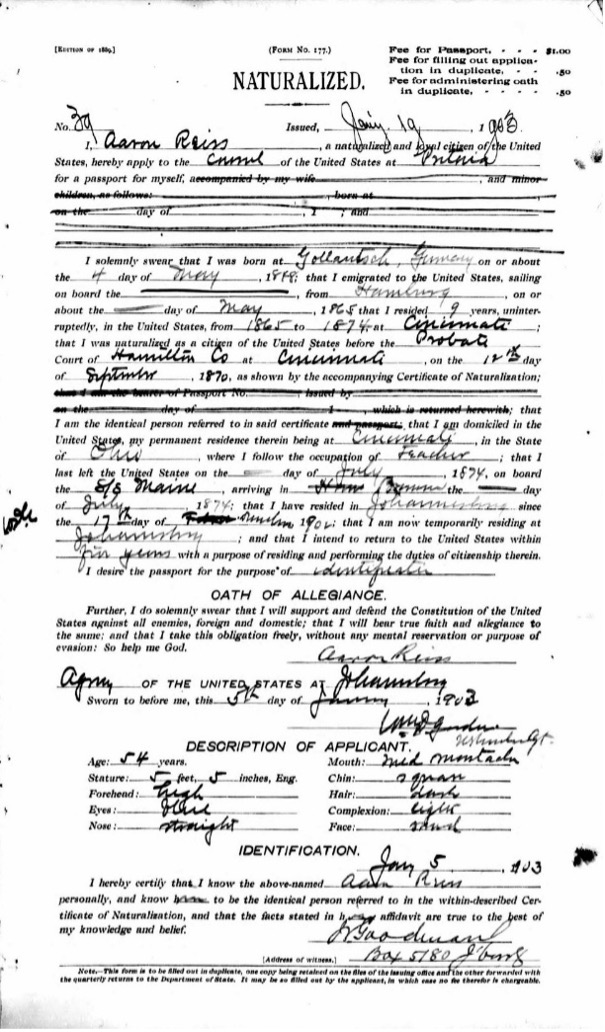
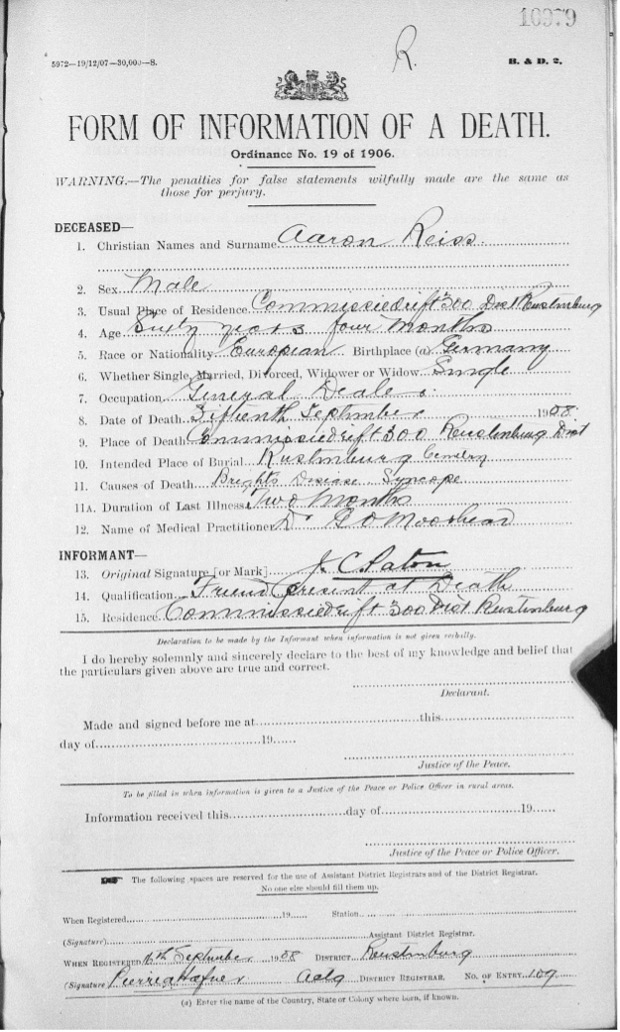
(1886 Pinne, Posen, Prussia - 1918 Rustenburg)
He was the son of Simon Lewy (1848-1906) and Bertha Lewy née Rachmiehl (1860-1888) of Pinne. His mother died in 1888 when he was 2 years old and his younger sister Else, aged 1 year, died the following year, in 1889. His father married Mathilde Lippstaedt (1860-1940) and they had 2 sons, Georg (1890-1890), who died as an infant, and Bruno Lewy (1891-1918), who died during the Great War. Max Lewy emigrated to South Africa and settled at Commissie Drift, where he worked as a shop assistant for the Machol family. His connection to the Machol family was through his paternal uncle, Bernhard Lewy, who had married Nanette Lewy née Machol (1858-1939), sister of the Machol siblings in Commissie Drift. Max Lewy was a bachelor. He died at the age of 32 and Leo Machol, his employer, was present at his death. Max was survived by his stepmother, who lived in Czarnikau, Posen, Prussia. His estate was distributed among his paternal and maternal uncles and aunts, including his uncle Bernhard Lewy.
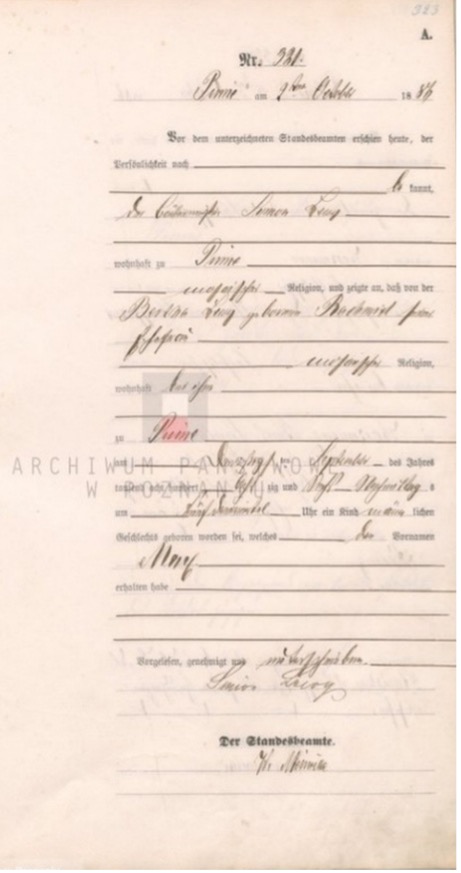
References:
- Trojan shipping manifesto, Curt and Leon Machol. Departure 20 Dec 1883 Hamburg, Deutschland; arrival Southampton: Afrika. Residence Schneidemühl.
- Chapter 18. Gold and Railways. Rustenburg Romance: The History of a Voortrekker Town. Eric Rosenthal. Perskor Publishers, Johannesburg. 1979, page 99.
- Chapter 24. Rustenburg's First Industries. Rustenburg Romance: The History of a Voortrekker Town. Eric Rosenthal. Perskor Publishers, Johannesburg. 1979, pages 131-132.
- NASA:
- 1891. Waarnemende Landdrost, Zeerust. Re Dranklicenties voor M Kohn, H Rogaly en N Machol.
- 1895. A Machol (Medicyne Dokter) Rustenburg maakt applicatie voor districts dokter te Waterberg.
- 1895. Dr. A Machol, Rustenburg. Maakt applicatie voor district dokter Aldaar.
- 1896. Landdrost, Rustenburg. N Machol Vraagt Brief van Naturalisatie.
- 1897. Landdrost Rustenburg. Legalisatie een document K Machol en Company.
- 1897. Landdrost Rustenburg. Zendt in rekening van Dr. Auden Ad £977-2-6 en van Dr. Machol Ad £446-15.
- 1898. Landdrost Rustenburg. Rekening Dr. Machol £2-2-0, Dr. Anden £1-11-0.
- 1899. Hoofd Inspecteur van Kantoren Pretoria. K Machol Zendt in rekeningen groot £8-15-6 en £3-5-3 ten uitbetaling.
- 1900. Landdrost Rustenburg. Dr. Machol is gereed om te vertrekken.
- 1900. Dr. Machol - Zendt in rekeningen re geneeskundige diensten op Commando.
- 1900. Hoofd Inspecteur Kantoren - Zendt in rekening K Machol Ad £84-14-4.
- 1901. Application by Dr A Machol for a permit to reside in Pretoria.
- 1900. K Machol en Company Rustenburg. Rekening £39 voor haver en mielies.
- 1900. Dr A Machol Rustenburg. Rekeningen £50-5 en £375-14-6 voor medicynen enz.
- 1901. Acting District Commissioner, Rustenburg. Mr. Leo Machol of Barkly East will be sent in by convoy.
- 1901. Attorney General Cape Town. Re: Witness Expenses Leo Machol.
- 1902. Permits for Ex-Burghers: N Machol, Herzfeld and MCA Meischke.
- 1903. Inform that the Lieutenant General Commanding disapproves of inhabitants being allowed to possess arms: Application for permit by L Machol.
- Obituary, Dr A. Machol. S.A. Medical Journal, Vol 336, October 14, 1944.
Modern names of towns in Posen, Prussia (Preußen):
Czarnikau - Czarnków, Poland
Friedheim - Miasteczko Krajeńskie, Poland
Gollantsch - Gołańcz, Poland
Pinne - Pniewy, Poland
Schneidemühl - Pila, Poland
Mankowitz, Joseph
(1884 Lithuania - 18 August 1946 Rustenburg)
He was a general dealer from Mafeking who in 1946 died whilst staying at the Grand Hotel in Rustenburg. He was buried in the Rustenburg Old Cemetery.
He emigrated to South Africa in the mid-1910s from Joniskis, Lithuania, and worked as a produce dealer in Dordrecht, Cape Colony. He married Nellie Leventhal (1893 Port Elizabeth - 1928 Villiers) on the 1 July 1919 in Port Elizabeth, and they had 3 sons, Leslie born 1920, Michael born 1922 and Nahum 'Neil' born 1928. The family moved to Villiers, Orange Free State, where Joseph worked as a miller. His wife, Nellie, died tragically 5 days after the birth of their youngest son, Neil. In 1943 Joseph married the widow Miriam Levy born Frank (1900-1980) in Johannesburg. By that time, he was farming and was resident in Lichtenburg. He and his wife subsequently moved to Mafeking, where he was a general dealer.
Mograbi family
Gabriel Mograbi (1877 Palestine - 15 March 1957 Johannesburg) and his wife, Lena Rebecca Mograbi née Koetz (1877 Gradno Russia (Hrodna, Belarus) - 6 May 1922 Rustenburg), settled in Rustenburg in the early 1920s with their 7 children, Aaron born 1905, Sidney Sad 'Solly' 1906, Zeev Woolfard Walter 'Wally' 1908, Joseph 'Joe' 1909, Sarah 1912, Ester 1913 and Juda Julius born in 1917.
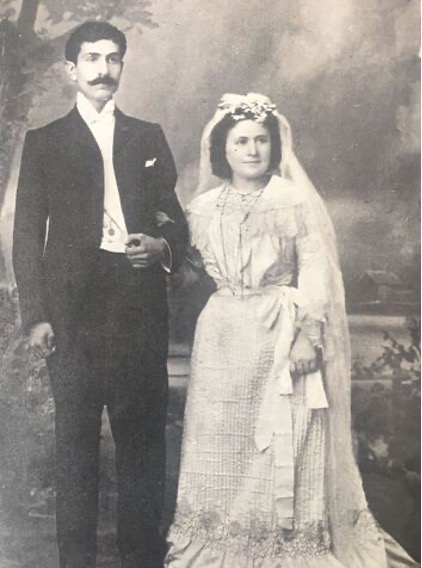
Gabriel Mograbi was originally from Beirut, French Mandate for Lebanon, and was a tailor. His wife was from Russia and following their marriage in Russia, they emigrated to South Africa, initially settling in the Cape Province. In 1908, whilst still residing in the Cape Province, Gabriel Mograbi applied for naturalization. The family subsequently left the Cape and settled in Rustenburg, where Gabriel ran a tailor shop. In May 1922, his wife, Lena, died from complications of childbirth at the age of 45. As the Mograbi marriage was not considered legal in South Africa, her death was registered under the name of Lenie Koetz, daughter of Juda Koetz and Sara Koetz of Gradna, Russia, unmarried. Six months after her death, their eldest son, Aaron, a 17-year-old scholar, died from complications of appendicitis. Gabriel Mograbi could not cope and sent his two daughters to Johannesburg. He and his 4 sons, Solly, Wally, Joe and Julius, lived in Joubert Street. He was a pious man who followed the Sephardi traditions.
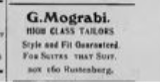
HIGH CLASS TAILORS
Style and Fit Guaranteed.
For Suites that Suit.
Box 160 Rustenburg.
The Mograbi boys were sportsmen, and in particular boxers, handy with their 'dooks' (fists). They won competitions in their various weight divisions. When young farmers made uncomplimentary remarks about Jews, the Mograbi boys challenged them, resulting in broken noses, jaws and black eyes. The Mograbi boys also played rugby and the tailor shop in Plein Street was known as Club Mograbi, as it served as a meeting place. The Rustenburg Rugby Club put up their weekly lists of players selected for the forthcoming Saturday games on the display window of the tailor shop. The list was also published in the Rustenburg Herald newspaper and always included one of the Mograbi boys, e.g., the list for Saturday 23 April 1932 in the match 'Rustenburg vs Koster' had Joe Mograbi in the one team and Wally Mograbi in the other team.
Gabriel Mograbi eventually left Rustenburg and spent his final days being cared for at the Jewish Aged Home, Doornfontein, Johannesburg. He died in 1957 at the age of 80.
The Mograbi sons
Sidney Sad Mograbi
(September 1906 Cape Province - 16 April 1991 Johannesburg)
Known as Solly, he was a middle-weight boxer. He initially worked for Philip Wulfsohn and in 1938 he set up a trading site, Mabies Cash More at Mabieskraal in the Pilanesberg, He married Greta Greberg Johanna Gouws on 29 July 1939 in Rustenburg. Five years later, 'Mr. and Mrs. Solly Mograbi, of Mabieskraal, were congratulated on the birth of a bonny son on Wednesday, 3rd October 1945'. Solly was a speculator and in 1959 he took out two chrome leases from the 'Native' owners of portion B of the farm Vogelstruisnek No 173, District Rustenburg, where he built a mine. In the mid-1960s Solly and Greta Mograbi got divorced. He remained in the Rustenburg area and when his brother Wally died in 1970, he took over Wally's panel beating shop. He moved to Johannesburg and is buried in West Park Cemetery.
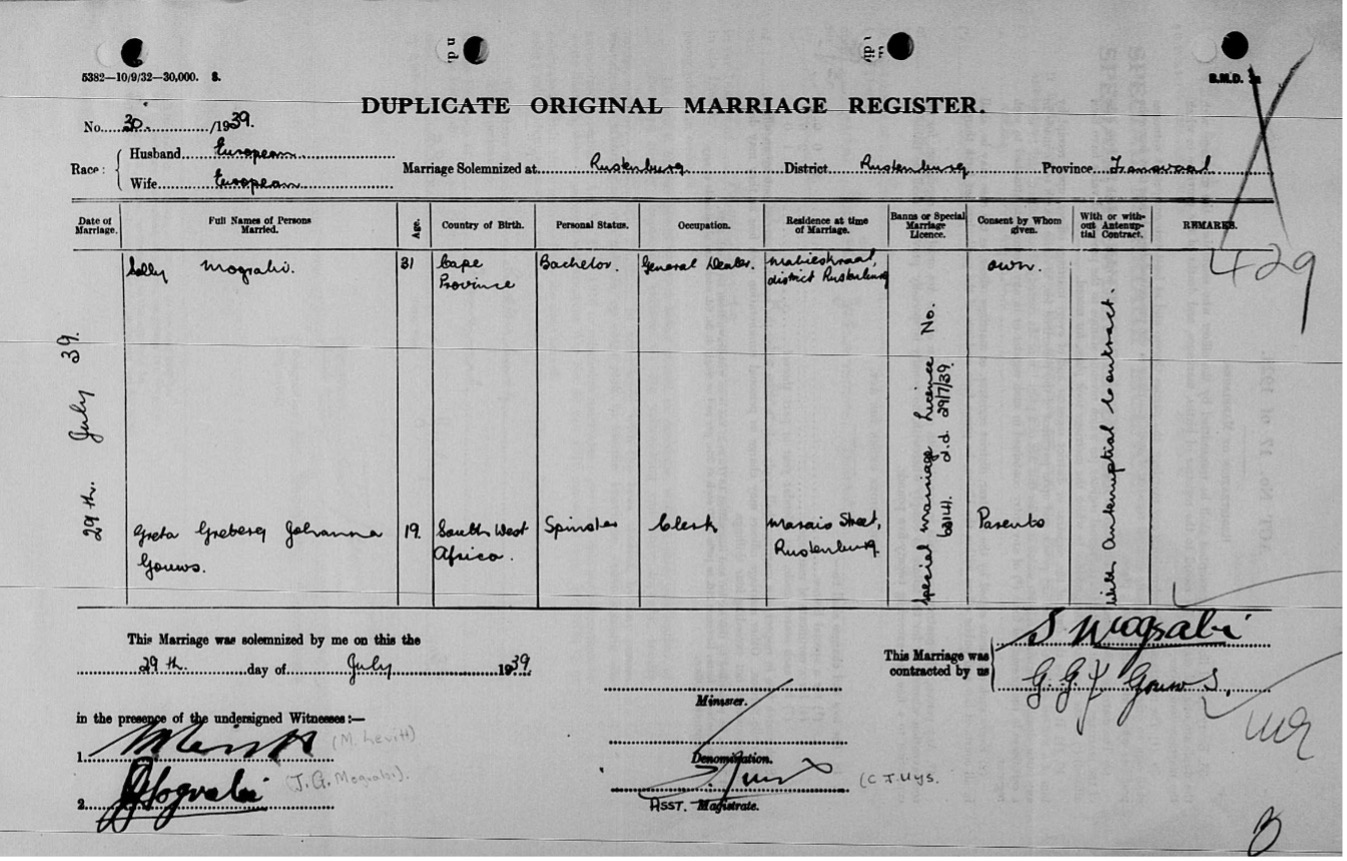
Zeev Woolfard Walter Mograbi
(April 1908 – 10 March 1970 Rustenburg)
Known as Wally, he was a rugby player. He was a bachelor and ran a panel beating shop. He died at the age of 61 and is buried in Rustenburg.
Joseph Mograbi
(Sept 1909 Cape Province – 7 April 1976 Rustenburg)
Known as Joe, he worked with his father in their tailor shop in Plein Street. He played rugby in the local team and was a wrestling, weightlifting and boxing instructor. He advertised his services in the local press. He married Lily Bertha Jacobson (1915 - 1983 Rustenburg) on the 14 March 1943. On the 8 July 1953, their baby daughter Lena Theresa died at the age of 9 weeks from prematurity, in the Sandra Nursing Home, Rustenburg. She had been named after Joe's mother. Joe and Lily Mograbi did not have any other children. They died in 1976 and 1983 respectively, and were mourned by their siblings.
Juda Julius Mograbi
(19 November 1917 – 1 December 1999 Johannesburg)
He was the youngest child. During World War Two he volunteered in the Union Defence Force and was wounded. He married Sylvia Chiplowitz (1925-1997) and they lived in Johannesburg.
References:
- The Golden Years: A Memoir of Old Rustenburg. Club Mograbi. Chapter 10. Lionel Wulfsohn, 2011, Watermark Press, Plettenberg Bay.
- NASA:
- 1938. Chief Native Commissioner. Western Areas. Trading Sites. Pilanesberg. Mabeskraal. SS Mograbi.
- 1953. Lease for period of three years of the Mograbi General Trading Site, Rustenburg, by the Batlako Tribe.
- 1959. Two chrome leases between the Native Owners of Portion B of the farm Vogelstruisnek No 173 District Rustenburg and Mr. SS Mograbi.
- 1959. Mynbou. Mining. Pilanesberg. Vogelstruisnek 602. SS Mograbi.
- 1962. Transvaal. Rustenburg. Kosterivier - Staatswaterskema. Gedeelte 1 van plaas Groenfontein No. 429 (sekere gedeelte). Resterende gedeelte van gedeelte 1 van Groenfontein. G Mograbi.
Mundel family
The Mundel family originated from Courland (Latvia), specifically the towns of Libau (Libava/Liepāja) and Gazenpot (Aizpute). Seeking new opportunities, several branches of the family immigrated to South Africa in the late 19th century and settled in Rustenburg, where Solomon Mundel and Wilhelm Herzfeld were pioneers of the tobacco industry and were foundation members of the Jewish community.
- Solomon Mundel
(1859 Libau, Courland - 17 October 1928 Johannesburg)
He established himself as a prominent tobacco manufacturer and landowner in the Rustenburg district during the late 1800s. In 1896, Solomon requested Letters of Naturalisation. During the historic Jameson Raid that same year, he supplied goods to the local forces, later submitting an account to the Veld Cornet for reimbursement. He co-founded Mundel and Herzfeld (Pty) Ltd., which manufactured the highly popular 'Horseshoe Tobacco' brand. Mundel and Herzfeld Tobacco Factory was situated at the corner of Plein and Berg streets. Next to the factory was an open field which was used for air-drying tobacco on tarpaulins. This field doubled as a bicycle polo field for the local children. Solomon Mundel acquired extensive agricultural land in the district, owning farms such as Zandfontein, Boschfontein, Waterkloof, and Onderstepoort. He served as a committee member responsible for erecting the Rustenburg Synagogue in 1924. On the 26 May 1896, Solomon married a family member, Paula Mundel (1875 Libau, Courland - 1967 Cape Town) in Rustenburg. The family eventually relocated from Rustenburg to Houghton Estate, Johannesburg, where Solomon passed away at age 69. They raised five children:
- Rachel Cornwall (née Mundel) (1897–1998).
- Burnell 'Burnie' Blankenberg Cole (née Mundel) (1899–2002), who passed away in Cape Town at the age of 103.
- Dr. Benjamin Samuel Mundel (b. 1903), who qualified as a medical doctor from the University of the Witwatersrand in 1929.
- Lea Lily Ashton (née Mundel) (1907–1999).
- Irene Johanna Williams (née Mundel) (1914–1990).
- Wilhelm Herzfeld
(1876 Hanover Germany – 16 July 1942 St James, Cape Province)
He emigrated from Germany and settled in Commissie Drift, district of Rustenburg. Wilhelm partnered with Solomon Mundel in the venture Mundel and Herzfeld (Pty) Ltd. He was involved in local governance, serving on the Rustenburg Village Management Board. When Rustenburg officially transitioned from a village to a town in 1918, Wilhelm was elected the Deputy Mayor during the maiden Town Council assembly on the 3 May 1918. He married Fanny Mundel (1888 Libau, Courland - 12 April 1965 Cape Town) in Rustenburg. Later in life, the family retired to St James, in the Cape Peninsula. They had three daughters:
- Edith Georgina Herzfeld (1909–1974), who married Alexander Zoond (Sand) in Johannesburg in 1930.
- Phyllis Rita Margo (1913–1965), who lived out her life in Cape Town.
- Stella Regina Herzfeld (1916–1981), who married Paul Koston in 1936 and following their divorce, she married well-known dermatologist Dr. Leonard Joseph Alphonse Loewenthal in 1950.
- Benjamin (Benshe Benzion) and Minnie Mundel
This branch of the family originally lived in Gazenpot (Aizpute), Latvia. Five children immigrated to South Africa, and they were joined by their mother, Khinka Mindel née Alshvang (1845–1919). She was known as Minnie Mundel and she settled in Rustenburg. She passed away in 1919 aged 74 at Stand 1106.
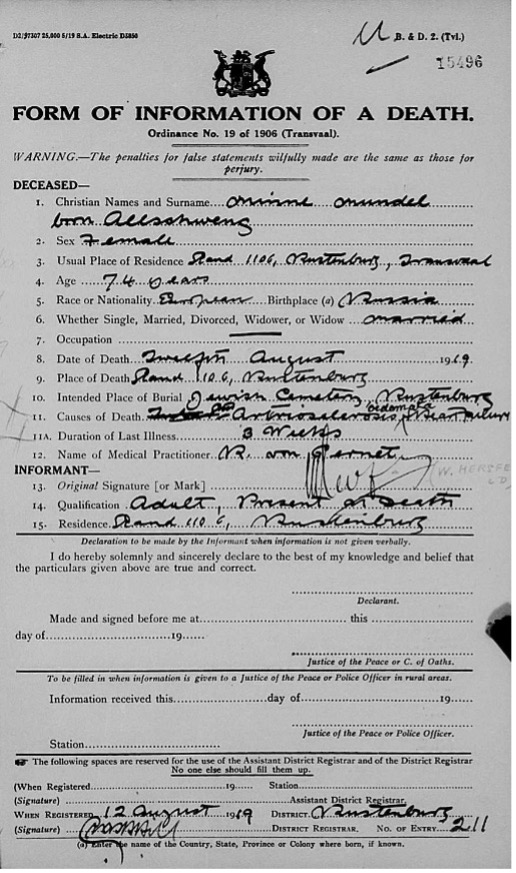
Death certificate of Minnie Mundel born Allschwang, 1919.
Children:
- Masha Swartz (née Mundel) (1878–1938)
She married a farmer, Samuel Swartz (1874–1941), and they farmed in Tarkastad, Cape Province. They had two sons. Following the deaths of Masha and her husband, Masha's younger brother, Jessel Sam Mundel, acted as an executor of their estate. - Lilly Starfield (née Mundel) (1879–1970)
She lived in Rustenburg and following her marriage to the widowed merchant Morris Starfield (1870–1944) in 1912, they lived in Potchefstroom, where they raised a son, Marcus, alongside Morris's children from his first marriage, Sadie Starfield and Lieut. Cpl. Hyman Starfield, MBE. Lilly later moved to Johannesburg. - Olga Abrahamson formerly Markson (née Mundel) (1880–1965)
She married Julius Markson (1869–1934) in Zeerust in 1904, raising four daughters. After she was widowed, she married Adolph Abrahamson (1880–1943) in 1936. - Jessel Sam Mundel (1883 Courland – 1953 Israel)
Known locally as Sam or 'Sammy', he was an active figure in Rustenburg's early history. During the Second Anglo Boer War, in 1900, he joined a local defence group who were deployed to establish a laager at the Elands River drift to secure Rustenburg against an incoming invasion. After the war, in 1903, he filed a burgher compensation claim. He was naturalized in 1908. He and his younger brother, Wolf Herman Mundel, were cattle dealers and owned the farm Tweerivier No. 823 Rustenburg. In 1914 during the failed Maritz Rebellion, which was led by armed pro-German disgruntled Boers who opposed Prime Minister Louis Botha's support of Britain in World War One, the Mundel brothers were targeted on their farm. They fled Tweerivier in fear for their lives after the anti-government insurgents seized and destroyed the farm. In early 1915 they filed sworn testimonies and claims regarding their property losses with the Rebellion Losses Commission. Sam diversified his business interests and set up 'Mundel and Robertson' trading firm. In 1917, he co-purchased the farm Bedford No. 435. He established W.H. Mundel, a radio and electrical cycle dealership and in 1946 his brother Wolf and nephew Frank joined him in the business.
Sam married Rona Miller (1890–1974) in 1916 and they had 2 children, Mignon and George. Sam and his wife left South Africa to spend their final years in Israel.
Children:
- Mignon Segal (née Mundel) (b. 1919): She was a social worker and married Sidney Leonard Segal. They emigrated to Australia in 1960. Her husband served as the Executive Director and Chairman of Consolidated Gold Fields, Australia.
- Dr. George Mundell (born Grisha Mundel) (1921–2012): He graduated from the University of the Witwatersrand as a medical doctor in 1944. He married Rosalie (Roxi) Michelson. In 1948, he volunteered with Machal during the Israeli War of Independence. The family settled in Israel, where he became a world-renowned authority on paediatric rehabilitation and child health. He served as Head of Paediatrics at Assaf HaRofeh Medical Centre and won the prestigious Yom-Tov Liman Prize in 1986.
- Wolf Herman Mundel (1887 Libau Courland – 14 January 1963 Rustenburg)
He was a cattle dealer and was targeted with his brother Sam on their farm Tweerivier during the failed Maritz Rebellion in 1914. Wolf briefly fled Rustenburg for Johannesburg. Wolf married Anna Freda Clara Ewald (1889-1916) in 1912 and they had two sons: Benjamin Ralph (1912 - 2000) and Salomon 'Solly' (b. 1915). Following Anna's death, Wolf married Julie Adelaide Arenstein (1892-1967) in 1920 and they had two sons, Frank and Derek. The family lived at 241 Wolmarans Street. Wolf and his son Frank joined his brother Sam in the business W.H. Mundel & Son, a radio and electrical cycle dealership in Plein Street. Over time, the family business evolved into a hardware business.
Children:
- Frank Mundel (1921–2012): He worked with his father at W. H. Mundel & Son. His passion was miniature trains, and he built a miniature railway at the family home where countless Rustenburg children enjoyed rides.
- Derek Mundel (1923–2007): He volunteered in the Union Defence Force in World War Two and served in the de la Rey Regiment, which merged into the WR/DLR battalion. He fought with the 6th South African Armoured Division in the Italian campaign. After the war, he practiced law in Potchefstroom before returning to Rustenburg to manage the family hardware business. He married Vera Ethel Bower on the 11 October 1955 in Johannesburg and they had two children. He managed the family business until it was sold in 2003. When he died in 2007, a memorial plaque was placed on his father's grave in the Jewish cemetery by his wife, Vera, and their two children, Trevor and Jennifer:
- Dr. Trevor Mundel is a prominent physician and scientist who serves as the President of the Global Health Division at the Bill & Melinda Gates Foundation.
- Jennifer Mundel (Mundel-Reinbold) was a successful professional tennis player. She reached the singles quarterfinals at Wimbledon in 1983 after defeating major seeded players, achieving a career-high world ranking of no. 55.
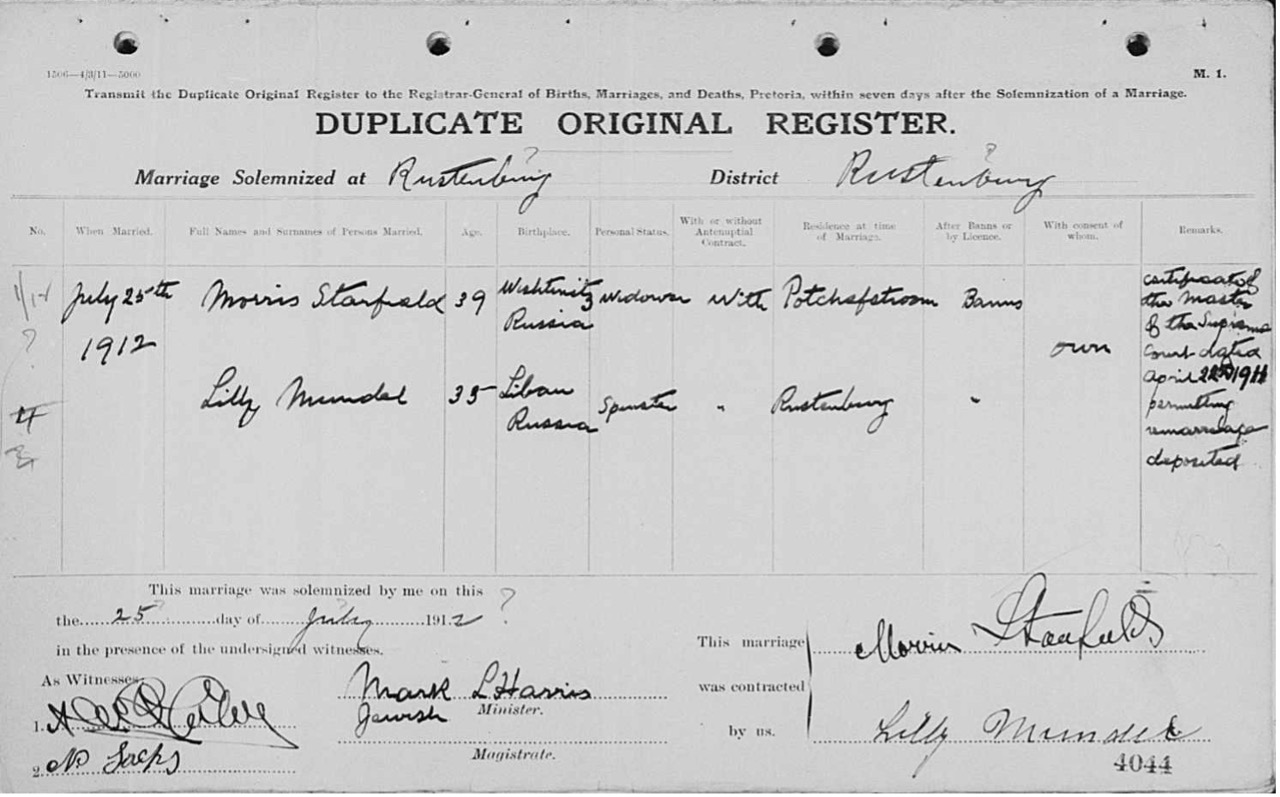
Starfield - Mundel marriage, Rustenburg, 1912.
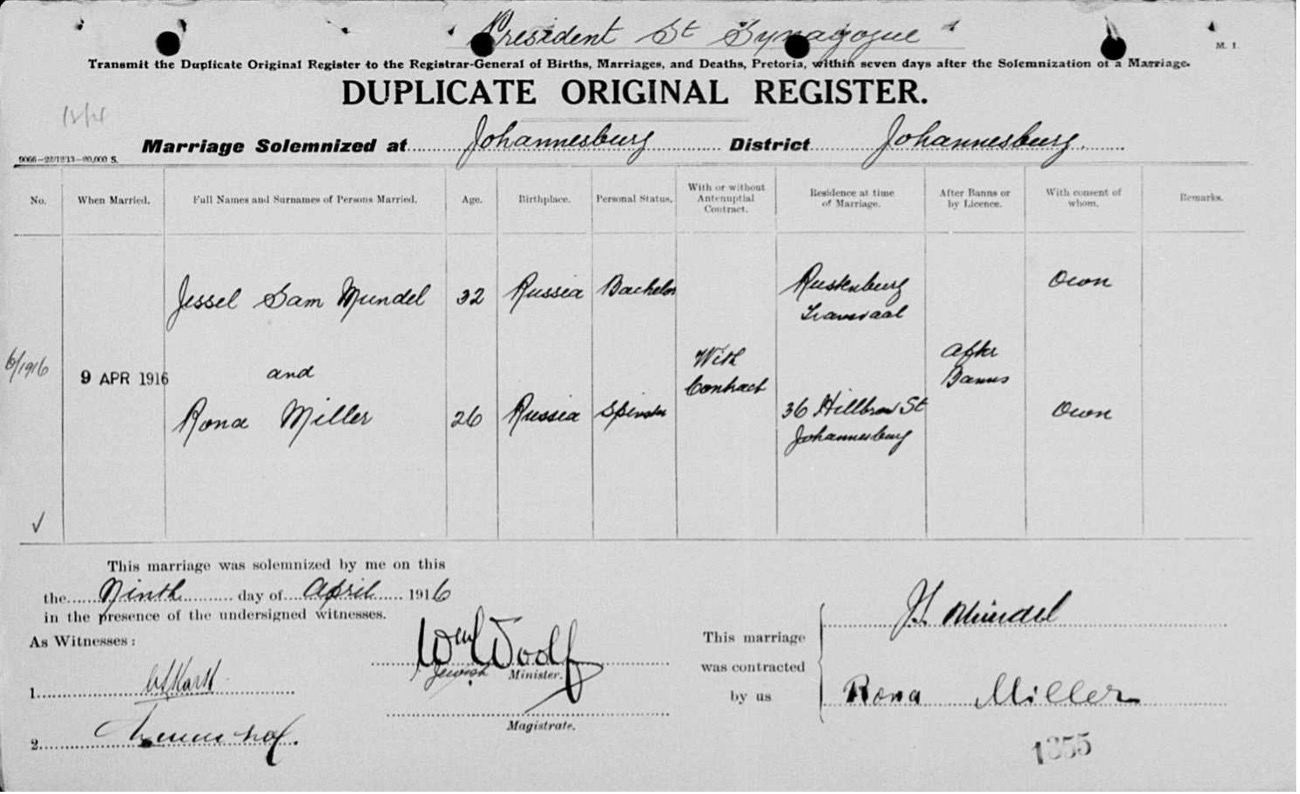
Marriage of Jessel Sam Mundel and Rona Miller, Johannesburg, 1916.
- Masha Swartz (née Mundel) (1878–1938)
- Arenstein family
Wolf Mundel's brother-in-law, Frederick Raymond Arenstein (1894-1979), also settled in Rustenburg. His parents were Bernard and Rebecca Arenstein and he was raised in Potchefstroom. Frederick married Margaret Munro Russell in 1923. They had three children: Raymond Russell Arenstein (1923–2006), Naomi Kottler née Arenstein (1926–2019) and Bernard Arenstein (b. 1932). Frederick Arenstein lived in Rustenburg for over 50 years. He died in 1979 aged 85 and is buried in the New Cemetery.
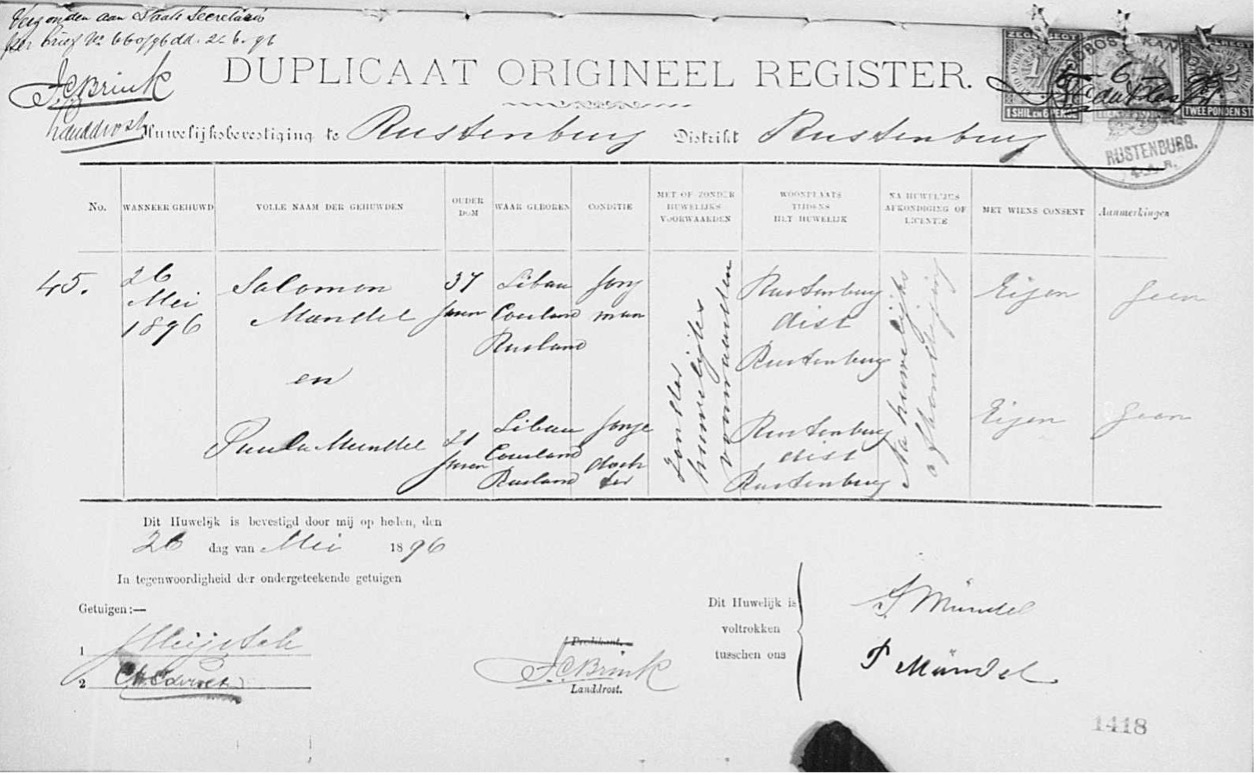
Back row: S. Isaacs, H. Gawron, M. Wulfsohn, F. Sholomir.
Front row: M. Sholomir, N. Kirsch, B. Harris, Chief Rabbi Dr. Landau, H. Wulfsohn, Rev. D. Leibovitz, M. Kadey, P. Wulfsohn, S. Mundel.
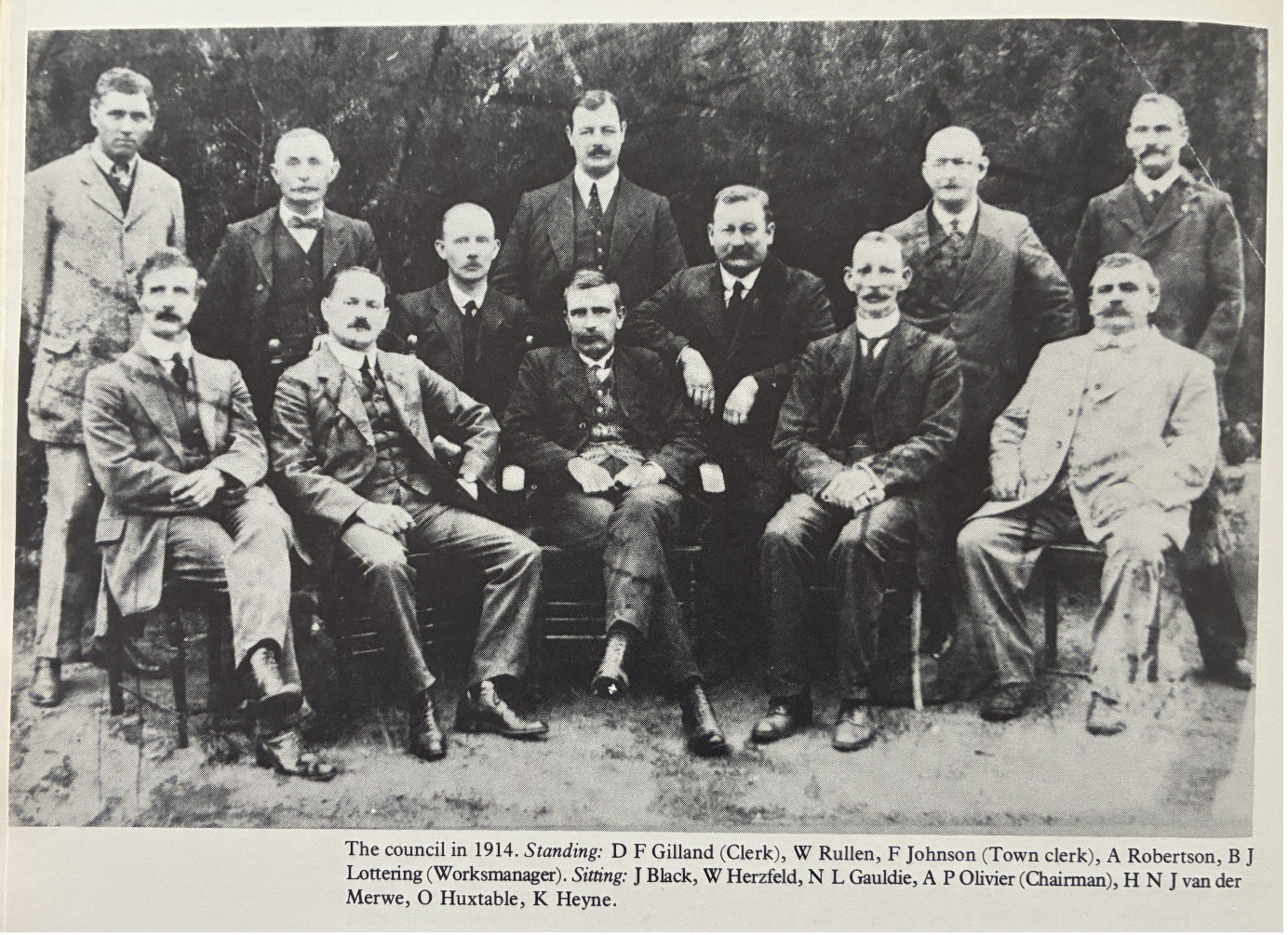
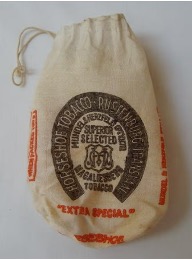
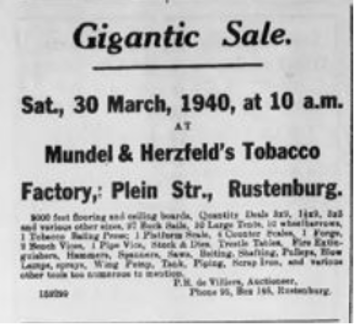
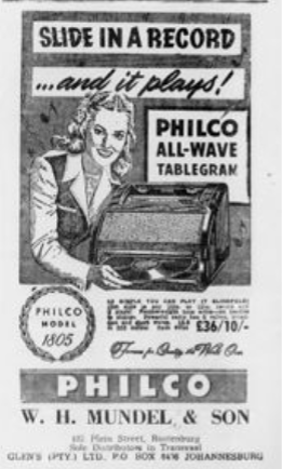
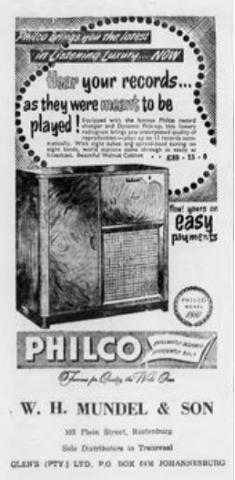
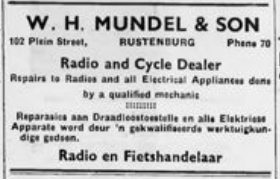
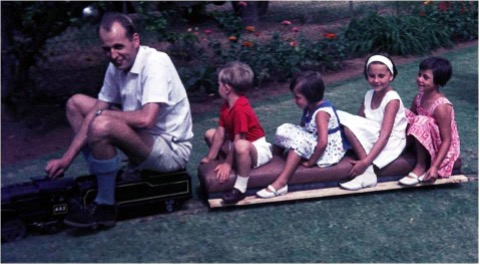
References:
- Chapter 26. Tobacco and General Progress. Rustenburg Romance: The History of a Voortrekker Town. Eric Rosenthal. Perskor Publishers, Johannesburg. 1979, pages 142-143.
- Higginson J. Chapter 6. A Glass Brimming Over. The Failed 1914 Rebellion in Rustenburg and Marico. Collective Violence and the Agrarian Origins of South African Apartheid 1900-1948. Cambridge University Press, 2014.
- NASA:
- 1896. Landdrost Rustenburg. S Mundel vraagt Brieven van Naturalisatie.
- 1897. Landdrost Rustenburg. Veldcornet Eloff zendt rekening teen $5-10 van S Mundel and Company zynde voor goederen gekocht door G Du Plessis tydens den Jameson Inval.
- 1901. Claims for Compensation. Pretoria District. S Mundel, Rustenburg.
- 1899. W Herzfeld Commissiedrift. Zegt dat hy zijn permit van het Kantoor van den Commandant Generaal ontvangen heft.
- 1899. Staatsecretaris, Sectie A, Pretoria. Willi Herzfeld, Commissiedrift Re Een jachtgeweer, dat hy via Delagoabaai wenscht in te voeren.
- 1909. Justices Of The Peace. Suggested appointment of Mr. Herzfeld.
- 1903. Claims for Compensation. Burghers. Rustenburg. Samuel Mundel.
- 1967. Estate Papers of Paula Mundel. Predeceased spouse Solomon Mundel. Identifier: ZA KAB 6/9/27419_4887/67.
Rustenburg Herald entries:
- 1946. Notice is hereby given that the business of General Dealer and (Radio and Electrical Cycle Dealer) hitherto carried on by J. S. Mundel under the style or firm of W. H. Mundel at Erf 102, Plein Street, Rustenburg has been transferred to J. S. Mundel, W. H. Mundel and F. Mundel as from the 1st day of July 1946 and that they will carry on the business at the same place under the style or firm of W. H. Mundel & Son. — P. R. de Villiers, Attorney for the Parties, Steen Street, P.O. Box 140, Rustenburg.
Narunsky family
Moses Louis Narunsky (1872 Lithuania - 7 July 1916 Rustenburg) and Pere 'Pearl' Narunsky née Herr (1867 Lithuania - 14 January 1952 Johannesburg) had 10 children - George (d. 1916 Belingwe, Southern Rhodesia), Ralph (1888 - 1952 Johannesburg), Rachel Leah Jacobson formerly Ackerman (1897 - 1978 Johannesburg), Dr Solomon Narunsky (b. 1898), Ethel Borkum (1902 - 1992 Johannesburg), Benjamin Narunsky (1903 - 1967 Durban), Harry Narunsky (1905 - 1943 Johannesburg), Edith 'Edie' Trauberman (1907 - 1972 Johannesburg), Katie Pesskin (1911 - 1989 Port Elizabeth) and Dora Behr (1916 - 2002 Johannesburg).
Moses and Pearl Narunsky emigrated to South Africa in the early 1890s with their 2 sons, George and Ralph. They settled in Natalspruit, district Germiston, Zuid Afrikaansche Republic, where their eldest daughter, Rachel Leah, was born in 1897. They were present in the area during the Second Anglo Boer War and after the war, Moses Narunsky claimed compensation as a foreign subject in Germiston. Their eldest son, George, settled in Southern Rhodesia, where he worked as a trader in Belingwe.
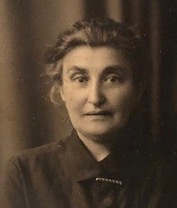
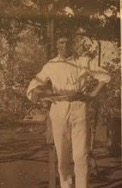
The family left Germiston and settled in Rustenburg, where their cousins, Frank and Michael Sholomir, lived. The 2 families were related through the Herr family on their maternal side. The Narunsky family lived at Erf No. 16. Moses was a general dealer and, on the 7 July 1916, he passed away, aged 54. Frank Sholomir was present at his death. Twelve days later, Moses and Pearl's eldest son, George Narunsky, a bachelor, passed away in Belingwe, Southern Rhodesia. Michael Sholomir was present at his death in Belingwe and signed the death notice. The Narunsky family remained in Rustenburg after Moses's death and 2 years later, when Rachel Leah Narunsky got married to Morris Ackerman, they were still resident in Rustenburg.
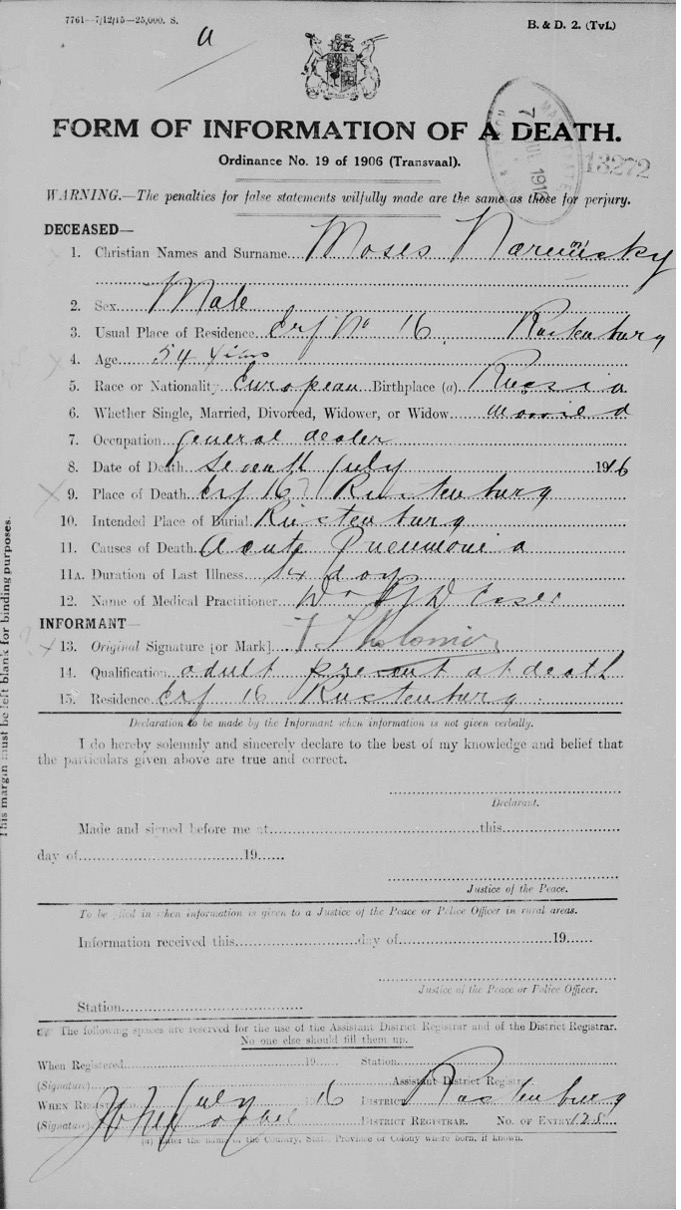
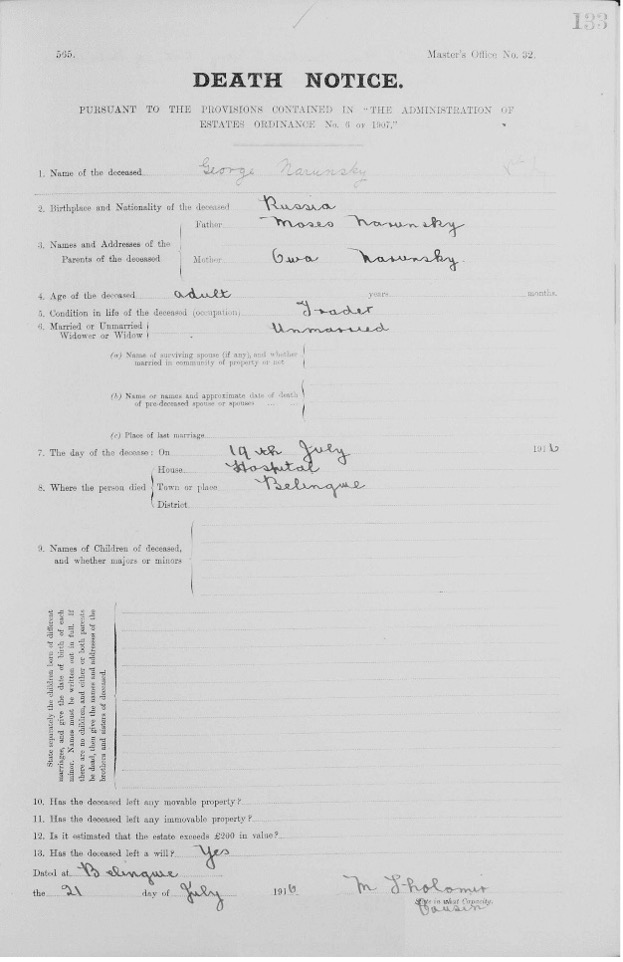
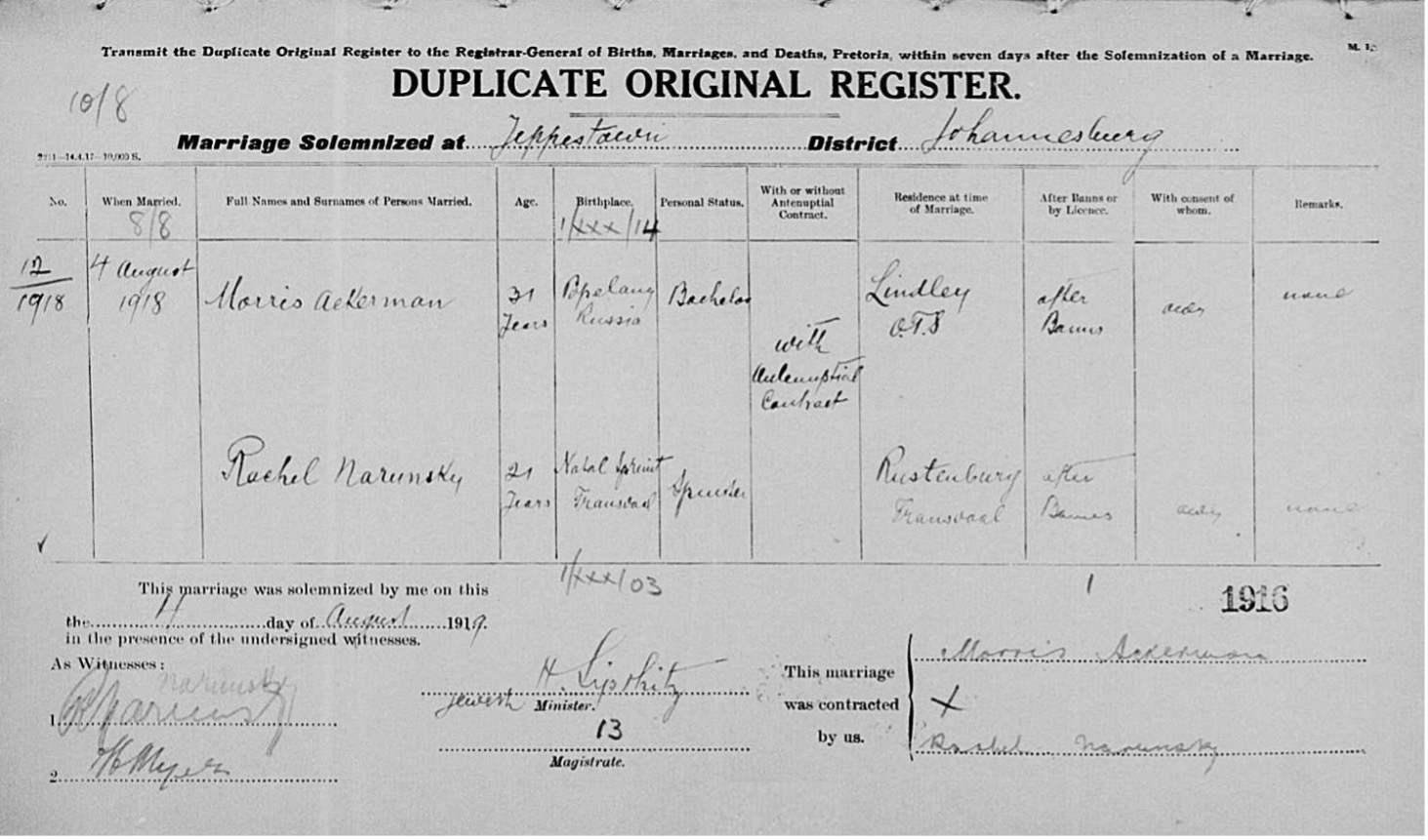
The family subsequently moved to Senekal, Orange Free State. Ralph, a bachelor, lived in the Senekal Hotel. Solomon, a doctor, was resident there when he got married in 1927 and their 2 sisters, Katie Pesskin and Edie Trauberman, both got married in Senekal in 1935 and 1937 respectively. When Dora Behr got married in 1943, the family were living in Johannesburg.
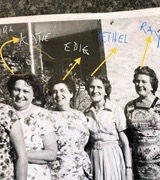
References:
- NASA Claims for Compensation. Foreign Subjects. Germiston. Moses Narunsky.
Ornstein, Gustav Samuel
(21 January 1870 Rotterdam, Holland - 8 August 1926 Rustenburg)
He was the son of Dutch Jews, Moses and Dina Ornstein, and was a tobacco manufacturer. He was associated with Wilhelm Herzfeld, who owned Mundel and Herzfeld Tobacco Factory. At the age of 50, Gustav Ornstein married Gertrude Stein born Jacobson (1883 Hohensala, Germany - 3 November 1942 Johannesburg), a divorcee, on the 21 April 1920 in Johannesburg. The family resided in Wolmarans Street, Rustenburg. Six years after their marriage, he died of heart failure.
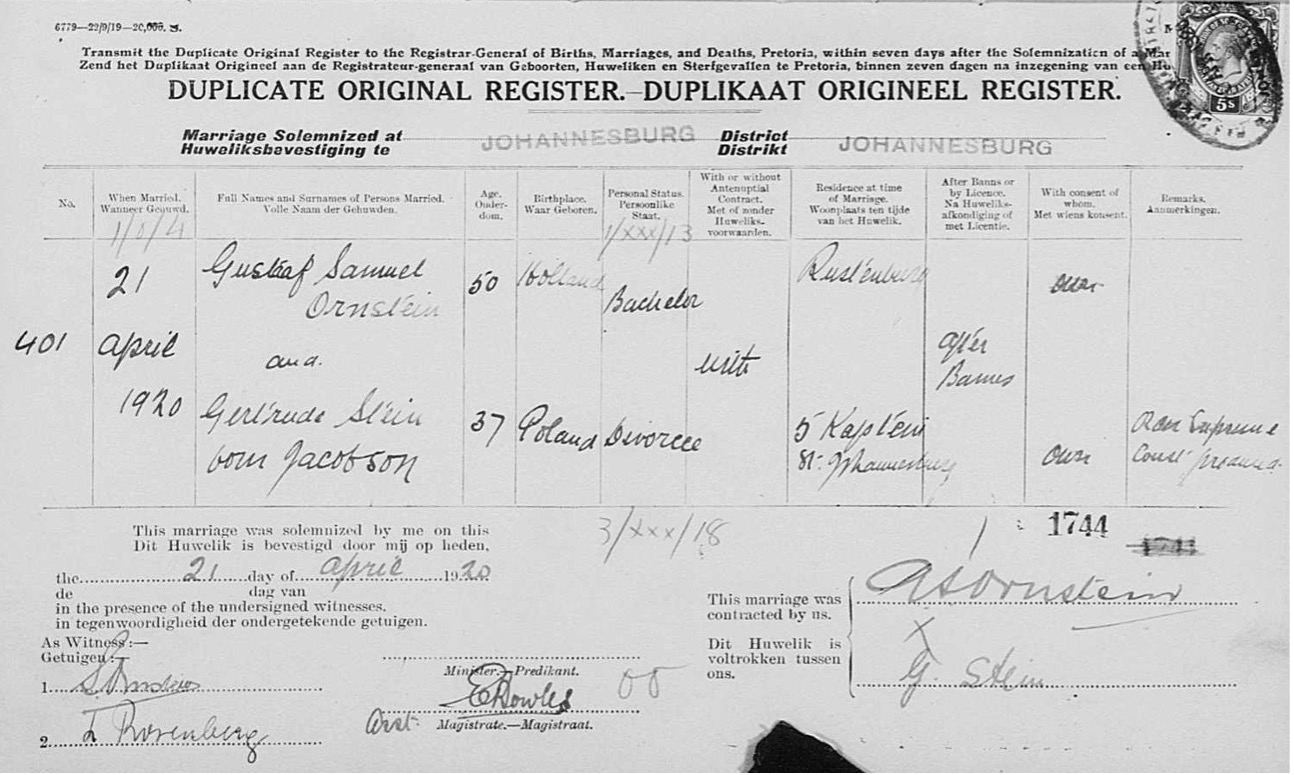
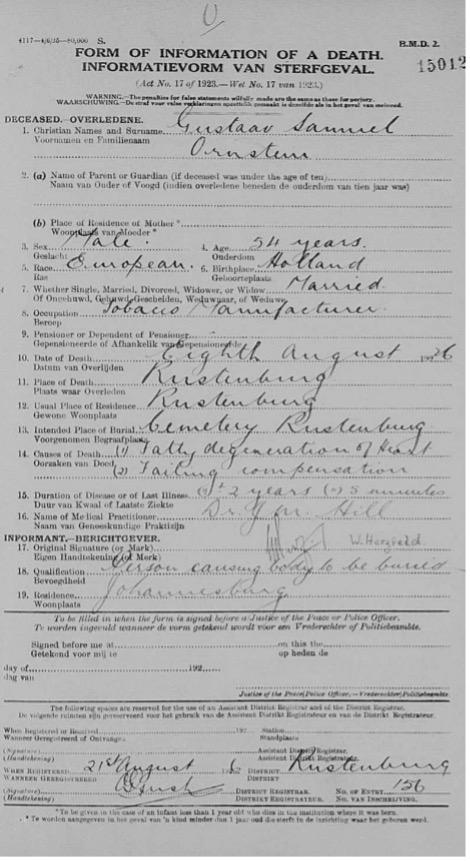
Oster family
Leo Oster (29 September 1914 Euskirchen, Flamersheim, Germany - 6 June 1975 Rustenburg) was the son of Max Oster (1878 - 1964 Rustenburg) and Regina Oster née Spier (1882 - 1969). He had two older siblings, Henrietta 'Henny' Heumann (1905-1937) and Walter Oster (1907-1979), and the family lived in Euskirchen. He and his brother left Nazi Germany for South Africa and were followed by their parents. The family settled in Bertrams, Johannesburg. In 1935 his sister, Henny, and her husband, Siegfried Heumann (1903-1960), left Euskirchen for Bonn and from there they managed to reach South Africa. Henny died shortly after her arrival in South Africa from valvular heart disease at the age of 32.
Leo worked as a salesman in Johannesburg. On the 26 September 1943 he married Sarah Levin (4 January 1918 Kupiskis, Lithuania – 22 September 1999 Johannesburg) and they had three children, Selwyn Harold Oster, Morris Oster (1945 - 2017 Johannesburg) and Helen Rosin. The family lived in Wolmarans Street, Rustenburg, and were active members of the Jewish congregation. In the early 1970's Morris Oster and his family contributed to the building fund of the Jacob Finkel Cultural Hall. Leo Oster died in 1975 at the age of 61 and is buried in the New Cemetery.
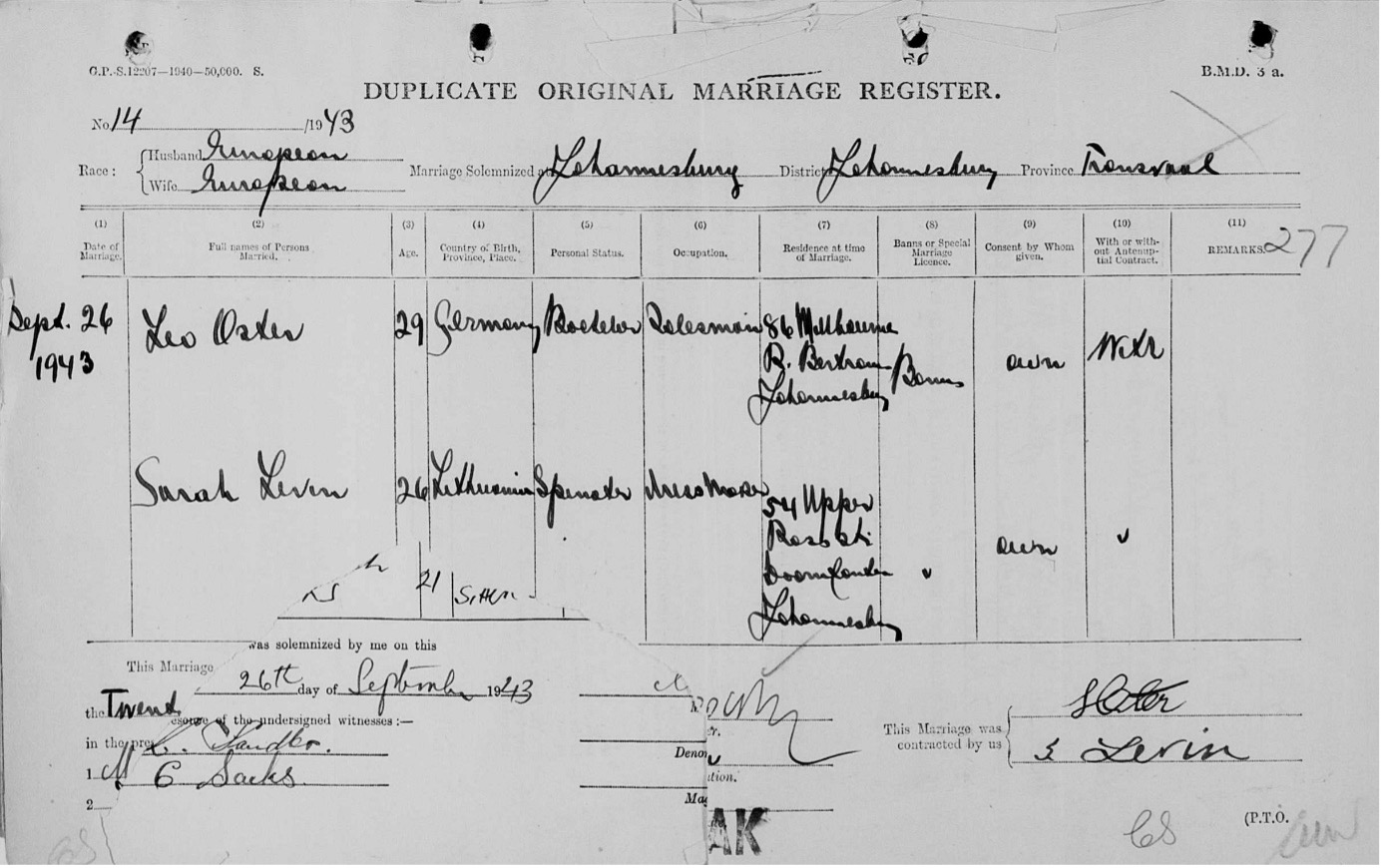
Two of the Oster children married Rustenburgers. Their elder son, Selwyn, married Rosalyn Weinstock (1950 Rustenburg – 2017 Johannesburg), daughter of Solly and Dinah Weinstock, and their daughter, Helen, married Gabriel 'Gaby' Rosin, son of Nochum and Emmie Rosin.
References:
- Jewish Holocaust Memorials and Jewish Residents of Germany, 1939-1945.
Pastoll family
For over half a century the Pastoll family provided entertainment to the Rustenburg public. They were the proprietors of the Town Hall Cinema and the Rustra Theatre in Rustenburg and also ran bioscopes in other Western Transvaal towns such as Lichtenburg. Their era in Rustenburg ended in 1990 when they sold their cinema theatre. Cinematography had a great influence on their children and grandchildren, inspiring a grandson, Abner Pastoll, to become a film director and screenwriter.
Solomon Pastolsky (3 December 1886, Worcester, Cape Colony - 20 July 1963, Rustenburg), known as Solly Pastoll, was the son of Julius Pastolsky (1852-1926) and Annie Pastolsky née Silverstone (1865-1943). His parents emigrated to South Africa and they were married in 1882 in Cape Town. Solly's wife, Sarah 'Sadie' Lily Singer (1895 London, England - 1966 Rustenburg), was the daughter of Nathan and Esther Singer née Hopps. Her parents were married in Janowo, Poland, and moved to London where Lily was born.
Solly Pastoll and Sadie Singer were married on the 10 August 1914 in Wolmaransstad, Transvaal. They had 5 children and the family lived in Makwassie near Rustenburg. Their children were Hannah Nathalia born 1915, Phyllis Paula born 1916, Nathan Sidney born 1918, Gerald Bernard born 1920 and Cyril Israel born 1923.
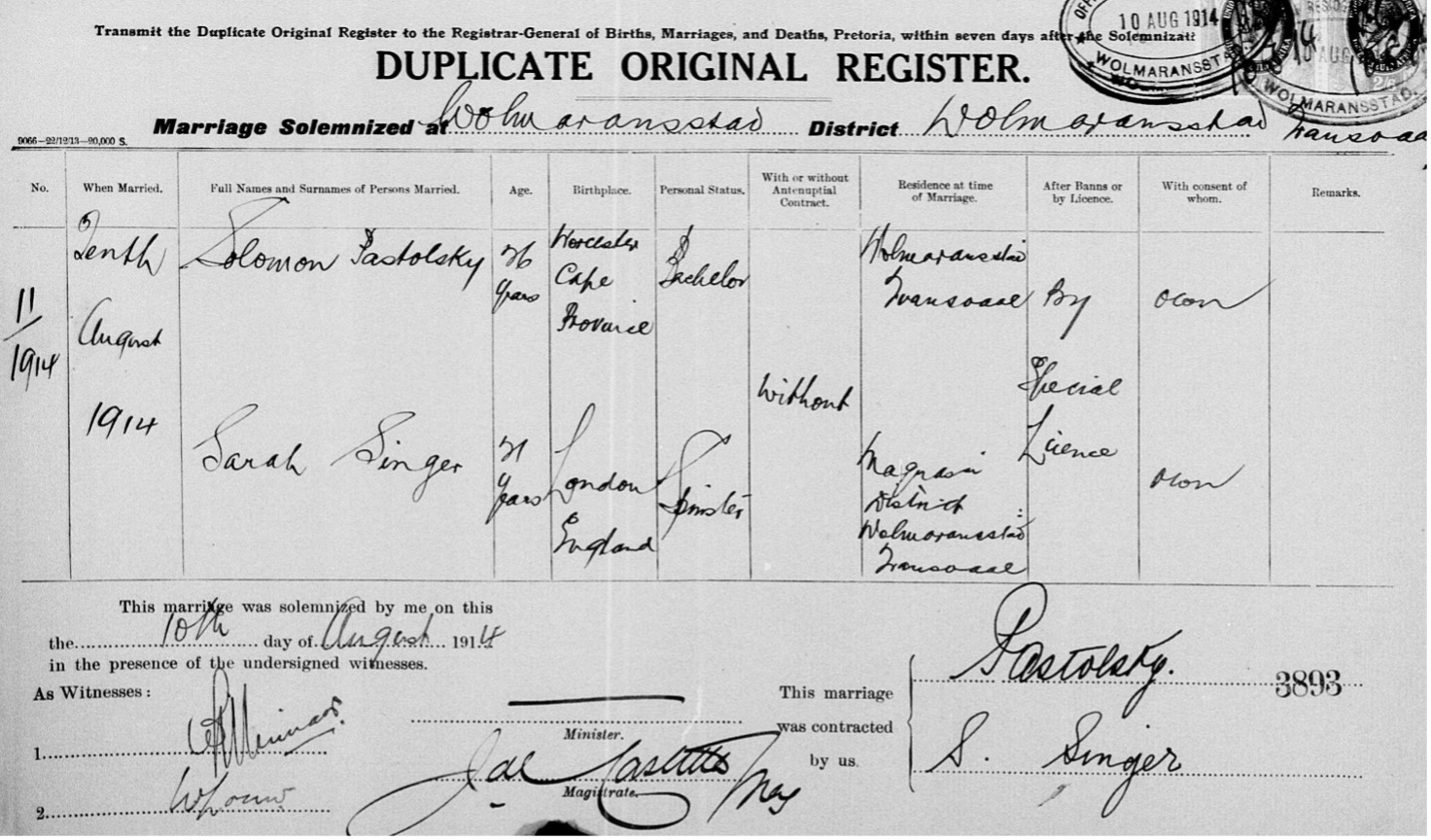
Solly and Sadie Pastoll and their 2 sons, Nathan and Gerald, subsequently settled in Rustenburg. The 2 brothers married 2 sisters, the Abrahams girls from Potchefstroom. The Pastoll family owned the local bioscope in town - Town Hall Cinema - as well as the Rustra Theatre. Each week a list of film screenings and the times of showing was published in the Rustenburg Herald newspaper. Numerous articles in the newspaper highlight the family's contribution to the town. An example in November 1948 was the publication of thanks by the committee of Rustenburg Flying Club Annual Dance to Mr Pastoll for the use of the Town Hall. In July 1950 the newspaper printed "Through the courtesy of Mr. N. S. Pastoll Town Hall Cinema proprietor, a Bioscope performance will be held on Wednesday, 2nd August 1950, the afternoon and evening, in aid of The Red Cross. The feature film will be a comedy, 'Here Come the Huggests'", a British comedy which was produced in 1948. During the Apartheid years the Pastolls had to apply for a group area permit in order to operate their bioscope. 'Departement Plaaslike Bestuur. Beheer oor plaaslike owerhede. Groepsgebiedpermitte. Rustenburg. Rustra Theatre.'
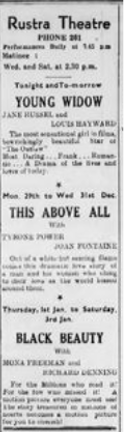
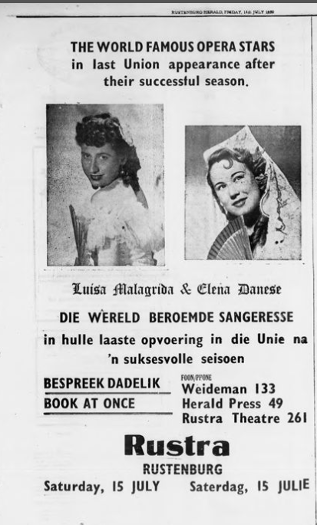
Sons who lived in Rustenburg:
- Nathan 'Natie' Sidney Pastoll
(24 June 1918 - 12 January 1982 Rustenburg)
He married Hilda Evelyn Abrahams (4 March 1932 Potchefstroom - 7 March 1991 Rustenburg) on the 17 June 1951 in Johannesburg. They had 4 children. Natie died in 1986 at the age of 68. The inscription on his tombstone aptly reflects his work and passion. "The man of moving pictures, silver screens and celluloid, the last of the great showmen." One of his sons, David Pastoll (d. 2017), lived in Johannesburg, where he worked as a set builder and lighting engineer. He owned Pastoll Photography and Ten Stirling B&B. In 2015 he and his wife started Studio Stirling and designed award-winning furniture. David was a competitive archer and served as the President of the South African National Archery Association from 2002 to 2006.
Natie and Hilda's one grandson, Abner Pastoll, is a British film director and screenwriter who is based in London. Although he moved to London with his parents at the age of 2, he traveled back to the family cinema for at least one month out of each year until the cinema closed down in 1999. He started making films at the age of 4, inspired primarily by his family's cinema and his father's film and video equipment. He originally thought he wanted to become an actor but soon discovered that he preferred being behind the camera. His debut Road Games (2015), which debuted on US Netflix on 12 July 2016, went straight to number 1 as the most popular, most watched film on the streaming service for 3 consecutive days. - Gerald Bernard Pastoll
He and his wife, Lois Rebecca Pastoll née Abrahams (10 December 1926 - 23 October 2024 Rustenburg), had 3 sons, Gregory, Steven and John. Gregory Pastoll is a writer, painter and violin maker. He studied mechanical engineering and after 2 years working as an engineer, switched to lecturing in engineering as well as specialising in teaching methods. His motivation for writing was growing up in a small town. There was no television there at the time, so social activities included plenty of conversation, building things, and imaginative ventures. He read widely as a boy and was always enchanted with good stories. When his children were born, he started making up stories to tell them and this resulted in the publication of children's stories. Besides publishing books on engineering and teaching methods, he has written scripts for 5 musicals. His childhood roots are also reflected in his painting portfolio, which includes scenes of Rustenburg and the surrounding area. Gregory emigrated to Perth, Western Australia, in 2013 after residing in Cape Town for many years. Steven Pastoll is an analogue electronics designer and emigrated to New Zealand. John Pastoll emigrated to England and is involved in construction management. Their mother, Lois Pastoll, was the last remaining family member in Rustenburg. She died in 2024 at the age of 98 and was cremated.
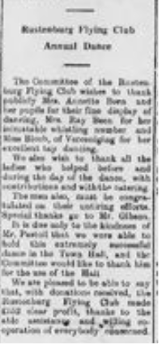
Rustenburg Herald entries:
- 1948 –11-12. Rustenburg Flying Club Annual Dance. The Committee of the Rustenburg Flying Club wishes to thank publicly Mrs. Annette Been and her pupils for their fine display of dancing, Mrs. Ray Been for her inimitable whistling number and Miss Bloch, of Vereeniging for her excellent tap dancing. We also wish to thank all the ladies who helped before and during the day of the dance, with contributions and with the catering. The men also, must be congra¬tulated on their untiring efforts. Special thanks go to Mr. Gibson. It is due only to the kindness of Mr. Pastoll that we were able to hold this extremely successful dance in the Town Hall, and the Committee would like to thank him for the use of the Hall. We are pleased to be able to say that, with donations received, the Rustenburg Flying Club made £152 clear profit, thanks to the able assistant and willing co¬operation of everybody concerned.
Rabinowitz, Reverend Nachum Mendel
(1887 Orla, Poland - 1966 Israel)
He was the son of Avraham Yaakov Szeresweski and Rochel Guta Szeresweski née Rishilevski. In order to escape being drafted into the Russian army, he changed his surname to Rabinowitz. In the early 1900s he left for Brest-Litovsk, where he studied at the Brisk Yeshiva under Rav Chaim Soloveichik (1853-1918). He then travelled to Palestine, where he married Chana Cheshe Miriam Herison (1888-1966) in Jerusalem in 1905. They emigrated to South Africa and in 1911 he served as the first minister of the Jewish community of Rustenburg. He then served the Jewish community in Volksrust. In 1914 he officiated at the marriage of Moses Simon Wulfsohn of Rustenburg to Flora Mannheim of Volksrust in Volksrust.
Reverend Rabinowitz's son, Zvi Hersh 'Harry', was the first of his children to be born in South Africa. His two older sons, Arieh Leib and Isaac, were born in 1908 and 1911 in Jerusalem. By 1919, the family had moved to Cape Town, where his two daughters, Rachel and Sarah, were born in 1922 and 1927 respectively. Reverend Rabinowitz served as a Hebrew teacher, shochet and mohel. He was Cantor and Ba'al Korea of the Cape Town Beth Hamedrash Hechodosh for more than 30 years and the secretary of the Cape Town Bikkur Cholim for 42 years.
Ramokgadi, Geoffrey Modise Menachem
(25 August 1953 - 13 September 2019)
He was born in Rustenburg in 1953 to Ellah Mampe Moche, a domestic worker who worked in Johannesburg for the Abramowitz family. His grandmother took care of him and he grew up near the mines in Rustenburg. During his school holidays he would visit his mother in Johannesburg. He left school early to embark on a music career, gaining a reputation as lead singer and musician in the first multiracial band. In the early nineties he decided to affiliate himself with the Jewish people and Israel. During his visits as a child to his mother in Johannesburg, he was exposed to a wealth of Jewish literature, including books and pictures of the Holocaust in the Abramowitz home. He learnt Hebrew, partly being self-taught as well as with the assistance of his friend, Nathi Gamedze, a linguist at the University of the Witwatersrand. After he got married, he and his wife, Dudu, lived in Mbabane, Swaziland, where they named their home 'The Kibbutz'. Ramokgadi made a covenant with his grandmother and his creator that one day he would make a contribution to education. This resulted in the founding of the Kobe-Ramokgadi Advanced Learning Academy in 2008. The academy, located in Ezulwini near Mbabane, is a primary and high school and the school emblem is the Torah. In 2013 the Rabbi Moshe Silberhaft Library was opened at the school.Ramokgadi served as the head of Swaziland's small Jewish community and organized shul services, Pesach seders, and Jewish communal events. He was responsible for having ground consecrated for a Jewish cemetery. He was Vice-President of the African Jewish Congress (AJC) and travelled throughout sub-Saharan Africa for AJC gatherings. He went to Israel and met Prime Minister Yitzhak Shamir. His friends included King Mswati III of eSwatini, the Swazi royal family, the family of the late Nelson Mandela, pop stars, and many others. In 2018 his biography, My Covenant: The Honorary Jew, was published and launched in Rustenburg. It was commissioned by his 'boss', Rabbi Moshe Silberhaft, AJC Chief Executive, and was written by Suzanne Belling. Ramokgadi died of cancer a year later in 2019. He requested to return to his childhood roots and is buried in the Rustenburg New Cemetery.

References:
- Ramokgadi, Geoffrey Modise Menachem. 2018. My Covenant: The Honorary Jew. Publisher, Geoffrey Modise Menachem Ramokgadi.
Rapeport family
The Rapeport family spent 60 years in Rustenburg. They arrived in 1916 from Calitzdorp, Cape Colony, where Louis Rapeport had been a shopkeeper. Following the collapse of the ostrich feather trade in the Cape Colony, the family was left financially destitute and sought a new future in the Transvaal.
Louis Rapeport (1859-1926), his wife Lieba 'Louisa' Rapeport (formerly Etten née Kantor) (1871-1930), their daughter Neche Mina 'Annie' Etten / Rapeport (1894-1918) and their 3 sons, William (1896-1952), Martin (1899-1976) and Lazarus 'Dummy' (1903-1961), settled in Rustenburg. William managed to get a job at Philip Wulfsohn and supported the family. Louisa's eldest daughter, Rosa Etten (1893-1961), who was born from her first marriage, married Solomon Goldstein in 1916 and settled in Pretoria. Two years later, in 1918, during the Spanish Flu pandemic, Louisa's younger daughter, Neche Mina Rapeport, aged 24, succumbed to the flu. She was buried in the Old Cemetery. Her tombstone was inscribed with the Hebrew name of her biological father, Samuel Etten (1866-1894), and in English with 'Beloved daughter of Mr and Mrs L. Rapport'. She grew up as a Rapeport as she was only a few months old when her father, Samuel Etten, a hotelkeeper, was murdered at Waterfall, Pretoria.
On the 6 April 1926, ten years after moving to Rustenburg, Louis Rapeport died in Pretoria, whilst visiting his stepdaughter Rosa Goldstein. He was 66 years old and although he resided in Rustenburg, he was buried in the Rebecca Street Cemetery, Pretoria. His English name was inscribed as Max Louis Rapeport. Four years later, in 1930, Louisa Rapeport died in Rustenburg and was buried in the Old Cemetery. Her death certificate stated that she was 72 years old.
Children and spouses:
William 'Willem' Rapeport
(1896 Johannesburg - 11 April 1952 Rustenburg)
He was the eldest son and was born in Fordsburg, Johannesburg. He spent his childhood in Calitzdorp. Following the move to Rustenburg he was employed by Philip Wulfsohn, general dealer. He initially was a junior staff member and was promoted to the position of General Manager. In a personal note written by Maurice McGregor, Emeritus Professor of Medicine, who grew up on the farm Rainhill, on the outskirts of the town, he wrote about his family's shopping excursion to Philip Wulfsohn and interaction with William Rapeport - 'After the week's grocery shopping, and always a gift of a chocolate bar to the children from Mr. Rapeport …'. Another incident reported during William's tenure as manager at Philip Wulfsohn was recalled by Lionel Wulfsohn - 'On one occasion, he (sic William Rapeport) was faced with an excessive stock of eggs in the grocery department. When one of Rustenburg's leading matrons had then included a dozen eggs in her telephonic order, Willem had sent her three dozen in order to get rid of his surplus. The matron was not amused, returned to the store and hurled the pack of eggs in Willem's face. Willem took this contretemps in his stride and subsequently became very good house friends of the matron and her husband.'
In 1924 William married Sylvia Simson, niece of Mary Wulfsohn, whom he met when she spent holidays with the Wulfsohn family in Rustenburg. They were married on the 3 February 1924 in Johannesburg. They moved in with William's parents and brothers, Martin and Lazzy, in Steen Street, Rustenburg. They had 3 children. Jack was born in 1925, Louis in 1926 and Jean in 1928.
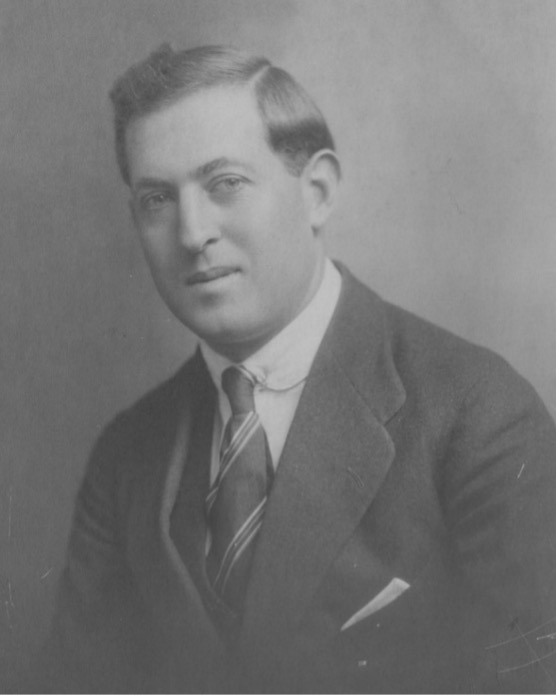
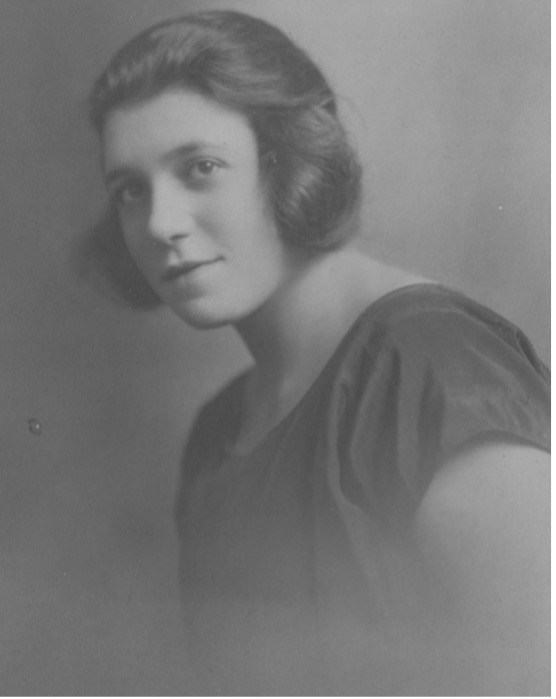
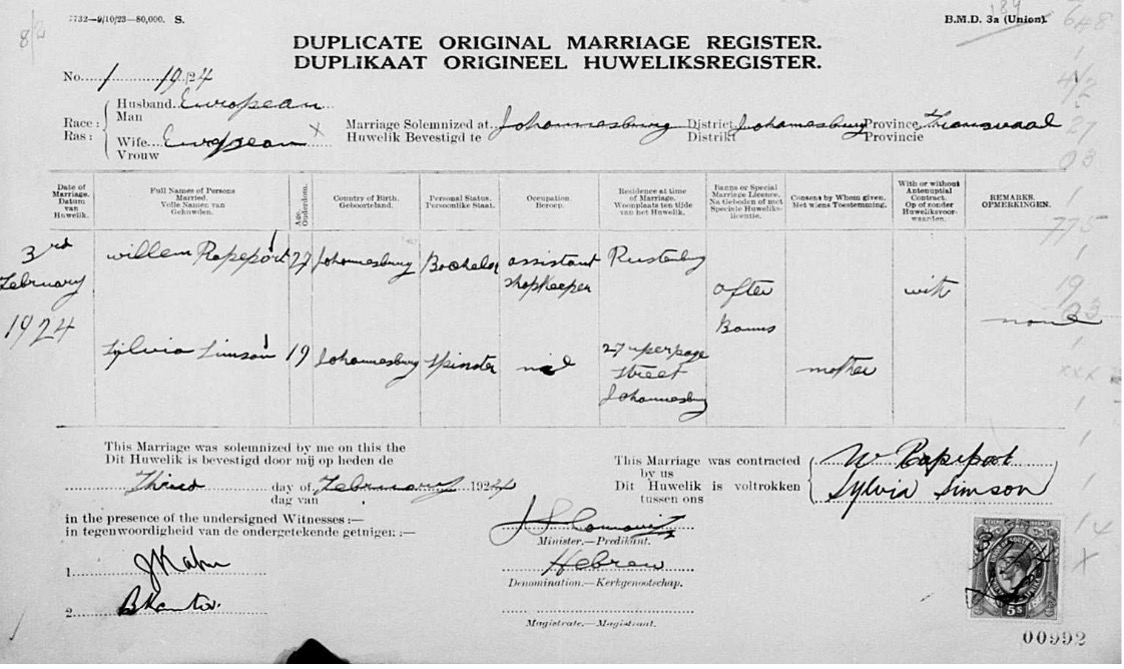
In 1933 William left the employ of Philip Wulfsohn and set up his own business on the corner of Plein and Burger Street. Initially he sold farm windmills, building material and furniture. Three years later, the business evolved into a draper, outfitter and furniture dealer. Every week, he placed an advert on the front page of the Rustenburg Herald. In December 1936 an article regarding the advertisers in the newspaper commented that his advert was a picture of a 'girl. He is assuredly an artist otherwise he would never be able to select the artistic models of costumes displayed by him. Willem and his brother Laz (our reporter) attract many people and the corner opposite the Town Hall has become a regular place of meeting'. This advert of a girl appeared weekly in the newspaper from 1936 until 1942. In 1942 William stopped selling furniture and traded solely as a draper and outfitter. In 1950 his eldest son, Jack, joined him in the business and they traded as W. Rapeport and Son (Pty) Ltd. In August 1950 the first Mannequin Parade held in Rustenburg was organized by W. Rapeport and Son, at the Rustra Theatre, where their spring fashion collection was exhibited.
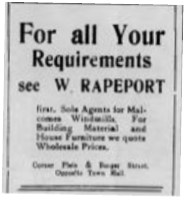
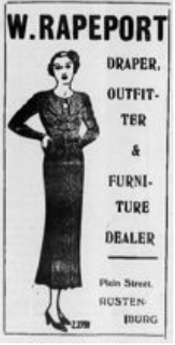
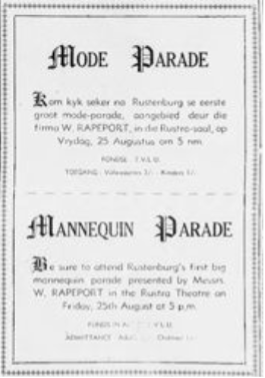
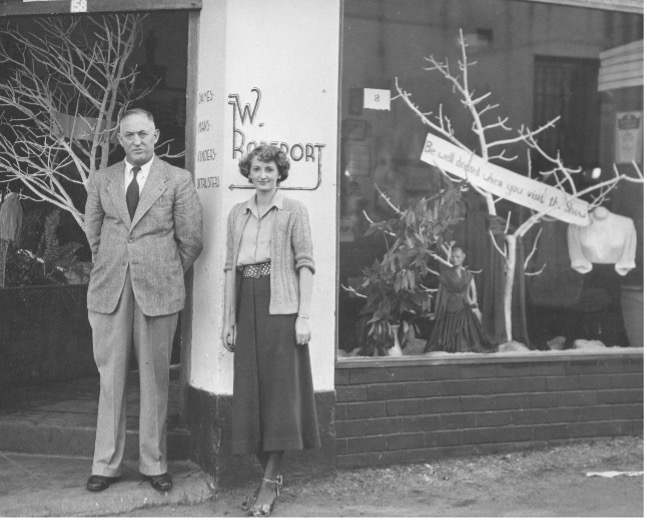
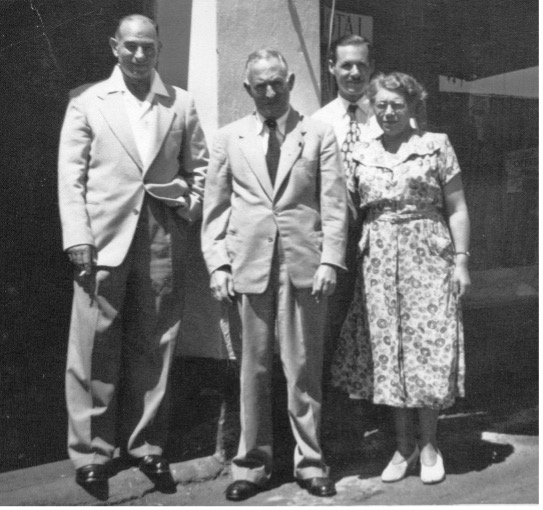
William was active in civic affairs and served as a town councillor for seven years. He was elected Mayor of Rustenburg and served in 1946-1947. He was listed in the 1947 Who's Who of South Africa. During his tenure the British Royal Family - King George VI, the Queen Mother and their 2 daughters, Princess Elizabeth and Princess Margaret - visited the Union of South Africa. William and his wife were presented to the Royal Family at the welcome ceremony held on 29 March 1947 at Church Square, Pretoria, and they attended the Administrator's garden party at the Administrator's Residence that afternoon. A gift of Outspan oranges was sent on behalf of the town to the Royal family. William served on numerous committees, including the Chamber of Commerce, Rotary, and the Rustenburg Sports Association. He was a member of the Paul Kruger Memorial Hospital board. He served on the Town Council finance committee and was in that position during the town's centenary in September 1951.
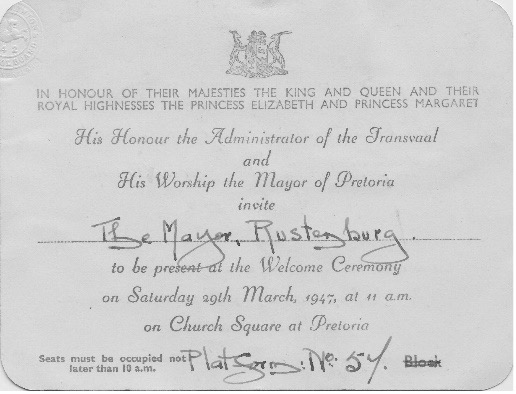
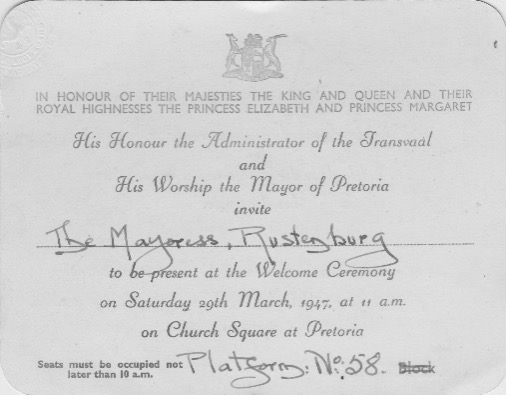
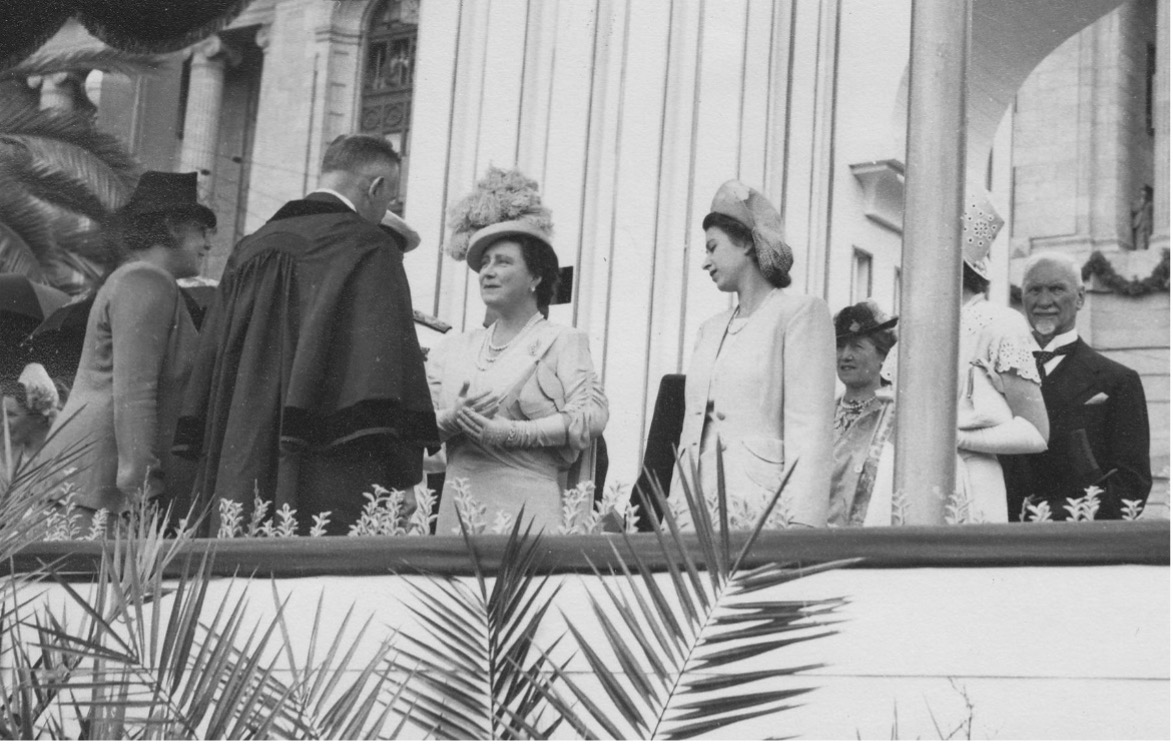
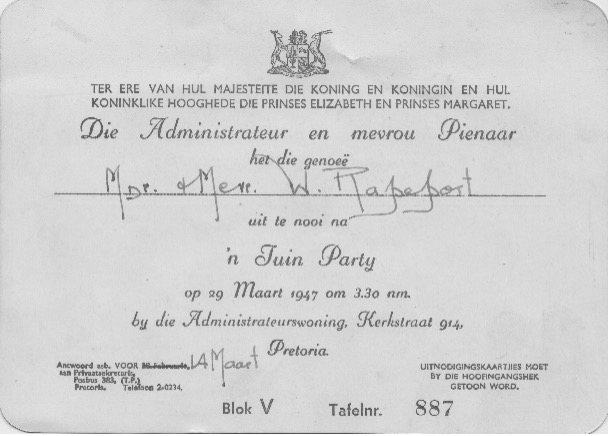
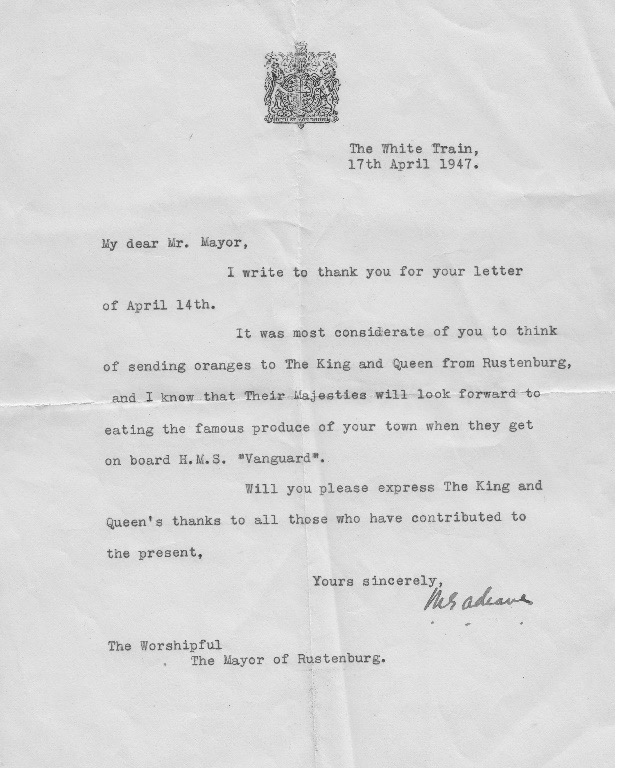
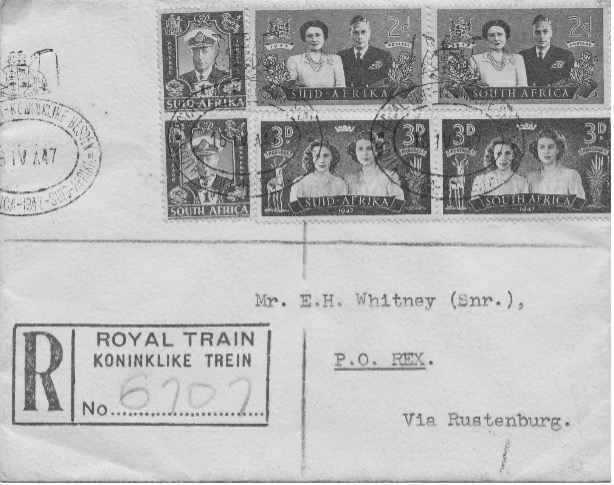

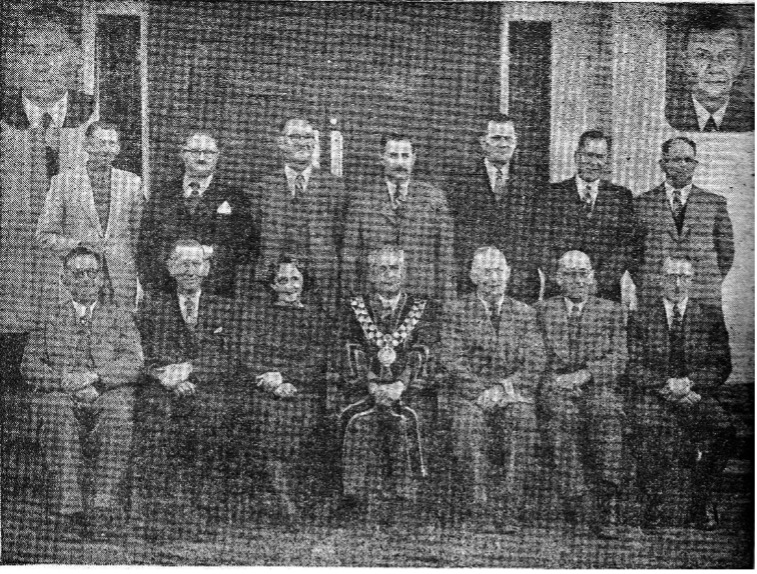
When William started to prosper, he built a home at 191 Wolmarans Street. During the construction of the house, the family resided at the Grand Hotel. The home was situated three blocks from the centre of the town and the Town Hall. His brother Lazzy lived with the family, sharing a bedroom with his nephew, Jack.
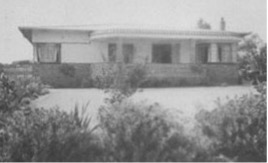
William was a heavy smoker and suffered from Buerger's disease. He died at home on the first night of Pesach, the 11 April 1952, aged 55 years. He was buried 2 days later in the Old Cemetery. His funeral was officiated by Rabbi L. Singer of the Oxford Synagogue, Johannesburg. In a letter sent to the Rabbi thanking him for his moving and dignified tribute, William's widow, Sylvia, stated that 'expressions of admiration of the beautiful service have been made to me by all sections of the community. The Afrikaans people, who are so much a part of our lives, were particularly moved by the inclusion of psalms in Afrikaans'. The town subsequently honoured William Rapeport, naming a street in the suburb of Cashan as Rapeport Street.
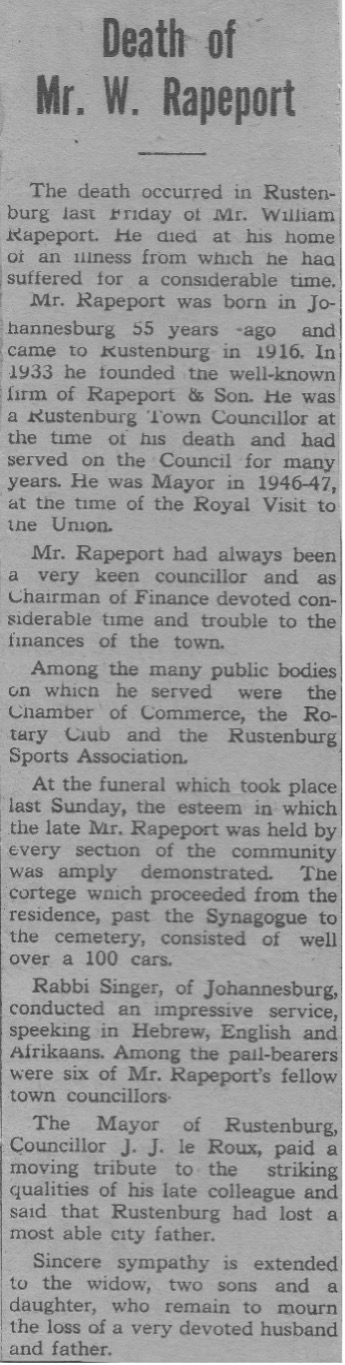 |
Rustenburg Herald, Friday 18th April 1952. |
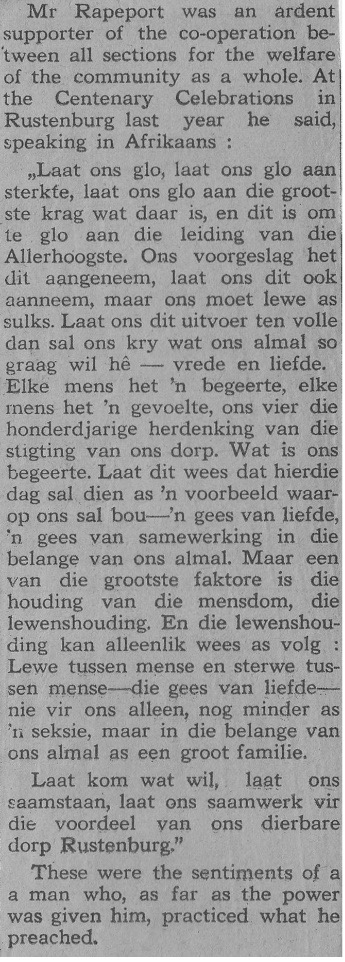 |
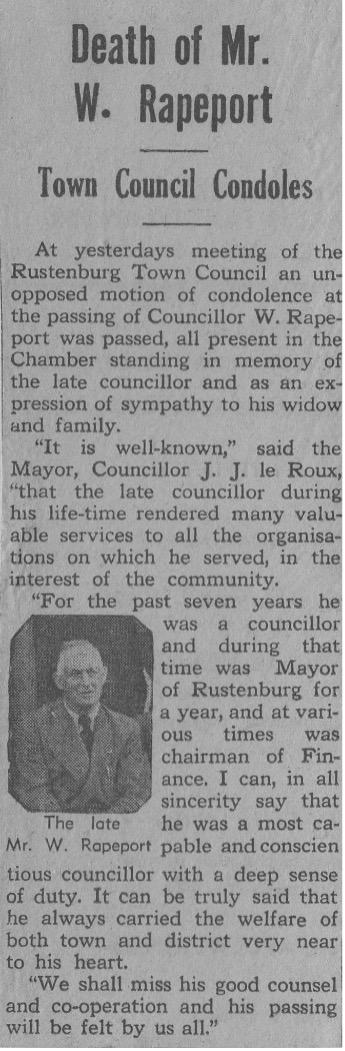 |
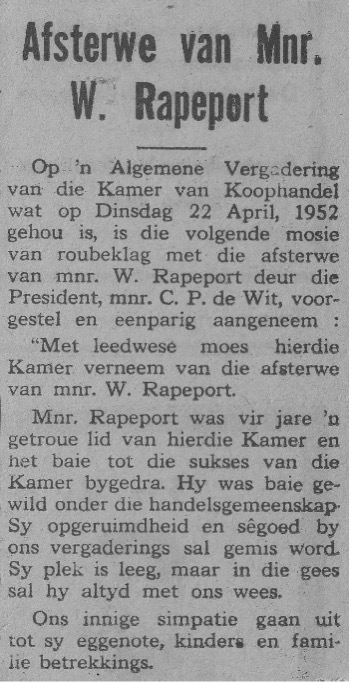 |
Slove 'Sylvia' Rapeport (née Simson)
(17 June 1905 Johannesburg – 24 August 1979 Johannesburg)
Sylvia was the eldest child of emigrants, Samuel Woolf Simson (1872-1913) and Annie Simson née Kurlansky (1882-1943). Her parents were from Courland. She was born at 22 Park Lane, Fordsburg, Johannesburg. She had 4 younger siblings. Her father died when she was 8 years old, whilst the family were on holiday in East London. Following his funeral, her mother and the 5 children returned to Johannesburg. The children ranged in age from one to eight years old. As her mother could not cope with caring for 5 little children, Sylvia was sent off to boarding school in Potchefstroom and attended the Convent of the Sacred Heart. After completing her schooling, Sylvia returned to Johannesburg and worked for a shadchan (marriage matchmaker). She was 19 years old when she married William Rapeport and settled in Rustenburg. Sylvia assisted William in his business and she was active in communal affairs. During the Second World War she worked for the Rustenburg branch of the South African Gifts and Comforts Fund. She kept a letter of thanks from 'Ouma' Smuts, wife of Prime Minister Jan Smuts, who acknowledged the work of the volunteers. She was a member of Rustenburg Women's Zionist Society and the Union of Jewish Women.
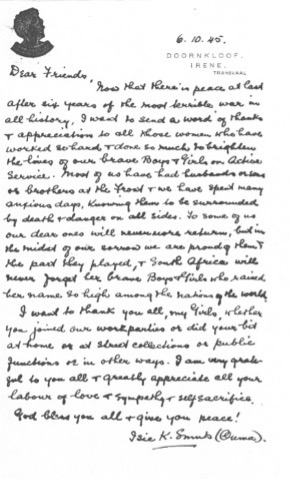
Following the death of William in 1955, Sylvia insisted that her eldest son, Jack, and his newlywed wife, Zelda, live with her in the family home. The young couple had only been married for 4 months. Sylvia lived with the family until she moved to Johannesburg in the early 1960s. When the family business and family home were sold in Rustenburg in 1966, Jack instructed that all the proceeds were to be given to his mother. She was able to live very comfortably off these proceeds for the rest of her life. She travelled extensively overseas and in her later years, being a respiratory invalid, she was able to have full-time home nursing care and had a full-time driver. She died at the age of 74 years on the 24 August 1979 at the Kenridge Hospital, Johannesburg, where she was nursed by Sisters of the Holy Family of Bordeaux Congregation. During her life, Catholic nuns played an important role in caring for her during her schooling and also during her terminal illness. She died under a cross affixed to the wall above her hospital bed. Although a burial plot was reserved for her next to William in Rustenburg, she requested to be buried in Johannesburg and was buried in West Park Cemetery.
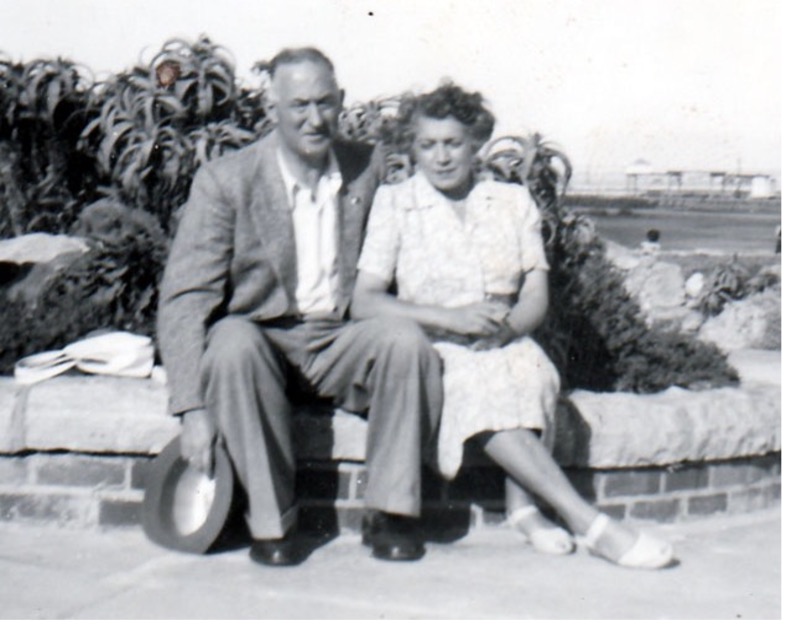
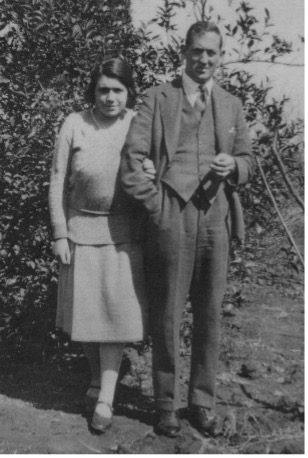
Martin Rapeport
(1899 Calitzdorp – 2 September 1976 Johannesburg)
He was 17 years old when the family moved to Rustenburg. His wife, Hannah Socher, was also a Rustenburg resident. In 1936 they were married in Krugersdorp and they settled there. They subsequently moved to Johannesburg, where they resided with Hannah's widowed sister, Elizabeth (Lizzie) Pleskus, at 186 Derby Road, Kensington, Johannesburg. Their son, Leonard, was born in Johannesburg and grew up surrounded by his older Pleskus cousins. Leonard studied law at the University of the Witwatersrand and qualified as an attorney. He was a partner in the law firm Rapeport, Fanaroff and Partners and over the years he changed partnership, eventually practising as Rapeport Incorporated, Attorneys at Law. Leonard married Hazel Berman (1944-1997) in Johannesburg and they lived in Saxonwold with their 3 children.
Martin died on 2 September 1976 at the age of 76 years. His widow, Hannah, died twelve years later in 1988 and they are buried next to one another in West Park Cemetery, Johannesburg.
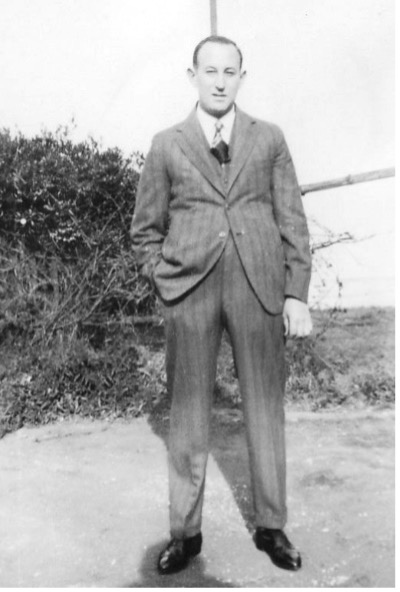
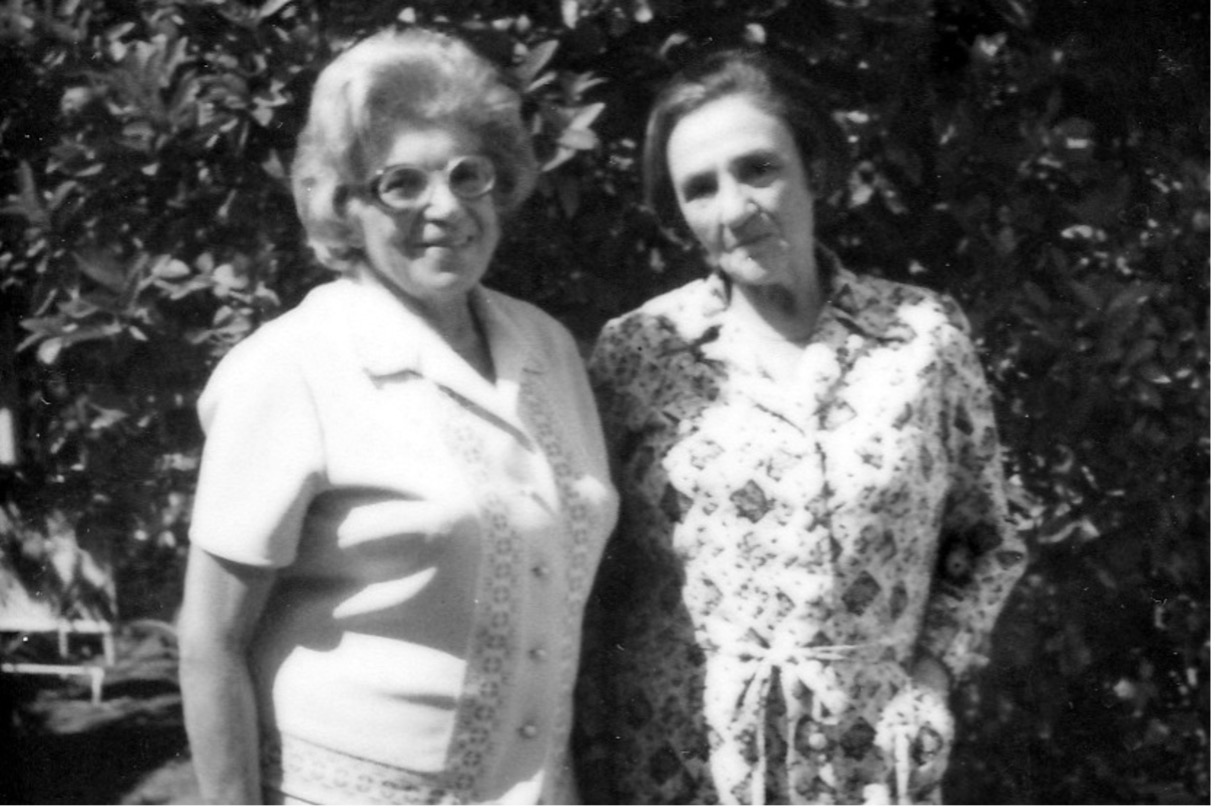
Lazarus 'Dummy' Rapeport
(1903 Calitzdorp – 1 June 1961 Johannesburg)
Known as Lazzy or 'Dummy', he was 'deaf and dumb'. Although he did not have any formal schooling, he was able to communicate exceptionally well using hand signs and mannerisms. He knew all the news in the town and worked as the Chief Reporter of the column 'Local & General' in the Rustenburg Herald newspaper. He was a great raconteur and imitator. He was a tall man who was always immaculately dressed and was a wonderful dancer who loved the ladies. A description of his character by Lionel Wulfsohn reads:
'Willem's youngest brother had never gone to any school. Nevertheless, he knew more about the goings on in Rustenburg (and for that matter the entire world) than most people with all the capabilities of hearing and speaking. One of Dummy's fortes was his ability to imitate people. Woe betide if he had the needle in for you, because at public functions he would demonstrate your worst characteristics, which you were doing unknowingly, such as scratching your behind or picking your nose. He reserved his best imitations, however, for men like Smuts, Botha, Hertzog, Winston Churchill, Stalin, Mussolini and Hitler.'
Lazzy often travelled to Pretoria to visit his sister Rosie Goldstein and to Johannesburg to visit his brother Martin. His comings and goings were reported in the local press. In the September 1939 edition of the Rustenburg Herald, it was reported in the 'Local & General' column that 'The reason of so few locals in this column, is because our chief reporter Mr Rapeport (Dummy) has gone to Pretoria to act as best-man at a wedding.' During the S.P.C.A. Variety Show it was reported that 'Dummy Rapeport was funnier than ever'. In July 1945, when the Red Cross Ball was held, 'Special mention was made of Mr. Rapeport (Dummy) who sold 100 raffle tickets (for the whiskey) in less than two days'. In 1946 he 'gave a number of his excellent impersonations of well-known characters' at the S.A. Legion Dance.
Dummy left Rustenburg and resided at Flat 107 Heerengracht, Spuy Street, Sunnyside, Pretoria. He was unemployed and was supported financially by his nephew Jack. In 1961 he died at the age of 58 at the home of his brother Martin in Kensington, Johannesburg. He was buried in the Rustenburg Old Cemetery.
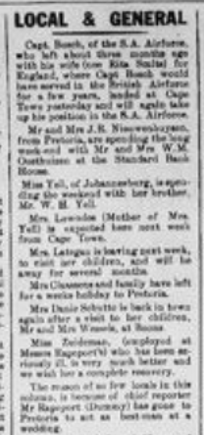
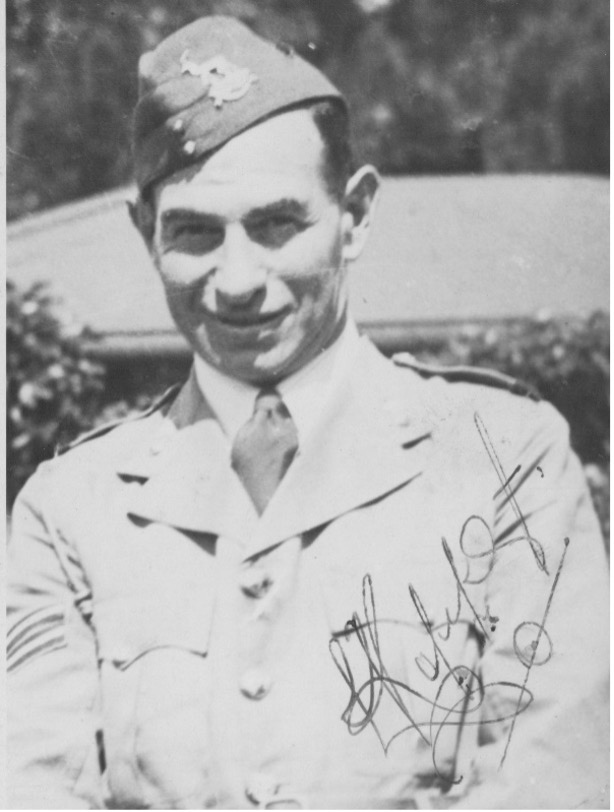
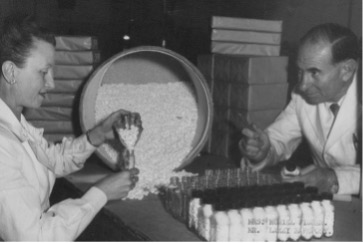
Grandchildren:
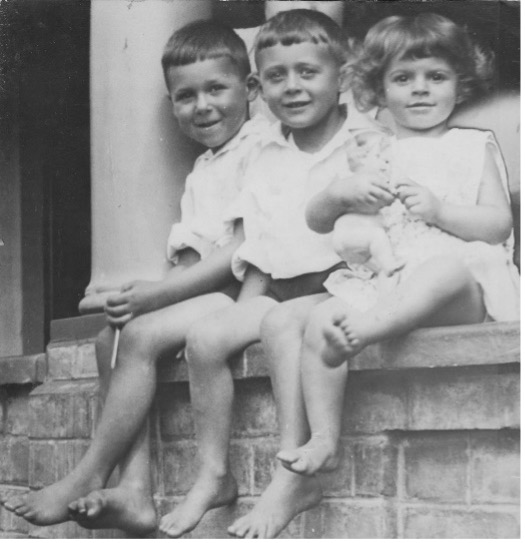
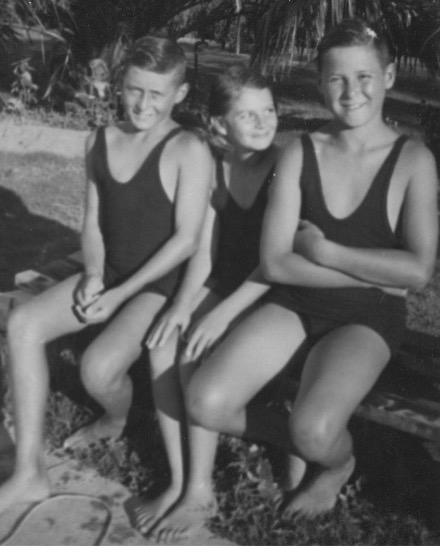
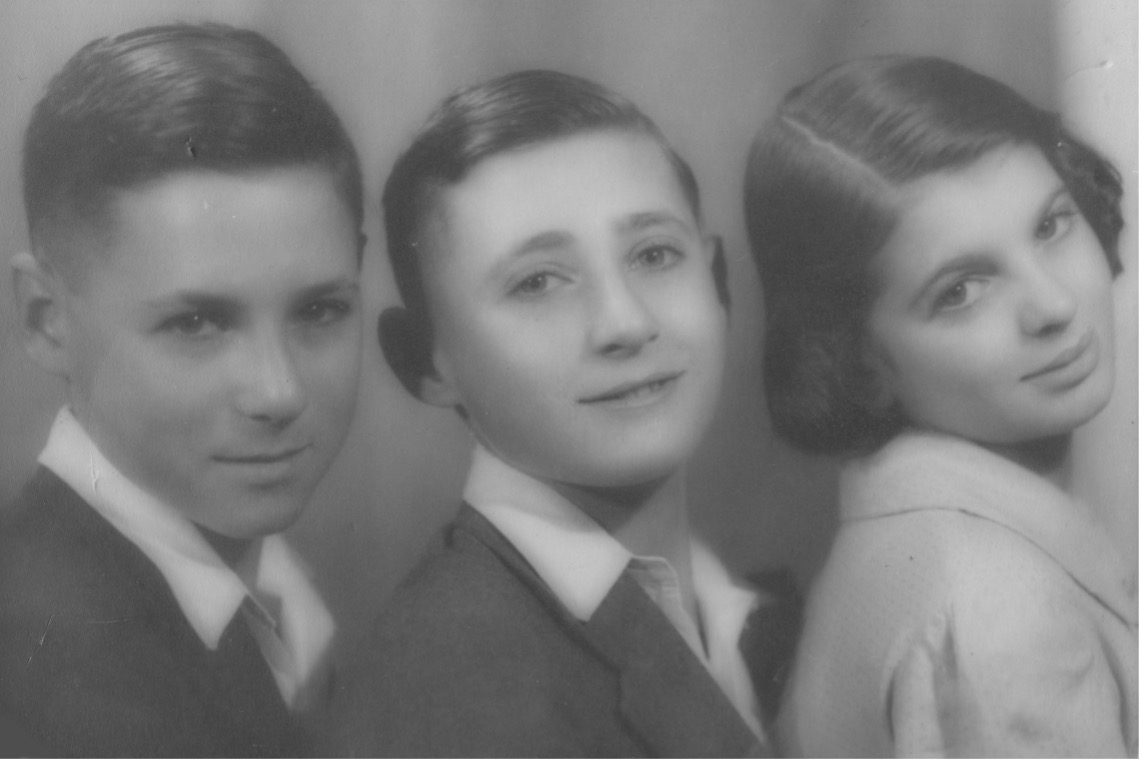
- Jack Rapeport
(30 April 1925 Rustenburg - 20 June 1992 Haifa, Israel)
See Jack and Zelda Rapeport. - Louis Rapeport
(24 June 1926 Rustenburg - November 2001 Durban)
Louis was born 2 months after his paternal grandfather died and was named after him. He attended Rustenburg High School and after matriculating, he went to Grahamstown to study for a Bachelor of Science at Rhodes University. He then studied medicine at the University of the Witwatersrand, qualifying as a doctor in 1952. He married Justine Shana Herman (7 November 1932 Pietersburg - 19 March 2019 Cape Town) on the 28 June 1953 at the Yeoville Synagogue, Johannesburg. She grew up in Pietersburg, where her grandparents were founder members of the Pietersburg Jewish community. The young couple settled in Durban, where Louis worked as a general practitioner. They had 3 sons, who all studied medicine at the University of the Witwatersrand. - Jean Ginsberg (née Rapeport, formerly Daniler)
(14 February 1928 Rustenburg - 30 August 2009 Johannesburg)
Jean was the youngest child. In April 1938, aged 8, she and several other Jewish children took part in the concert 'The Micky Mouses' at the Rustenburg Town Hall. Her performance was reported in the local press - 'The Dances of the Golliwogs by Jean Rapeport, Rhona Sholomir and Jeanette Wulfsohn was a novelty, when 3 huge boxes opened and 3 little Gollis hopped up and out and having completed a fascinating dance hopped back and shut their boxes.' Jean was schooled in Rustenburg. In 1944, at the age of 16, she left Rustenburg for Johannesburg to do a commercial training course. She remained in Johannesburg and each time she returned to Rustenburg, her visit was reported in the press. In 1948 she married David Daniler (d. 1994) in Johannesburg. His family was from Bloemhof, Transvaal. The Daniler family lived in Greenside, Johannesburg, and they had 2 daughters. Their eldest daughter was named after Jean's two grandmothers, Annie Simson and Louisa Rapeport, and their younger daughter was named after her maternal grandfather, William Rapeport.
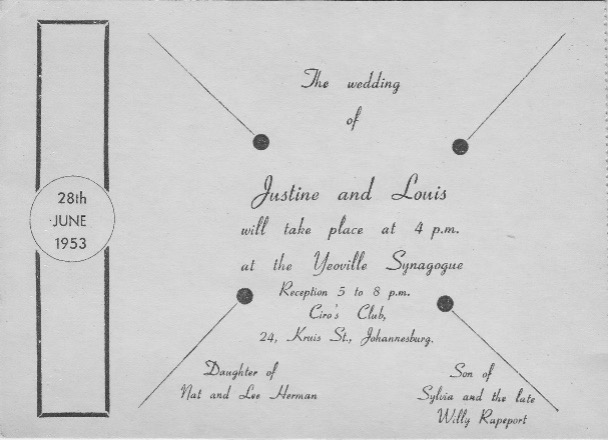
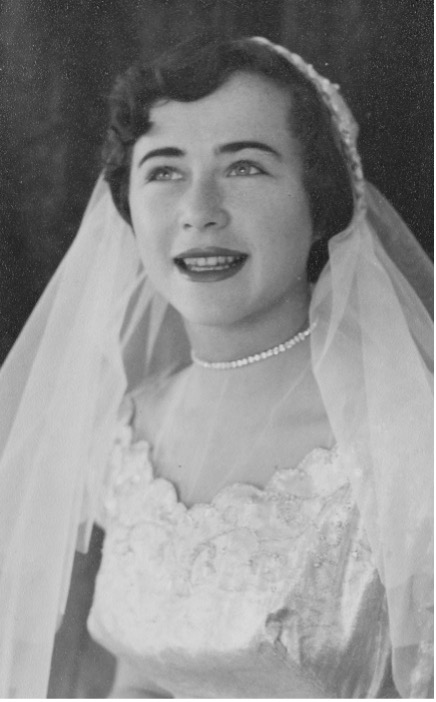
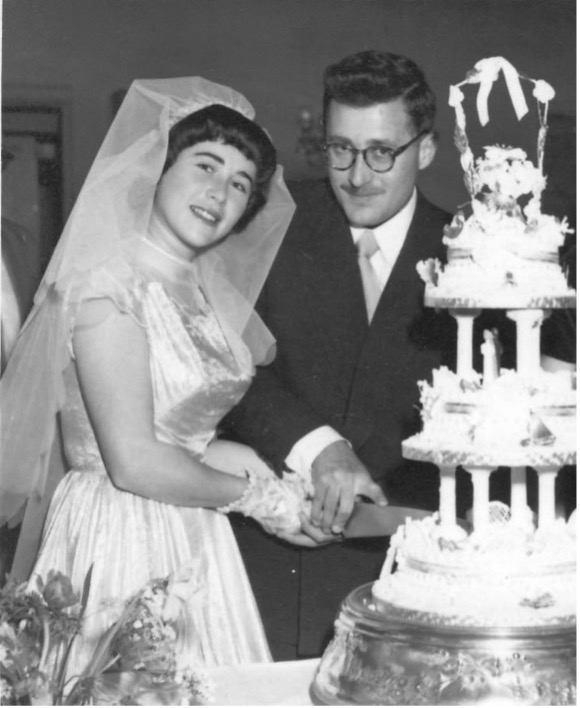
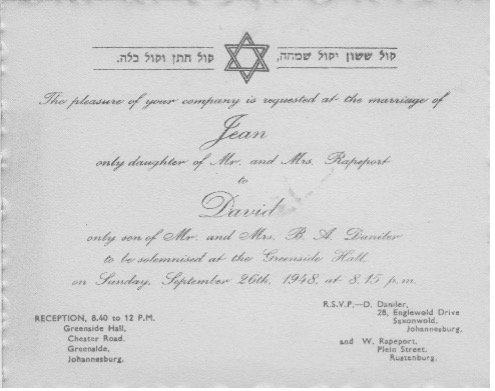
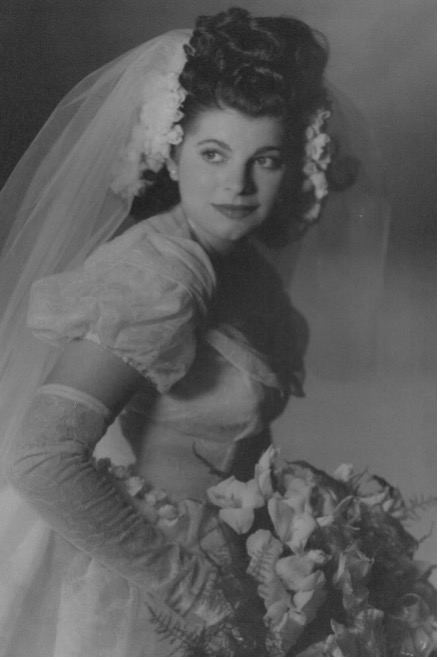
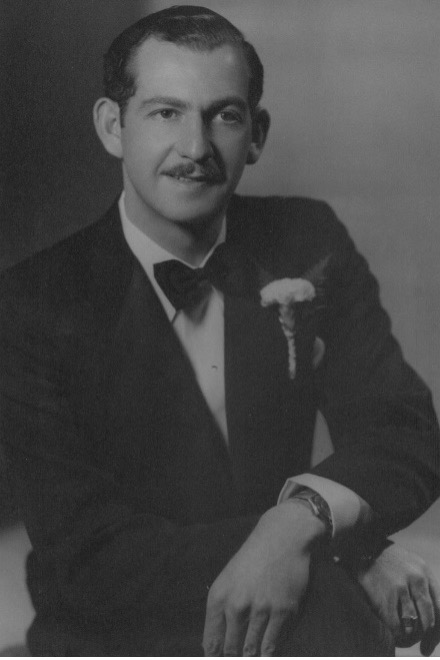
Very few of the Rapeport descendants have remained in South Africa. The majority have emigrated and they reside on four different continents in Israel, England, the United States of America and Australia. The family, who originated from Eastern Europe, has spanned six generations in South Africa and soon the surname Rapeport will disappear completely in South Africa.
References:
- The Golden Years: A Memoir of Old Rustenburg. Lionel Wulfsohn. The Watermark Press, 2011. Chapter 8. A few more salty characters. Page 59.
- Martin Rapeport. Personal communication, Leonard Rapeport. 2013.
Rustenburg Herald entries:
- 1936-04-03. Friday 27th March at the Town Hall at 7.30 p.m. a most delightful entertainment was given by "The Micky Mouses". Next came a charming Doll-Dance by Ann Pleskus and Rita Wulfsohn (Shirley Lederman sadly enough being unable to perform owing to sickness) who pushed their prams and admonished their dollies accompanied by much polkaing and pirouetting, to the delight of all. … Dances of the Golliwogs by Jean Rapeport, Rhona Sholomir and Janet Wulfsohn was a novelty, when 3 huge boxes opened and 3 little Gollis hopped up and out and having completed a fascinating dance hopped back and shut their boxes. … The Tap Dance, a Male Dude number - Martin Pleskus, "Tookie" Wulfsohn, Hedley Lederman and Stanley Gawron brought the house down and had to be repeated three times - (Bravo Boys!). A dainty Old English Ballet by Zelda Pleskus, complete with crinoline and sunshade and adorable frilled socks to her ankles completed a most pleasant little dancing display.
- 1936-09-04. Mrs. M. Rapeport from Krugersdorp is here as her brother-in-law, Mr. Pleskus, is seriously ill.
- 1936-12-25. Our Advertisers by the Editor. We shall therefore begin at the beginning. The Grand Hotel … Follows that of Mr. W. Rapeport, with a photo of his girl. He is assuredly an artist otherwise he would never be able to select the artistic models of costumes displayed by him. Willem and his brother Laz (our reporter) attract many people and the corner opposite the Town Hall has become a regular place of meeting.
- 1939-06-23. S.P.C.A. Concert. An All-Round Successful Show. Dummy Rapeport was funnier than ever.
- 1939-09-29. Local & General. Mrs. Rapeport, who has been seriously ill, is very much better and we wish her a complete recovery. … The reason of so few locals in this column, is because of chief reporter Mr Rapeport (Dummy) has gone to Pretoria to act as best-man at a wedding.
- 1944 12-01. Mr. William Rapeport left on Friday for Cape Town. He was accompanied by Mr. 'Dummy' Rapeport from Pretoria.
- 1944-02-11. Miss Jean Rapeport has left for Johannesburg where she will take a Commercial Training.
- 1945-07-13. RED CROSS BALL. Again this dance proved to be one of the outstanding social functions of the year. … Special mention must also be made of Mr. Rapeport (Dummy) who sold 100 raffle tickets (for the whiskey) in less than two days. We feel that Red Cross is well supported in our town and can only hope that the public will continue giving generously to this most deserving cause.
- 1946-05-10. S.A. Legion Dance. Mr. L. Rapeport gave a number of bis excellent impersonations of well-known characters.
- 1946-11-08. The Mayor, Mr. W. Rapeport, has launched an appeal for funds for the S. A. Red Cross. Donations may be sent to Box 16, or to the Herald Office.
- 1947-10-31. Rustenburg Municipal Election Results. The following are the results of the Municipal Elections which took place on Wednesday. Ward 1. W. Rapeport, 357, L. P. Vos, 200. Ward II. J.H.B. Trichardt, 275, Mrs H. Lyons, 206. Ward III. D J. Van Zyl, 329, P.J. Bothma, 275. Messrs. Rapeport, Trichardt and Van Zyl are thus elected to the Town Council for the ensuing three years.
- 1948-10-01. The marriage took place in Johannesburg last Sunday of David, only son of Mr. and Mrs B. Daniler, of Johannesburg and Jean, only daughter of Mr. and Mrs. W. Rapeport of Rustenburg.
- 1949-12-02. We are pleased to see Mr Dummy Rapeport in our midst town again after spending a vacation with his sister at Pretoria.
- 1950-09-08. Rustenburg's First Mannequin Parade. This attractive and well-arranged show sponsored by W. Rapeport & Son was held at the Rustra Theatre on the 25th of August and was opened by Dr J. D. Venter, Deputy Mayor. Over 300 ladies and a sprinkling of gentlemen had the pleasure of seeing a tasteful display of the newest Spring Fashions in cool and colourful creations. The well-known Delswa, Cole of California, Betty Barclay, Kitty Kent, Fairweather, Gavotte, K. & C. Originals and Lindemans were shown to good advantage in a collection of morning, sports wear, afternoon, cocktail and evening wear. It is gratifying that Rustenburg's first mannequin Parade can compare so favourably with those seen in the larger centers. The sensation of the evening was an old-fashioned bathing costume as worn by our great-grandmothers, so originally and cleverly displayed by Jo, well known stage personality of our Town. Rhoda Olivier was responsible for the musical background. Mrs. La Grange carried out her duties as compere very ably. Our thanks and appreciation to Mr and Mrs. W. Rapeport and staff, also the members of the T. A. U. (Transvaal Agricultural Union) Women Branch to whom the proceeds were given. Also, last but not least the mannequins and their helpers behind the scenes. Greka is congratulated on their charming display of kiddie's frocks at the beginning of the show.
- 1950-05-19. Mr. and Mrs. D. Daniler (daughter of Mr. and Mrs. W. Rapeport, of Rustenburg) of Johannesburg, are being congratulated on the birth of a daughter.
- 1952-04-18. Death of Mr W. Rapeport.
Rapeport, Jack and Zelda
Jack Rapeport was the eldest son of William Rapeport and Sylvia (née Simson). When he was born on the 30 April 1925 in Rustenburg, his birth was reported in the Rustenburg Herald as "Birth of Mr. Jack Rappeport – he is the nephew of Mr. Dummy Rappeport".

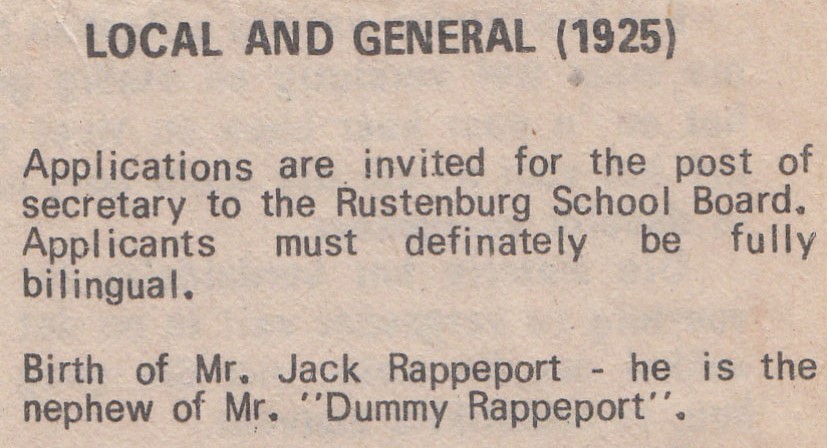
Jack was educated in Rustenburg and attended Rustenburg High School. The community was predominantly Afrikaans, and he was fluent in Afrikaans, having many Afrikaans friends.
He grew up during the Depression of the 1930s and recalled that his family was financially strapped. During the cold winters, he and his siblings were wrapped in newspapers to provide extra warmth under their blankets. In 1938 he celebrated his bar mitzvah in the Rustenburg shul. In later years, when their financial position improved, his father built a family home. During the period of construction of the house, the family stayed at the Grand Hotel. Jack was in his element, as he loved meat and could eat meat three times a day, followed by biltong snacks in between the meals. This habit was curtailed when the family moved into their new house at 191 Wolmarans Street.
As a teenager he worked at the Outspan Packhouse sorting and packing oranges. Due to the availability of cigarettes, he smoked excessively, consuming over 60 cigarettes a day. This habit continued until he was informed by a physician in Johannesburg that he had nicotine poisoning. He quit immediately and became an avid anti-smoker.
Jack spoke of a care-free childhood in Rustenburg. He loved to play in the water furrows on the side of the streets with his friends. The furrows carried water from the nearby Kloof to provide water to irrigate the gardens and vegetable patches. A lot of time was spent playing in the Kloof, swimming in the natural pools in the mountains and hiking in the surrounding mountains. There were lots of baboons and monkeys in the area, as well as wild dogs that formed marauding packs. He cautioned his children to keep clear of these dogs, particularly as rabies was endemic. Jack loved dogs and had a dog, Sparkey, who slept on his bed. When he got married, the dog was banned from his bedroom.
At the outbreak of the Second War World Jack went off to volunteer for duty. His father, however, would not sign consent as he was underage. Jack was not an academic scholar. He had difficulty writing and could not write cursive. However, he had an excellent acumen for numbers and for business. In 1950 he officially joined his father in the business, and they traded as W. Rapeport and Son (Pty) Ltd.
In September 1951 he got engaged to Zelda Meyer from Johannesburg. She was the youngest child of Abraham Leopold Meyer and Fanny Meyer née Blieden. She was a bright child who was promoted to the third grade when she started school, as she could already read and write. She attended Barnato Park School and matriculated at the age of 16. Due to financial constraints, she was unable to attend university and was sent off to work. Although she wanted to do nursing, her parents refused and instead she did a secretarial course, which included shorthand dictation, typing and bookkeeping. She worked at the law firm, Nathan Werksman, initially as a secretary and was promoted to personal assistant.
Jack and Zelda were married on the 6 January 1952 at the Great Synagogue, Wolmarans Street, Johannesburg. Following the ceremony, they had a buffet luncheon at the home of Zelda's cousin, Annie Zulman (née Beinashowitz). The only people who did not arrive at the reception on time were the newlywed couple, as no transport had been organized to transport them from the chupah to the luncheon! Jack, dressed in his wedding suit, had to hail a taxi to transport them from the city centre to Saxonwold to enable them to attend their reception!
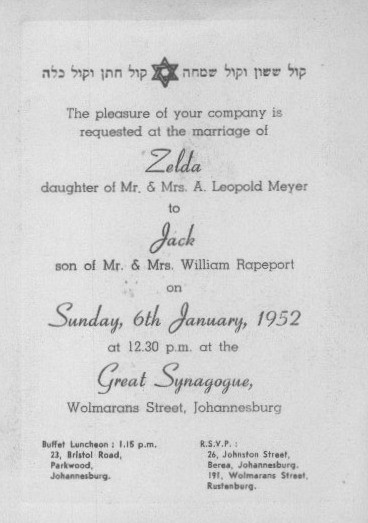
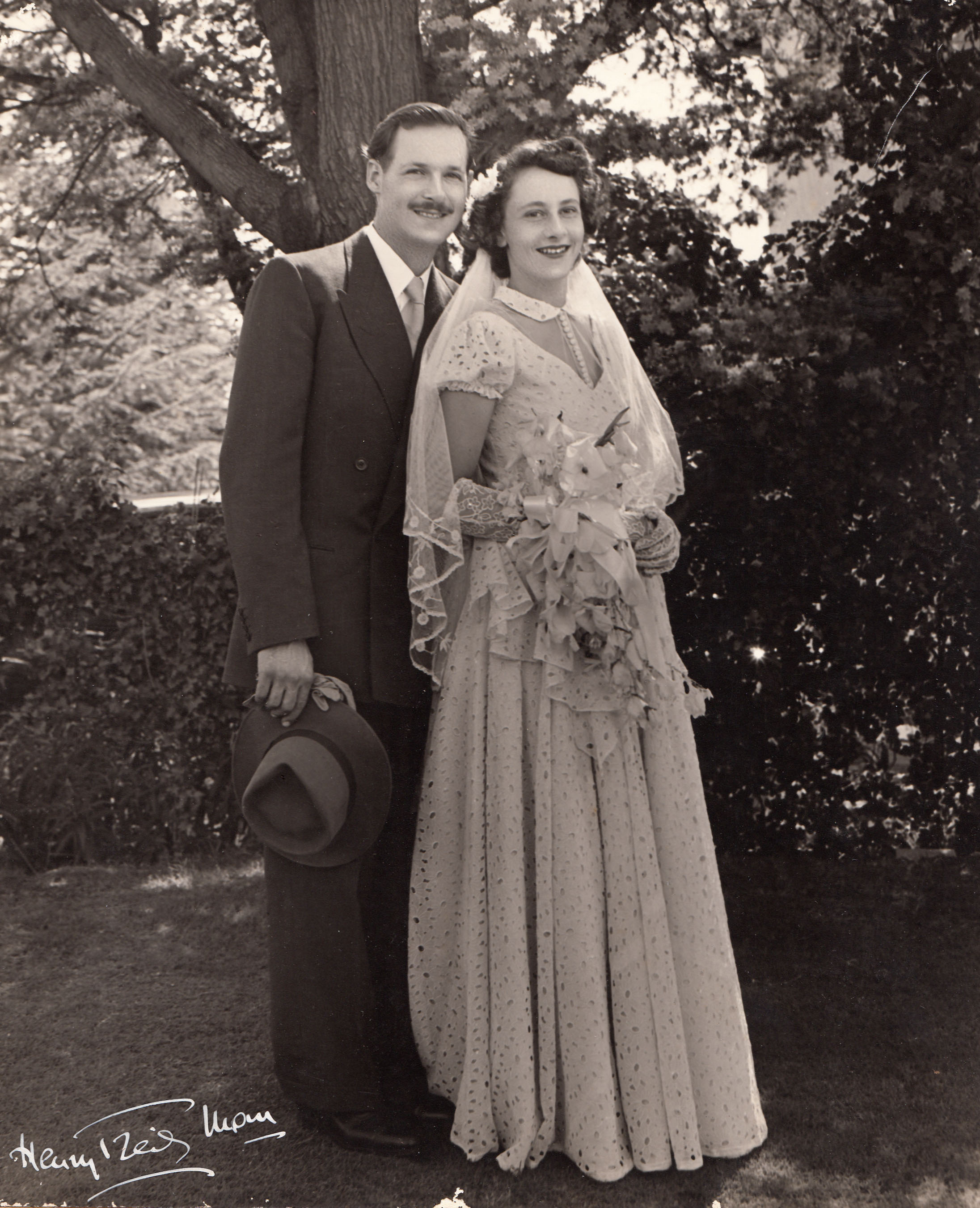
Four months after they were married, William Rapeport passed away. The family suddenly discovered that the business financial records were in disarray as William had used his wallet as a cash register, collecting cash from purchases and not depositing the money in the bank. Zelda took over the bookkeeping of the business and from that time onwards, all financial matters were done under her supervision. The business was re-organized, proper structures were put in place and an auditor, Mr. Hermann Sluiter, a German national, who had been interned during the Second World War, was hired. He remained the family auditor and friend until Jack and Zelda emigrated to Israel 30 years later. The only family member who was very unhappy about the change was Jack's uncle, Lazzy Rapeport, who previously received handouts from William.
At the instance of Sylvia Rapeport, the newlyweds moved in with her. Zelda's first requisite was to kosher the kitchen. Besides raising four daughters and working full time, she was very involved in Jewish communal affairs. She served as Chairlady of the Rustenburg Women's Zionist Society and the Union of Jewish Women, Rustenburg Branch. She ran the children's programme at the shul until the arrival of Chana Kramer, who then took over the programme.
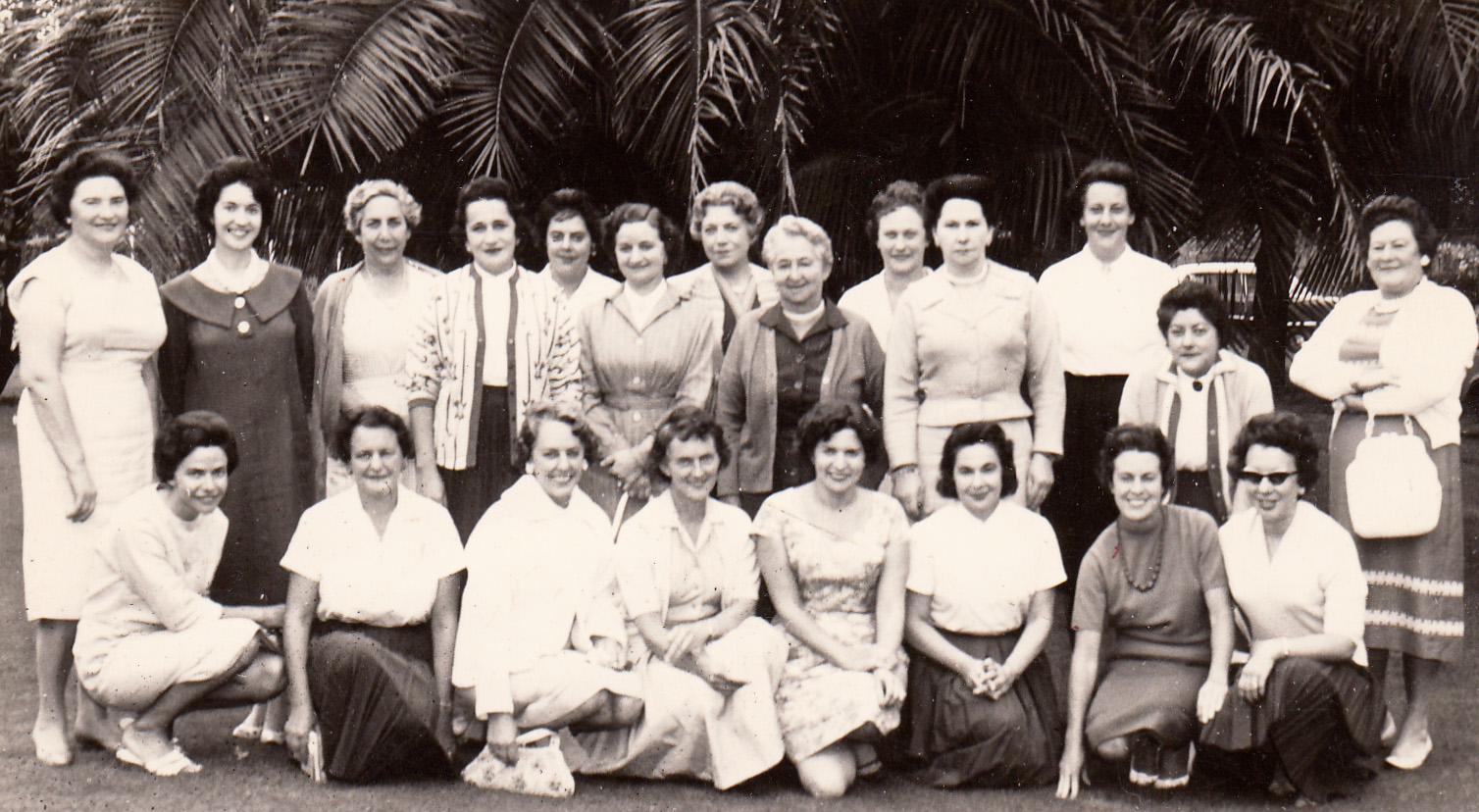
Back row L-R: Dinah Weinstock, Rivea Gawron, Rae Gersh, Renee Cantor, Neta Epstein, Amy Roos, Sylvia Rapeport, Bessie Ritchken, Julia Cohen, guest speaker, Zelda Rapeport, Rae Been, Sylvia Wolpe.
Front row L-R: Rita Sonnenberg, Minnie Wolpe, Flo Katzenellenbogen, Fay Rosmarin, Pearl Wulfsohn, Monica Ritchkin, Ethene Wulfsohn and Clarice Been.
Jack was successful in merchandising and revolutionized W Rapeport and Son (Pty) Ltd. He and his mother were the Directors of the business and Rapeport Arcade was built at 140-142 Plein Street. It housed the shop as well as other premises, which were rented out. Jack traveled abroad regularly to buy merchandise. In the early years this was predominantly to England and later to the Far East to Hong Kong, Taiwan and Japan. He believed in keeping up with the current business trends and attended overseas seminars such as the National Cash Register (NCR) Company, Modern Merchandising Methods Seminars in the United States of America. The business was constantly upgraded. However, Zelda was the backbone of the business, involved in controlling the stocks and the banking.
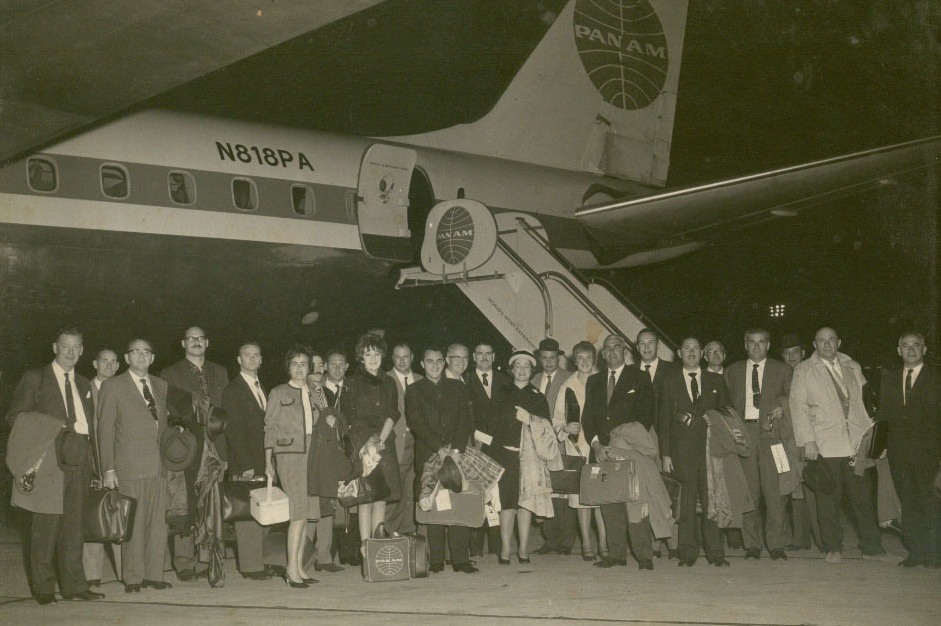

A crucial part of the business was window dressing. The shop window displays were always beautifully appointed, and a full-time window dresser was employed. The business won numerous window dressing competitions which were held during the annual Rustenburg Show. In 1965, Jack sold W Rapeport and Son (Pty) Ltd to Uniewinkels Beperk, a Pretoria-based company. Rapeports was reported as one of the biggest and best-known firms in the town. As part of the business deal, he continued to manage the business for a further eighteen months. The family left Rustenburg on 17 May 1966, having been in the town since 1916. At the time of his departure, a statement was published in the local newspaper by "Mr. Jackie Rapeport", thanking the Rustenburg residents for their support and asking them to support the new owners. It was published in both official languages - English and Afrikaans.
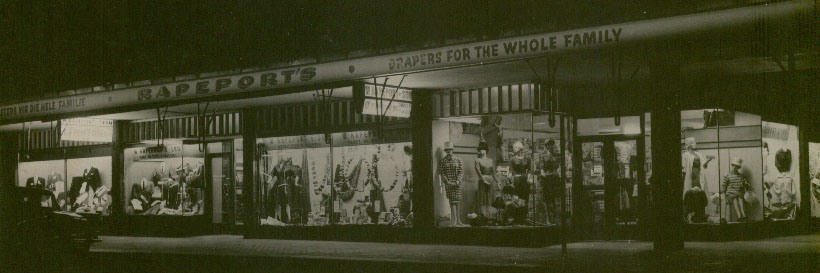
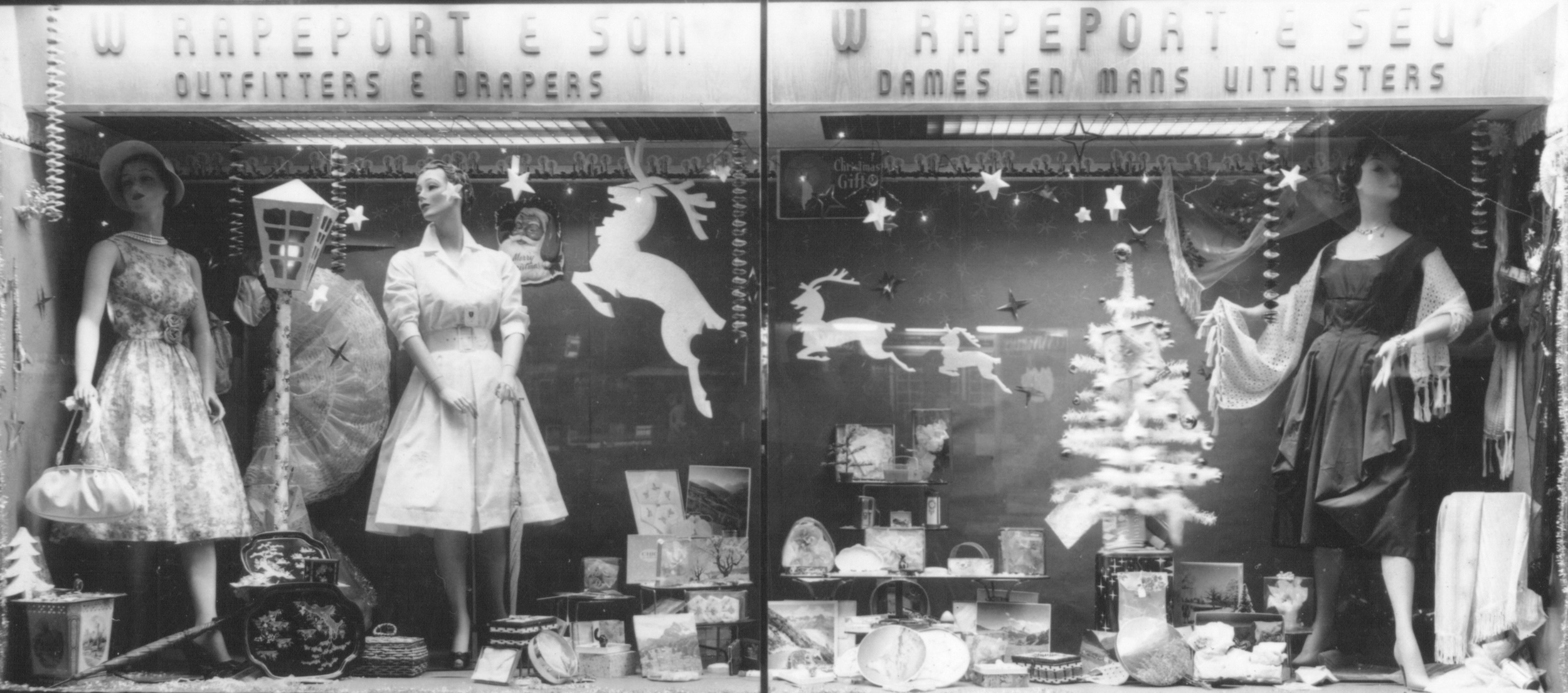
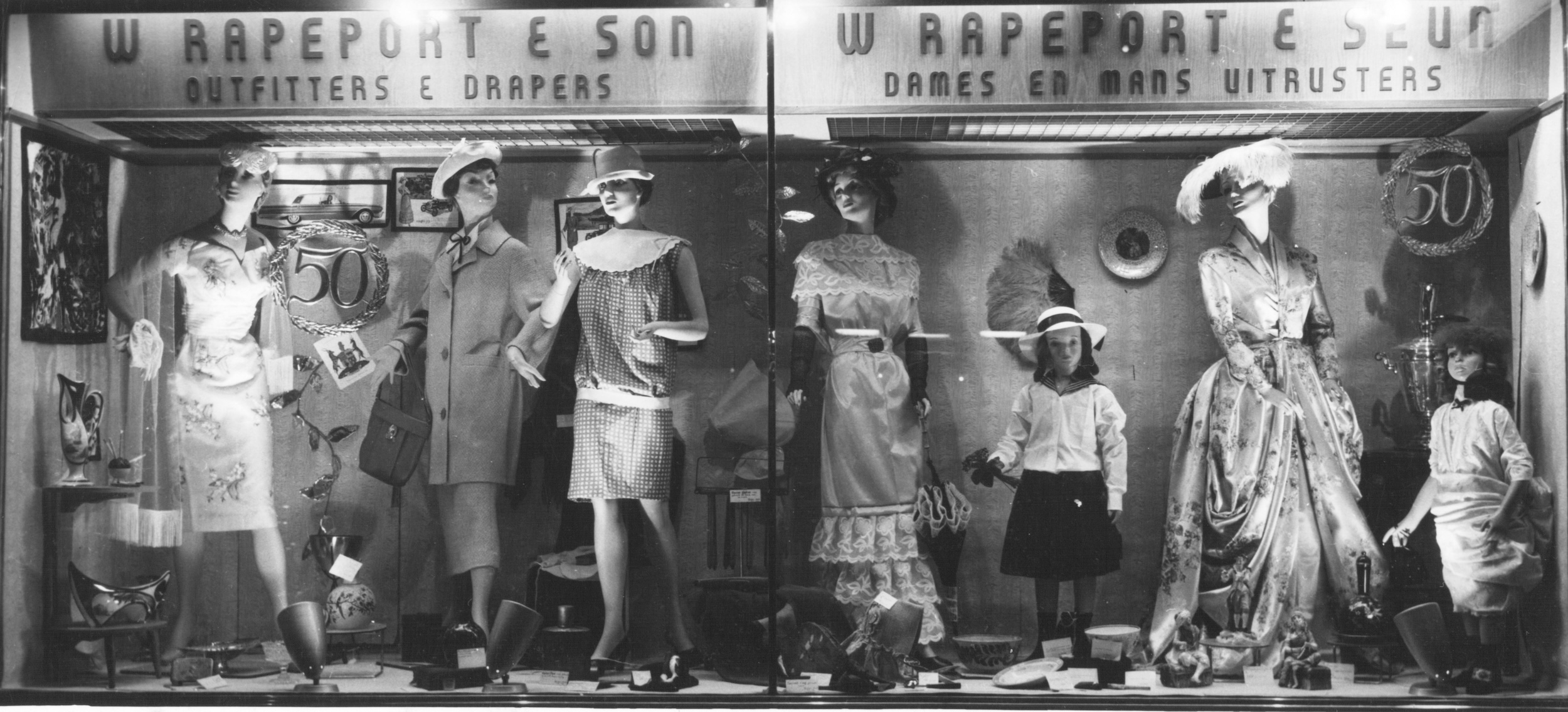
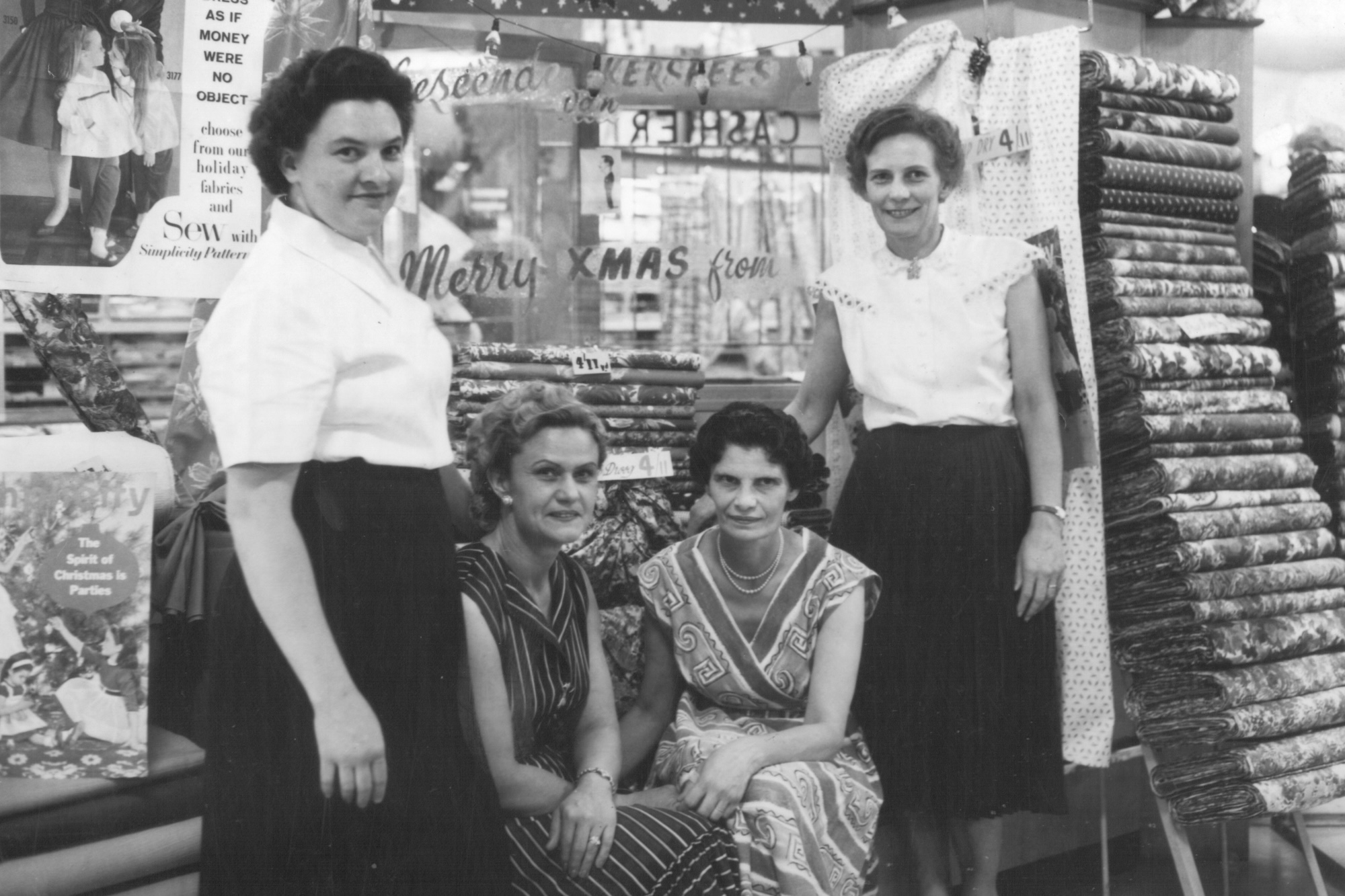
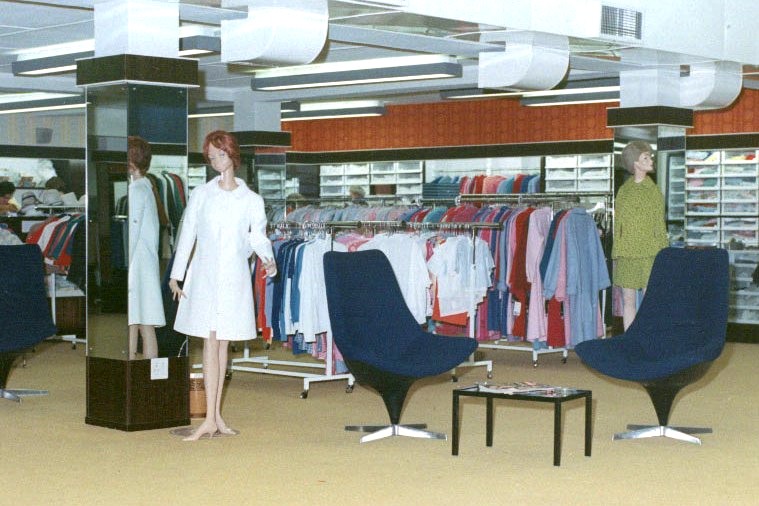
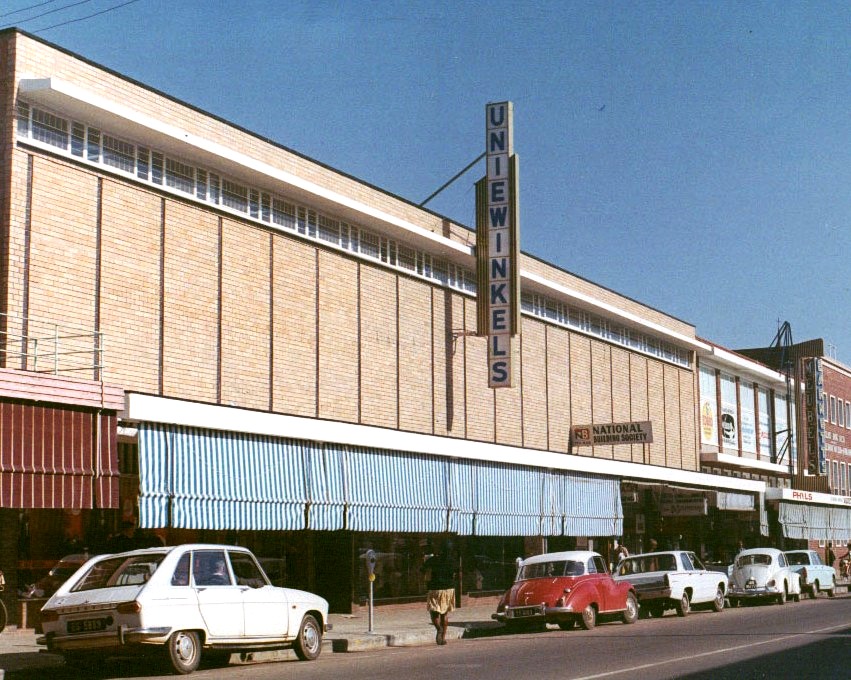
Although Jack publicly stated that the reason for selling the business was due to ill health, as he had a heart attack in his early forties, the main reason was related to the political situation in Rustenburg. The Afrikaners in Rustenburg were very conservative and with the rise of the Nationalist Party anyone who was verlig (enlightened) was considered a threat. Jack was a member of the United Party in Rustenburg. When the anti-apartheid activist, Braam Fisher (1908-1975), went underground in 1965, the family was suspected of assisting him. One of Jack's closest childhood friends was Paul Bodenstein. His parents, Dr Mannie and Ethel Bodenstein née L'Ange, had been very close family friends of William and Sylvia Rapeport. Unfortunately, politics interfered in their friendship. Paul was a member of the ruling Nationalist Party and belonged to the Broederbond. Although he knew how to ask favours from Jack, which included running his dental practice in Rapeport Arcade, when he was seen in public he would ignore Jack. Paul Bodenstein subsequently progressed through the ranks of the Nationalist Party, became Mayor of Rustenburg and was promoted to Ambassador to the Transkei, one of the Black homelands - Bantustans.
Jack was very proud of his father having served as Mayor of Rustenburg in 1947. In December 1964 he donated a life-size bronze sculpture of a klipspringer in his memory which was placed in the Rustenburg Nature Park. It was sculpted by Hendrik Christoffel 'Hennie' Potgieter (1916-1992). In the early 1970s the sculpture was stolen and the bronze was smelted down.
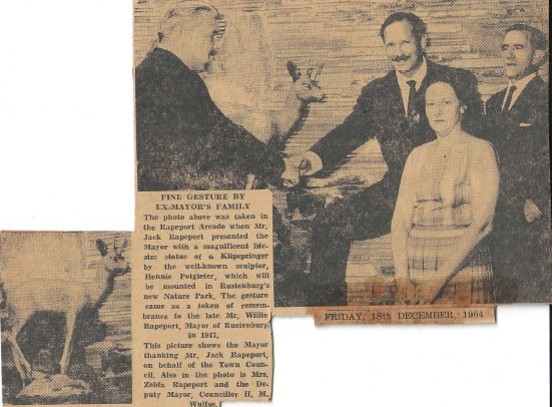
Jack was involved in local community affairs. He served as Gabbah of the Rustenburg shul and during his tenure he installed comfortable padded seats. He was a member of Rotary, a member of the Rustenburg Golf Club and played in the local poker school with Leo Oster.
He was always concerned about the wellbeing of people, irrespective of their race. He was invited to attend the coronation of Kgosi Lebone Edward Molotlegi, Chief of the Bafokeng Tribe, in 1956. He organized and paid for Christmas gifts which were distributed to staff and prisoners at the Rustenburg prison. Most were black prisoners who were jailed because of 'pass offences'. They had to carry a passbook and were not allowed in the town after 21h00. Every night at nine p.m. a siren was sounded and if any 'natives' were spotted in the street, they were arrested. When Jack moved to Durban he maintained contact with the Rustenburg African community. On one occasion he assisted a tour of 210 scholars and teachers from Tlhabane H.P. School who visited Durban. He was contacted by Mr. Sidney L. Rametsi, a teacher, prior to their trip, who needed help to provide sleeping mats for the group, who were to be accommodated at the Lutheran Church in Lamontville, Durban. Jack organized sleeping mats on which the teachers and children could sleep. He paid for buses to take the scholars on a tour of the Durban harbour and gave them spending money and sweets. To quote a letter from Mr Rametsi, 'Your kind hand to the Rustenburg African does not leave our memory'.
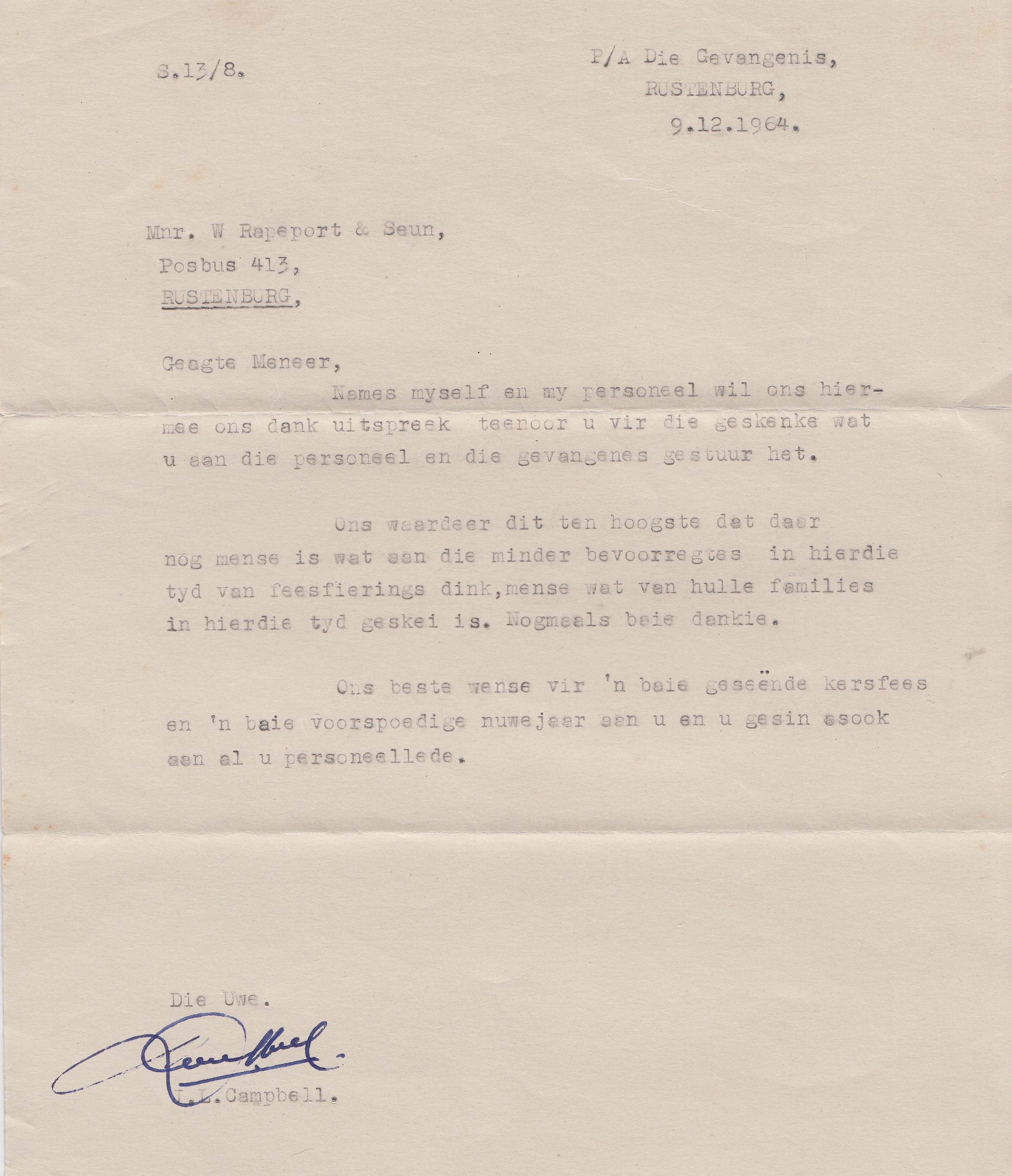
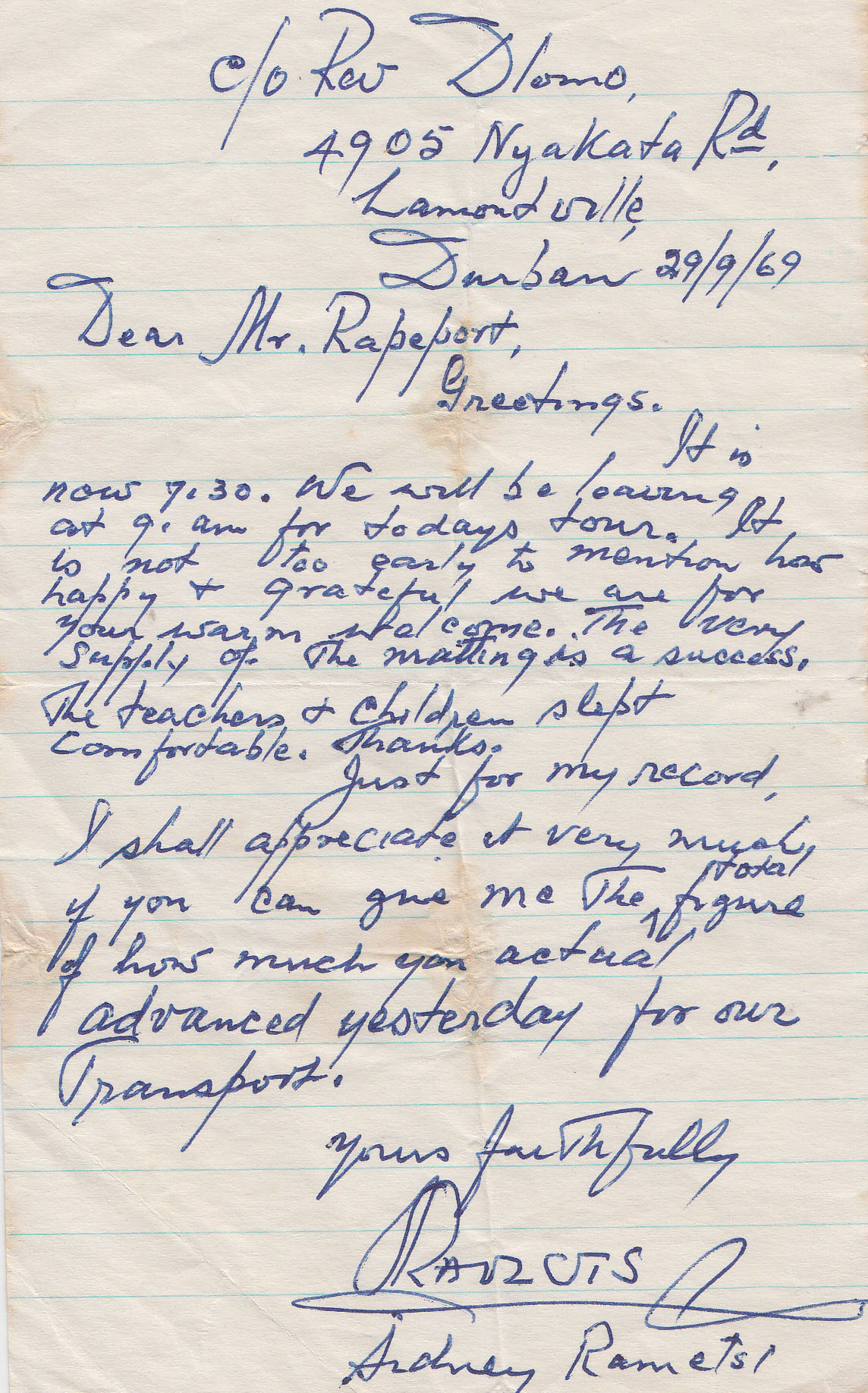
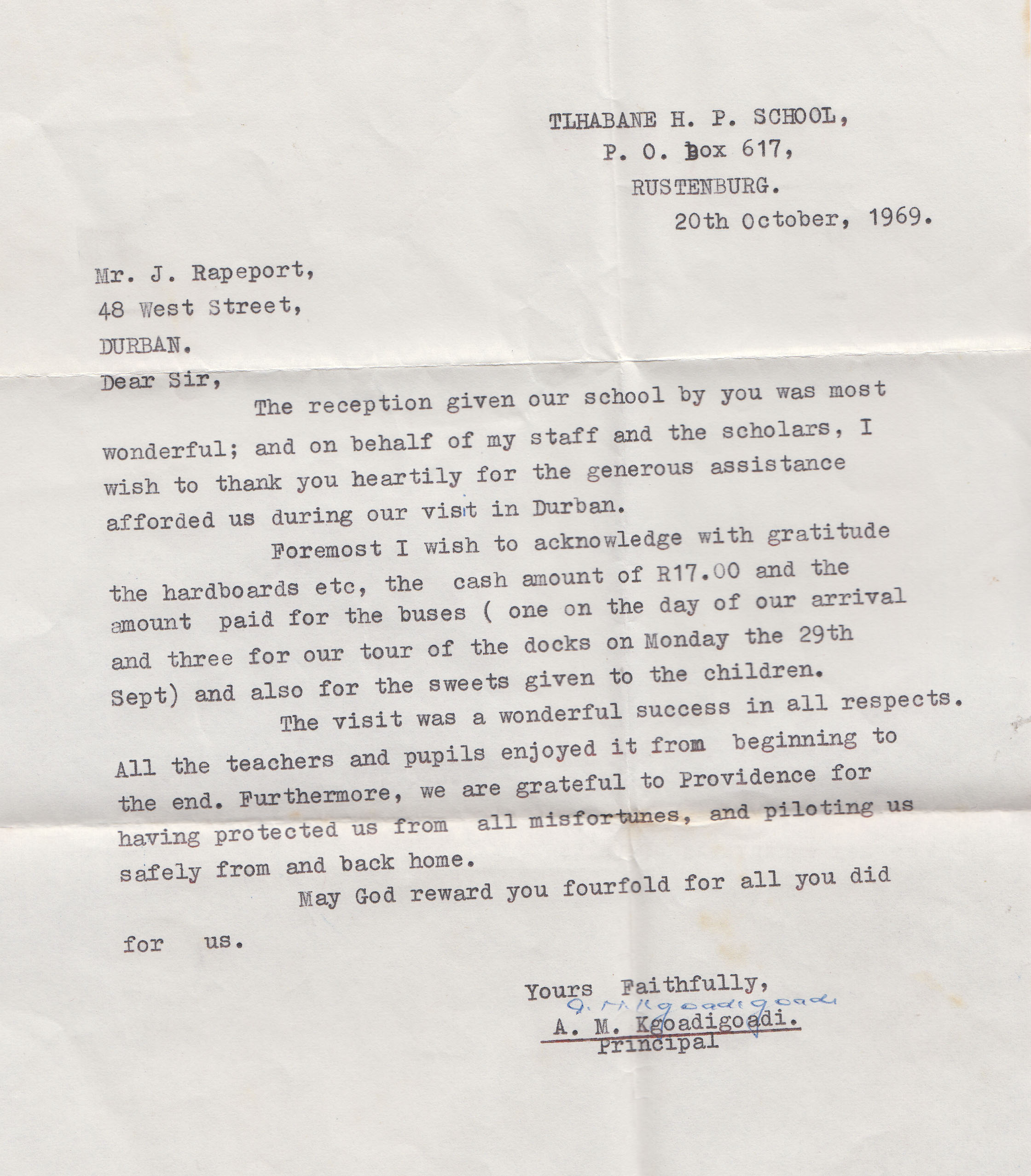
The family had employed a manservant, Robby, whom Jack continued to support even after the family left Rustenburg in 1966. Arrangements were made with Mr. Sluiter, the auditor, to ensure that Robby received a monthly stipend. Each time Jack and Zelda visited Rustenburg they would meet up with Robby. Their final encounter occurred during Jack's last visit to Rustenburg in February 1991.
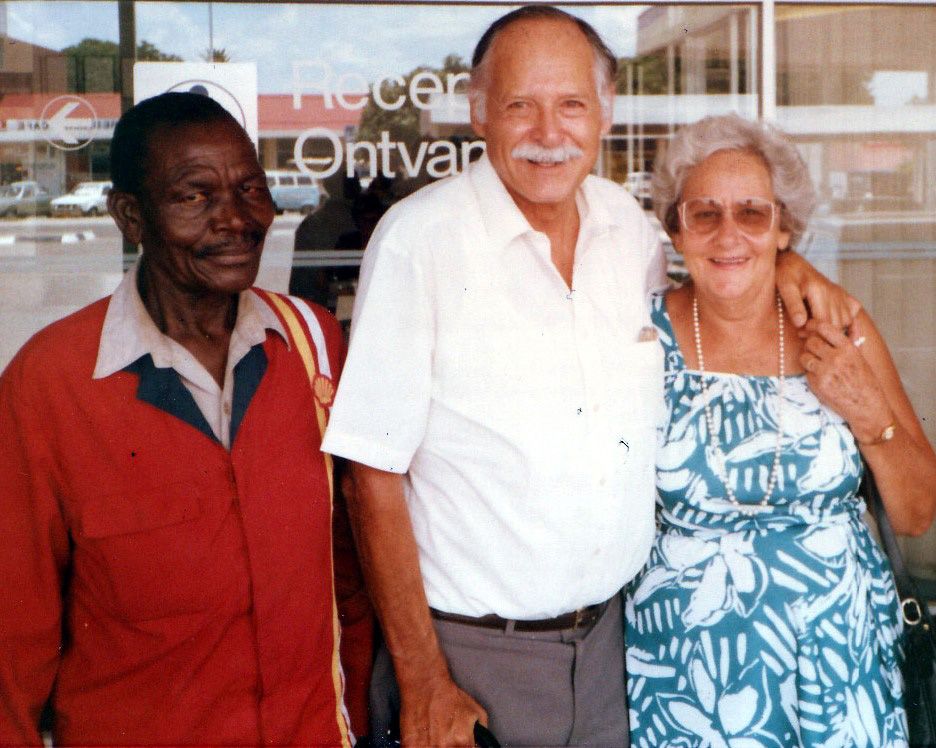
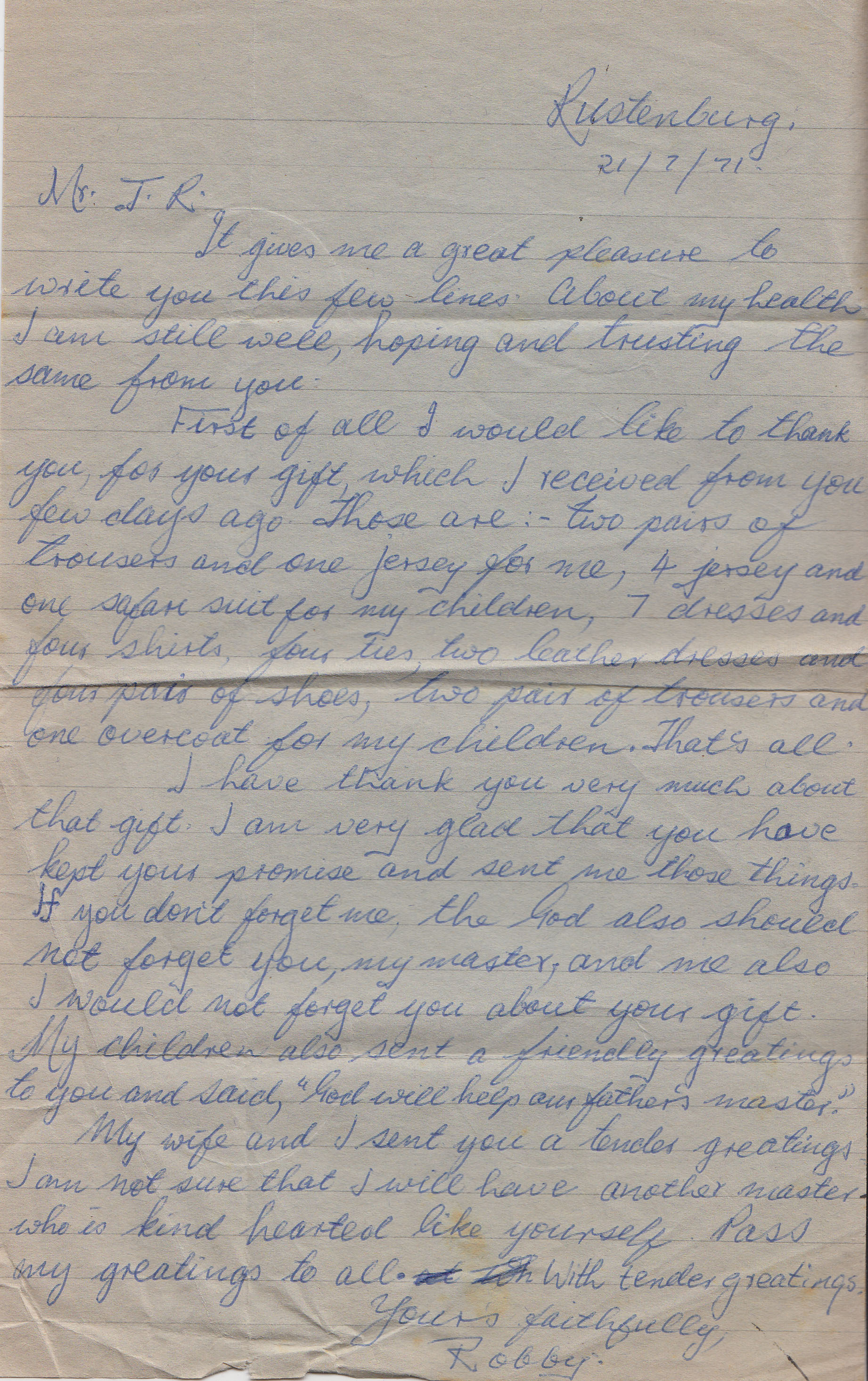
Jack was also well-known in assisting the local Afrikaans farming community. Many children who were sent to the boarding school residence (koshuis) knew to approach him if they had problems. He supplied them with school uniforms, clothes and money. The farmers ran accounts at the business and would buy on credit or ask that their accounts be debited for money loaned to their children. They always promised to pay off their debts "wanner daar 'n goeie oes is" (when there is a good harvest).
Jack and Zelda's home was open to family and friends from Johannesburg and surrounds, who would descend on them over weekends and on many occasions would leave their children in Rustenburg for a holiday. Zelda spent her time organizing the meals and accommodation while Jack would take the visitors on a tour of the town or open the business after hours to allow them to choose clothes that they wanted. On a Sunday afternoon he often spent the afternoons riding a bicycle with the children around the town, while Zelda entertained the guests.
Zelda loved gardening. In Rustenburg she established a beautiful flower garden with roses and annuals. Red hibiscus trees were planted on the west side of the property which formed a hedge, blocking out the view of the koshuis across the road. The front fence on Wolmarans Street was covered in honeysuckle. There was an enormous orchard as well as a chicken hok (coop) where chickens, turkeys and ducks were kept. These birds were sent for slaughter when a shochet visited Rustenburg. The birds were transported by Robby in the front basket of his bicycle to the shochet. Often Robby would return with a treiff chicken. He knew that if the bird was injured, it was not kosher and therefore would receive a chicken for dinner. There was a large aviary containing budgies, hamsters and rabbits in the back garden and numerous dogs and cats were part of the household. Sometimes tadpoles were brought from a fishpond at the Cantors' home and suddenly frogs would abound in the back yard.
Following the death of Zelda's father in 1961, her mother, Fanny, suffered a stroke. She was brought to Rustenburg and lived in a flat nearby. Zelda ensured that she was taken care of and did all her shopping. She ensured that Fanny had a ready stock of Nestle Milk Chocolate blocks, which she purchased from L. Sussman Distributors. Each time a grandchild visited Fanny, they were rewarded with a red wrapper milk chocolate bar. When the family left Rustenburg in 1966, Granny Fanny moved to Viljoenskroon as she did not wish to live in Durban.
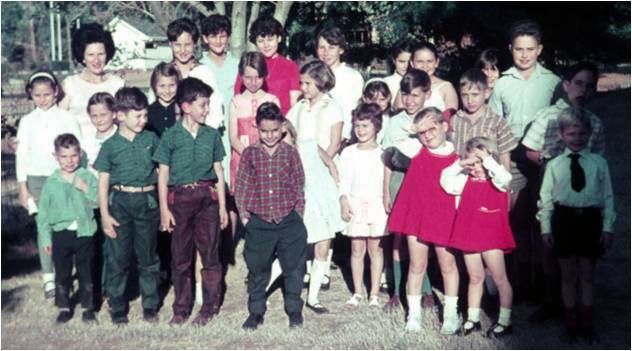
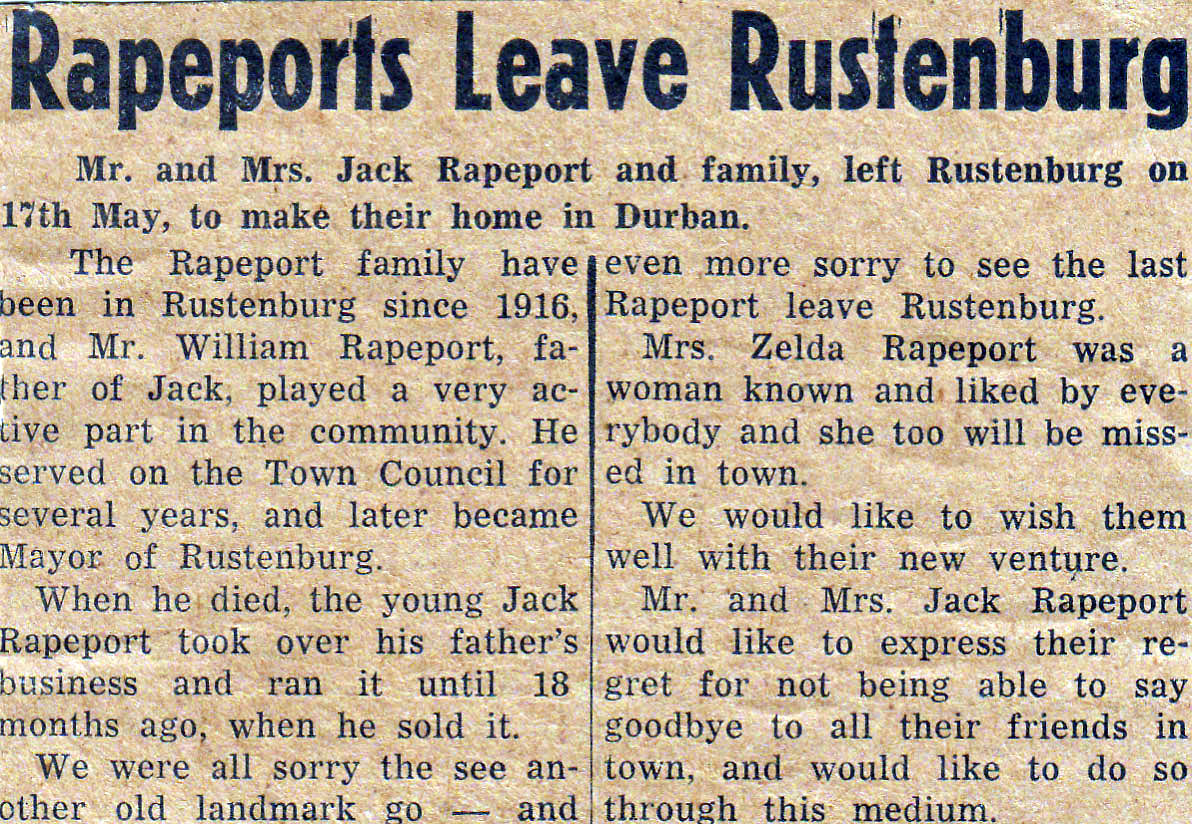
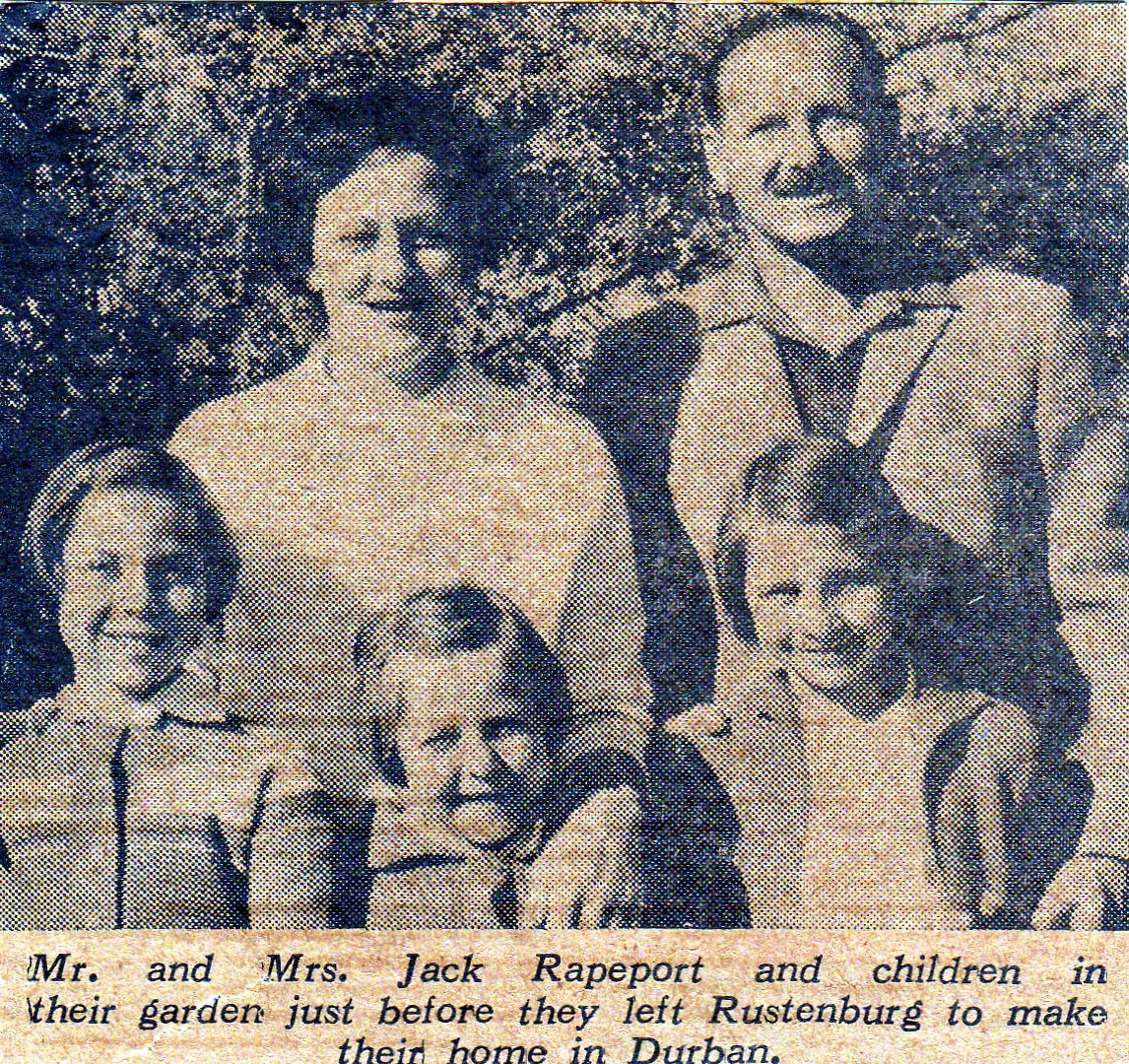
When the family moved to Durban, Jack and Zelda took out a mortgage bond to buy a home and a loan to finance their business, as all the proceeds from the sale of the business and family home in Rustenburg went to Sylvia Rapeport. The family lived at Pumula, 49 Grosvenor Crescent, Durban North. In Durban, Jack and Zelda established various retail clothing businesses. In 1966 they established Off the Peg, catering in ladies fashion wear. The business was in the Lonsdale Hotel Building, West Street, near the Durban beachfront. Over time the business expanded and it included a mail order business. In 1970 the business was sold to Scotts Shoes. In 1972, when a restraint clause in the sale agreement prevented Jack from re-entering ladies' wear, he and Zelda established Up and Coming, specializing in children's clothing. Over the course of three years, five branches were opened, four in Durban and one in Pietermaritzburg. In 1975 Scotts again approached Jack to buy this business. The last business venture, Rag Trade, catered for women's wear. This business was subsequently sold to Big Blu, prior to Jack and Zelda emigrating to Israel.
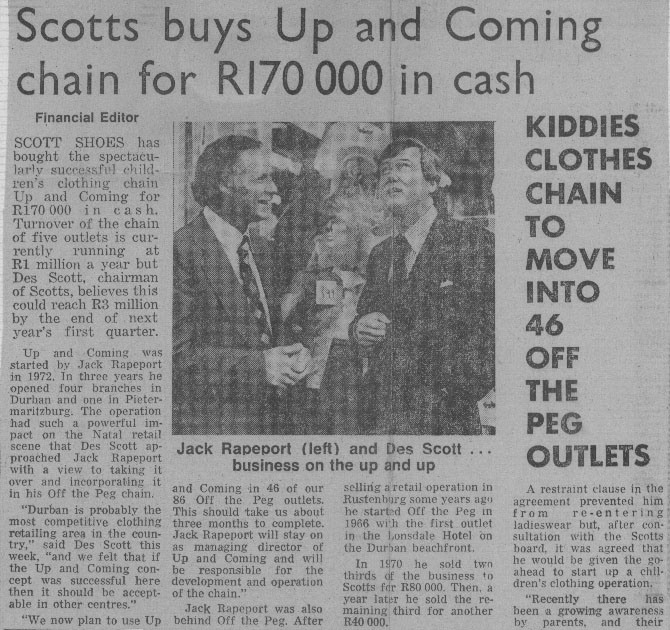
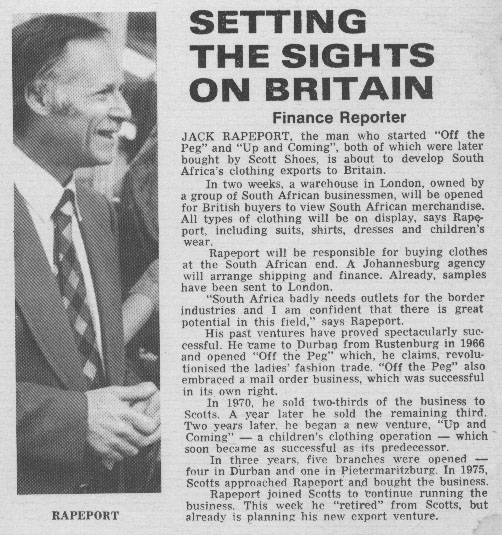
Jack enjoyed sport, and in particular rugby. When the train hired by the tobacco farmers, the Tabak Boer Special, brought Rustenburgers to Durban to attend rugby matches, Jack always met them at Durban station. On most occasions the majority of the men arrived in Durban totally inebriated having spent the journey consuming gallons of alcohol and they had no recall of the rugby match they had come to see.
In 1982 Jack and Zelda settled in Haifa, Israel. In Israel Jack got involved in the hamburger chain Burger Ranch, where he assisted his sons-in-law in business.
Jack helped set up the Haifa Lawn Bowling Club and was instrumental in establishing blind bowling in Israel. He organized equipment from South Africa as well as the training of blind bowlers by the South African expert, Julius Sergay, and even visited Stoke Mandeville in England to see how they assisted disabled athletes. The Rapeport Rose Garden (Gan Veradim) was planted in honour of Jack and Zelda at the Haifa Lawn Bowling Club.
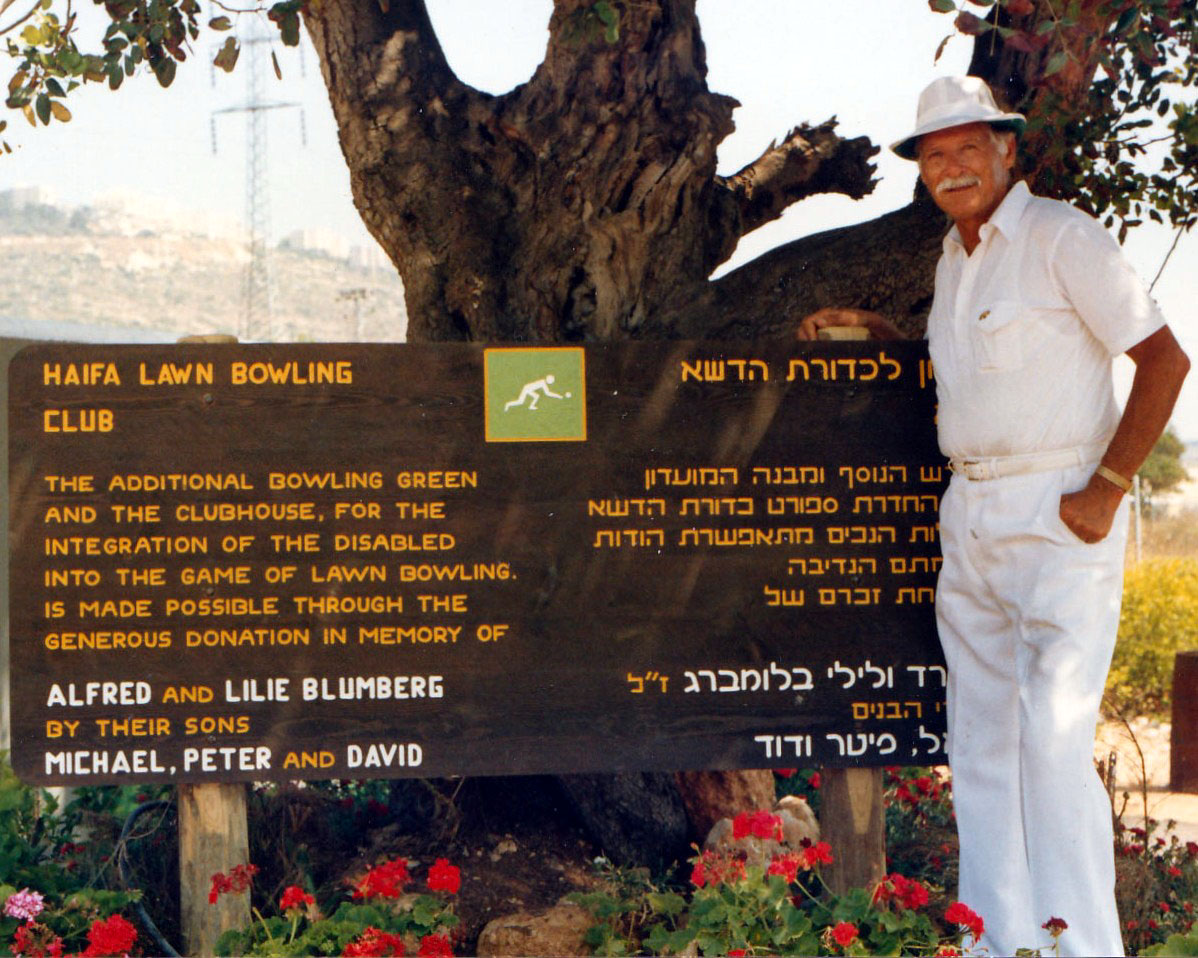
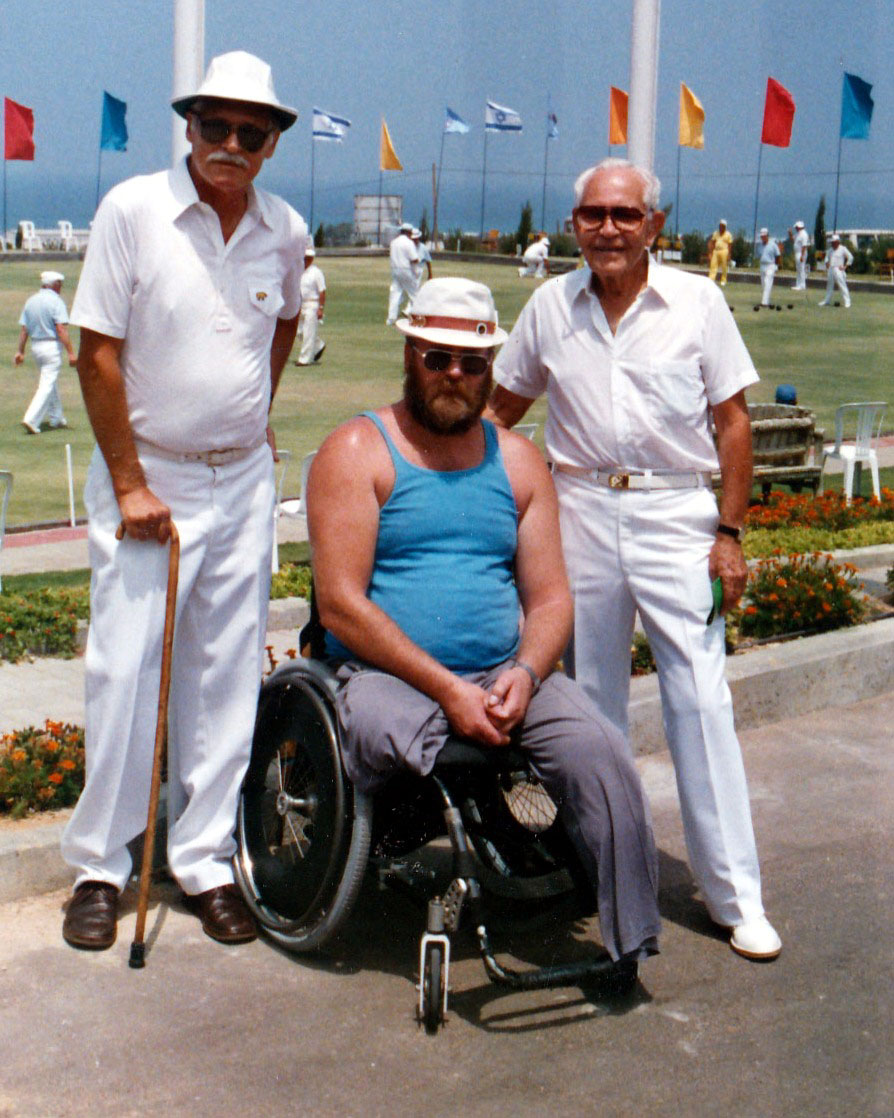
In February 1991 Jack and Zelda visited Rustenburg. It would be his last visit. Jack died in Haifa on 20 June 1992 at the age of 67 and was buried in the Sde Yeshoshua Cemetery. Zelda died 7 years later in 1999 aged 75 and was buried next to him. Both their graves are covered in white granite from Israel, and the headstones are black granite which comes from Rustenburg, South Africa.
References:
- The Golden Years: A Memoir of Old Rustenburg. Lionel Wulfsohn. The Watermark Press. 2011.
- Sunday Tribune, 3 August 1975. Scotts buys Up and Coming chain for R170 000 in cash. Kiddies' clothes chain to move into 46 Off the Peg outlets. Setting the Sights on Britain. Financial Reporter.
- South African Jewry 1976-77. A survey of the Jewish Community; Its contributions to South Africa; Directory of Communal Institutions; and a Who's Who of Leading Personalities. Edited by Leon Feldberg. Rapeport, Jack. Businessman. Page 291.
Rustenburg Herald entries:
- 1925-05. Birth of Mr. Jack Rappeport – he is the nephew of Mr. Dummy Rappeport.
- 1938-05-13. On Saturday last, Jackie, son of Mr. and Mrs. W. Rapeport "read a portion of the Law" at the local Synagogue.
- 1951-09-14. The engagement is announced of Mr. Jack Rapeport of Rustenburg to Miss Zelda Meyer of Johannesburg. Congratulations to Councillor and Mrs. W Rapeport.
- 1965-04-02. Uniewinkels "Take Over" of W. Rapeport & Son.
- 1966-05-20. Rapeports Leave Rustenburg.
- 1991-02-05. The Rapeports are back…
Resnick family
Leslie 'Les' Resnick, son of Israel 'Bill' and Esther Resnick of Krugersdorp, lived in Rustenburg during the 1970s. He and his family contributed to the building fund of the Jacob Finkel Cultural Hall.
Ress family
Barney Ress (1912 - 1992 Cape Town) and Fae Ress née Abrahamson (1912 - 1996 Cape Town) moved to Rustenburg in 1950 when Barney Ress joined Harry Stern as a partner in the Rustenburg Pharmacy. Their son, Stanley, Professor of Internal Medicine, University of Cape Town, was schooled in Rustenburg. The family left Rustenburg and returned to Cape Town.
Rustenburg Herald entries:
- Notice is hereby given that the partnership business hitherto carried in by HARRY STERN and BENNO DAVID KARSTAEDT under the style or firm of Rustenburg Pharmacy at 137 Plein Street, Rustenburg has been dissolved with effect as at the 30th June, 1950. And further take notice that as and from the 1st July, 1950 the said HARRY STERN and BARNEY RESS will continue to trade in partnership under the same style and firm and at the same address for their joint benefit. All the assets and liabilities will be taken over by the said STERN and the said RESS. B. STERN & CO. Attorneys for Parties. 29 Sauer's Bldgs. Loveday St., Johannesburg. 367-3.
Ritchken - Michaelis families
Simon Ritchken (1880 Kovno, Lithuania - 21 March 1940 Farm Waterval No 544, Rustenburg) was the second son of Girsh 'Herman' Ritchken (1851 Kelmė, Russia - 1911 Telzh, Kovno, Russia) and Lebe Ritchken née Shur (1851 - 1937 Telzh, Russia) of Telzh. He had 6 siblings, 3 brothers and 3 sisters – Joseph (1876-1912), Manuel (1885-1946), Max (1883-1923), Reitche, Anna and Rashel.
Simon Ritchken came to South Africa at the beginning of the 20th century to join his father, Herman, and his older brother, Joseph Ritchken (1876 Konstantinovo Russia - 15 February 1912) on the East Rand. In 1903 he applied for naturalisation. His father was a storekeeper and speculator who purchased numerous stands and claims at Rietfontein, and Driefontein near Germiston. He applied for prospecting licences and in 1907 New Rietfontein Gold Mining Company Ltd. was listed by Ritchken, Shure and Charles Thomas. In 1909 Simon and his older brother, Joseph, made applications on behalf of their father to enlarge some of their stands at Rietfontein. Herman Ritchken returned to Lithuania and died in March 1911 in Telzh. His South African estate was liquidated. All Herman's properties were sold at public auction and the proceeds were distributed between his wife and their 7 children. At that time all 4 sons were resident in South Africa and his widow and 3 daughters were in Lithuania.


Simon Richken lived at the New Rietfontein gold mine. He married Bessie Braudie (1891 Kovno Russia) on the 10 May 1910 in Zuurfontein, Germiston. They had 2 sons and a daughter, Herbert Benjamin Ritchken, Joseph Ritchken and Pauline Ritchken. The family lived on the farm Blauwgomfontein, district of Pretoria, prior to moving to Rustenburg. When they moved to Rustenburg, Simon Ritchken farmed at Waterval No. 544. When he died in March 1940, it was reported in the Rustenburg Herald that his two children, Dr J. Ritchken of Salisbury and Pauline Ritchken of Salisbury, had returned to South Africa to stay with their mother, Mrs Simon Ritchken, at Waterval Farm. Bessie Ritchken remained in Rustenburg after her husband's death and was a member of the Rustenburg Women's Zionist Society.
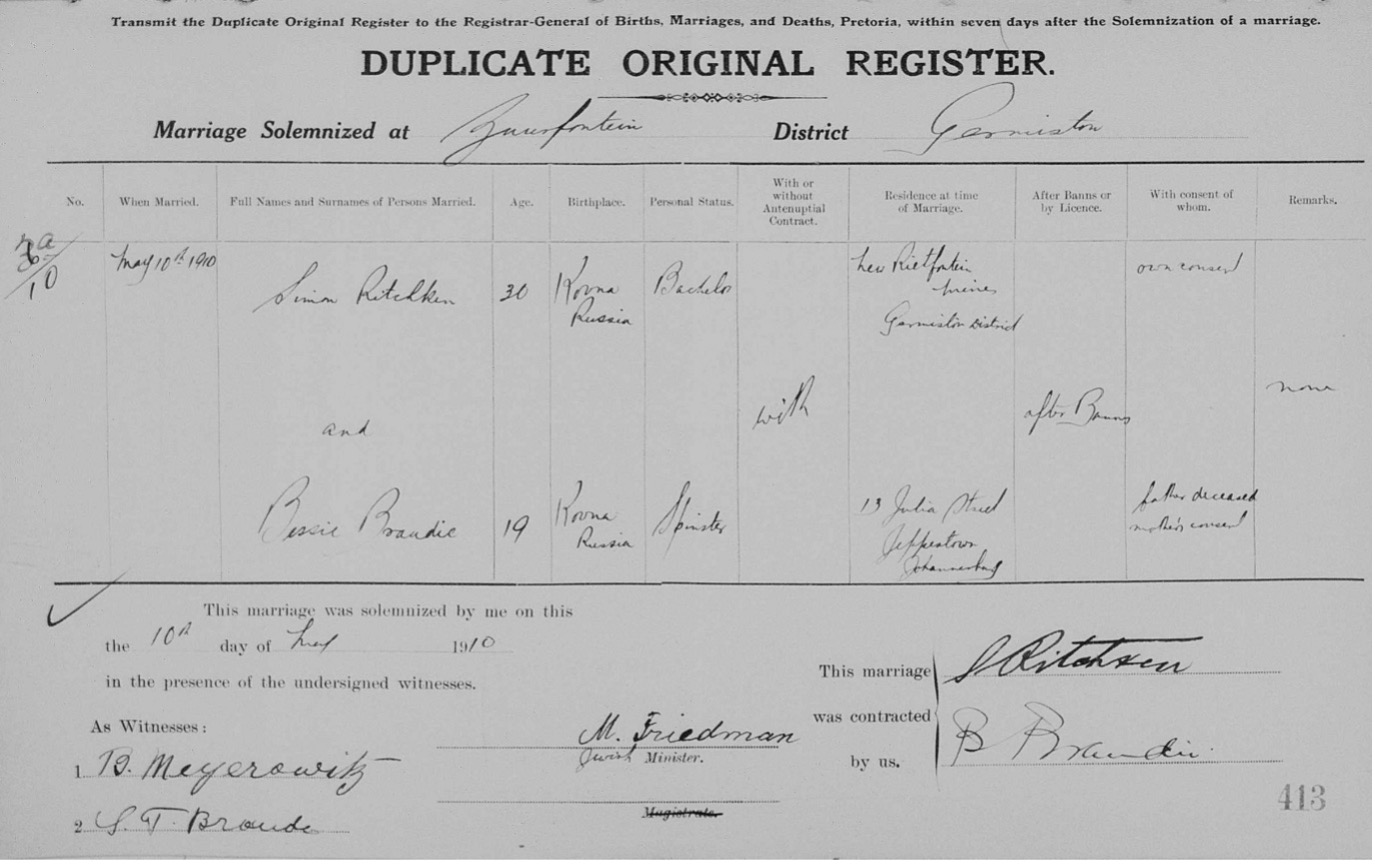
Children:
- Herbert Benjamin Ritchken (6 July 1911 - 20 June 2007 Muizenberg) was born a few months after the death of his paternal grandfather and was named after him. He married Monica Ella Lover (1 November 1914 - 30 December 2005 Cape Town) and they had a daughter Pamella. Herbert was a dairy farmer in Rustenburg. The family were members of the Rustenburg Hebrew Congregation and Monica Ritchken was a member of the Rustenburg Women's Zionist Society. The family left Rustenburg and lived in Muizenberg.
- Joseph Ritchkin (15 March 1914 Johannesburg – 27 May 1977 Salisbury, Rhodesia), known as Joe, was named after his father's oldest brother, Joseph, who died in 1912. He grew up on the family farm near Pretoria and was educated at Pretoria Boys' High School. He then studied medicine at the University of the Witwatersrand, qualifying as a doctor in 1937. Soon afterwards, he went to Southern Rhodesia to do a locum and ended up remaining there. He settled in Salisbury, where he practised for almost 34 years. Whilst in practice, he obtained a Doctor of Medicine from Wits University in 1947. He married Zelda Susman (1919 - 1980 Johannesburg) and they had 4 children.
- Pauline Michaelis née Ritchken (15 March 1919 - 13 April 2001) moved to Rhodesia, where she joined her brother Joe in Salisbury. She married Herman Rudolf Michaelis (30 June 1919 - 31 March 1996) and they lived in Rustenburg. They had 3 children, John, Jane and Frank. Their daughter, Jane, a graduate of Wits Medical School (1975), moved to Cape Town and in 1984 she graduated from the Michaelis School of Art. She is an artist and landscaper in Cape Town. Their son Frank Michaelis graduated at Wits Medical School in 1979 and is a radiation oncologist on the West Rand. None of the Michaelis children returned to Rustenburg. In May 2022 the Rustenburg Hebrew Congregation Fund erected a stone on the graves of Herman and Pauline, which had been left unmarked following their deaths.
References:
- Obituary. Dr Joseph Ritchken M.L.M., M.D. The Central African Journal of Medicine, Vol. 23, 6 June 1977.
- NASA:
- 1902. Application for Letters of Naturalisation. Joseph Ritchken.
- 1903. Naturalisation Simon Ritchken. Forwarding application for above.
- 1903. Diagram of Stand 266, Rietfontein owned by H Ritchken, forwarded for registration. Diagram of claim 1290 Rietfontein, owned by H Ritchken, forwarded for registration.
- 1904. Diagram of Stand 283, Rietfontein registered in the name of H Ritchken, forwarded for registration. Survey on Rietfontein of claim 1290 registered in the name of H Ritchken, and claim 1336 registered in the name of J Tomlinson.
- 1905. Renewal of licences of prospecting claims 1290, 7482 and stands 266, 283 and 329, registered in the name of the Ritchken Brothers. Licences of prospecting claims 1290 7482 and stand 266, 283 and 329, Ritchken Brothers. Enquiry if stands 66/7, claims 7267/8, Rietfontein registered in the name of H Ritchken and L Hersh are to be sold on 2 March.
- 1906. Renewal of licences of prospecting claims 7482, Driefontein No. 148 and 1290, 7267, Rietfontein 145 in the name of H. Ritchken and mining stands 329, Driefontein 148, 66, 283, Rietfontein 145 and 266, Rietfontein No. 145 in the name of Ritchken and Brothers.
- 1907. Renewal of licences of prospecting claims on Rietfontein No. 145 in the name of H Ritchken and Ritchken Brothers.
- 1907. Ritchken and Shure and Charles Thomas. New Rietfontein Gold Mining Company Ltd.
- 1908. Renewal of licences of prospecting claims Nos. 7482, 1290, 7267 and Mining Stands 266 and 329 in the name of the Ritchken Brothers.
- 1909. Renewal of various licences in the name of the Ritchken Brothers. Application by J and S Ritchken on behalf of H Ritchken for enlargement of stand 66, Rietfontein 145. Application by J and S Ritchken on behalf of H Ritchken for the enlargement of stand 329, Driefontein 148. Application by J and S Ritchken for the enlargement of stand 283 Rietfontein 145 in the name of H Ritchken. Application by the Ritchken Brothers for the enlargement of stand No. 266, Rietfontein No. 145.
- 1910. Report by the Beacon Inspector Cossins re fencing on claim 5007, Driefontein No. 1 by Bessie Ritchken.
- 1911. Renewal of licences of H Ritchken, of various farms.
- 1912. J and S Ritchken Renewal of licenses - various.
Rustenburg Herald entries:
- 1940-04-05. Dr J. Ritchken of Salisbury and Pauline Ritchken of Salisbury are both staying with their mother, Mrs Simon Ritchken, at Waterval Farm.
Roos, Amy née Springer
(1914 South Africa – 2011 Durban)
She was the daughter of Hungarian Jews, Martin Springer (1878 Hungary - 1953 Bloemhof) and Sida Springer née Donner (1892 Hungary - 1964 Bloemhof), who settled in Bloemhof, Transvaal. Amy married Stephanus Johannes Roos (1905 - 1980 Durban) and they lived in Rustenburg, where he was a bank manager. They had 2 children, Reginald 'Reg' (1938-2025) and Estelle. Amy was involved in the Jewish community and belonged to the Rustenburg Women's Zionist Society. She was a piano teacher.
The Roos family left Rustenburg and retired to Durban, where their son, Reg Roos, lived. He was a prominent gynaecologist in the city and served as the President of the South African Society of Obstetricians and Gynaecologists. Their daughter, Estelle, qualified as a speech therapist and following her marriage in Durban, she moved to Johannesburg.
Rosenstein, Willy
(28 January 1892 Wiesbaden, Germany - 23 May 1949 Rustenburg)
Willy Rosenstein was a German-Jewish aviation pioneer, World War I fighter ace, and professional race car driver who gained historical prominence not only for his aerial victories in World War One but also for standing up against anti-Semitism within the German military, specifically confronting his squadron commander, Hermann Göring.
Willy was the son of Ernest Rosenstein (1860-1907) and Pauline Noerdlinger Rosenstein née Zimmern (1867 - 1926). He had an older sister, Olga Gertrude Kauffmann née Rosenstein (1890-1976). Willy developed a passion for engineering and motor cars. In 1912 he earned his pilot license (No. 170) at the Johannisthal airfield and before World War I he worked as a flight instructor for Rumpler and as a test pilot/designer for the Gotha wagon factory.
When war broke out in 1914, Rosenstein volunteered as a pilot, flying over 180 combat missions. He initially served in Jasta 17 under Hermann Göring. In late 1917, Göring made an anti-Semitic remark in front of the squadron. Rosenstein demanded a formal apology and when Göring refused, Rosenstein requested a transfer. He transferred to Jasta 40, where he thrived, eventually becoming the Deputy Squadron Leader and earning the Iron Cross (First Class).
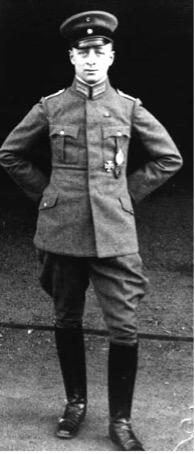
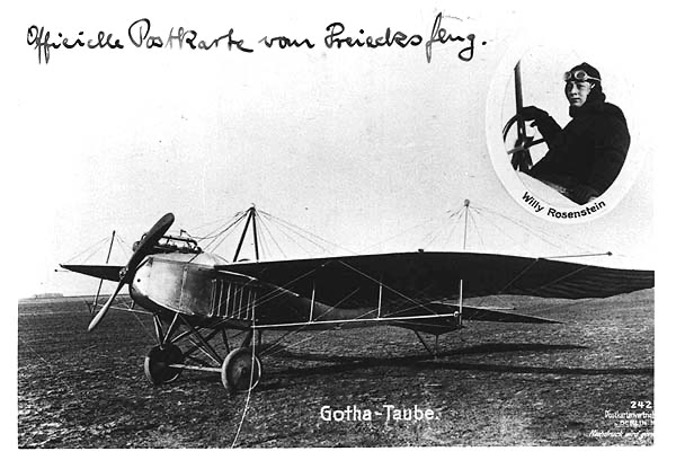
After the war he married Hedwig Rothschild (1892-1926) and their son, Ernest Willy Rosenstein (1923 Stuttgart, Germany - 2 April 1945 Italy), was born in 1923. His wife died 3 years later when Ernest was 3 years old. Although he remarried, the marriage was short-lived.
After the Nazis rose to power in 1933, Rosenstein was deprived of his right to fly commercial aircraft, and he turned to racing. He became an avid sports car driver between 1928 and 1930, driving Mercedes Benz S, SS, and SSK models, and earned a reputation as one of Germany's top amateur drivers. In 1936, due to escalating Nazi anti-Semitism, he emigrated. In an ironic twist of fate, he utilized a letter handled by Göring's office to clear bureaucratic hurdles, allowing him to leave Germany for South Africa with three of his planes and spare parts.
He initially settled in Johannesburg and established Union Aviation Co. Pty Ltd, based at Rand Airport, Germiston, where he also operated a flying school. He then purchased a small citrus farm, Mountain View, near Rustenburg and settled there, opening the Willy Rosenstein's Flying School. When the Rustenburg Flying Club was established after the war, he volunteered as a flying instructor and was the club's ground engineer.
On the 30 December 1944 he married Ursula Cohler (1914 Germany - 1956) in Rustenburg. She was the daughter of Siegmund Cohler (1877-1943) and Margarete Cohler (d. 1931). During the war, her father was deported from Berlin and died in Theresienstadt concentration camp.
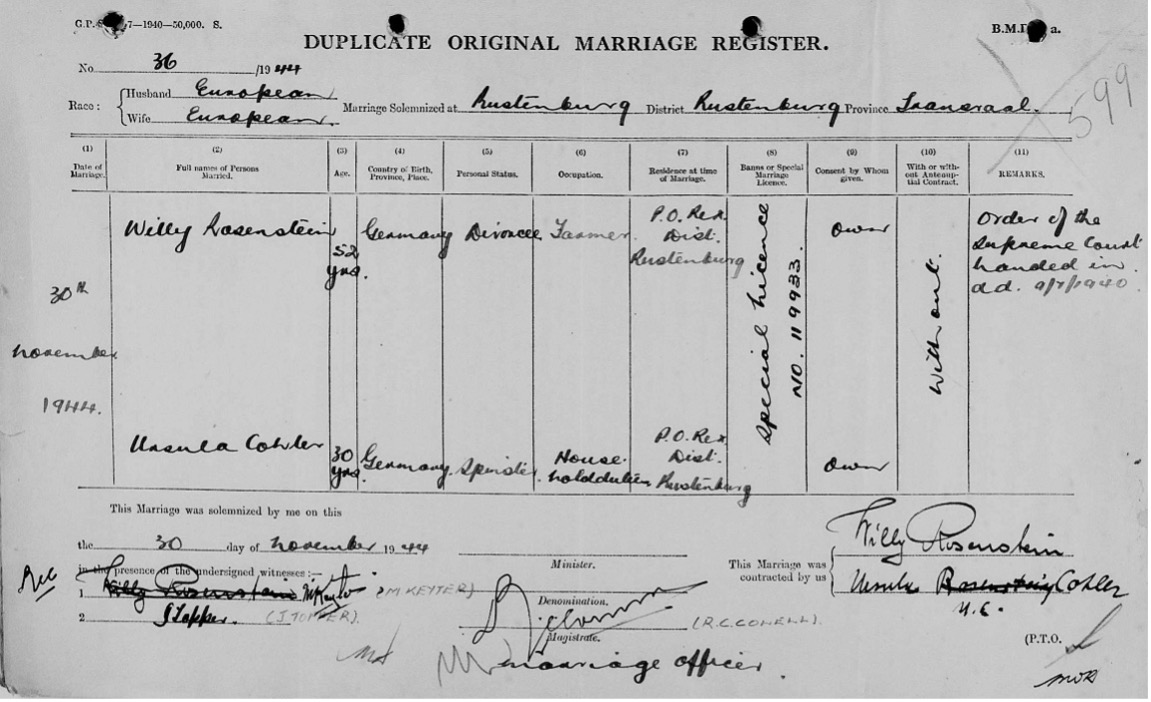
During World War II, Willy's son, Ernest, volunteered in the South African Air Force and served as a fighter pilot. On the 2 April 1945, he was killed whilst leading a bombing mission against a German ammunition dump in the province of Modena in North Italy.
Four years later, Willy Rosenstein died from injuries sustained in an aeroplane accident at the Wigwam Holiday Resort. The circumstances of the accident as reported in the Rustenburg Herald read: 'Willy Rosenstein Killed in Flying Accident. One of the Union's most experienced pilots and one of Rustenburg's popular citizens was killed on a private flying field near Rustenburg yesterday afternoon when two planes collided just after touching down. He was Mr. W. Rosenstein, who had 40 years flying experience and was a member of the famous Richthoffen Circus during the First World War. In 1911 he attained the world altitude record of 600 ft. The accident occurred on a private landing field of a guest farm about 10 miles from Rustenburg. One plane was piloted by Mr. Rosenstein, and the other by Mr. Scheibe owner of the guest house. In Mr. Rosenstein's plane was one woman passenger and in Mr. Scheibe's plane there were two women passengers. There are two runways and it appears that the two planes touched down from different directions at about the same time. Except for Mr. Rosenstein, who received head injuries, the others concerned in the accident received comparatively slight hurts.'
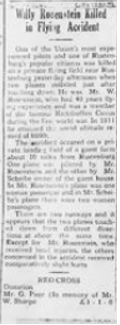
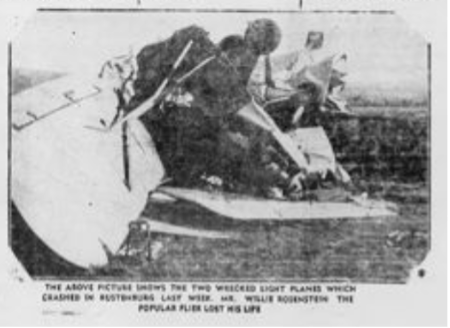
'The above picture shows the two wrecked light planes which crashed in Rustenburg last week. Mr. Willie Rosenstein the popular flier lost his life.' Rustenburg Herald
References:
- Willy Rosenstein, German-Jewish Air Ace, WWI, Chapter 19. The Golden Years: A Memoir of Old Rustenburg. Lionel Wulfsohn, 2011, Watermark Press, Plettenberg Bay, pages 162-169.
Rosmarin and Raphael families
During World War Two, Isaac 'Ike' Abraham Rosmarin (12 January 1915 Roodebank - 10 July 2008 Johannesburg), a soldier serving in the Union Defence Force, married his fiancee, Fanny ‘Fay' Margaret Raphael (1917 - 27 August 2011 Johannesburg). They were married on 17th June 1940 at the Magistrate's Court, Johannesburg. They had been engaged for a year and decided to get married before he was sent 'up North'. Fay was the daughter of Elias Raphael (5 January 1876 Birmingham, England - 5 December 1979 Rustenburg) and Katharine 'Kate' Raphael née Bloom (1892 England - 14 June 1959 Rustenburg), emigrants from England who lived in Yeoville, Johannesburg with their 3 daughters, Rachel 'Rae' Ida Goldin (1915-2001), Fay Rosmarin and Marcia Katz (1922-1995). Fay remained in Johannesburg with her family when Ike was sent 'up North' in 1941. In June 1942, Ike was taken prisoner of war at the fall of Tobruk and the couple were only reunited at the end of the war, following his repatriation to South Africa.
The Rosmarin family settled in Rustenburg and Ike worked as the manager of Victoria Trading Store on the Rustenburg Platinum mine. They had 4 children, 2 sons and 2 daughters, and the family lived in Joubert Street. Fay's parents moved from Johannesburg to Rustenburg and following her mother's death in 1959 in Rustenburg, her father, Elias Raphael, moved in with the family. He died twenty years later in 1979 and was buried next to his wife in the Rustenburg Old Cemetery. Fay was a member of the Rustenburg Women's Zionist Society
After the war, Ike Rosmarin joined the South African Red Cross as he felt deeply indebted to the Red Cross, who had helped alleviate the suffering of prisoners of war during the years of captivity. He served as Chairman of the Rustenburg branch. He was also a member of the Memorable Order of Tin Hats. In 1990 he published Inside Story, detailing his experience in the war. Ike worked at the mine trading store for 40 years. Following his retirement, he and Fay left Rustenburg for Johannesburg. He died in 2008 and Fay 3 years later in 2011. They were buried alongside one another in the West Park Cemetery.
References:
- Inside Story. Ike Rosmarin, W.J. Flesch and Partners, 1990. ISBN 10: 0949989495, ISBN 13: 9780949989499.
Samuel, Ruth
Ruth Samuel (9 September 1903 - 27 October 1905), daughter of Joseph and Grete Samuel, died of croup at the age of 2 years and was buried in the Rustenburg Old Cemetery.
Schumacher, Leo
(1902 Courland - 12 February 1975 Johannesburg)
Known as 'Skoenie', he was the son of Moshe Schumacher and Sarah Schumacher née Simon of Tukums, Latvia. In 1925 he left Eastern Europe for South Africa to join his mother's family who had all emigrated from Courland (Latvia) many years earlier. Skoenie settled in Rustenburg, where his maternal aunt, Mary Wulfsohn, resided. He was employed by Mary's husband, Philip Wulfsohn. He was a bachelor and for many years he lived in a back room at the Wulfsohn home. He only spoke Yiddish and befriended the Socher family, whose home was known as 'a home from home' for young Jewish immigrants. According to his cousin, Lionel Wulfsohn, Skoenie could get evening meals, play cards and in an emergency even sleep overnight at the Socher home. Skoenie subsequently moved in with Zundel and Sarah Weisberg née Socher. During the last years of his life, Skoenie lived in Johannesburg, where he often visited the home of Martin and Hannah Rapeport née Socher. He spent many hours playing klaberjas with Lazzy 'Dummy' Rapeport, Martin's younger brother. Skoenie died in 1975 aged 73 and was survived by his sister and her family. He was buried in the West Park Cemetery, Johannesburg.
References:
- Schamroth Rapeport N. The Rapeport Meyer family sojourn in South Africa. 2014. The Simson family.
- The Golden Years: A Memoir of Old Rustenburg. Lionel Wulfsohn, 2011, Watermark Press, Plettenberg Bay.
Schwarz family
Ernest Schwarz (4 October 1900 Osnabrück, Germany - 13 September 1963 Durban) was born on 4 October 1900 and was the son of Felix Schwarz and Betty Schwarz née Frankenstein of Osnabrück, Germany. In 1929 he married Ilse Stern (1909 Wuerzburg, Germany - 1988) in Wuerzburg and they settled in Berlin, where he worked as a merchant. Their son, Rolf 'Ralph' Raphael Schwarz was born on the 18 September 1930 in Berlin. In c. 1931, Ernest and Ilse got divorced. He left Germany and emigrated to Rustenburg, where he worked as a tobacco blender for Mundel and Herzfeld (Pty) Ltd. In 1933 he sent for his widowed mother, Betty Schwarz née Frankenstein (1864 Dannenberg, Germany - 1934 Rustenburg), who travelled by ship from Hamburg, Germany, to Cape Town and then on to Rustenburg. She died a year later from cancer and was buried in the Rustenburg Old Cemetery. Three years later, in 1936, Ernest married Annie Simon (1913 South Africa - 2 June 1986 Johannesburg) in Bloemfontein.
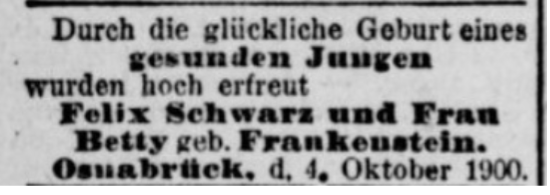
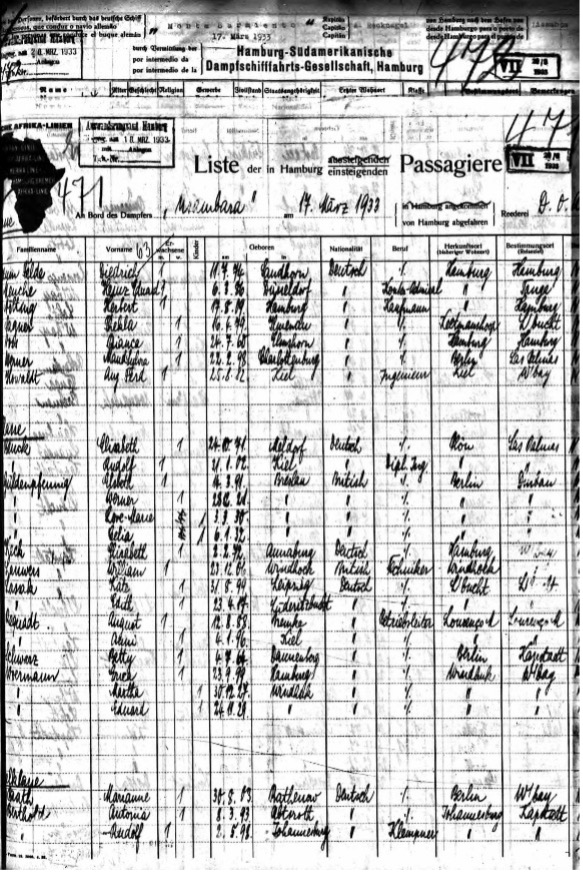
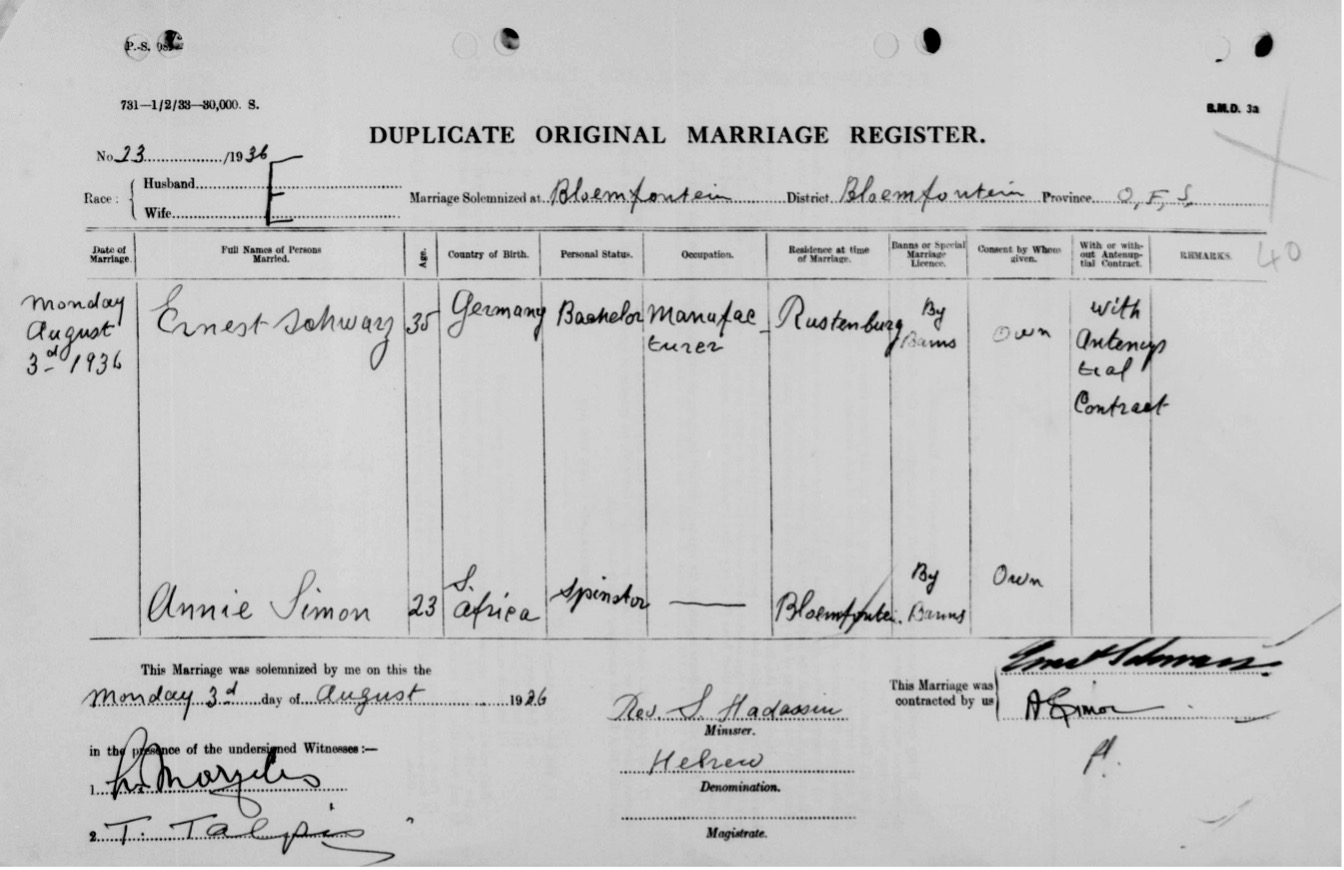
Ernest's ex-wife, Ilse Schwarz, and their son remained in Germany and lived in Wiesbaden. During World War Two, Ilse managed to escape to Athens, Greece, but their son, Rolf Schwarz, a child of 9, was deported and was interned in numerous concentration camps, including Theresienstadt, Auschwitz, Sachsenhausen, and Mauthausen. Although Rolf and his mother survived the war, they were not united after the war and were registered in different Displaced Persons’ camps in Italy. In November 1945, Rolf was part of a group of young Holocaust survivors and orphans who were repatriated from Italy to the British Mandate of Palestine on the ship Princess Kathleen. Upon their arrival in Haifa on the 8 November 1945, they were transferred to the Atlit detainee camp for processing by the British authorities. Rolf Schwarz eventually made his way to South Africa and was reunited with his father. He lived in Vereeniging and worked as a teacher. In 1958, aged 28, he was killed in a motor vehicle accident at Ingogo, Natal. He was buried in West Park Cemetery, Johannesburg, and the inscription on his tombstone reads 'The young man Raphael son of Joseph Schwarz who survived the Shoah in Europe, perished in a car accident'.
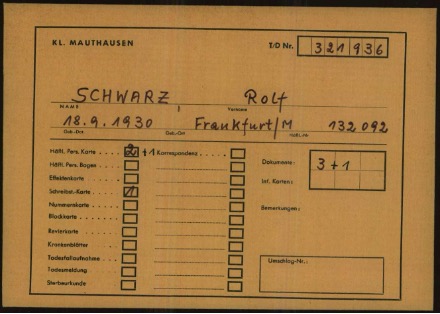
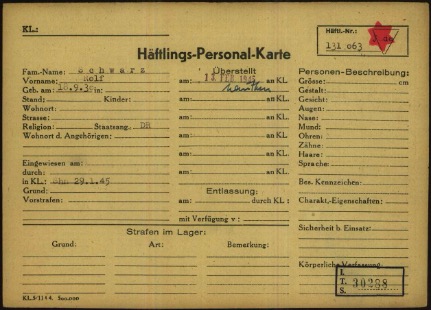
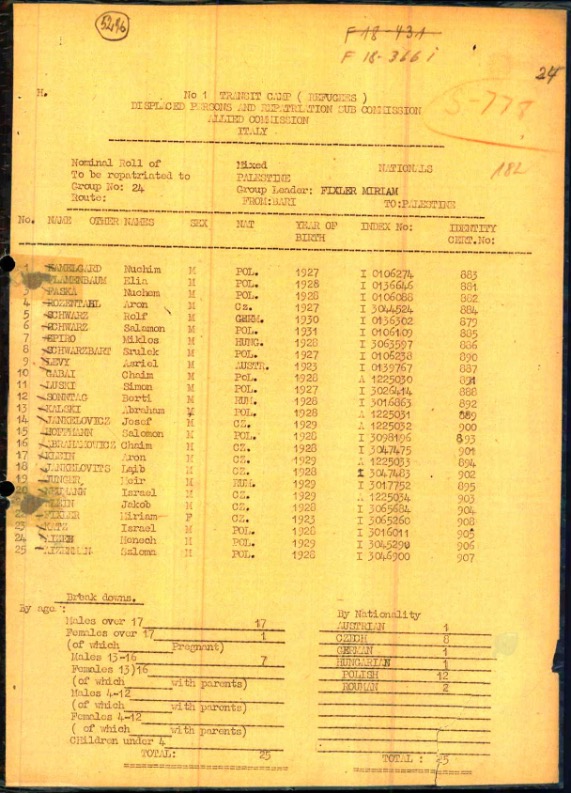
Ernest Schwarz and his wife, Annie, subsequently settled in Durban. He died in 1963 and was buried in the Stellawood Cemetery. Annie died in 1986 in Johannesburg and was buried in West Park Cemetery.
References:
- NASA. 1963 Schwarz, Ernest. Also known as Ernst Schwarz. Born in Osnabrueck, Germany. Spouse Anne Schwarz. (Born Simon).
- Shipping manifesto Deutsche Ost-Afrika-Linie, Usambara, Hamburg, Germany to Cape Town, departure date 17 March 1933.
- Jewish Holocaust Memorials and Jewish Residents of Germany, 1939-1945.
- Reiner Strätz. Biographisches Handbuch Würzburger Juden 1900-1945. Würzburg: Ferdinand Schöningh, 1989. 2 volumes.
- Arolsen Archives; Bad Arolsen, Germany; Registration and Care of DPs Inside and Outside of Camps; Reference Number: 00000088/8805940.
- Arolsen Archives. Registration of Foreigners and German Persecutees by Public Institutions, Social Securities and Companies (1939-1947).
- Israel Immigration Lists, MyHeritage.
Rustenburg Herald entries:
- 1936-07-31. The marriage will take place at the Jewish Synagogue, Bloemfontein. on Monday, 3rd August, of Mr. E. Schwartz, and Anna Simon, daughter of Mr. and Mrs. B. Simon, of Bloemfontein. Mr. Schwartz, who is on the clerical staff of Messrs. Mundel and Herzfeld, left for Bloemfontein yesterday.
Segel, Samuel
(1869 Russia - 6 December 1913 Middelfontein)
He was the son of Morris and Rachel Segel. He emigrated to South Africa and married Sarah Sachs (1873 Russia - 1949 Johannesburg) in Cape Town on the 12 September 1895. At that time, he worked as a collector. The couple had 3 children, Maurice Segel (21 June 1896 Cape Town – 31 August 1963 Johannesburg), Rachel Segel (born 21 August 1897) and Heyman Segel (born 7 November 1899). The family moved from the Cape to Rustenburg, where Samuel was a general dealer and miller at Middelfontein, district Rustenburg. He died in 1913 at the age of 43 following a machinery accident. After his death, his widow, Sarah, and family moved to Johannesburg. She died in 1949 at the age of 75 years and was buried in West Park Cemetery. Their son Maurice Segel married Joyce Eva Rosen (1901 - 1965) in 1927 in Johannesburg. He died tragically when he drowned in the Emmarentia Dam, Johannesburg, in 1963.
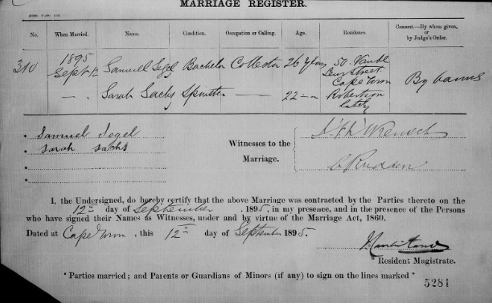
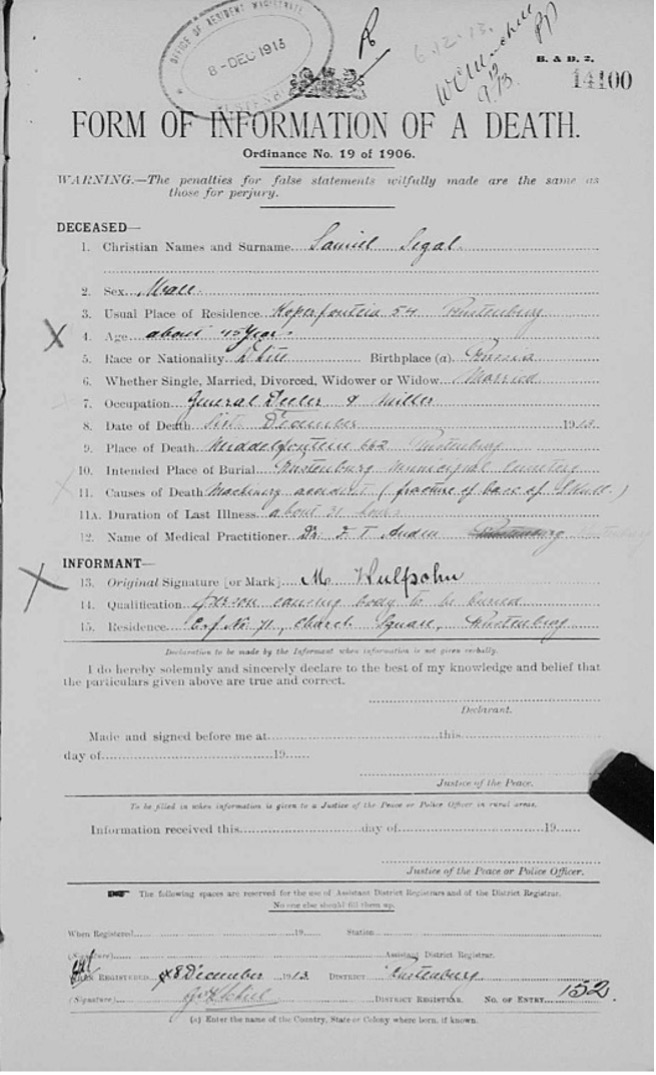
Sholomir and Milner family
Sholomir family
Chaim 'Harris' Sholomir (1853 Kedainiai, Lithuania – 28 December 1911 Johannesburg), his wife, Peche 'Paulina' Sholomir née Herr (1857 Lithuania – 25 May 1941 Johannesburg), and their 5 children emigrated to South Africa from Lithuania. Their children were Michael Sholomir (1875-1959), Frank Sholomir (1883-1941), Ida Wolov née Sholomir (1883-1959), Samuel Ralph Sholomir (1894-1959) and Rachel Groll née Sholomir (b. 1904). Harris Sholomir settled in the Zuid Afrikaansche Republiek before the Anglo Boer War. After the war in 1903 he submitted a claim for compensation in Elandsfontein as he was a foreign subject. He passed away in Johannesburg in 1911. His 2 eldest sons, Michael and Frank, settled in Rustenburg.
Michael Sholomir
(1875 Radvilishok (Radviliškis), Lithuania - 25 August 1959 Johannesburg) He established himself as a shopkeeper in Rustenburg. On the 16 October 1921 he married Esther Milner (1897 Kelem, Russia – 1 November 1988 Pretoria), a fellow Rustenburg resident. Her father was Meyer Milner (1864 Lithuania - 1924 Rustenburg), a Lithuanian immigrant. The couple were married in Jeppestown, Johannesburg. The Sholomir family were active in the Rustenburg Jewish community and Michael Sholomir served on the committee responsible for the erection of the Rustenburg Synagogue in 1924. They had 2 children, Jack Mervyn Sholomir and Rhona Annette Sholomir. In April 1938, Rhona and several other Jewish children took part in the concert 'The Micky Mouses' at the Town Hall. Her performance was reported in the local press - 'The "Dances of the Golliwogs" by Jean Rapeport, Rhona Sholomir and Jeanette Wulfsohn was a novelty, when 3 huge boxes opened and 3 little Gollis hopped up and out and having completed a fascinating dance hopped back and shut their boxes.' Rhona was a pupil of the pianist, Miss Bertha Liebenthal. The results of her music examinations, under Miss Liebenthal's tutelage, were published in the Rustenburg Herald in the years 1936-1938.
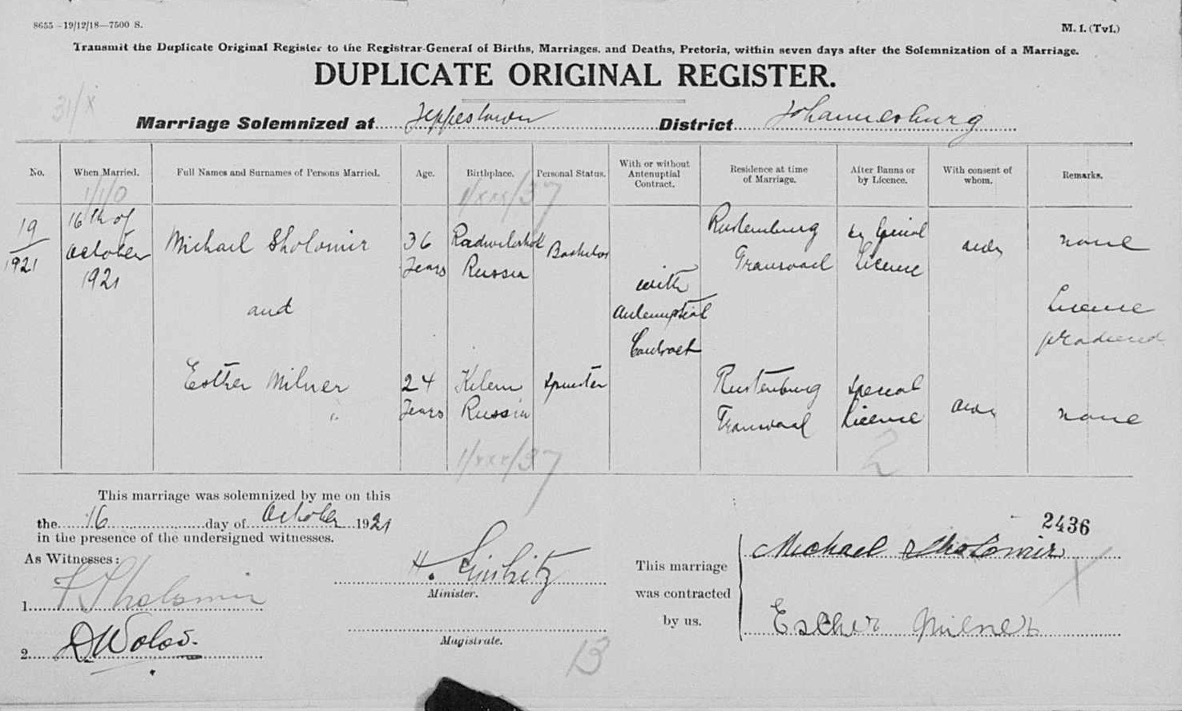
Michael Sholomir was involved in numerous business ventures in the Rustenburg district. In 1930 he and fellow Rustenburgers Harry Gawron and Isador Lederman bought Waterval Native Eating House and Butchery from Sarah Socher and Benny Girnun. The 3 partners traded as Waterval Trading Company. The men also partnered in the Platinum Supply Stores on the farm Kroondal No. 177. In 1932 their partnership was dissolved, with Sholomir carrying on the business. Sholomir also leased a trading site on the farm Tweedepoort No. 189 directly from the Bafokeng Tribe in that year. Sholomir and his brother-in-law Louis Milner also worked together. In 1931 they bought Vliegpoort Trading Store in Thabazimbi, which they operated together for 16 years. The 2 brothers-in-law and Jacobus Johannes Booysens partnered together and ran a general dealer's business on the farm Groenboom No. 444, district Rustenburg, which they abandoned in 1936. In 1938 Sholomir and Louis Milner took over the licence of a general dealer on the farm Zwartkop No 855, district Rustenburg, and traded as Chrome Trading Store. The following year Sholomir and Milner bought Louis Garage at Donkerpoort No 880, district Rustenburg, and they continued to run the business at the farm Rossouwspoort No 82. In 1947, the 2 brothers-in-law sold Vliegpoort Trading Store. Michael Sholomir then devoted his activities to their farming operations whilst Louis Milner continued to run the garage.
In their later years, Michael Sholomir and his wife, Esther, retired to Yeoville, Johannesburg. He died in 1959 and was buried at the West Park Cemetery. Esther relocated to Pretoria to spend her final years with her daughter, Rhona Annette Pokroy, eventually passing away in 1988 at the advanced age of 91.
Frank Sholomir
(1883 Lithuania - 14 September 1941 Port Elizabeth)
Although Frank Sholomir was listed as being born in c. 1883, his birth was registered in Kedainiai, Lithuania, on the 14 December 1875. He owned the Princess Café in Plein Street, Rustenburg. Frank spoke both English and Afrikaans in a rapid, staccato cadence, earning him the nickname 'Pom Pom', as it mimicked the quick-firing sound of the Maxim automatic guns used during the Anglo-Boer War. Frank served with his bother on the building committee responsible for the erection of the Rustenburg Synagogue. He married Latvian-born Ethel Mahler (1895 - 1970 Cape Town). The couple subsequently left Rustenburg and settled in Benoni. They eventually moved to Port Elizabeth, where he worked as a theatre manager until his passing in 1941. The couple did not have children. Following Frank's death, his widow, Ethel, married Louis Chosack and they lived in Pretoria. Ethel died in Cape Town in 1970.

Back row: S. Isaacs, H. Gawron, M. Wulfsohn, F. Sholomir.
Front row: M. Sholomir, N. Kirsch, B. Harris, Chief Rabbi Dr. Landau, H. Wulfsohn, Rev. D. Leibovitz, M. Kadey, P. Wulfsohn, S. Mundel.
Milner family
The Milner family originated from Šilalė, Lithuania. Meyer Milner (1864 Russia - 18 October 1924 Rustenburg) and his wife, Hannah, had 4 children - Isaac Milner (1891-1939), Esther Sholomir née Milner (1897-1988), Joseph Milner (1905-1939) and Louis Hyman Milner (1908-1978). In c. 1910 Meyer Milner and his 4 children immigrated to Southern Africa. While Meyer, his daughter, Esther, and his youngest son, Louis, established their roots in Rustenburg, his 2 older sons, Isaac and Joseph, went north to Southern Rhodesia (Zimbabwe) and settled in the Bulawayo area. Meyer joined his sons in Southern Rhodesia for a time, working in Bulawayo as a storekeeper and general dealer. However, in 1924 he returned to Rustenburg due to ill health. He was admitted to the Cottage Hospital, where he passed away on the 18 October 1924 at the age of 60.
Children:
Esther Sholomir
She married Michael Sholomir (see above).
(25 August 1908 Šilalė, Lithuania – 10 February 1978)
He grew up in Rustenburg and in 1930 he set out for Thabazimbi. Although he and his brother-in-law Michael Sholomir were involved in numerous business ventures in the district, their most successful venture was Vliegpoort Trading Store, which they bought in 1930 and operated together for 16 years. When they sold the business in 1947, Louis Milner continued to run the garage. He continued in business in Thabazimbi and traded as Vliegpoort Handelshuis. In 1935 Louis Milner married Isabelle 'Belle' Myers (1912 - 10 May 2008 Pretoria), whose family resided in Piketberg, Cape Province. The early days of Louis and Belle's marriage in Thabazimbi epitomized the true hardships of rural life. A niece of Belle later recalled the stark reality the young bride faced upon arrival:
"Life in Thabazimbi in 1935 was extremely difficult and she lived in a one-room cubicle with outside amenities. No running or hot water, electricity, or tarred roads. No stove, just a primus. According to my mother, her sister, she always had a smile on her face and that is exactly how I knew her for 76 years. Despite hardships and the very isolated life up there on her mountain, she never complained. She was, in every sense of the word, as the Bible says in Proverbs 31: 'A woman of Valour who can find? for her price is far above rubies …'."
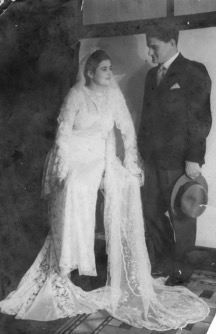
The Milners had 4 children - 2 sons and 2 daughters. Their daughter Lee Milner (13 January 1947 – 13 February 1953 Thabazimbi) suffered a fatal cerebral haemorrhage in 1953 at the age of six years old. She was brought to Rustenburg and was buried in the Old Cemetery. Their eldest son, Mervyn Milner, remained a resident and anchor of the Thabazimbi community for 70 years. Their second son, Eric Milner, was a successful Johannesburg businessman. He subsequently made Aliyah to Israel. Their daughter, Analee Milner, went on to achieve academic distinction, serving as Professor of Anaesthetics at the Academic Hospital, Pretoria.
Although the Milner family were isolated in Thabazimbi, Isabelle's sister, Jenny Gertie Levi née Myers, lived in nearby Zwartruggens with her husband and 2 daughters, and the two families were very close to one another.
References:
- NASA:
- 1932. Transactions in terms of Section 1 of Natives Land Act of 1913. Lease by Bafokeng Tribe of Natives to Michael Sholomir of site on Farm Tweedepoort No 189, Rustenburg, Etcetera.
- 1933. Transactions in terms of Section 1 of Natives Land Act of 1913. (Cession from M Sholomir to a page of Lease in respect of site on Farm 'Tweedepoort' No 189, Rustenburg, Etc.
- The Golden Years: A Memoir of Old Rustenburg. Lionel Wulfsohn, 2011, Watermark Press, Plettenberg Bay.
- Communication, Julian Pokroy, grandson, Pretoria, South Africa.
Rustenburg Herald entries:
- 1930-04-11. The Native Eating House and Butchery carried on by Sarah Socher and Benny Girnun, trading as the Waterval Native Eating house and Butchery, has been sold to Harry Gawron, Isodore Lederman and Michael Sholomir, trading as the Waterval Trading Company and will be transferred with effect from the 19th April 1930. Dated at Rustenburg this 5th day of April 1930. Herbert Cranko & Shapiro, Attorneys.
- 1932-06-10. The partnership carried on by M. Sholomir, H. Gawron and I. Lederman as General Dealers and Butchers on the farm Kroondal No. 177 trading as Platinum Supply Stores has been dissolved as from 1st May 1931. M. Sholomir is carrying on, on his own accord and responsibility.
- 1936-01-24. Notice is hereby given that the General Dealers Business hereto for carried on by Michael Sholomir, Louis Milner and Jacobus Johannes Booysens, on the farm Groenboom No. 444 District Rustenburg under the style or firm of Drieriviersboom Trading Company has been abandoned as and from the 31st October 1936 and that the partnership between the said Michael Sholomir, Louis Milner and Jacobus Johannes Booysons has been dissolved as and from the said 31st October 1935. Dated at Rustenburg the 12th Decernber 1935.
- 1938-01-21. Notice is hereby given that the licence of General Dealer held by Cornelis Johannes van Wyk in respect of the farm Zwartkop No. 855, district Rustenburg, will be transferred to Michael Sholomir and Louis Milner trading as Chrome Trading Store as from the 1st February 1938. de Villiers & van Noorden. Attorneys Box 146, Rustenburg.
- 1939-11-24. The business of 'Louis Garage' carried on by Louis Gustavus Erasmus on Donkerpoort No. 880, district Rustenburg, has been sold to Louis Milner and Michael Sholomir, who will carry on business under the same name at the farm Rossouwspoort No. 82, district Rustenburg, as from the date of the last insertion hereof. M. Levitt, Attorney for parties, Steen Street, Rustenburg. 7th November 1989.
- 1947-12-12. Mr. Louis Milner and his partner, Mr. Sholomir, who have been running the Vliegpoort Trading Store for the past sixteen years, have now sold their business to Mr. I. Queit of Balfour and Johannesburg. The Garage will continue to be run by Mr. Milner, while Mr. Sholomir will devote his activities to their farming operations.
Sichel family
The Sichel family, who originated from Bavaria, Germany, lived in Rustenburg for 90 years. Although they were associated with the Jewish community, there is no trace of the family in the Rustenburg Jewish cemeteries.
Max Michael Sichel (8 April 1880 Veitshöchheim, Bavaria, Germany - 10 December 1964 Rustenburg) settled in South Africa in 1903 and established himself at Kookfontein, district Rustenburg, where he farmed.
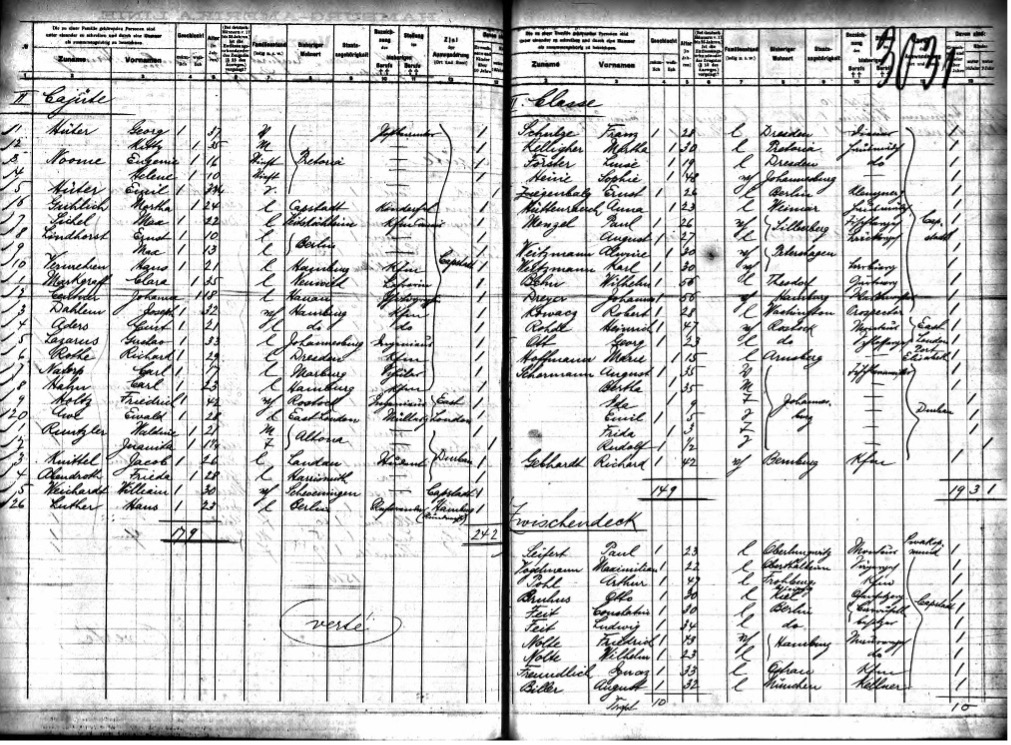
Max was the youngest son of Simon Sichel (1847-1911) and Babette Sichel née Blumlein (1850-1883), who lived in Veitshöchheim, Bavaria. He had 3 older siblings, Jakob Sichel (1875-1943), Karl Sichel (1876-1942) and Rosa Mainzer née Sichel (1878-1962). Following his mother's death, his father married Helene Sichel née Sichel (1856-1892) and 4 children were born from this union – Emil Sichel (1885-1945), Meta Sander née Sichel (1887 - 1936 Suhl, Thuringia, Germany), Anna Ehrlich née Sichel (1889-1984) and Sigmund Sichel (1890-1915). During World War One, his youngest sibling, Sigmund, was killed in Flanders, France, whilst serving in the German Army.
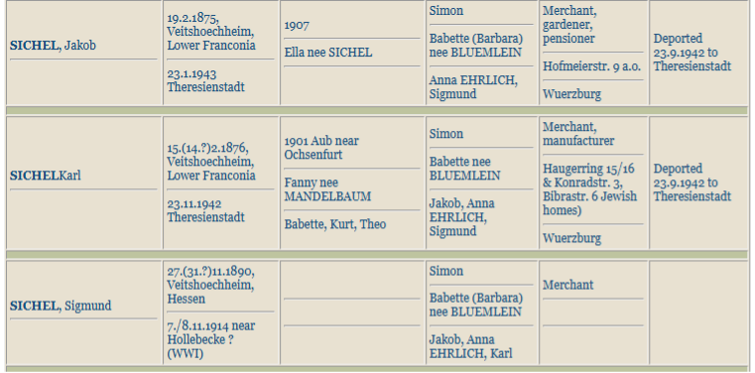
Max Sichel returned to Germany in June 1911 to visit his ailing father in Veitshöchheim. During his visit, he met a distant relative, Klaerchen 'Clara' Sichel (1885 Germany - 16 July 1937 Rustenburg), daughter of Gustav Sichel (1852-1919) and Julie Sichel née Maier (1857-1940) of Gunzburg, Germany. Clara followed Max back to South Africa and they were married in Cape Town on the 23 October 1912 in the Great Synagogue. The newlyweds settled in Rustenburg, where their 3 children were born - Iris b. 1914, Gertude b. 1916 and Simon Leo, born on 1 March 1921. The family lived on the farm Waterval 544, 2 miles outside Rustenburg on Pretoria Road. Max spoke Tswana and had a close relationship with the Royal Bafokeng Chief, Kgosi August Molotlegi, who reigned from 1896 until 1938. In 1937, after a long illness, Clara Sichel passed away at their home on the farm. Many members of the Bafokeng nation came to the farm to pay their respects to the family.
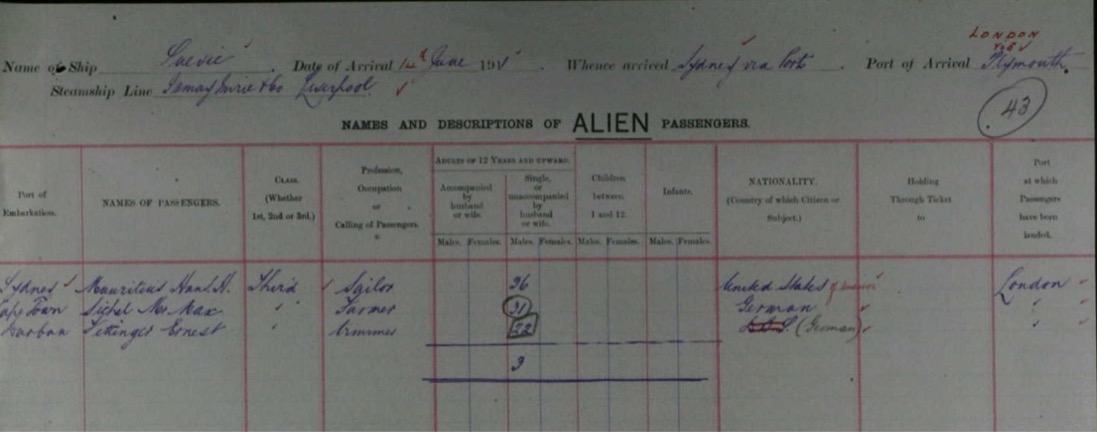
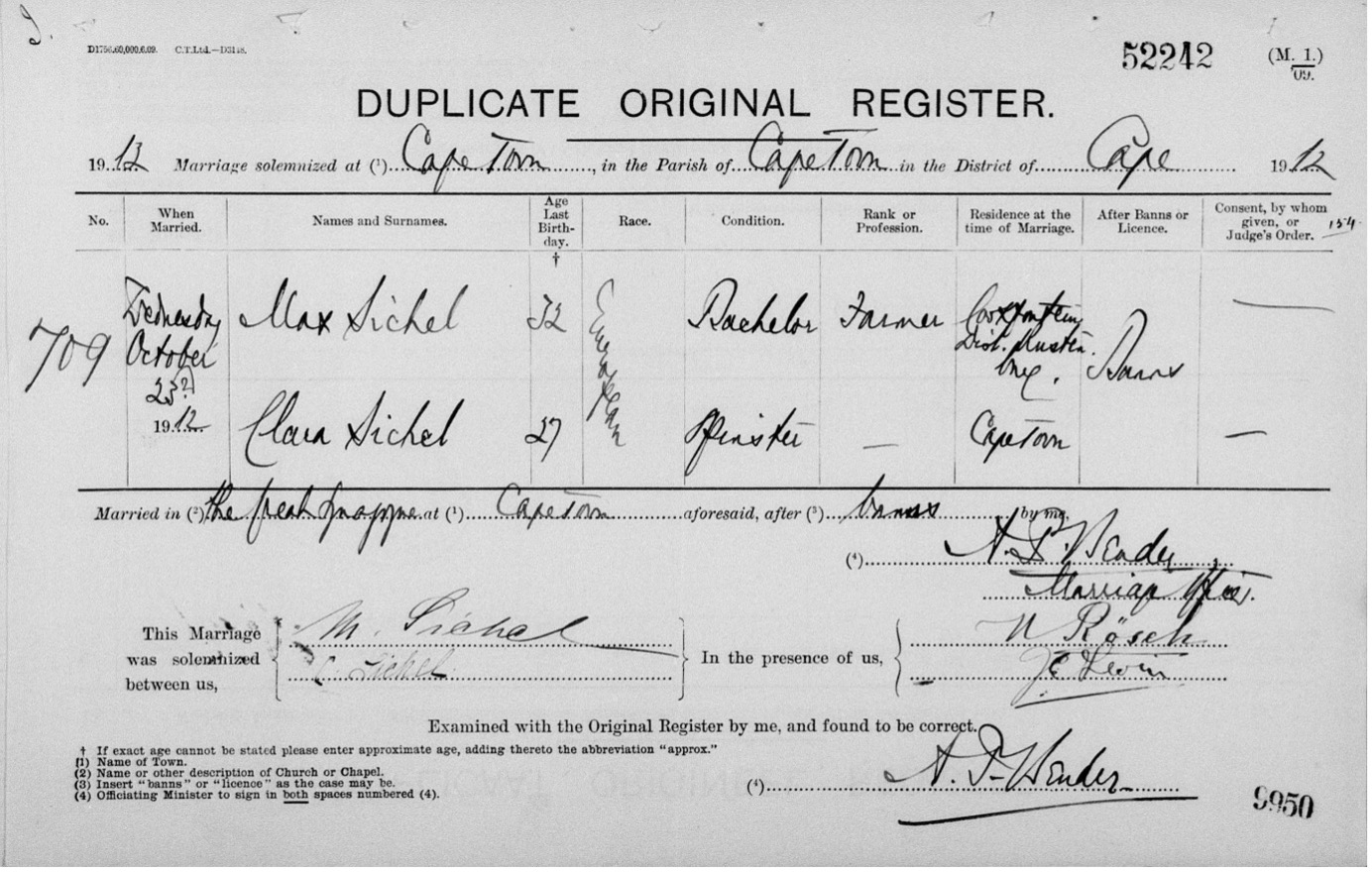
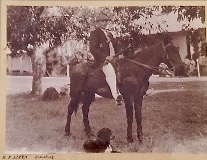
With the rise of Nazism, some of Max Sichel's siblings managed to leave Nazi Germany. His brother Emil Sichel left for the USA in 1935, Anna Ehrlich and her family managed to emigrate to Britain in 1939 and then went to the USA in September 1940. Rosa Mainzer and her family also managed to get to the USA. Max's two older brothers, Jacob and Karl, and their wives were deported to Theresienstadt on the 23 September 1942, where they all perished. In 1940 Max's mother-in-law, Julie Sichel, who lived in Munich, was deported to the State Hospital and Sanatorium in Zwiefalten as part of the Nazi euthanasia program (Aktion T4). From there she was sent to NS-Tötungsanstalt Grafeneck, a euthanasia centre, where she was murdered in a gas chamber camouflaged as a shower room. She was 82 years old.
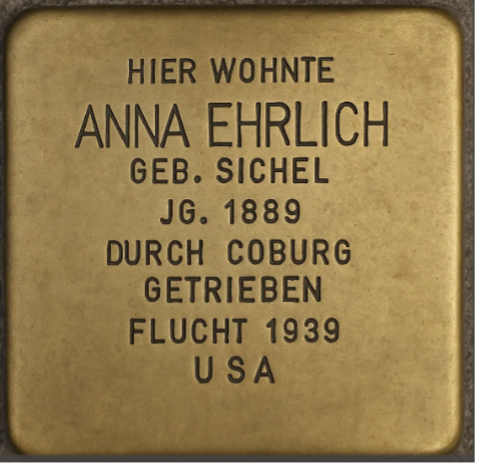
In 1941 Max's second daughter, Gertude Sichel, married Peter Hamilton and 3 years later their daughter was born. During the war, Max's son, Simon Sichel, volunteered in the Union Defence Force. He served for more than 2 years with the 6th S. A. Armoured Division in Italy and in July 1945 he returned home to Rustenburg.
After Simon Sichel returned to Rustenburg from the war, he went to study at Cedara Agricultural College, Natal, in October 1946 and obtained a Diploma in Agriculture the following year. In 1948 he married Patricia 'Pat' Tertia Ennis (9 January 1921 Rustenburg - 31 December 1995 Kaitaia, New Zealand). They were married on the 11 June in Johannesburg. Pat was the twin daughter of engineer Robert Joseph Stanley Ennis (1877 Sydney, Australia – 21 February 1937 Rustenburg) and Georgina Sarah Collins Ennis née L'Ange (b.1896 Rustenburg). Her family resided in Rustenburg and they identified themselves as Afrikaans. Pat had an older sister, and her twin was Pamella Una.
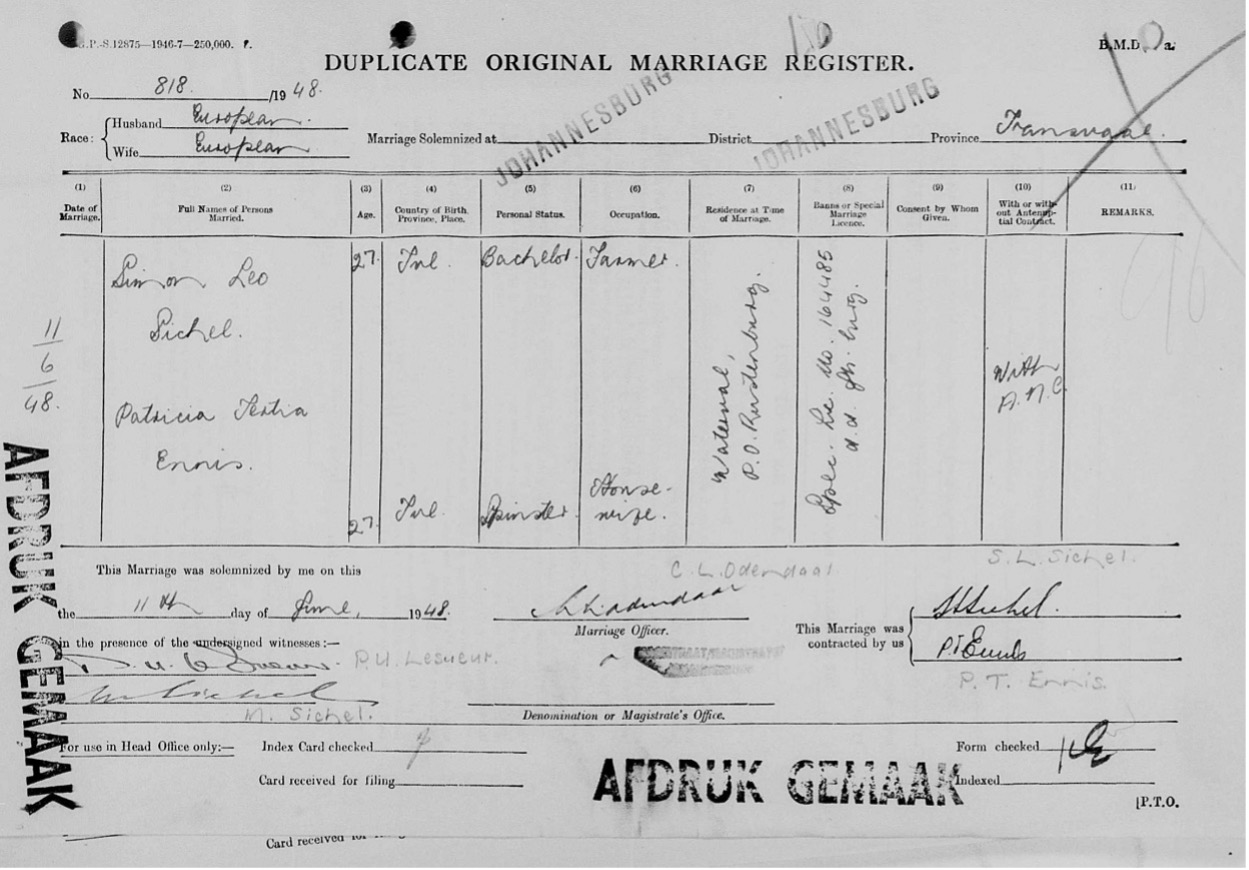
Simon and Pat Sichel had 3 daughters, Adrienne Cynthia, Pamela Klara and Clare Simone Sichel. The family lived with 'Oupa' Max on the farm. On the 10 December 1964 Max Sichel, aged 84, died on the farm. There is no trace of the family in the Jewish cemeteries as both Max and Clara Sichel had instructed in their will that they were to be cremated. Simon and Pat Sichel remained on the family farm until Simon's death on the 30 December 1992.
The Sichels' eldest daughter, Adrienne, is a retired journalist, dance critic, and co-founder of The Ar(t)chive, an independent South African contemporary dance and physical performance archive. She spent 40 years documenting and critiquing the changing landscape of contemporary dance in pre- and post-democracy South Africa. In 2018 she published the book Body Politics: Fingerprinting South African Contemporary Dance. In an interview in 2024 she related that 'Her oupa, of German-Jewish descent, lost almost his entire family in the Holocaust. Her mother was Afrikaans. According to traditional Jewish law where identity is passed down matrilineally, Sichel is not Jewish. Yet she imbibed Jewish customs growing up on her grandfather's farm in Rustenburg, … where the family observed all the major Jewish holidays.' 'She spoke of her Jewish grandfather, recalling, "there was no othering." Unusually for a white man at the time, he spoke Tswana and maintained close ties with the local king of the Bafokeng people, King Pokeng. When Sichel's grandmother died - her father was just 14 years old – hundreds of King Pokeng's followers walked to the family's farm to pay their respects.' ‘Sichel recalled her Afrikaans mother learning to cook Jewish meals through the Union of Jewish Women, an organisation which "she adored".'
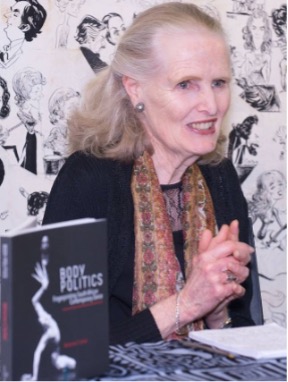
The Sichels' second daughter, Pamella Sichel-Mearns, emigrated to New Zealand in 1985. Influenced by her mother's resourceful cooking and the diverse food traditions around her, she began selling sauces and preserves at a farmers' market in Kaitaia. This evolved into the establishment of the business 'Due North Foods'. Her mother, Pat, joined her in New Zealand after the death of Simon and died in Kaitaia in 1995.
References:
- Jewish Holocaust Memorials and Jewish Residents of Germany 1939-1945.
Rustenburg Herald entries:
- 1937-07-23. After a long illness, Mrs M. Sichel passed away at her home on the farm Waterval on Friday the 16th. Sincere sympathy is extended to Mr. Sichel and the family.
- 1941-11-21. Miss Gertrude Sichel of Rustenburg is to be married to Mr Peter Hamilton, on Sat. 22 Nov. 1941 in Pretoria.
- 1944-02-25. Lieutenant Peter, and Mrs. Hamilton (née Sichel) are being congratulated on the birth of a bonny daughter.
- 1945 07-20. Pte. Simon Sichel, only son of Mr. Mux Sichel, arrived in Rustenburg on Wednesday from Italy, where he was serving with the 6th S. A. Armoured Division for over two years.
- 1946 10-11. Mr. S. Sichel has left Rustenburg for Cedara, Natal, where he will be spending approximately two months at the Agricultural College. We wish him every success in his studies.
- 1945-09-14. Mr. and Mrs. Hamilton (formerly Miss Sichel) and baby daughter have returned from their holidays spent at White River where they were on a visit to Mr. Hamilton’s parents.
- 1947-02-21. Mr. Simon Leo Sichel, only son of Mr. M. Sichel, Malelane, has obtained his Diploma in Agriculture.
- 1950-08-04. M. Sichel has returned from a holiday spent at Durban. … Mr. and Mrs. Simon Sichel and Adrienne, accompanied by Mr. and Mrs. B. Kohler and baby, have left for a holiday at Uvongo.
- 1950-11-03. United Party, Rustenburg South Branch BRAAFVLEIS and BARN DANCE will be held on SICHEL'S FARM (two miles from Town on Pretoria Rd.)
Socher family descendants
Yitzchak (Icyk) (b. 1853 Moletai, Lithuania) and Chia Sheina 'Sarah' Socher (1863 Lithuania - 19 June 1929 Rustenburg) were married on 12 January 1882 in Pasvalys, Lithuania. They had 7 children, Harry, Rakhel Rivka, Khackel 'Charlie', Abraham, Elizabeth, Sarah and Hannah. The family emigrated to South Africa after the birth of their daughter Sarah and the youngest child, Hannah, was born in Cape Town in 1907. The whereabouts of Yitzchak Socher and their daughter Rakhel are unknown as only Chia Sheina and six of her children lived in Rustenburg.

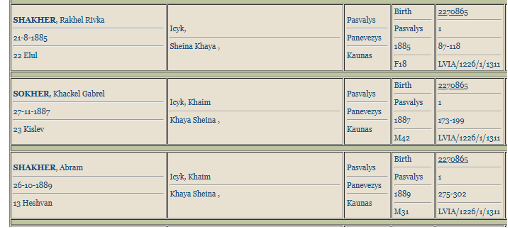
In Rustenburg the Socher residence became legendary as a 'home from home' for young Jewish immigrants arriving penniless from Eastern Europe. Chia Sheina Socher opened her home to them and newcomers could always count on a warm evening meal, a friendly game of cards, or a safe place to sleep overnight. She also operated the Waterval Native Eating House and Butchery. Chia Sheina Socher passed away in 1929 and the following year the Waterval Native Eating House and Butchery, which she had operated with Benny Girnun, was sold to fellow Rustenburgers, Harry Gawron, Isador Lederman and Michael Sholomir.
Children:
- Harry Socher (1882 - 1956 Rustenburg) was resident in South Africa at the beginning of the 20th century, taking the oath of allegiance in 1902 and achieving naturalization by 1909. He settled in Rustenburg and was a speculator, involved in livestock and farming. He and his brother-in-law, Ralph Pleskus, partnered in some business ventures. Harry married Celia Goldblatt (1894 Russia - 1961 Johannesburg) in 1919. The couple did not have children. They were active members of the community. Following Harry's passing in 1956, his widow moved to Johannesburg.
- Charlie Socher (Khackel Gabrel) (1887 - 1942 Rustenburg) also achieved naturalization in 1909. He remained a lifelong bachelor and was a local butcher trading under the name of the Premier Butchery.
- Abraham Socher (26 October 1889 – 5 February 1969 Johannesburg) was a farmer and speculator. In 1927 he partnered with Solomon Been to establish the company Been and Socher. He married Rita Gabbaholz (1911 Johannesburg - 2001 USA), a dancing teacher, on 30 April 1938 in Rustenburg. The family relocated to Johannesburg.
- Elizabeth 'Lizzie' Pleskus (1899 - 1987 Johannesburg) married Raphael 'Ralph' Pleskus (1881 Lupnik, Russia (Lipnic, Moldova) - 14 February 1938 Rustenburg) in Pretoria in 1916. Ralph was naturalised in 1907 and lived in Pretoria. The couple settled in Rustenburg, where their 6 children were born. Ralph owned Pleskus' Cycle Shop. He passed away in Rustenburg in 1938. When Lizzie's children left Rustenburg and moved to Johannesburg, Lizzie followed them to Johannesburg.
- Bernard 'Bokkie' Marks Pleskus (1917–1955) served in the Union Defence Force in World War Two with the Imperial Light Horse Regiment, 2nd South African Infantry Division. He was sent 'up North' and during the Battle of Bardia on 31 December 1941, he took over the command of his platoon when his superior was wounded and led the platoon successfully. After the war he worked as a commercial traveller for Marcuson Pty Ltd.
- Isaac Pleskus (1919–1985) also served in the Union Defence Force during World War Two. He was taken a prisoner of war at the infamous fall of Tobruk in June 1942. After the war he returned to build a life in Krugersdorp with his wife, Leonie Bark (1923-1987).
- Zelda Lena Belcher (1920 - 2012) married Cyril Isaac Belcher (1911-1984), a prominent advocate, in November 1940 in Johannesburg. The family resided in Johannesburg.
- Moss Martin 'Gigi' Pleskus (1923–1982) emigrated from South Africa and settled in England.
- Percy James Pleskus (1927–2025) emigrated from South Africa and settled in Australia. He died at the age of 97 in Sydney.
- Alice Ann Maud Levinson (b. 1931) married Ralph Morris Levinson (1923-2012) and settled in Johannesburg.
- Sarah Weisberg (1901 - 28 August 1970 Rustenburg) married Zeidel Weisberg (1896 Russia - 24 July 1970 Rustenburg) in 1934. The couple remained lifelong residents of Rustenburg, passing away within one month of each other in the winter of 1970. They had no children.
- Hannah Rapeport (23 May 1907 Cape Town – 31 August 1988 Johannesburg), the youngest child, married Martin Rapeport (1899 Calitzdorp – 2 September 1976 Johannesburg) on the 2 July 1936, a match that united two established Rustenburg families. Their marriage was reported in the Rustenburg Herald, 'Mr Martin Rapeport, who for many years lived in Rustenburg, was married yesterday at Krugersdorp to Miss Hannah Socher, sister of Mr Abraham Scoher. The Socher family has been here for many years also.' Hannah and Martin initially settled in Krugersdorp and then moved to Johannesburg, where they lived with Hannah's sister, Lizzie Pleskus, at 186 Derby Road, Kensington, Johannesburg. Hannah's son, Leonard Rapeport, grew up surrounded by his older Pleskus cousins.
All Accessories Stocked
Repairs done to all kinds of cycles
Plein Street, Rustenburg.
References:
- NASA:
- 1902. Application by H Socher to take the Oath Of Allegiance.
- 1909 Naturalization. Harry Socher.
- Scherman, Jean-Pierre. Contact at Bardia: The Baptism of Fire of the Men of the 2nd South African Infantry Division, 31 December 1941 – 1 January 1942, pages 253-4.
Rustenburg Herald entries:
- 1930-04-11. The Native Eating House and Butchery carried on by Sarah Socher and Benny Girnun, trading as the Waterval Native Eating House and Butchery, has been sold to Harry Gawron, Isodore Lederman and Michael Sholomir, trading as the Waterval Trading Company and will be transferred with effect from the 19th April 1930. Dated at Rustenburg this 5th day of April 1930. Herbert Cranko & Shapiro, Attorneys.
- 1930-07-04. Mr. and Mrs R. Pleskus wish to announce the Bar mitzvah of their eldest son, Bernard Marx (Bokkie) who will read a portion of the law at the Rustenburg Synagogue on Saturday 12th July. Reception at the Synagogue, all relatives and friends cordially invited.
- 1935-05-10. Notice is hereby given that the business carried on by Raphael Pleskus on Erf No. 86, Plein Street, Rustenburg has been abandoned from the 1st instant. 29th April, 1935. Rustenburg. D.J. Kotze, Attorney for R. Pleskus, Plein Street, Rustenburg. 31017
- 1938-02-18. The late R. Pleskus. The funeral of the late Mr. Pleskus took place at the local cemetery on Tuesday afternoon and there was a large attendance at the graveside, of his friends who came to pay their last respects. The deceased gentleman has been ailing for some considerable time and was unable to take an active part in business. After living in Pretoria, as a young man Mr. Pleskus came to Rustenburg many years ago, married here and settled down. To Mrs. Pleskus and the children and the other members of the family, sincere sympathy is extended.
Susser, Asher
(16 December 1880 Lutzin (Ludza), Latvia - 26 January 1938 Rustenburg)
He emigrated to South Africa and married Dora Millie Falkow (1894 Latvia - 1994 Johannesburg) on the 21 June 1915 in Johannesburg. They had 3 children, Gerald Manfred Susser (1916-2004), Hilda Broide née Susser (1918-1986) and Mavis Harris née Susser (1920-1995). In 1924 the family moved to Pietersburg, where Susser owned Northern Transvaal Agencies. In 1935 the family left Pietersburg and moved to Selonstad, where he was a storekeeper. Their son Gerald remained in Pietersburg and boarded with the Levy family.
In January 1938 Susser came to Rustenburg and he committed suicide. His death made headlines in the Rustenburg Herald. 'Suicide in Rustenburg. Asher Susser, of Selonstad, arrived in Rustenburg on Sunday and booked at the Grand Hotel where he appeared to be quite normal. On Wednesday he asked for a glass of water and when it was brought, he could not drink it. A doctor was summoned and he ordered Susser to hospital, but he died on the way there. The verdict at the inquest was that he had died of strychnine poisoning, self-administered. The deceased left the following letter addressed to the Magistrate: The Resident Magistrate, Rustenburg. Worshipful Sir, I am writing the letter to you as the head of the district. I wish to make it clear that I have taken my life and that no one is responsible. I am about to do so now and I am going to take strychnine and hope it will have the effect. Yours, obedient servant, Asher Susser.'
Swimmer family
Isaac Swimmer (1890 - 1969 Johannesburg) and Rachel Swimmer éee Levin (1895 - 1976 Johannesburg) were married in Cape Town in 1916. Three years later, their son, Harold Louis Swimmer (21 April 1918 Cape Town - 24 December 1992 Cape Town), was born. The family left Cape Town for Rustenburg, where Harold spent his childhood. In 1931, Harold celebrated his bar mitzvah in the Rustenburg Synagogue.
Harold married Helen Friedman (1919 Mafikeng - 2008 Cape Town) and they lived in Cape Town. His parents moved to Johannesburg and are buried in West Park Cemetery.
Rustenburg Herald entries:
- 1931-05-29. BAR MITZVAH NOTICE. SWIMMER. Mr. and Mrs. Swimmer of Rustenburg will be delighted to see all relatives and friends on the occasion of the Bar-Mitzvah of their only son Harold who will read a portion of the law on Saturday morning the 5th June at Rustenburg Synagogue. Reception at the Masonic Hall on Saturday night at 8 p.m.
Terner family
Jacob Terner (1869 Russia - 18 July 1932 Rustenburg) and Eugenie 'Janie' Terner née Chmelnitska (1873 Russia - 3 August 1933 Johannesburg) had 5 children, Abram Terner, Nina Terner, Valia Elkin née Terner (1898 Russia - 1967 Johannesburg), Michael Terner (1904 Russia - 1973 Johannesburg) and Alexander Terner (b. 1905 Russia). It is unknown whether their son Abram and daughter Nina emigrated to South Africa.
The Terner family settled in Rustenburg, where Jacob was a shopkeeper / general dealer. He owned Rustenburg Cheap Store in Plein Street. When he died in 1932 at the age of 63, his business was sold at a public auction in order to pay his creditors. His wife moved to Johannesburg and died a year later. Her body was brought back to Rustenburg, where she was buried next to her husband.
The Terners' son Michael Terner (1904 Russia – 1973 Johannesburg) resided in Lichtenburg, where he worked as an alluvial diamond digger. He married Rosalie Wax (1910 - 1981 Pretoria) in 1933 in East London.
The Terners' youngest son, Alex Terner, lived in Rustenburg. He was a baker and was a partner of Mr A. J. Parsons. They owned Rustenburg Steam Bakery. In 1933 Alex Terner married fellow Rustenburger Vera Dobie (1907 - 1994 Johannesburg). They were married on the 3 January in Durban. Two years later, their daughter Joy was born in Rustenburg. The family subsequently left Rustenburg.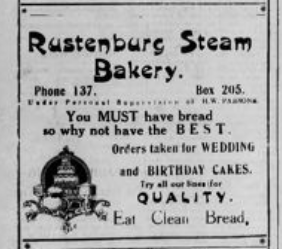
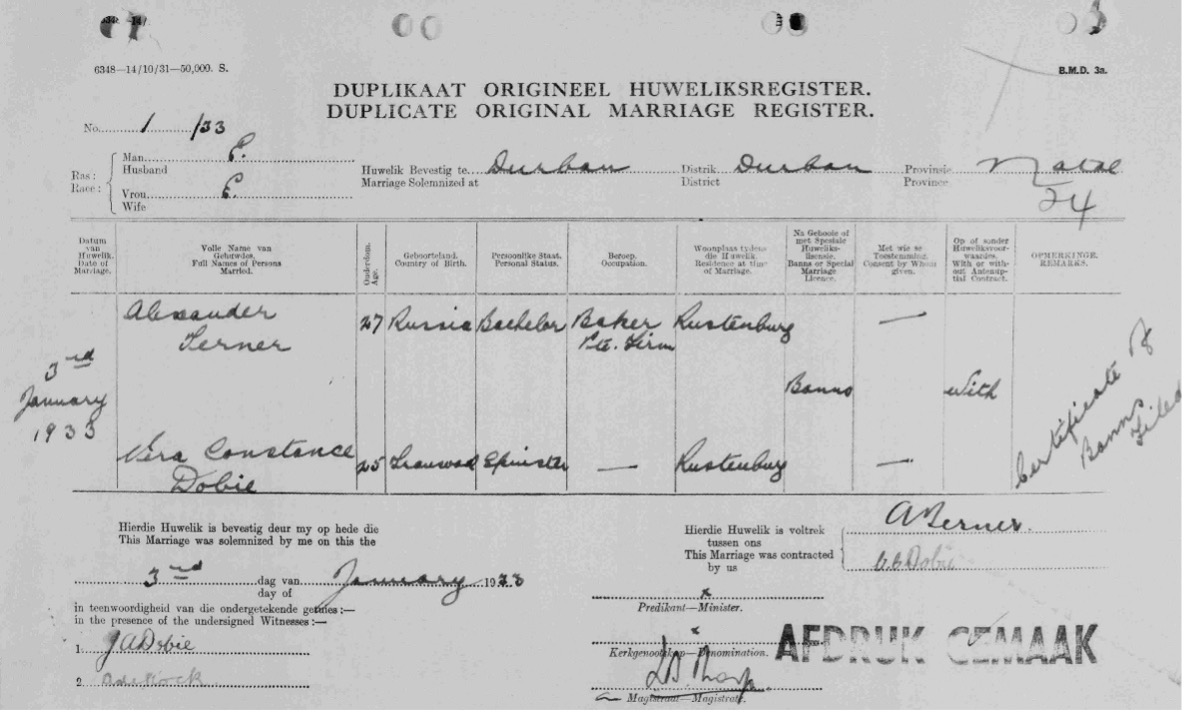
Rustenburg Herald entries:
- 1931-04-03. NOTICE. The General Dealers business carried on by J. Terner under the style of the "Rustenburg Cheap Store" on Erf No. 1056, Plein Street, Rustenburg has been transferred to Erf No. 1062 Plein Street, Rustenburg, as from the 1st April 1931. 3 10 17.
- 1932-07-29. The death took place at Rustenburg on the 18th of July of Mr. J. Terner. The deceased gentleman was 63 years.
- 1933-01-06. On the 3rd of January at Durban the marriage took place of Miss Vera Dobie to Mr. Alec Terner, both well known in Rustenburg. Hearty congratulations.
- 1933-08-04. Sincere sympathy is expressed with Mr. and Mrs Alex Terner, on the death of Mr. Terner's mother at Johannesburg last night.
Weinstock - Gutkin family
Solomon 'Solly' Weinstock (1910 Latvia - 21 June 1991 Johannesburg) was the son of Chaim Weinstock (1877 - 19 July 1960 Rustenburg) and Brocha Weinstock née Druian (1878 - 9 January 1963 Johannesburg) of Zilupe, Latvia. He emigrated to South Africa and settled in Rustenburg, where he was employed by Moses Fleischman. In 1932 during the trial of Mr Nicolaas Biakovich (1875 Yugoslavia – 8 July 1943 Nigel), who was accused of burning down the Rustenburg Town Hall, Solly Weinstock gave evidence that the accused purchased a gallon tin of paraffin from him on the 31 December 1931. Moses Fleischman also gave corroborative evidence during the trial. Solly subsequently left the employee of Moses Fleischman and by 1937 he and Jacob Finkel were trading as Weinstock and Finkel, a general dealership in Plein Street.
Solly's wife, Dinah Ella Gutkin (14 January 1911 Latvia – 30 May 2006 Johannesburg), was the eldest child of Reuvin and Chaia Tzirli Gutkin. She had 4 siblings, Izrail born 1912, Zalel born 1914, Icik born 1916 and a sister Zajuda born in 1919. Her father was a tailor and the family lived in Rezekne. In 1921 her father applied for an internal passport book for the family. In 1938 Dinah bade farewell to her family and travelled to South Africa to marry Solly Weinstock. Their marriage took place on the 12 July 1938 in Johannesburg. The newlyweds lived in Rustenburg and they had 3 daughters, Yona 'Thelma' Wiseman, Hilda Bresgi and Rosalyn Oster (1950-2017). During World War Two, Dinah's family disappeared. Her mother was reported murdered in 1941 but the location of her death was unknown.

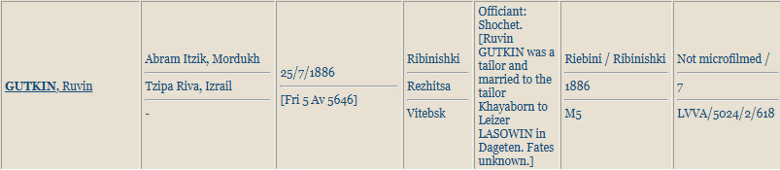
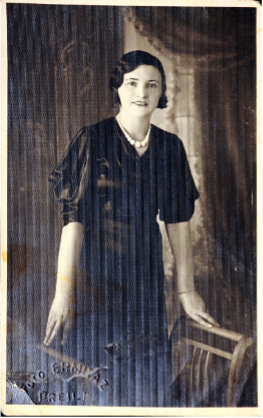
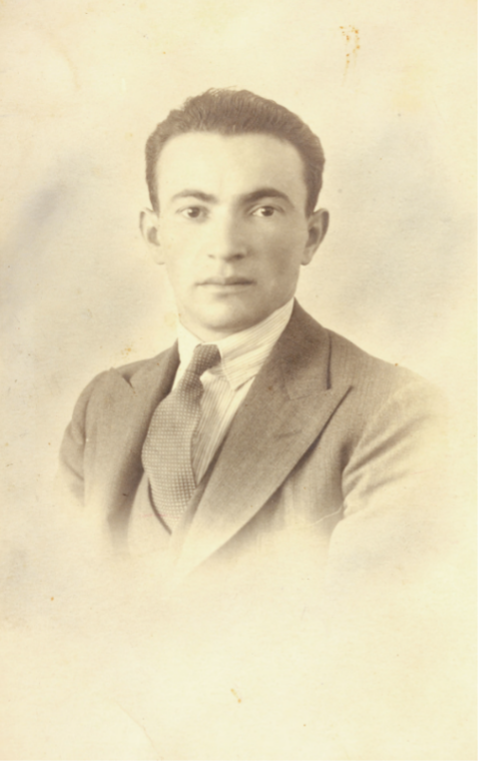
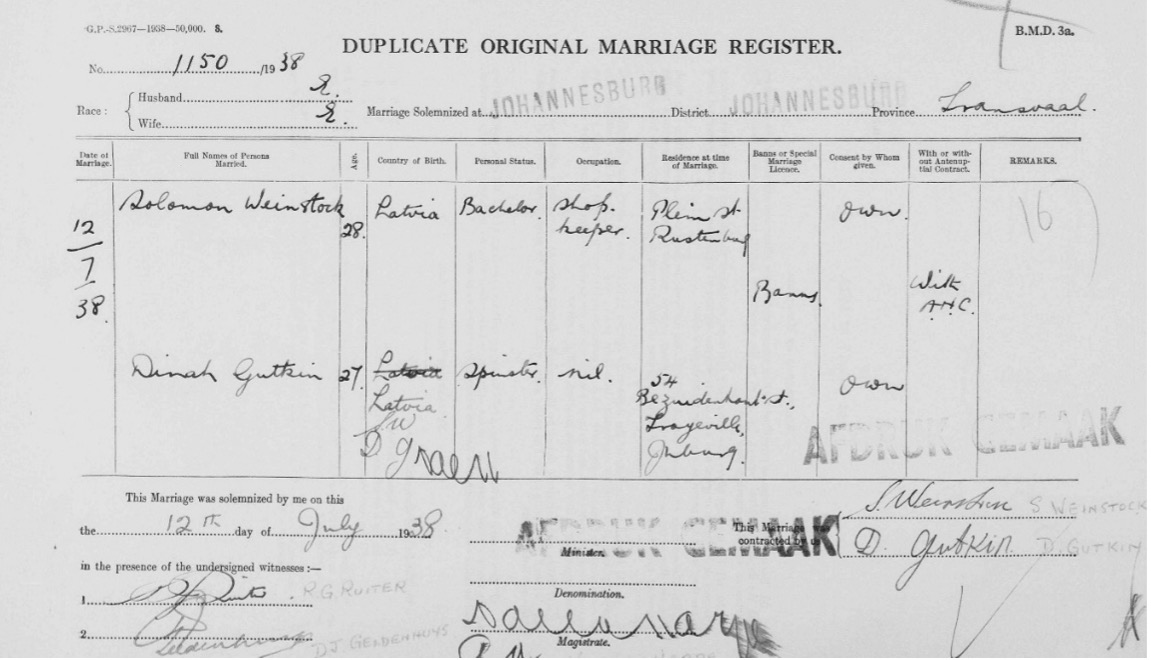
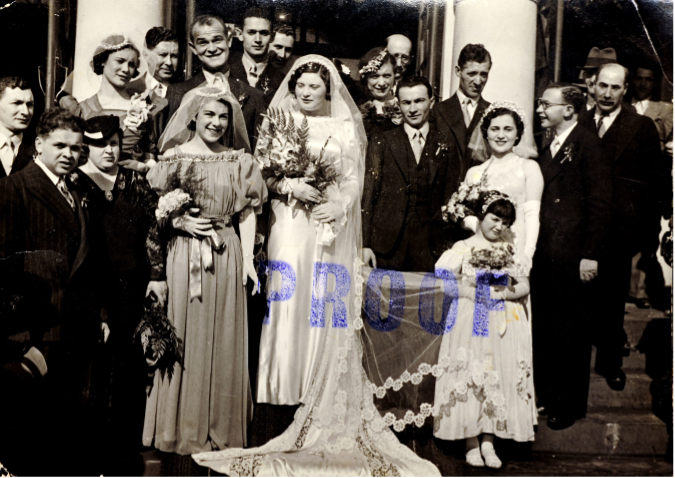
The Weinstock daughters attended Rustenburg High School. The family were active members of the Rustenburg Hebrew Congregation and Dinah was involved in the Rustenburg Women's Zionist Society.
Solly's parents emigrated to South Africa and joined the family in Rustenburg. Chaim Weinstock died in Rustenburg in 1960 and was buried in the Old Cemetery. Solly's mother, Brocha, died 3 years later and was buried in West Park Cemetery, Johannesburg. After their 3 daughters left Rustenburg, Solly and Dinah settled in Johannesburg. Their youngest daughter, Rosalyn, married fellow Rustenburger, Selwyn Oster, son of Leo and Sarah Oster, and they lived in Johannesburg. Solly and Dinah's daughter Yona Wiseman emigrated to Israel and Hilda Bresgi and her family emigrated to Canada. Solly Weinstock died in 1991 and Dinah in 2006. Both were buried in West Park Cemetery. In 2017 Yona Wiseman donated a collection of photographs to Yad Vashem which included photographs that her mother, Dinah, had brought with her to South Africa. They were the last memories Dinah Weinstock had of her family.
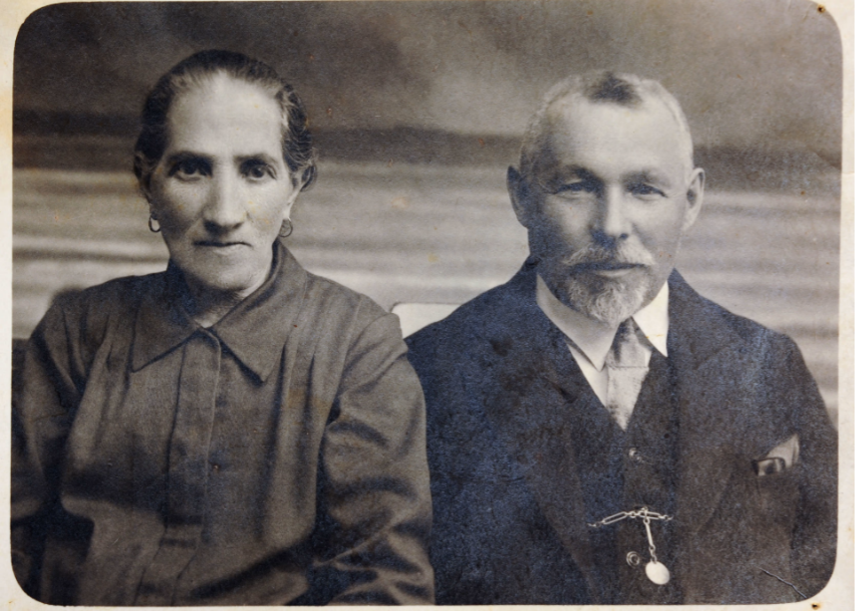
In December 2006, Yona Wiseman and a friend were travelling in a train in the Sri Lankan jungle when a tsunami struck. She managed to escape from the train and attributed her survival to her yoga training. She then had to walk barefoot through the jungle to reach safety. She related 'I didn’t mind. Even for that I was trained. As a child in Rustenburg, I always used to walk barefoot, so my soles were rock hard.'
References:
Rustenburg Herald entries:
- 1932-04-22. The Town Hall Fire. Further Sensational Details. Police Story of Trap. … More About the Paraffin. Solly Weinstock, employed in Mr. Moses Fleishman's store, stated he was in the shop on the 31st December, when the accused purchased a gallon tin of paraffin for two shillings and nine pence, He could not recollect what brand of paraffin, but it was in a tin similar to the tin produced in Court. "I have not sold any paraffin to the accused before or since," stated witness. Moses Fleischman gave corroborative evidence and stated the tin in Court had contained Atlantic Paraffin, a brand stocked by him. He was a lessee of a shop premises owned by the accused.
- 1950-07-14. Notice of intention to apply for Certificate of Naturalization as a South African Citizen. I, Solomon Weinstock, a General Dealer residing at 3 Berg Street, Rustenburg in the Province of Transvaal, hereby give notice that I intend to apply to Minister of the Interior, in terms of Section Ten of the South African Citizenship Act, 1949, for a Certificate of Naturalization as a South African citizen.
Wolpe families
The Wolpe brothers, Sydney and Nathan Wolpe, Lithuanian emigrants, spent over 60 years in Rustenburg. They settled in Rustenburg in the mid-1930s. In 1936 they partnered with Louis Friedman and Max Mendelsohn in the purchase of a butchery in Kroondal, near Rustenburg Platinum Mine, where they traded as Platinum Mine Supply Stores. They also purchased Western Wholesalers at Bleskop, district Rustenburg, and in 1948 the two businesses were renamed Western Trading Company. Their partners in this venture were Daniel Wolf Herson (1899-1967) and Max Mendelsohn.
Sydney Wolpe (1912 Lithuania – 30 August 1996) married Sylvia Mofsowitz (1917-1987) on 29 November 1936 in Boksburg. At that time he was working as a storekeeper at Millsite, Krugersdorp. They had 3 children – 2 sons and a daughter, Pamella. Their infant son Alan Wolpe died in 1955 at the age of 8 months and is buried in the Rustenburg Cemetery. Sylvia was a member of the Rustenburg Women's Zionist Society. She died in 1987 aged 70 and Sydney in 1996 aged 83. Both are buried in the Rustenburg New Cemetery.
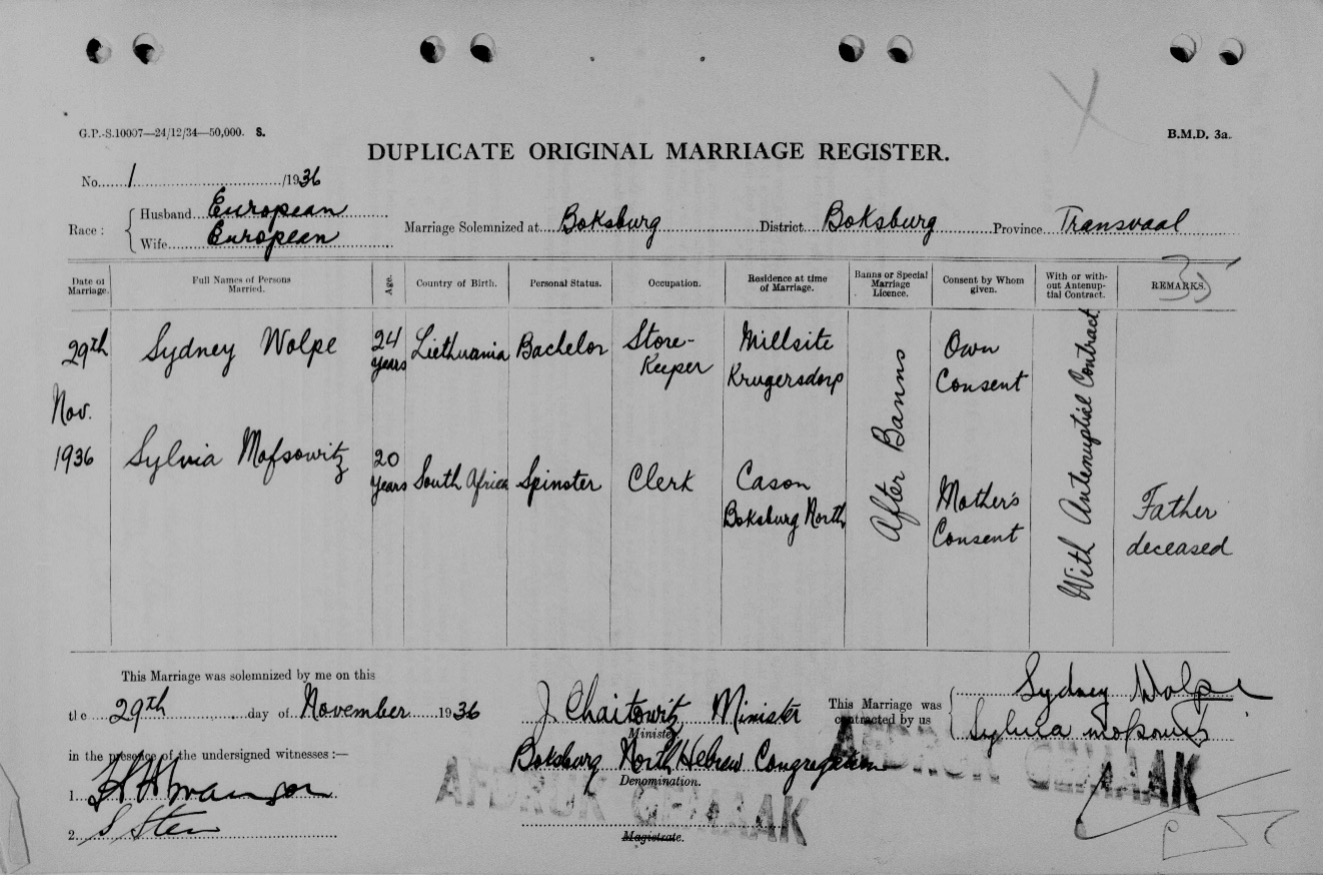
Nathan 'Natie' Wolpe (1913 Lithuania - 2001 Johannesburg) married Minnie Prag (1914 Germiston - 1997 Johannesburg), daughter of Barnett and Rachel Prag of Germiston. They had 3 sons, Russell, Cecil and Leon Wolpe. They were active members of the Rustenburg Hebrew Congregation and Minnie was a member of the Rustenburg Women's Zionist Society. Natie went into the motor trade, running Wolpe's Motors. His son Leon remained in the motor trade and traded as Leon's Rustenburg. In their later years, Natie and Minnie retired to Johannesburg. They lived into their eighties and are buried next to one another in West Park Cemetery. Their son Russell is a chartered accountant and is a masters swimmer and previous Comrades runner.
Rustenburg Herald entries:
- 1936-07-16. Business Registration. Butchers Business now carried on by Friedrich Georg Karl Behrens on Lot 69 Kroondal No 177 Rustenburg (near to Rustenburg Platinum Mine) by the said A. W.T. Behrens and F.G.K. Behrens to Louis Friedman, Max Mendelsohn, Sidney Wolpe and Nathan Wolpe trading as PLATINUM MINE SUPPLY STORES. Rustenburg, 1st July 1936, Penzhorn Olivier & Coetsee, Box 55, Rustenburg Attorneys for Parties.
- 1946-06-28. Mr. and Mrs. Nathan Wolpe, a bonny son on Sunday 23rd June. Thanks to doctor and Sister Wyman.
- 1945-07-20. Mrs Mendelsohn and her son are on a visit to Rustenburg and are staying with Mrs. S. Wolpe.
- 1948-01-16. Notice is hereby given that the Businesses of General Dealers, Butchers, and Dealers in Patent Medicines carried on under the name and style of PLATINUM SUPPLY STORES and the Business of Wholesale Merchants carried on under the name and style of WESTERN WHOLESALERS at BLESKOP, district Rustenburg by SIDNEY WOLPE, NATHAN WOLPE, DANIEL WOLF HERSON and MAX MENDELSOHN will as and from the 1st day of January, 1918 be carried on by the same parties at the same place under the name and style of WESTERN TRADING COMPANY. Penzhorn, Olivier & Coetsee, Attorneys for Parties, Steen Street, P O Box 55, Rustenburg.
Wulfsohn family
Abel (Avraham Abba) and Zensa Wulfsohn of Žeimelis, Lithuania, had 5 sons and 3 daughters. Their sons were Moses Simon Wulfsohn (1873-1930), Solem Elias Wulfsohn (1874-1950), Abraham Herman Wulfsohn (1880-1934), Philip Wulfsohn (1880-1956) and Hyman Ber Wulfsohn (1882-1952). Their daughters were Sheina Rachel Joffe (1870-1933), Mrs Ruttenburg, who emigrated to the USA, and Mrs Fleischman, who remained in Lithuania. The Wulfsohn family lived on a farm near the village of Žeimelis, where the prime activity was the rearing and purchasing of horses suitable for working as pit ponies in the British coal-mining industry.
Philip Wulfsohn, aged 17, was the first to emigrate to South Africa and arrived in Rustenburg in 1897. He wrote to his family and encouraged his siblings to join him. He was joined by his brothers in 1899. His older sister, Sheina Rachel Joffe, and her family, as well as the 2 sons and a daughter of his sister, Mrs Fleischman, all emigrated to South Africa. By 1907 Moses Simon, Solem Elias, Abraham Herman and Philip had been naturalized. Philip was the first to get married in 1908 aged 28, followed by Moses Simon in 1914 aged 39, Abraham Herman in 1918 aged 36, and Solem Elias in 1928, aged 53. Solem's marriage was the only one officiated in Rustenburg. Hyman Ber Wulfsohn married soon afterwards, in his late forties. He and his niece Sarah Fleischman were married in Lourenco Marques, Portuguese East Africa.
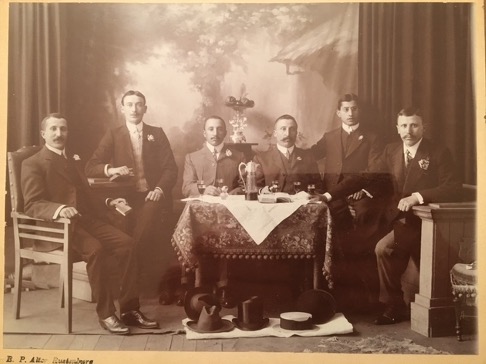
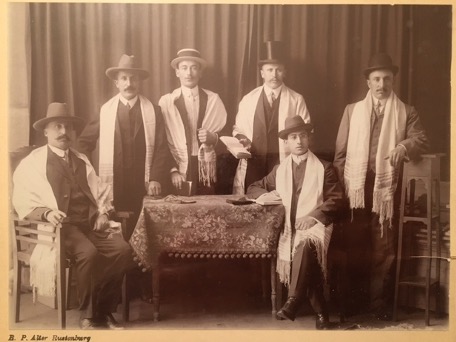
The Wulfsohn brothers prospered in Rustenburg. They donated ground for the synagogue in memory of their parents, Abel and Zensa. The site was situated on Erf no. 1083 on the corner of van Staden and Wolmarans Street. At the time, Abraham Herman Wulfsohn served as President of the Rustenburg Hebrew Congregation and he and his 2 brothers, Moses Wulfsohn and Philip Wulfsohn, served on the committee responsible for the erection of the synagogue. On the 9 April 1924 the synagogue was officially opened by Chief Rabbi Dr Landau. The Wulfsohn brothers were active in the congregation and on the High Holy holidays of Rosh Hashanah and Yom Kippur, Abraham Herman was Baal Tefillah, Moses was Chazan and Hyman sang in the choir.
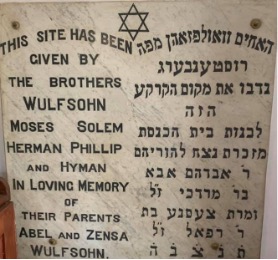
1. Moses Simon Wulfsohn
(1873 Gruzd (Gruzdžiai), Lithuania - 4 January 1930 Pretoria)
He was the eldest son and was naturalized in 1907. On 15 March 1914 he married Flora Mannheim (1889 Liverpool, England - 18 May 1936 Rustenburg) in Volksrust, Transvaal. Their ceremony was officiated by Reverend N. M. Rabinowitz, who had served as the first minister of the Rustenburg Jewish community. The Wulfsohns had four children, Pearl Cecilia Shulkin née Wulfsohn born 1915, Harry Asher Wulfsohn born 18 December 1916, Aubrey Wulfsohn born 6 April 1920 and Lazer Mendel Selwyn Wulfsohn born 2 May 1924. The family lived at Erf no. 980, Zendeling Street. Flora Wulfsohn had the distinction of being the first woman in Rustenburg to own a car. Moses leased land from the Batgatla tribe and set up a trading store, Mabieskraal Cash Store, on the farm Mabieskraal, No. 620, Rustenburg. His customers were local tribesmen and white farmers in the area. He and his brother Solem purchased the farm Witkleifontein, No. 20 Portion A. He had shares in the farm Syferfontein No. 625 as well as in numerous stands in Rustenburg. Moses Wulfsohn spent most of his time at Mabieskraal and travelled to Rustenburg every month or so to visit his wife and family. He would come to Rustenburg every Rosh Hashanah and Yom Kippur and served as the Chazan of the congregation. He died on the 3 January 1930 at the age of 56 years in Pretoria. He was buried in the Rustenburg Old Cemetery. At the time of his death, his children were still minors, ranging in age from 5 to 15 years. In 1935, his daughter, Pearl, opened a kindergarten at the family residence. A year later his wife, Flora, died, aged 47. The Wulfsohn children remained in the family home in Zendeling Street.
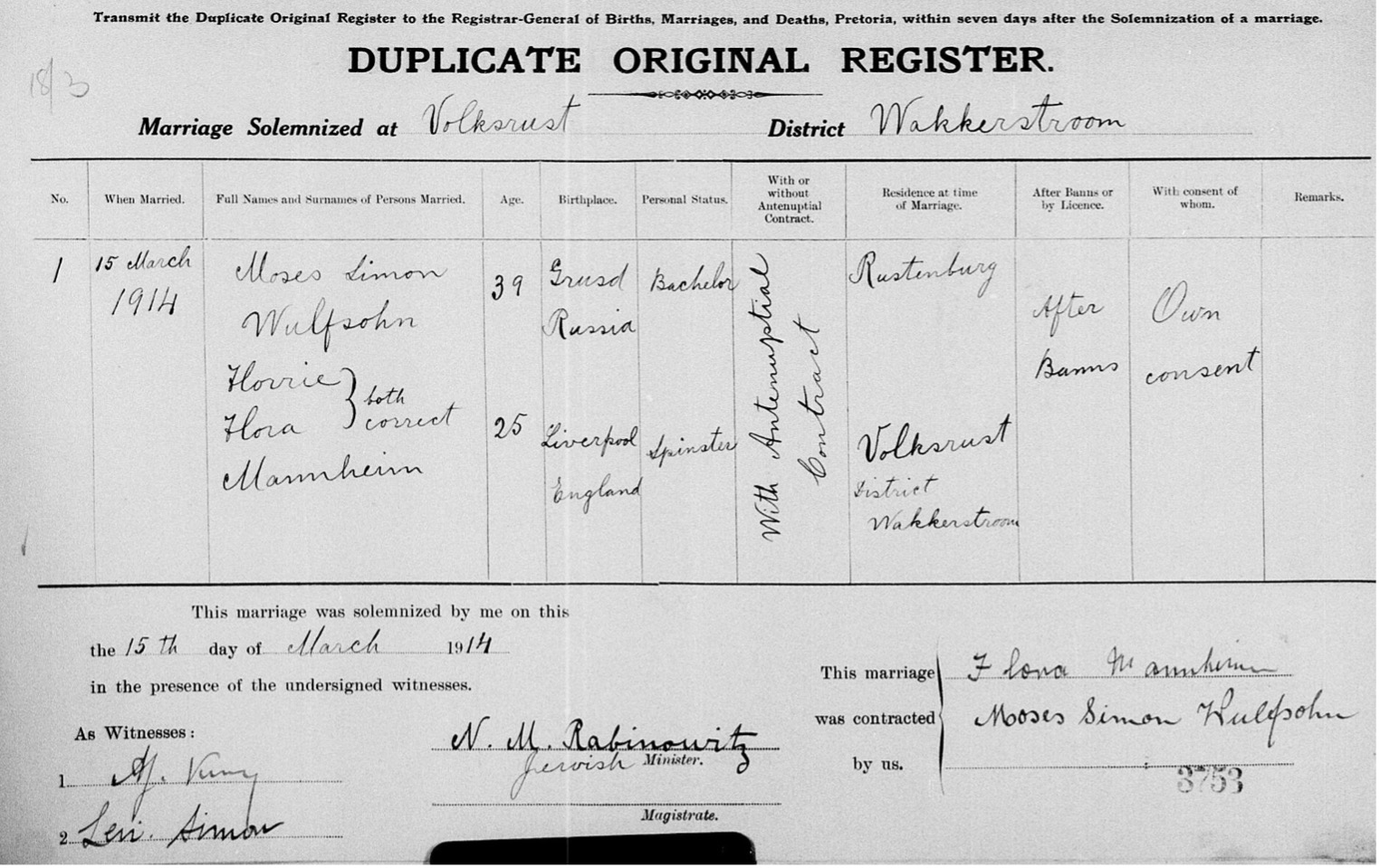
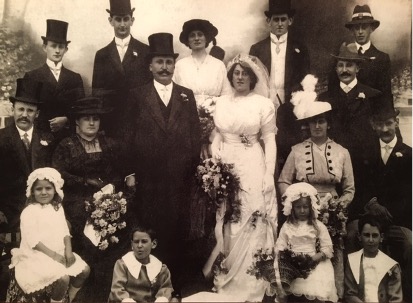
In 1937 Pearl Wulfsohn married Cemach Shulkin, a Rustenburg storekeeper. They were married on the 19 September 1937 in Johannesburg. Shulkin's family lived in Šeduva, Lithuania, where Pearl's paternal aunt, Mrs Fleischman, also lived. Cemach Shulkin was the only family member to emigrate to South Africa. His father, Eliash Shulkin, died at the age of 37 years and his mother, Hanna Shulkin née Behr (1885-1941), a grocer in Šeduva, perished in the Holocaust.
The four Wulfsohn children all left Rustenburg, initially for Johannesburg. Pearl Shulkin died in Johannesburg on the 2 August 1985, Harry Asher Wulfsohn died in Johannesburg on the 11 December 1983, Aubrey Wulfsohn died in Melbourne, Australia, on 22 December 2007 and Selwyn Wulfsohn died on the 23 July 1991 in Harare, Zimbabwe.
2. Solem Elias Wulfsohn
(1874 Lithuania – 20 July 1950 Rustenburg)
In 1899 Solem went to Rustenburg and left soon afterwards for the Cape Colony. After spending a few years in Cape Town, he returned to Rustenburg and in 1907 he was naturalized in the Transvaal. In 1928, at the age of 53, he married Lina Dörge (24 May 1895 Hornburg, Germany – 25 February 1978 Rustenburg) in Rustenburg. She had worked as a nurse in German military hospitals during World War One. She emigrated to Rustenburg from Germany and worked as an au pair for Florrie Wulfsohn. Solem and Lina had three children. Abraham Karl was born on the 21 September 1928, Simon was born on 20 January 1930, and Zesne Rieta 'Rita' was born on the 4 January 1932. Solem was in business with his younger brother, Herman, and they traded as Wulfsohn Brothers, in hardware and agricultural supplies. Besides his business in town, Solem had farming interests in the bushveld. All his children lived in Rustenburg.
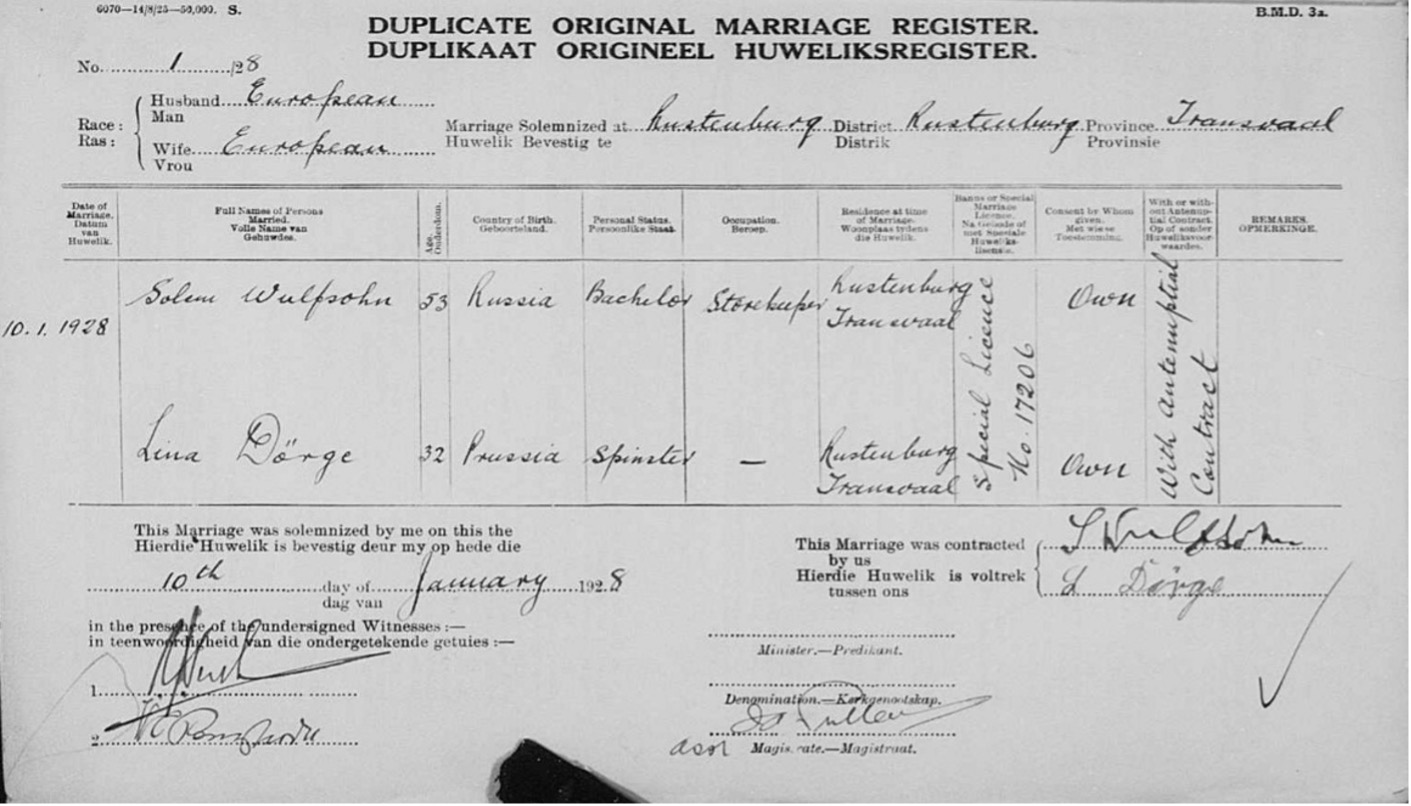
- Karl Wulfsohn married Christina Kock (b. 1929 Rustenburg) on the 28 February 1953 in Rustenburg. They had two children, a son and daughter. Their son, Michael Wulfsohn (1954-1973), died at the age of 19 whilst serving in the South African Army.
- Simon Wulfsohn married Josephine Aske on the 4 January 1958 in Rustenburg.
- Rita Wulfsohn (4 January 1932 Rustenburg - 22 February 2025 Rustenburg) was named after her paternal grandmother. She married Paul Sonnenberg (1923-1999) on the 20 September 1953 in Johannesburg. They lived in Rustenburg and had 2 sons, David and Trevor. The family were active members of the Rustenburg Hebrew Congregation. Rita taught dancing to numerous generations of Rustenburgers and was involved in organisng and training the Jewish community's children whenever they performed at communal functions. She belonged to the Rustenburg Women's Zionist Society. In 2009 Rita had the distinction as the only Wulfsohn descendant living in Rustenburg. She died in 2025 and is buried in the Rustenburg New Cemetery.
3. Abraham Herman Wulfsohn
(April 1880 Žagarė, Lithuania - 18 May 1934 Johannesburg)
Known as Herman, he was the third son and was credited as being the brightest of the 5 sons. He was sent to Doncaster, England, to work for Shapiro Sons & Co., importers of horses and pit ponies, and apparently influenced his employers to import ponies from the family farm in Žeimelis, Lithuania. Herman emigrated to South Africa in 1899 and initially worked for jewelers in Johannesburg. When he married Norina 'Nora' Gillis (12 June 1895 Oudtshoorn - 10 March 1976 Durban) on the 28 July 1918 in Oudtshoorn, he was resident in Oudtshoorn. She was the daughter of an ostrich feather dealer, Solomon Gillis (1857-1904) and Augusta Gillis née Sandman (1858-1960) of Oudtshoorn, and was one of 10 children. The newlyweds moved to Rustenburg and Herman joined his brother Solem in setting up the hardware store, Wulfsohn Brothers. Herman and Nora Wulfsohn had 4 children, Zelda Sonia Wulfsohn born on 8 March 1920, Stanley Wulfsohn born 29 October 1921, Allan Wulfsohn born 13 February 1923 and Jesmond Montague Wulfsohn, known as Tookie, born 10 June 1925. Norina Wulfsohn's two younger sisters, Lily Gillis and Ethel Gillis, left Oudtshoorn and joined her in Rustenburg, where they met their respective husbands, Isador Lederman and Harry Gawron, both local storekeepers.
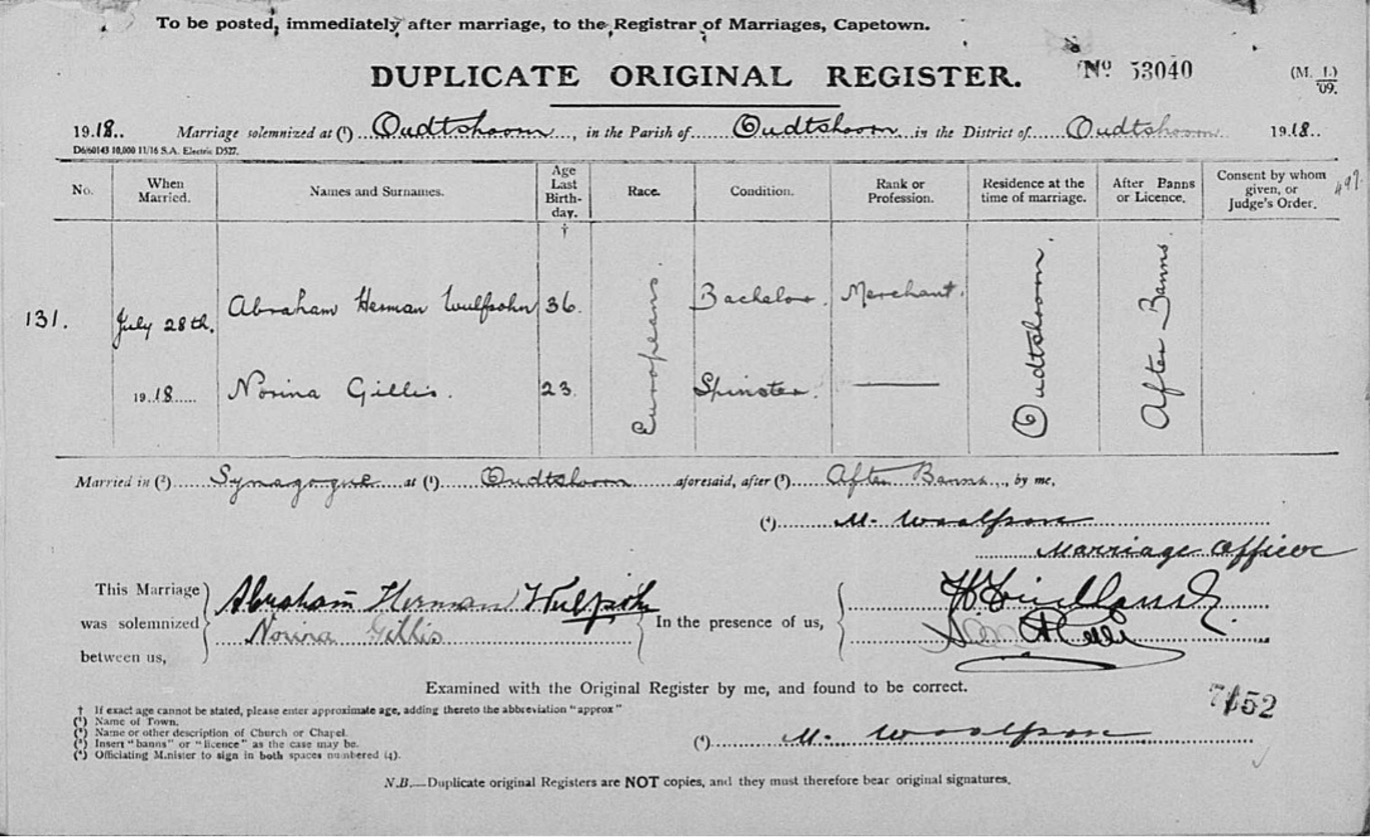
Herman was active in civic and Jewish communal affairs. He served as a Town Councillor during the late 1920s and early 1930s and was Chairman of the Rustenburg Chamber of Commerce. He was one of the prime movers in the establishment of the Paul Kruger Memorial Hospital as well as the original hospital situated at the corner of Marais and Kerk Streets. In March 1923 he was appointed President of the Rustenburg Zionist Society. He was President of the Rustenburg Hebrew Congregation and laid the foundation stone in memory of his parents at the inauguration of the synagogue in 1924. During the High Holy Days, he was Baal Tefillah.
Herman amassed a considerable amount of property in Rustenburg and was a shareholder in numerous farms with his brothers. The Rustenburg properties included erven 71 and 72 Church Street, 87 Plein Street, 1053 and 1059 Plein Street. The farms were Zwartkop No. 531, Potchefstroom No 94, Blinkpan No. 998, Mabieskraal Cash Store, Saulspoort Stores, Tweerivier No. 594, Mackayskraal No. 1018, Tusschenkomst No. 287, Witkleifontein No. 20, Hoylesdale No. 196 and Cyferfontein. In 1934 Herman suffered a heart attack whilst attending a wedding in Johannesburg and was taken to the Joubert Park Nursing Home, where he died. His body was brought back to Rustenburg for burial in the Old Cemetery. Following his demise, his wife left Rustenburg and settled in Durban where their daughter Zelda and son Jesmond lived. Their son Allan was a doctor and lived with his family in Johannesburg.
4. Philip Wulfsohn
(1880 Kovno, Lithuania – 5 March 1956 Johannesburg)
5. Hyman Ber Wulfsohn
(1882 Lithuania - 23 September 1952 Rustenburg)
Known as Chaim Ber, he was the youngest child. He married his sister's daughter, Sarah Hoda Fleischman (1904 Lithuania – 10 August 1952 Rustenburg), child of Mr and Mrs Noach Fleischman, who lived in Šeduva, Lithuania. They were married in Lourenco Marques, Portuguese East Africa in the late 1920s. They had 5 children, who were all born in Rustenburg - Jeanette Lack née Wulfsohn (4 April 1930 - 26 June 1995 Johannesburg), who was named after her paternal grandmother Chesna, Abraham (Abe) Wulfsohn (2 March 1931 - 28 March 2002 Pretoria), Minyon Wulfsohn (d. 1985 Potchefstroom), Rose Berger née Wulfsohn (26 August 1934 - 26 September 2023 Johannesburg) and Helene Wulfsohn (8 September 1940 - 1 January 2013 Springs).
The family lived at 49 Heystek Street. Hyman was involved in business with his brothers and was a shareholder of the farms Mackayskraal No. 1018 and Tusschenkomst No. 287. He was a livestock speculator and used his farms to feed cattle whilst waiting to resell them to farmers. Hyman and Sarah Wulfsohn died a few weeks apart in 1952. The year prior to their death, their eldest daughter, Jeanette, married Leonard Mostyn Lack (1923-2004), a farmer from Belfast, on the 28 November 1951 in Johannesburg. All the Wulfsohn children left Rustenburg, except Abe, who subsequently moved to Pretoria. Jeanette Lack and her family lived in Belfast, Transvaal. Mignon lived in Potchefstroom. Rose Berger left Rustenburg in 1952 when she finished school and settled in Johannesburg. Helene Wulfsohn lived on the East Rand. All the Wulfsohn children are buried in West Park Cemetery, Johannesburg, except for Mignon, who is buried in Potchefstroom.
6. Sheina Rachel Joffe née Wulfsohn
(1870 Lithuania – 10 August 1933 Rustenburg)
Known as Rachel, she was older than her 5 brothers. She married Shleima Zalmen Joffe (1875 Lithuania – 1948 Johannesburg) in Lithuania and the family emigrated to South Africa. They lived in Doornfontein, Johannesburg. She suffered from valvular heart disease and died in Rustenburg at the age of 63. The informant of her death was her brother Abraham Herman. She was buried in the Rustenburg Cemetery. She was survived by her husband, sons and relatives.
Back row: S. Isaacs, H. Gawron, M. Wulfsohn, F. Sholomir.
Front row: M. Sholomir, N. Kirsch, B. Harris, Chief Rabbi Dr. Landau, H. Wulfsohn, Rev. D. Leibovitz, M. Kadey, P. Wulfsohn, S. Mundel.
7. Fleischman family
The siblings Isaac Fleischman alias Raphael Isaac Fleischman (1893 Šeduva, Lithuania - 22 June 1959 Rustenburg), Moses Fleischman and Sarah Hoda Wulfsohn née Fleischman (1904 Lithuania - 10 August 1952 Rustenburg), children of Mr and Mrs Noach Fleischman of Šeduva, Lithuania, settled in Rustenburg. The Fleischman brothers were bachelors and their sister was married to their maternal uncle, Hyman Ber Wulfsohn. Isaac Fleischman lived at 5 van Zyl Street and owned the business R. I. Fleischman on the corner of van Zyl and Leyd Streets. In 1950 the two brothers applied for a licence to trade as Fleischman Bros, produce buyers, dealing in hides, skins, bones, horns, etc., on Stand no. 1693, in the Rustenburg Industrial Area. The Fleischman siblings Sarah Wulfsohn died in 1952 aged 48 and Isaac on the 22 June 1959 aged 66. They were buried in the Old Cemetery. Moses Fleischman died on the 13 July 1979 and was buried in the New Cemetery.
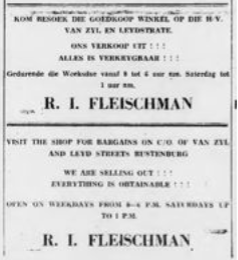
OPEN ON WEEKDAYS FROM 8 - 6 P.M. SATURDAYS UP TO 1 P.M.
R. I. FLEISCHMAN
Advert, Rustenburg Herald.
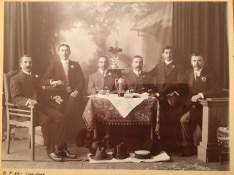 This article was printed in the Rustenburg Herald in the 1970s with the accompanying photograph. |
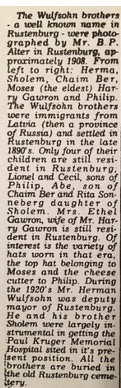 |
References:
- Zeimelis (Zheimel in Yiddish) is a small town in northern Lithuania, near the border with Latvia. It is likely that the local Jewish Community was established in Zeimelis in the 17th century. The Jews of Zeimelis made their living from commerce and agriculture. Almost every family had an auxiliary farm near their home. At the end of the 19th century the Jewish community was at its largest; in 1897 there were 679 Jewish residents comprising 54% of the town. After World War I, Zeimelis was cut off from its rural hinterland, which was incorporated into Latvia. This led to the decline of the fortunes of the Zeimelis Jews, and many emigrated to South Africa, the United States, and Israel.
- JewishGen. Lithuania Taxpayers and Voters. Fleyshman Ayzik, son of Noakh, had postal savings. He was born 1893/August/25, lives at Keydanskaya street, at private house, father - Noakh, son of Ayzik, deposited 1 ruble. Bank records 10 August 1894 Šeduva, Siauliai, Kaunas.
Rustenburg Herald entries:
- 1930-01-10. The late Moses S. Wulfsohn. We regret to have to record the death of Mr Moses Simon Wulfsohn which took place at Johannesburg on Friday night last. The deceased gentleman was 57 years old and came to South Africa in 1899 and for many years and up to the time of his demise was a respected merchant in this district. The funeral took place on Sunday and was largely attended by relatives and friends, testifying to the high esteem in which he was held. Mr Wulfsohn leaves a widow and four children and to them and the other members of the family sincere sympathy is tendered.
- 1930-02-07. The Rustenburg Chamber of Commerce was again brought into being and it was decided that it shall in future take an active part in the affairs of the town. The following gentlemen were elected as a Committee and as they are all well-known business men, a forward policy may be anticipated: - Mr. Herman Wulfsohn (Chairman), Messrs. S. Lipman, Philip Wulfsohn and Harry Gawron, with Mr. Felix Hill as Secretary.
- 1931 10-30. The Municipal Elections. Quite an amount of excitement was in evidence in connection with the Municipal election held on Wednesday. … The result was declared: Herman Wulfsohn 184, Geo. W. Dobie 104. Ward 1 was by many considered to be the dark horse and first one and then the other candidate was said to be in.
- 1934-05-04. Mr. Herman Wulfsohn, who attended the wedding of Miss Booher in Johannesburg yesterday, suffered a severe heart attack during the ceremony and was removed to the Hospital. We understand that the attack was not of a serious nature.
- 1935-03-01. Kindergarten. Miss Pearl Wulfsohn will open on 1st of February a Kindergarten at the residence of Mrs Moses Wulfsohn. Zendeling Street. Pleasant surroundings and competent teaching. Charges: - 10/6 per month. Phone 75.
- 1935-04-15. The interest of the late Abraham Herman Wulfsohn in the business of "Wulfsohn Bros.", carrying on business as General dealers on Erf 72, Rustenburg, has been sold to Solem Wulfsohn with effect as from the 15th day of April 1935. Herbert Cranko & Levitt. Attorneys for parties, Steen Street, Rustenburg.
- 1938-07-14. Aubrey, son of the late Mr. Mose Wulfsohn and of Mrs Wulfsohn will read a portion of the Law at the Rustenburg Synagogue on Saturday, 15th July, at 9 a.m. Reception after the ceremony. All relatives and friends are cordially invited, At Home. 8 30 p.m. on Saturday evening, Zendeling Street.
- 1950-06-26. TOWN COUNCIL OF RUSTENBURG APPLICATION FOR THE GRANT OF AN OFFENSIVE TRADE LICENCE. Notice is hereby given that it is the intention of the undersigned, in terms of the provisions of Section 95(1) and (3) of the Local Government Ordinance, No. 17 of 1939, as amended, to apply to the Town Council of Rustenburg for the grant of a licence to carry on the business or trade of a Produce Buyer, Dealing in Hides, Skins, Bones, Horns, etc. on Stand no. 1693, in the Rustenburg Industrial Area. The trade name, designation or style under which the business or trade will be carried on is Fleischman Bros. The full name of the person who will be in actual control of the business or trade is Raphael Isaac Fleischman and Moses Fleischman. R. I. FLEISCHMAN, MOSES FLEISCHMAN, Signature of Applicants. Postal Address. P.O. Box 195, Rustenburg. Date: 26th June 1950. Any person who desires to object to the grant of the above licence shall forward by registered post, written notice of his objection, stating the grounds thereof, to the Town Clerk, P. O. Box 16, Rustenburg, and to the applicant, within 21 days of the date stamped on top of this notice.
- 1950-07-21. Death of Mr. S. Wulfsohn. Mr. Solem E. Wulfsohn, a well-known resident of Rustenburg died suddenly yesterday morning of heart-failure. Mr. Wulfshon, who was 75 years of age, first came to Rustenburg in 1899. After spending a few years in Cape Town at the beginning of the century he returned with his brother Philip to Rustenburg where he remained ever since. As well as his business in town he had farming interests in the bushveld. He leaves a widow, a daughter, Rita and two sons, Karl and Simon. The funeral took place this (Friday) afternoon in Rustenburg.
Wulfsohn, Philip and Mary
Philip Wulfsohn (1880 Kovno, Lithuania - 5 March 1956 Johannesburg) was the 4th son of Abel and Zensa Wulfsohn of Žeimelis, Lithuania. He had 4 brothers and 3 sisters. In 1897, at the age of 17, he left Lithuania and settled in the district of Rustenburg. He set himself up in a mud hut on the banks of the Waagfontein spruit. Practically penniless, he managed to secure on credit a modest supply of goods and began trekking with a pack and donkey amongst the farmers of the district. The countryside was so wild that he had to discover his own route across the Magaliesberg at Breedt's Nek in order to get to Krugersdorp, where he replenished his stock from the local merchants. He carried on working as a smous in the area and during the Second Anglo-Boer War he required a pass. This was registered as Mr Phillip Wilson and it was signed by Rustenburg Commandant J. M. Graham on the 12 October 1900.
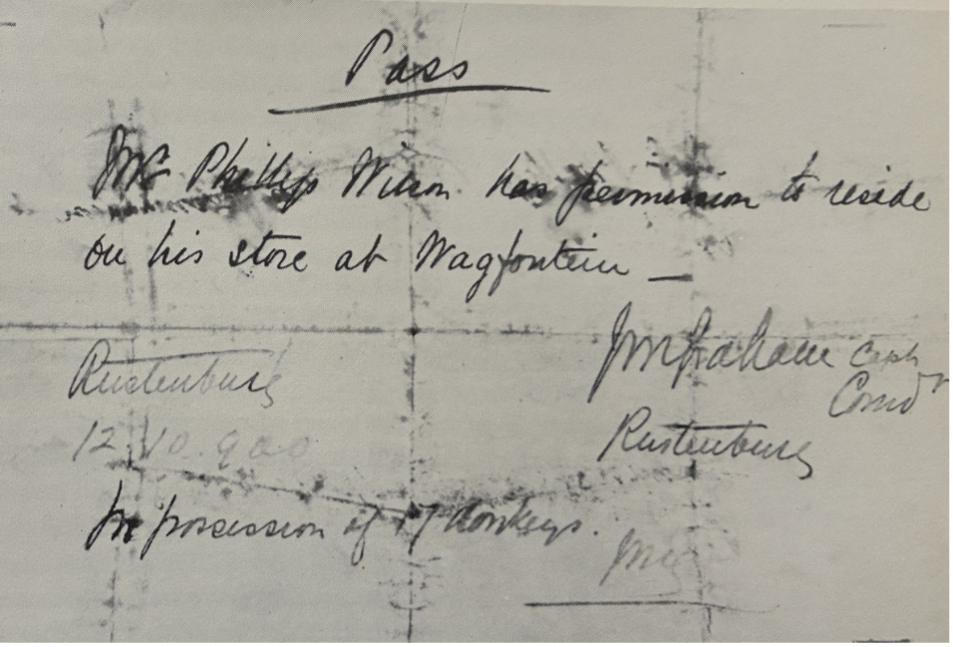
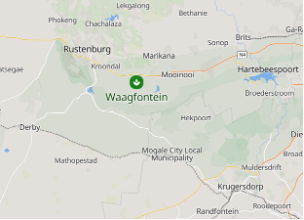
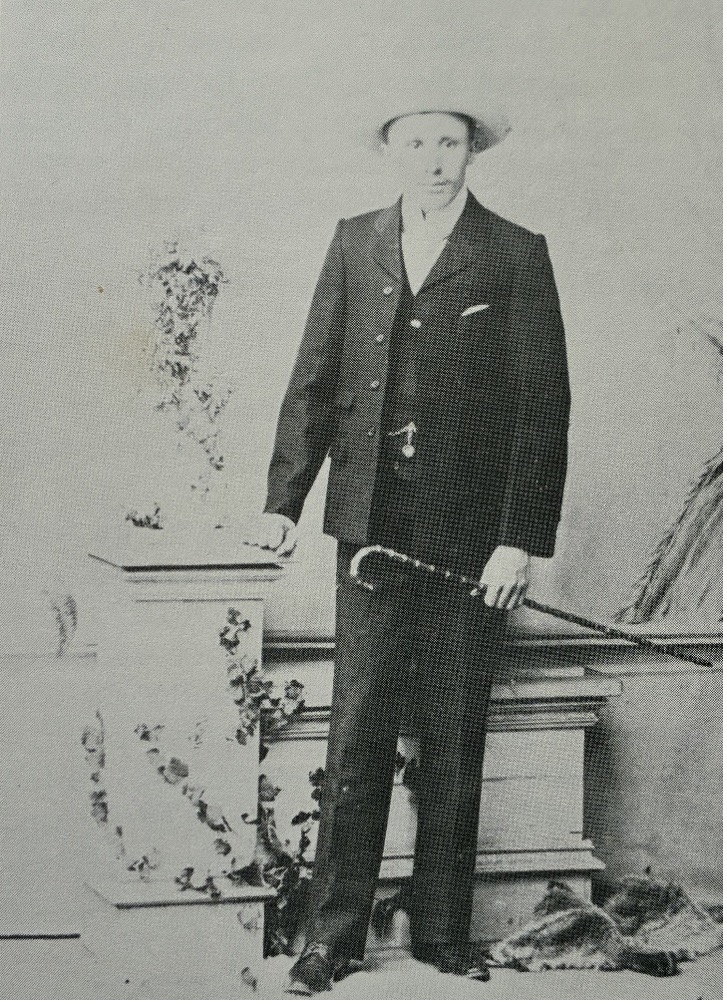
When peace returned, Philip Wulfsohn settled in Rustenburg. He married Mary Simson (1883 Frauenberg, Courland (Saldus, Latvia) – 17 July 1940 Rustenburg), daughter of Hyam Simson (1847 Tukums, Courland – 1907 Durban) and Sheina Simson née Hirschmann (1852 Frauenburg, Courland – 1924 Durban), whose family had emigrated from Courland and settled in Johannesburg. The couple were married on 12 April 1908 in Johannesburg. They had 5 children, Hettie Wulfsohn born 1909, Dorothy Wulfsohn 1911, Cecil Woolf Wulfsohn 1915, Abel Joe Wulfsohn 1917 and Lionel Mendel Wulfsohn 1919.
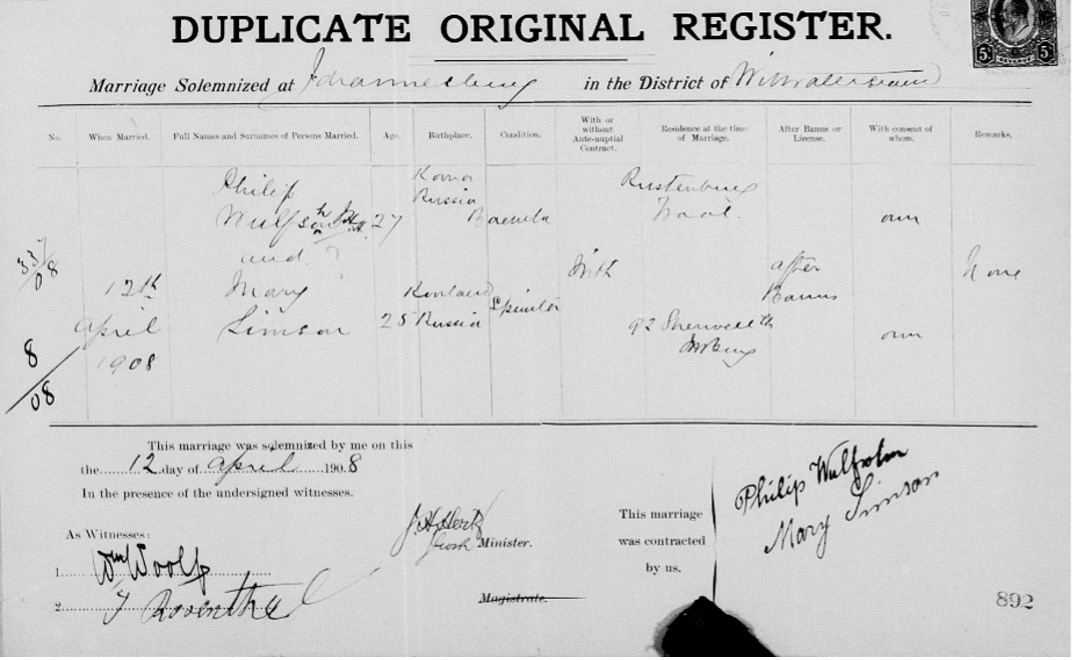
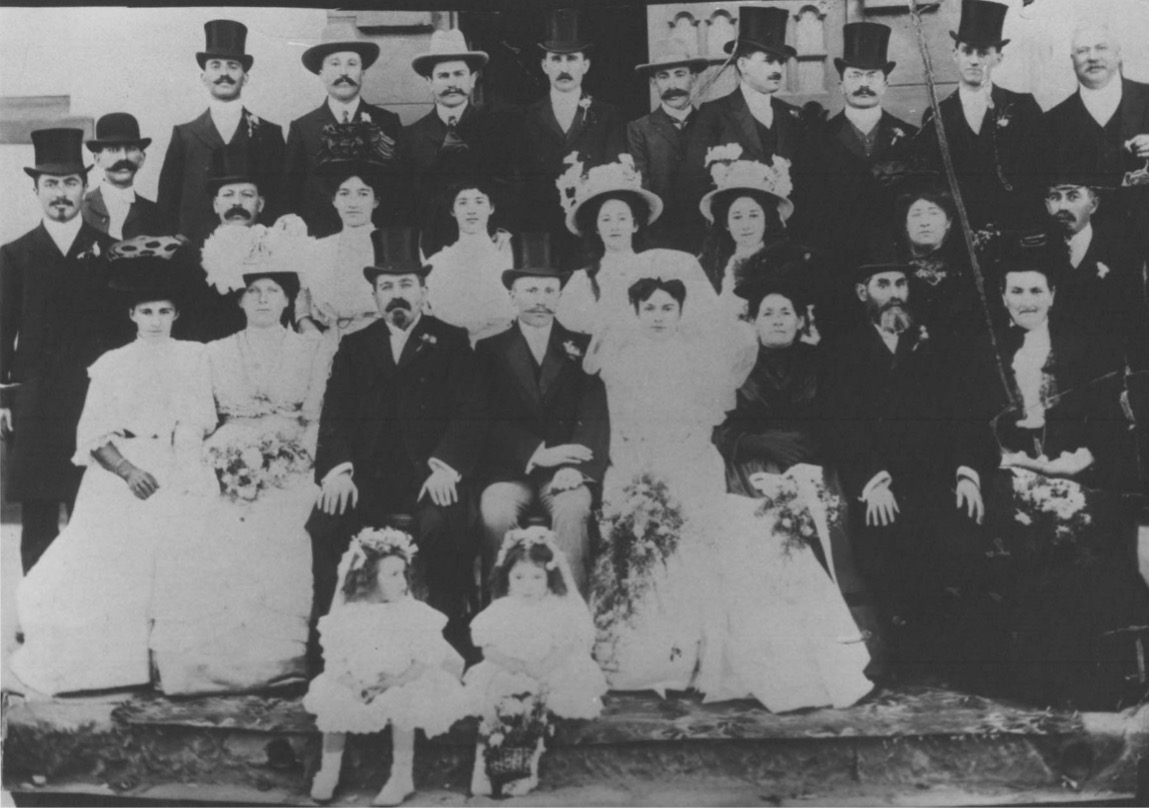
Bottom row (L-R): Sylvia Rapeport (née Simson), Judith Bertscher (née Hurwitz).
Seated 1st row (L-R): Fanny Hurwitz (née Simson), Annie Simson (née Kurlansky), Samuel Woolf Simson, Philip Wulfsohn, Mary Wulfsohn (née Simson), Sheina Simson (née Hirschman), Mr Judes, Mrs Judes.
Standing 2nd row: (L-R) Boris Hurwitz, Jacob Shapiro, Yetchen Shapiro (née Simson), Dora Jacobs (née Simson), Lena Jacobs (née Simson), unknown, unknown, unknown.
Standing 3rd row (L-R): Zacharias Simson, Solem Elias Wulfsohn, Moses Simon Wulfsohn, Morris Jacobs, Abraham Herman Wulfsohn, Chaim Ber Wulfsohn, Joseph Simson, Mr Beiles, Jacob 'Jack' Simson, unknown.
Philip Wulfsohn initially set up a general dealership, Philip Wulfsohn, in Burger Street and the family lived next to the store. As his business grew, he prospered. He built a large home for his family on the corner of 175 Wolmarans and Heysteck Streets. In 1922 the family moved into their new home, which had been built by artisans. A lot of the materials were imported and were also used to build the Shul situated opposite Wulfsohns' home.
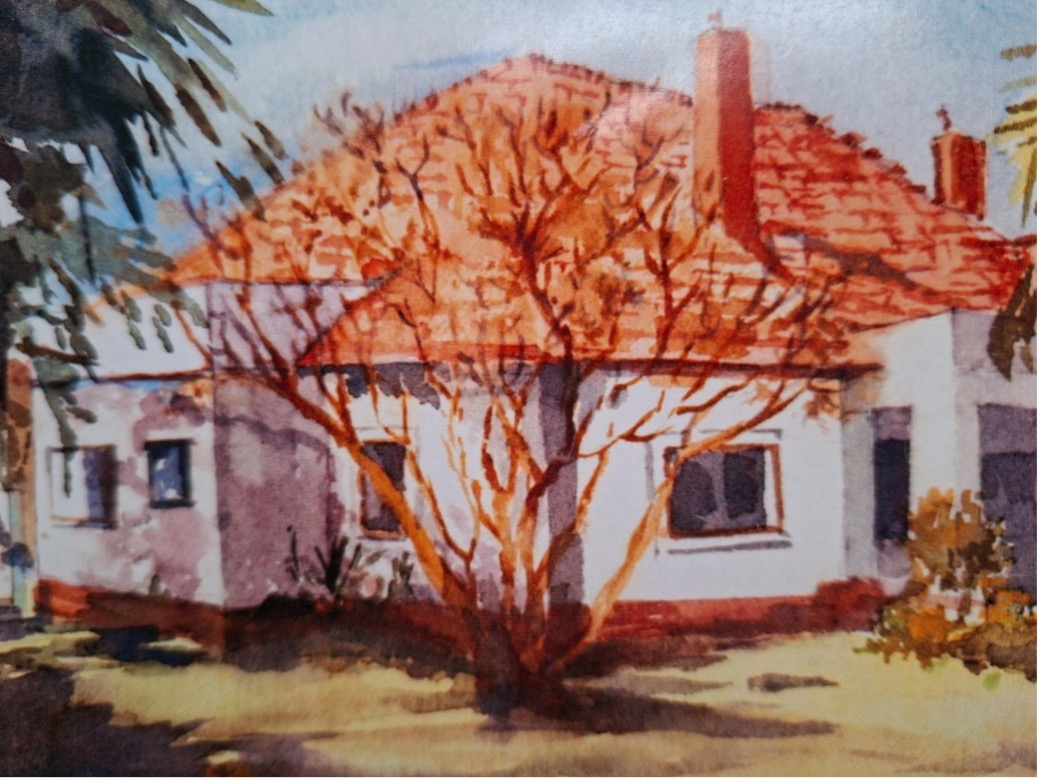
Over time, Philip Wulfsohn's business evolved into a department store, Philip Wulfsohn and Sons (Pty) Ltd. The business '… assumed the dignity of a "Departmental Store", its range of stock including farm tractors, which were now beginning to replace the traditional teams of oxen.' In December 1936 the Editor of the Rustenburg Herald wrote: 'There is not the slightest doubt that Mr. Wulfsohn was "born with the business instinct in his veins." He has built up a concern here that Rustenburg not only may well be proud of but a business that is a great pillar of support as far as the town is concerned. Under Mr. Wulfsohn's personal direction, the staff works with a will and the service cannot be improved upon.' His staff included William Rapeport (1896-1952), who served as a general manager. His sons also worked in the business as well as his wife's nephew, Leo 'Skoenie' Schumacher (1902-1975). Philip Wulfsohn was also involved in farming in the area and purchased a number of farms. He and his brothers were shareholders in numerous farms in the district.
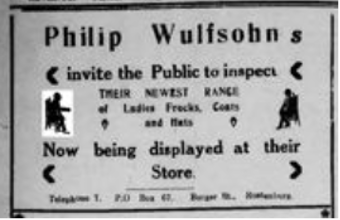
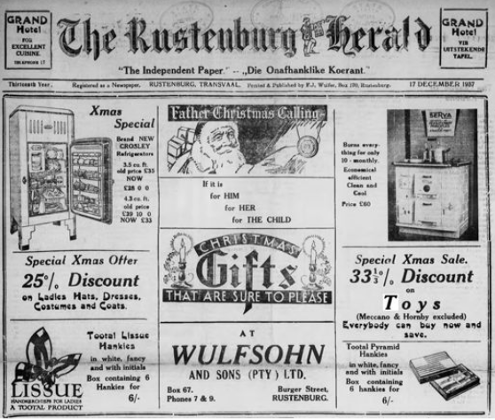
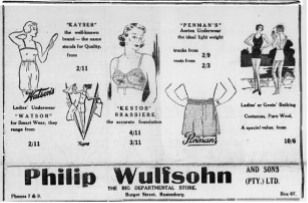
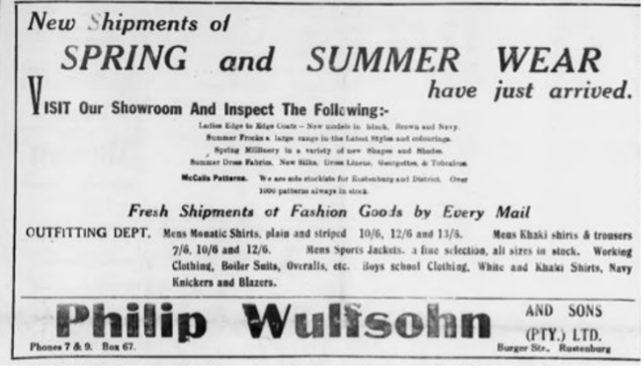
In 1940 Mary Wulfsohn died at the age of 57. Her death reported in the Rustenburg Herald reads: 'OBITUARY. Mrs Philip Wulfsohn. Just fourteen days ago Mrs Wulfsohn was obliged to keep to her bed having had a heart attack, her many friends were all hoping that she may soon recover and be strong enough to be up and about again, but on Wednesday noon she had a sudden collapse and died about 1 p.m., she was 66 years old. The funeral took place on Thursday morning. It is not only a great loss to Mr Wulfsohn, but also her two daughters and three sons have lost the help and love of a truly good mother. It was clearly shown the esteem in which the Wulfsohn family is held, by the hundreds of people that attended the burial, it was a long procession first to the Synagogue and then to her last resting place. At the Synagogue the Rev. Baron of Johannesburg held a service, Rev. Glover, of the English Church, Rustenburg, spoke very impressively at the graveside. The hundreds of wreaths which were sent were a token of the liking and respect everybody had for Mrs Wulfsohn. We also wish to express our deepest sympathy to Mr Wulfsohn and family in their great loss.'
Children:
- Hettie Broido was the eldest child and was born on the 25 January 1909. She lived to the age of 96 and died on 29 April 2006 in Jerusalem, Israel. She married Alec Broido, who came from Ladysmith, Natal. They went to Dublin, Ireland, where Alec Broido studied medicine. Their eldest daughter, Joyce, was born there in 1932. The family then returned to South Africa, where their second daughter, Sybil, was born on 30th September 1936 in Johannesburg. Their eldest daughter, Joyce, died at the age of 29 in 1961 in Johannesburg. Sybil Broido married Chaim Altman, an Israeli born in Jerusalem, and following their marriage they settled there. They had 2 children, Zvi Phillip Altman and Ronit. Sybil was very artistic and ran a florist shop in Jerusalem. She died during a visit to South Africa on 31 August 2004 at the age of 68.
- Dorothy Hellmann was born on 5 October 1911 and died shortly after celebrating her hundredth birthday on 26 October 2011 in Durban. She married Joseph 'Jos' Hellmann (1902 Lithuania – 1995 Durban) on 26 November 1933 in Pretoria. Jos was the son of a tailor from Brandfort, Orange Free State. Although he was sent to the USA to study for the rabbinate, he decided to change his career and studied dentistry at the University of Michigan, Ann Arbor, Michigan. He returned to Pretoria and following their marriage the family initially lived in Pretoria. They subsequently moved to Durban and lived in Durban North. They had 2 sons, Michael Lawrence Hellmann (1935 Pretoria - 2025 Cape Town) and Alan Julius Hellmann (1938 Pretoria - 1995 Durban). Alan left Durban and went to work for his maternal uncle, Cecil Wulfsohn, in the family business in Rustenburg. Following his marriage, Alan moved back to Durban. He was a founder of the successful superstore chain Game, which operated initially near the Durban beachfront. Alan sold his interest in the business and emigrated with his family to the USA. He subsequently returned to South Africa. He died at the age of 59. Both Hellmann sons had 2 children.
- Cecil Woolf Wulfsohn was the third child and the eldest of the sons. He was born on 20 March 1915 and died on 13 August 1984 in Johannesburg, aged 69. He was educated at Marist Brothers College, Johannesburg, and attended the University of the Witwatersrand. At the age of 22 he started flying. In 1937 he left Rustenburg to work for the Johannesburg Light Plane Club at Baragwanath.
During World War Two he served in the South African Air Force and was involved in training airmen. From 1943 he served with Royal Air Force No. 216 Squadron, based at Ramat David, British Mandate of Palestine, where he flew Dakotas. He then served with No. 28 Squadron South African Air Force. After the war, on the 26 March 1946, he established the Rustenburg Flying Club. He and Willy Rosenstein were flying instructors at the club. During the Israeli War of Independence in 1948-49 he volunteered with Machal and was instrumental in obtaining planes for the fledgling air force. He was also involved in the formation of a non-scheduled airline, 'West Air', later renamed 'Universal Airways', which was the forerunner of El Al.
He married Perla 'Pearl' Polné (1924 - 2017). She was born in Alexandria, Egypt, and moved with her family to the British Mandate of Palestine in 1947. The couple met through Cecil's close friend and flying colleague, Cecil Margo, who was married to Marguerite Polné, Perla's older sister. Pearl served in the Israeli Air Force. The couple were married on the 20 May 1954 in Johannesburg. They had 4 children, Diane Rosemary, Marie Gisele (1957-2011), Susan Elaine Phillipa and Philip Roy Wulfsohn. The children grew up in Rustenburg and lived in the family home built by their grandfather, Philip. Cecil continued to manage the family business, Philip Wulfsohn and Sons. He loved to travel and diversified his business, running a travel agency in Rustenburg. Cecil and Pearl were active members of the Jewish community. Pearl was a member of the Rustenburg Women's Zionist Society and the Union of Jewish Women. Following Cecil's death, Pearl settled in Johannesburg once all her children had left Rustenburg. Diane lived in Pretoria prior to her emigration to Atlanta, Georga, USA, Gisele lived in Johannesburg and Susan and Philip settled in Cape Town. In December 2011 Gisele, a renowned photographer, died following a battle against lung cancer. Pearl died 6 years later aged 93 and is buried next to Gisele in the West Park Cemetery. - Abel 'Abie' Joe Wulfsohn was born in 1917. He was a bachelor and lived in the Rustenburg area. He spent a lot of time on his father's farm, Mackayskraal. He died on 21 April 1978 at the age of 61.
- Lionel Mendel Wulfsohn was the youngest son. He was born on 14 January 1919 in Rustenburg and died at the age of 89 on 6 August 2009 in Plettenberg Bay. After he matriculated he joined his father's department store, where he worked as a junior clerk. During World War Two, Lionel served in the Regiment De La Rey. He fought in the North African campaign and the Italian Campaign. He was severely wounded at the Battle of Monte Stanco in northern Italy on the 13 October 1944. He was subsequently flown back to South Africa for surgical treatment. After the war, he married Maureen Ethene Flemming (1924-2013) on 18 May 1946 in Port Shepstone, Natal. The family lived in Rustenburg and had 4 children, Richard, Marilyn, Terence 'Ben' Orde (1955-2024) and Theresa. The family were involved in the Jewish community and Ethene was a member of the Rustenburg Women's Zionist Society. In 1968, following the dissolution of Philip Wulfsohn's business, Lionel and his eldest son, Richard, formed the motor company L.M. Wulfsohn Motors (Pty) Ltd. They had the Datsun / Nissan motor dealership in Rustenburg. Lionel, his wife and 2 daughters subsequently left Rustenburg and they all lived in Plettenberg Bay. His son Richard remained in Rustenburg. Terence lived in Pietermaritzburg where he practiced as a homeopath. He retired to Cape Town and died in December 2024 at the age of 69.
Lionel Wulfsohn had a great interest in military history, in particular the Anglo-Boer War. He founded the Rustenburg MOTH Shellhole and with the assistance of its members he spent all his spare time restoring military cemeteries in the Western Transvaal. He received an award from the British Commonwealth War Graves Commission for his sterling work. He wrote two books. The first, published in 1987, Rustenburg At War: The Story of Rustenburg and its Citizens in the First and Second Anglo-Boer Wars, was dedicated to the memory of his parents, pioneers of early Rustenburg. When Lionel died in 2009, he was busy writing a book about his life in Rustenburg. The Golden Years: A Memoir of Old Rustenburg was published in 2011 and was dedicated to the memory of the five men of his section of 3 Platoon "A" Company WR/DLR Regiment who died by his side at the Battle of Monte Stanco on Friday, 13 October 1944.
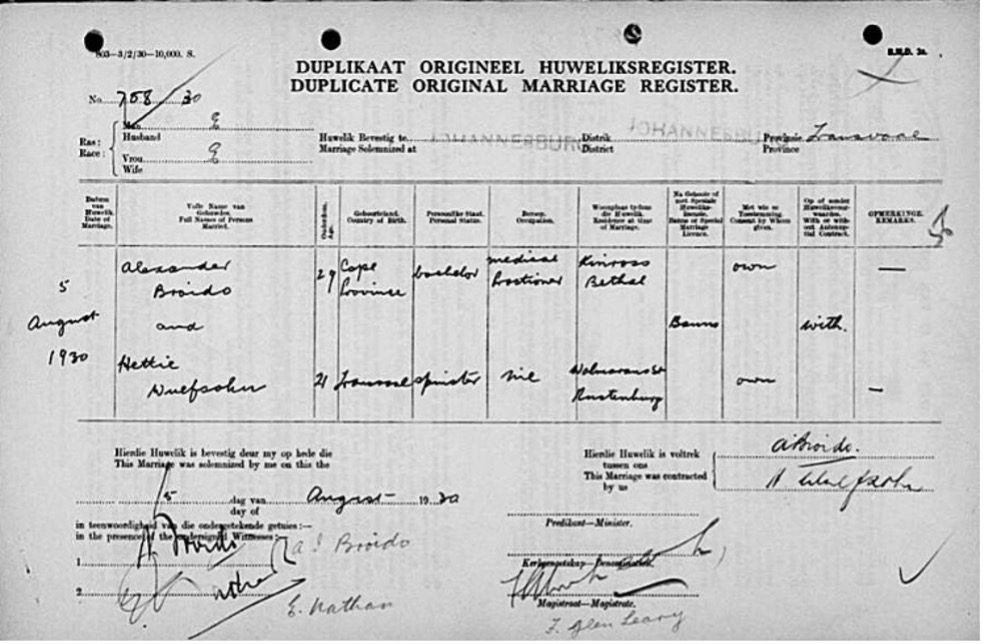
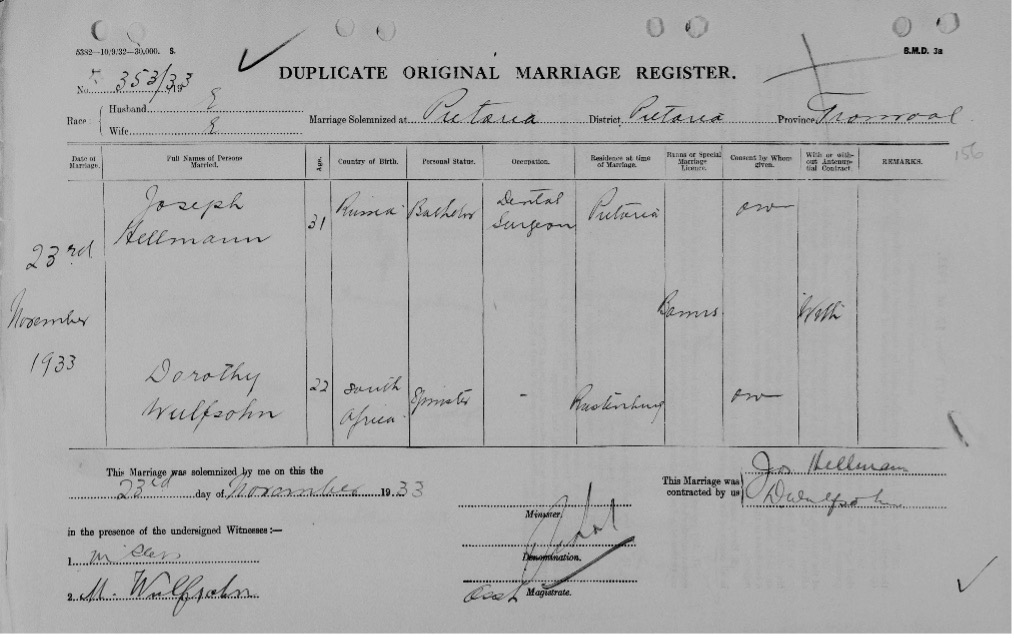
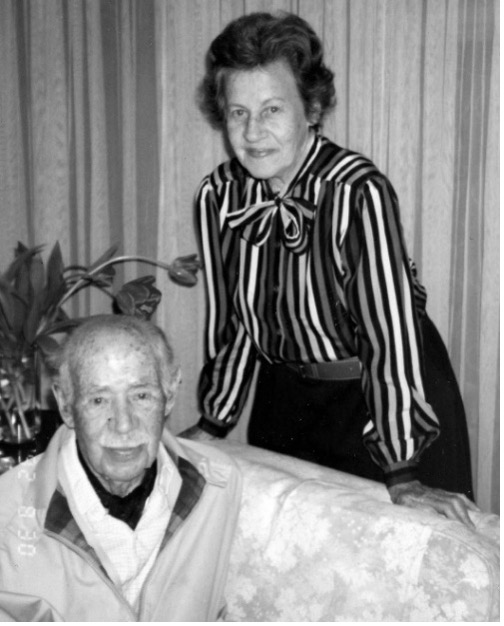
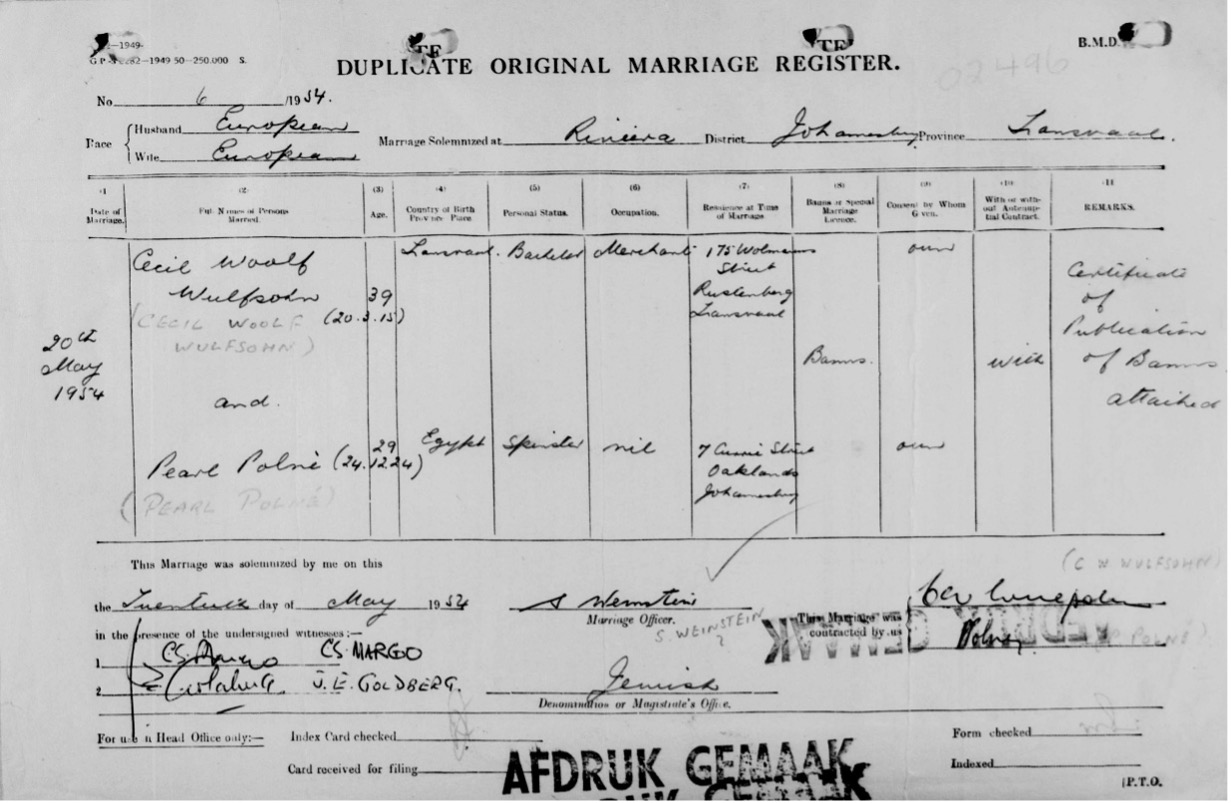
References:
- The Golden Years: A Memoir of Old Rustenburg. Lionel Wulfsohn. The Watermark Press, 2011.
- Rustenburg Romance. Eric Rosenthal. Perskor Publishers, Johannesburg, 1979.
Rustenburg Herald entries:
- 1936-06-20. Mr and Mrs Wulfsohn wish to announce the Barmitzvah of their second son, Abe Joe, who will read a portion of the law at the Rustenburg Synagogue on Saturday, 28th June. At Home at their residence on Saturday at 8 p.m. all relatives and friends cordially invited.
- 1936-06-27. Mr. and Mis. Philip Wulfsohn wish to announce the Barmitzvah of their second son, Abe Joe, who will read a portion of the law at Rustenburg Synagogue on Saturday, 28th June.
- 1940-07-19. OBITUARY. Mrs Philip Wulfsohn.
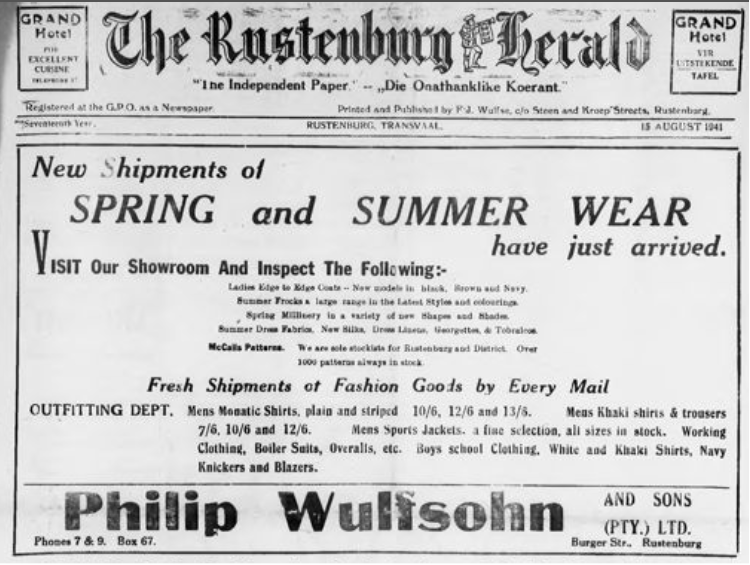
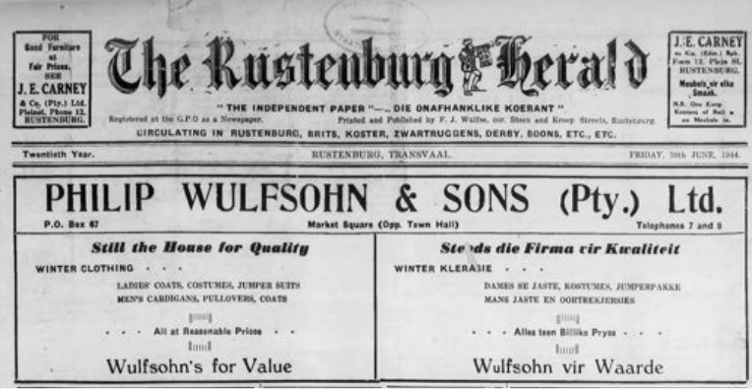
Zeffertt family
Penelope 'Penny' Laura Zeffert lived on the Zeffertt family farm R43 on the northern slopes of the Magaliesberg mountains just outside Rustenburg. She was a spinster and ran Old Traditions, an artisanal bread-making school and sustainable farming initiative. She lived with her brother, Michael Zeffertt, an artisan, who owns Michael Zeffertt Woodworks and Design. Penny died from breast cancer and was buried in the Rustenburg New Cemetery. She was survived by her two brothers, Michael and Gidon.
Her nephew, Boaz Zeffertt, a blacksmith and tool maker, also lives on the family farm. His bar mitzvah was the last bar mitzvah to be celebrated in the Rustenburg shul and was officiated by Rabbi Moshe Silberhaft.
References:
- The Travelling Rabbi: Journeys Continued. Rabbi Moshe Silberhaft as told to David Saks. Batya Bricker Publishing, 2026, pages 145-149.