Timeline of Jewish life in Rustenburg
- 1850: The village of Rustenburg is established in the Zuid Afrikaansche Republic and the following year it is officially founded as an administrative centre for the surrounding region.
- 1880s: The first Jews to settle in the village and surrounding area are from Germany.
- 1890: First marriage takes place of Oskar Laserstein and Lea Friedenthal on the 3 June 1890. In September Ida Jacobsohn, wife of Jacob Jacobsohn, is the first person to be buried in the Rustenburg Jewish Cemetery.
- 1891: K Machol and Company is established on the southern slopes of the Magaliesberg and manufactures tobacco for distribution in South Africa, London and Berlin.
- 1893: Dr Albert Machol, a cousin of Kurt Machol, emigrates to Rustenburg and is a general practitioner there for nine years.
- 1894: Oskar Laserstein and Kurt Machol are the first clients of the National Bank of the Zuid Afrikaansche Republic.
- 1899-1902: The Second Anglo Boer War impacts on the Jewish community. Some Jews support the Boers. Dr Arnold Machol provides medical treatment to the Boer commandos. Kurt Jacobsohn, son of Jacob and Ida Jacobsohn, fights with the Boers and is taken prisoner of war by the British and sent to Bermuda. Numerous Jews leave for the Cape Colony as they are classified as Uitlanders - foreign subjects. After the war they return and submit claims for compensation.
- 1905: The Rustenburg Hebrew congregation is formed. There are about 10 Jewish families in the town.
- 1911: The first minister appointed to serve the Rustenburg Hebrew Congregation is Reverend Nachum Mendel Rabinowitz.
- 1914: The Rustenburg Zionist Association is formed.
- 1918: The status of Rustenburg changes from a village to a town. Wilhelm Herzfeld, a German Jew, is elected Deputy Mayor of Rustenburg.
- 1924: The Synagogue is officially opened by Chief Rabbi Dr Judah Leo Landau on the 9 April. It is built in honour of the parents of the Wulfsohn brothers, emigrants from Lithuania, who donated the land.
- 1925: Jack Frankfurth, a Viennese Jew, involved in prospecting and mining, discovers platinum on the farm Waterval No. 557. In 1929, the first vertical shaft is sunk at what is to become Rustenburg Platinum Mines Ltd.
- 1936: Willy Rosenstein, a German-Jewish World War One ace fighter pilot, and his son Ernest flee Nazi Germany to South Africa. They purchase a citrus farm in Rustenburg. A flying club is established later in Rustenburg where Willy trains pilots.
- 1939: The Hebrew school has some 20 pupils.
- 1939-1945: A number of Rustenburg Jewish men serve in World War Two. David Cohen is taken prisoner of war in North Africa and is interned in Italy, where he manages to escape and reaches Allied lines. Cecil Wulfsohn, pilot, serves with the Royal Air Force and South African Air Force. Lionel Wulfsohn is seriously wounded at the Battle of Monte Stanco, Italy, on the 13 October 1944. Ernest Rosenstein, son of Willy Rosenstein, is killed whilst flying a Spitfire on a strafing mission over Turin, Italy, on 2 April 1945. Manfred Hermer serves in the South African Corps of Signals. Benjamin Hermer serves with the South African Medical Corps and is awarded the Member of the Most Excellent Order of the British Empire for alleviating the conditions in the Benghazi prisoner of war camp following the outbreak of dysentery.
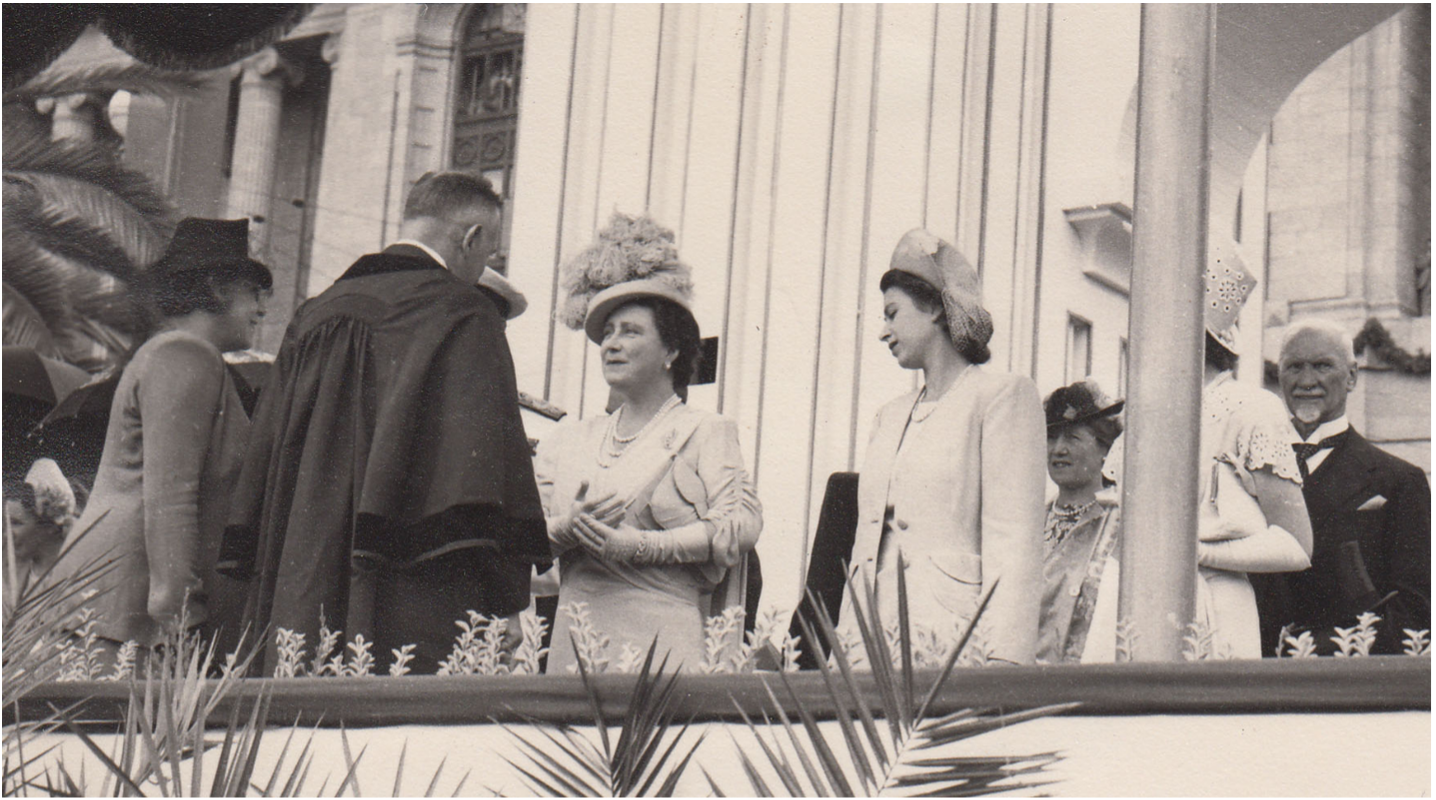
- 1946-7: William Rapeport serves as Mayor of Rustenburg. He is the only Jew to serve in this capacity. He and his wife are presented to the British Royal Family during their visit to South Africa in 1947 at the Administrator’s Garden Party, Pretoria (pictured above). Outspan oranges, produce from Rustenburg, is sent on behalf of the town to HMS Vanguard for the Royal Family.
- 1960: New Rustenburg Cemetery is consecrated.
- 1973: The Golden Jubilee of the Synagogue is held and attended by Chief Rabbi Bernard M Casper and by Cllr and Mrs J Hattingh, Mayor and Mayoress of Rustenburg.
- 1974: The Jacob Finkel Cultural Hall is opened by Chief Rabbi Bernard M. Casper.
- 2002: The Synagogue is no longer used.
- 2022: The Synagogue and Jacob Finkel Cultural Hall are sold.
- 2025: Death of Rita Sonnenberg née Wulfsohn, the last Wulfsohn family member living in Rustenburg.
This marks the end of a once prominent and thriving Jewish Community.